

HCPCS Code L0472: Hyperextension TLSO billing guide
HCPCS code L0472: Official descriptor and device definition HCPCS code L0472 des...

Last Updated: Nov 5, 2026
93623 is the CPT add-on code for programmed stimulation and pacing after intravenous drug infusion (list separately in addition to code for primary procedure). It covers repeat pacing at set sites and rates after an IV drug, to test the drug's effect on arrhythmia induction.
93623 is reported only with a qualifying primary code: 93610, 93612, 93619, 93620, 93653, 93654, or 93656. Stimulation after an intracardiac ablation to test its result is included in the ablation, not billed as 93623.
Let Pabau's smart automation suggest the right codes, reduce claim denials, and keep your practice compliant—effortlessly.
Automate repetitive tasks and focus on what matters most—your patients.
Reduce coding errors and ensure compliance with the latest regulations.
Clean claims, fewer denials, and faster reimbursements.
Powerful insights and reporting to help your practice thrive.
HIPAA compliant SOC 2 certified GDPR-compliant Trusted by 4,000+ clinics worldwide

CPT code 93623 is an AMA add-on (+) code for programmed stimulation and pacing after intravenous drug infusion, not a standalone procedure code.
It must accompany a qualifying primary code (93610, 93612, 93619, 93620, 93653, 93654, or 93656) on the same claim, or it will be denied.
NCCI policy bars 93623 for stimulation that tests the result of an intracardiac ablation, apart from narrow exceptions the report must document.
93624 is a standalone follow-up study that tests whether therapy worked, so the two codes describe different services.
Pabau’s claims management software sends EP claims electronically through Claim.MD, with real-time eligibility checks and ERA remittances.
CPT code 93623 is the add-on code for programmed stimulation and pacing after intravenous drug infusion.
It is billed on its own line, below one of seven qualifying primary EP codes. Use this table as your check before filing a claim that includes it.
The American Medical Association publishes the full CPT descriptor for 93623. It reads: Programmed stimulation and pacing after intravenous drug infusion (list separately in addition to code for primary procedure). Two phrases decide how the code is billed.
First, “after intravenous drug infusion” refers to pharmacologic challenge testing. An antiarrhythmic or provocative agent is infused, and pacing is then repeated to test its effect on arrhythmia inducibility. Second, “list separately in addition to code for primary procedure” is the AMA’s statement that 93623 is an add-on and cannot stand alone.
Clinically, the physician delivers a programmed drive train (a series of fixed-rate pacing beats) followed by one or more precisely timed extrastimuli. The report records the stimulation protocol at each site, the drug, the route, the dose, and whether an arrhythmia was induced or suppressed. That documentation becomes the billing record.
Knowing the bundle boundaries prevents both overbilling and underbilling. One unit of 93623 covers the following, and leaves out the rest.
The ablation boundary is the one auditors check first. NCCI policy treats testing after an intracardiac ablation as part of the ablation, so it is never billed as CPT code 93623.
CPT code 93623 must appear below a qualifying primary code on the claim form. Filing it without one guarantees a denial. CPT instructions and the NCCI Policy Manual name these seven primary codes.
On a diagnostic study with induction, the primary is 93620. On a VT ablation, it is 93654, and the drug has to precede the ablation for 93623 to stand.
93621, 93622, 93655 and 93657 are add-on codes themselves, so none of them can anchor 93623. They may still sit on the same claim when one of the seven primaries is there.
Line order on the CMS-1500 or 837P matters. The primary code occupies the first service line, and 93623 follows on the next one. A claim that carries 93623 with no primary EP code is denied automatically.
93623 is an add-on for stimulation repeated after an IV drug, inside a qualifying EP study. 93624 is a standalone electrophysiologic follow-up study, with pacing and recording, that tests whether therapy worked.
93624 remains an active code in the AMA CPT set. Its descriptor includes induction or attempted induction of arrhythmia. It is used when a patient returns for a separate study after drug, device or ablation therapy. NCCI edits bundle 93624 into an ablation reported for the same session.
NCCI policy says 93623 may not be reported for stimulation after an intracardiac ablation (93650–93657). Confirming that the ablation worked, with or without a drug, is included in the ablation code. The three checks below decide whether a 93623 line survives an EP claim.
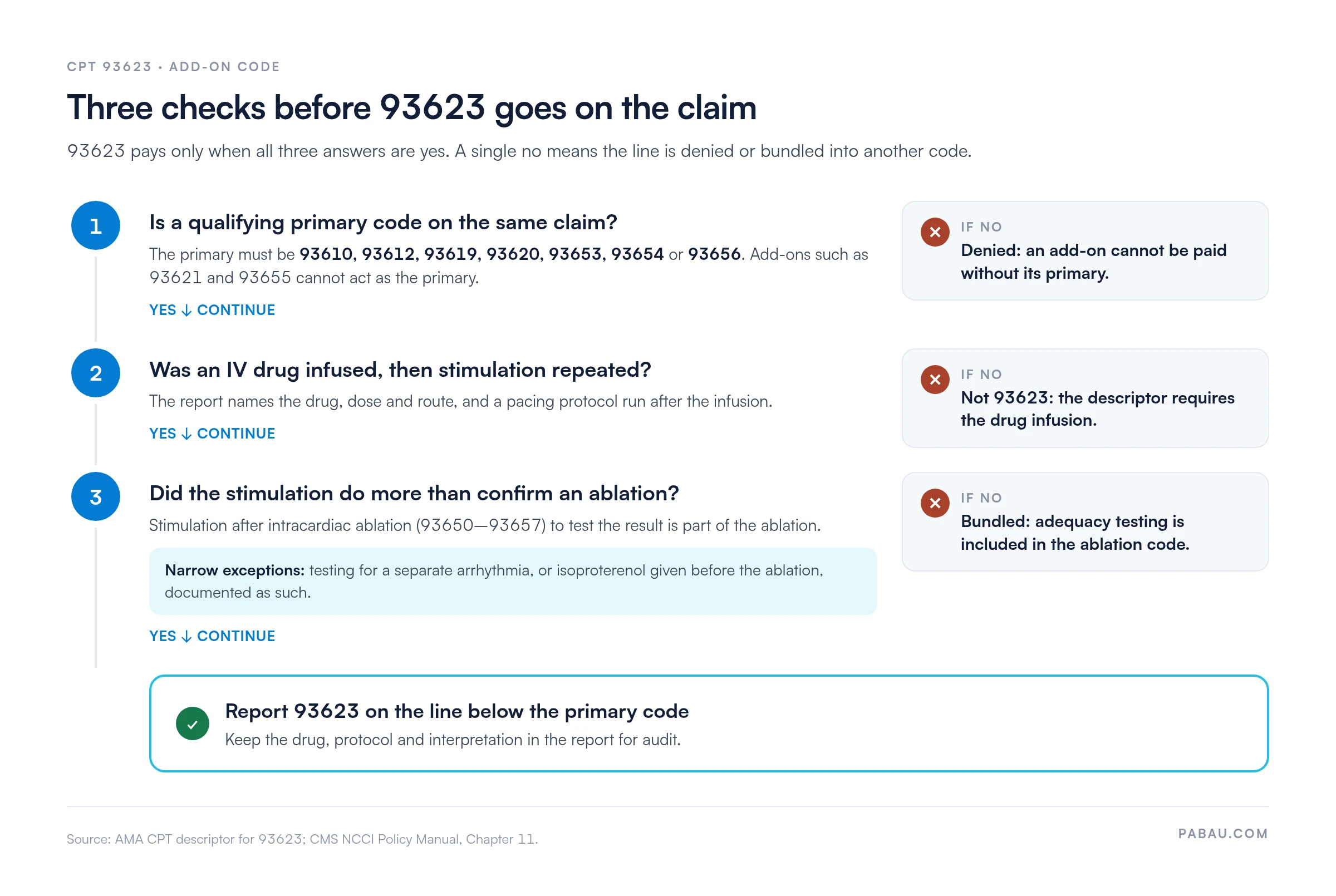
The exceptions are narrow, and the report has to show which one applies.
Scenario 1: SVT ablation (93653) followed by a drug challenge. After ablating AVNRT, the physician infuses isoproterenol and repeats stimulation to confirm the circuit is no longer inducible. That testing confirms the ablation result, so 93623 is not reportable.
Scenario 2: AF ablation (93656) with isoproterenol before isolation. The physician infuses isoproterenol before pulmonary vein isolation to provoke triggers and guide the lesion set. This falls under the pre-ablation exception, so 93623 is supportable when the report documents the drug, dose, timing and protocol.
Scenario 3: Unsuccessful ablation. Repeat stimulation after an ablation that did not work still tests the ablation result. NCCI policy gives no separate allowance for it, so 93623 does not apply.
The National Correct Coding Initiative (NCCI) publishes quarterly tables of column one/column two code pairs. When 93623 is the column two code in a pair, its payment is bundled unless a modifier overrides the edit and the edit allows one.
Modifier 59 (or the more specific X-modifiers XE, XP, XS, XU) allows separate payment only when the services are genuinely distinct. The CMS NCCI Policy Manual requires documentation to support the modifier. Applied reflexively, it is a compliance risk.
Always verify NCCI pairs against the current quarterly table release before filing. CMS updates the edits every quarter, and a pair that allowed a modifier last quarter may not allow one now. The CMS website publishes each quarterly update as a downloadable file.
Filing CPT code 93623 correctly means getting five elements right on the same claim. Pabau, the practice management platform we build, includes claims management software that submits 837P claims electronically through its Claim.MD integration. Real-time eligibility checks and ERA remittances run through the same connection.
Reserve I49.9 for reports that name no specific rhythm, because an unspecified code invites a medical-necessity review on a high-value claim.
Medicare pays CPT code 93623 under the Medicare Physician Fee Schedule (MPFS) as an add-on. It earns its own payment in addition to, not instead of, the primary code payment.
For current values, use the CMS Physician Fee Schedule search tool and select the current calendar year. Rates change every year and are adjusted by the Geographic Practice Cost Index (GPCI) for each Medicare locality.
Because 93623 pays on top of the primary, a dropped add-on line never shows up as a denial. It shows up as missing revenue, which is why revenue cycle management reports should compare EP claims against the operative reports.
EP billing teams meet the same denial patterns again and again. Knowing them in advance is the most effective form of denial management for high-value cardiac procedure claims.
Our guide to denial codes explains each adjustment and remark code in the table above. Knowing what each one signals helps EP billing staff route a denial to the right fix faster.
Documentation is what separates a payable 93623 from a denied one. The operative or EP report must contain each of the following elements, written into the procedural narrative rather than added later for billing.
Ask EP physicians to dictate the drug-challenge stimulation as its own paragraph, separate from the ablation end-point section. When the two run together, reviewers cannot tell a pre-ablation drug study from post-ablation testing, and the claim is denied.
CPT code 93623 sits within the intracardiac electrophysiology code family. This table covers the codes most often reported alongside 93623, or confused with it.
Many EP billing teams still build 93623 claims by hand from the operative report. The add-on line is easy to drop, and just as easy to send without its primary.
In Pabau, the claim is built from the encounter and submitted electronically through the Claim.MD integration. Eligibility is checked in real time before the study, and ERA remittances come back into Pabau after the payer decides.
The result is a claim trail your coders can work from. When a 93623 line comes back unpaid, the remittance and the original claim sit side by side, so the fix starts the same day.

Pabau’s claims management integrates with Claim.MD for 837P submission, real-time eligibility checks, and ERA remittances. Electrophysiology and cardiology practices see each add-on line from filing to payment.

Treat 93623 as a narrow code. Bill it only when an IV drug study sits inside a qualifying primary, and never for testing an ablation’s result.
The coding decision is made in the operative report, long before the claim. If physicians document the drug, protocol and timing as a separate step, the line holds up under audit. If they do not, no modifier will rescue it.
A clean claim submission workflow keeps the add-on paired with its primary and shows you every remittance. Book a demo to see how Pabau handles claim submission for cardiology and EP practices.

Need a denial management framework for EP claims? Denial management in healthcare covers workflows for identifying, appealing, and preventing high-volume denial patterns.
What is the 837P and how does it relate to claim submission? 837 file overview explains the electronic claim format used for professional claims including EP procedures.
How does electronic remittance advice work after a claim pays? Electronic remittance advice explains how 835 ERA files report payment decisions and denial codes back to the billing team.
CPT code 93623 is an add-on code for programmed stimulation and pacing after intravenous drug infusion during an electrophysiology study. Its full descriptor is: Programmed stimulation and pacing after intravenous drug infusion (list separately in addition to code for primary procedure). It must be reported with a qualifying primary EP code and cannot be billed on its own.
Yes. The AMA marks 93623 with the plus (+) symbol, so it is an add-on code. It can only appear on a claim that also includes a qualifying primary code: 93610, 93612, 93619, 93620, 93653, 93654, or 93656. Filing it without one results in a denial.
93623 is an add-on for stimulation repeated after an IV drug infusion, within a qualifying EP study. 93624 is a standalone electrophysiologic follow-up study that tests the effectiveness of therapy, with induction or attempted induction of arrhythmia. NCCI edits bundle 93624 into an ablation reported for the same session.
Medicare pays 93623 under the MPFS as an add-on, on top of the primary code payment. The amount changes every year and varies by locality through the GPCI. Look up the current-year RVUs and payment in the CMS Physician Fee Schedule search tool before using any figure for revenue planning.
Stimulation after an intracardiac ablation that tests whether the ablation worked is an adequacy check. NCCI includes it in the ablation code, with or without a drug. A drug study counts as a separate diagnostic service only in narrow cases, such as isoproterenol given before ablation or testing for a separate arrhythmia.
Modifier 59, or one of the X-modifiers (XE, XP, XS, XU), overrides an NCCI edit when the services are distinct. The edit itself must allow a modifier. The operative report must support the modifier. CMS does not allow it to be applied by default, and no modifier makes post-ablation testing reportable.
No. Repeat stimulation after an ablation that did not work still tests the ablation result, and NCCI policy bars 93623 for stimulation after intracardiac ablation. The narrow exceptions are a drug given before the ablation, or stimulation that tests for a separate arrhythmia.



