CPT code 63081: Vertebral corpectomy, cervical spine
CPT code 63081: official descriptor and procedure overview CPT code 63081 descri...

Last Updated: Oct 6, 2026
93654 is the CPT code for comprehensive electrophysiologic evaluation with catheter ablation to treat ventricular tachycardia or a focus of ventricular ectopy. The service includes intracardiac 3D mapping and left ventricular pacing and recording when performed.
The arrhythmia treated is what sets 93654 apart from its neighbors. Supraventricular tachycardia ablation is coded 93653, and atrial fibrillation ablation by pulmonary vein isolation is coded 93656. Transseptal catheterization isn't part of the 93654 descriptor.
Let Pabau's smart automation suggest the right codes, reduce claim denials, and keep your practice compliant—effortlessly.
Automate repetitive tasks and focus on what matters most—your patients.
Reduce coding errors and ensure compliance with the latest regulations.
Clean claims, fewer denials, and faster reimbursements.
Powerful insights and reporting to help your practice thrive.
HIPAA compliant SOC 2 certified GDPR-compliant Trusted by 4,000+ clinics worldwide

CPT code 93654 covers a comprehensive EP study with catheter ablation of ventricular tachycardia or a focus of ventricular ectopy.
The arrhythmia treated decides the code: 93653 is for SVT, 93654 for ventricular arrhythmias, and 93656 for atrial fibrillation.
93654 carries a 0-day global period. Confirm prior authorization and the ICD-10 pairing, most often I47.20 or I47.29, before the procedure date.
3D mapping and left ventricular pacing and recording are bundled into 93654 when performed, so neither is billed separately.
Pabau’s claims management software checks, submits and tracks 93654 claims from the patient record through to denial follow-up.
CPT code 93654 is the comprehensive electrophysiology (EP) code for catheter ablation of ventricular tachycardia (VT) or a focus of ventricular ectopy. The American Medical Association descriptor runs as one long clause, so here it is in its parts. The code covers:
It is a comprehensive code, so these components count as one service and aren’t billed separately on the same date of service. Transseptal catheterization isn’t part of the 93654 descriptor, unlike 93656, which bundles it.
Most 93654 claims are VT ablations, often in patients with structural heart disease. The code also covers ablation of frequent premature ventricular contractions (PVCs) when they are the target.
The EP study underlying 93654 follows a structured sequence. Coders need to understand each step because the operative note must reflect all of them for the claim to hold up at audit.
The operative note has to name the ventricular arrhythmia that was ablated, because that diagnosis is what supports 93654 over 93653 or 93656. Record LV pacing and 3D mapping when they were performed, since an auditor will look for the work the code pays for.
In a hospital outpatient setting, the facility reports the mapping catheter on its own claim with device code C1732.
The three primary ablation codes in the 93650-93657 family are each defined by the arrhythmia treated. The diagnosis in the note therefore points straight to the code, as the chart below shows.
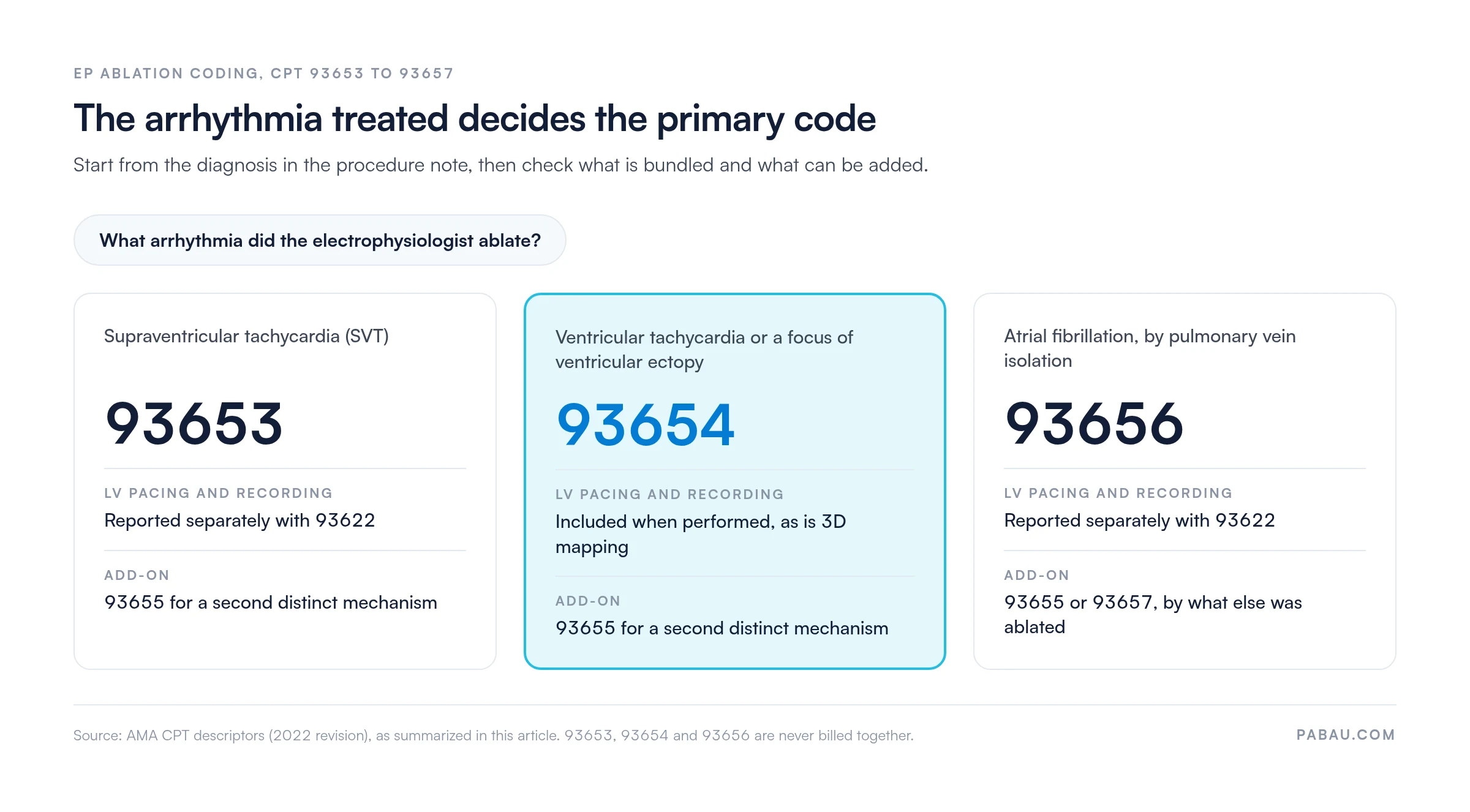
93655 is an add-on code listed separately in addition to the primary ablation code. It applies when the electrophysiologist ablates a second, distinct arrhythmia mechanism during the same session. It cannot be billed as a standalone service.
The operative or procedure note for CPT code 93654 must contain every element listed below. Medicare and commercial payer auditors check for each one. A missing element is treated as work that wasn’t done, even if it was.
Modifier selection for CPT code 93654 depends on the billing setting and who owns the equipment. It also turns on NCCI edits with any companion codes billed that day.
Medicare reimburses 93654 under the CMS Physician Fee Schedule. Payment is built from three relative value unit (RVU) components: work, practice expense and malpractice. Each is adjusted by the Geographic Practice Cost Index (GPCI) for the locality, then multiplied by the annual conversion factor.
Because 93654 carries a 0-day global period, no post-operative period bundles the follow-up visits. E&M services from the day after the ablation are billed separately with the appropriate office visit code.
Before quoting expected reimbursement, pull the current RVU values for 93654 from the FastRVU 2026 RVU lookup tool. Dollar amounts change every year and by GPCI locality, so a national average can mislead practices in high- or low-cost areas.
The National Correct Coding Initiative (NCCI) bundles certain codes into 93654 as column-two codes. They can’t be billed separately on the same date unless a modifier is appended and the documentation justifies a distinct service.
A frequent bundling error is billing 93654 and 93653 together because the session treated both an SVT and a VT. Bill 93654 as the primary code with 93655 for the additional mechanism, never two primary ablation codes. A denial management workflow shows which NCCI pairs keep sending claims back for reprocessing.
Check the NCCI edits table on a quarterly basis rather than relying on memory. CMS updates bundling pairs each January, April, July, and October. A pair with a Modifier Indicator of ‘1’ can be unbundled with Modifier -59 and proper documentation. A Modifier Indicator of ‘0’ means no modifier overrides the edit.
Payers judge medical necessity for CPT code 93654 by matching the ICD-10-CM diagnosis to the clinical indication. The diagnosis must support catheter ablation as an appropriate treatment. Many payers’ prior authorization criteria require documented failed antiarrhythmic drug therapy or a high-risk arrhythmia diagnosis.
Confirm every diagnosis code on a 93654 claim is current for the fiscal year. The October update can expand a code, as it did when I47.2 split into I47.20, I47.21 and I47.29. A non-billable header code is rejected on arrival.
Where coronary artery disease underlies the VT, I25.10 is the usual secondary code. Check current code status and crosswalks in AAPC’s CPT code lookup before the claim goes out.
CPT code 93654 claims tend to deny for five predictable reasons. Each one has a specific fix, set out below.
For bundling denials, read the remittance denial codes on the ERA before choosing an appeal path. A CO-97 means the service was bundled, while a CO-4 means a modifier is missing or wrong. Log each denial against its code, and the recurring documentation fault shows up in the note template.
In many EP practices, a 93654 claim passes from the procedure note to a clearinghouse portal and then into a denial spreadsheet. Each handoff is a chance for a stale diagnosis code or a missing authorization number to slip through.
Pabau, the practice management and billing platform we build, keeps that work on the patient record. Its claims software for EP practices pre-fills each claim with patient, treatment and insurer details. Background checks flag missing membership numbers and authorization codes before the claim goes out.
Submissions run through Pabau’s Claim.MD integration, which reaches thousands of US insurance payers. Real-time eligibility checks confirm coverage before the procedure, and electronic remittance advice posts payments back against each claim. Denied claims are flagged on the claims dashboard, so your team can appeal while the case is still fresh.

Pabau helps cardiology and EP practices check eligibility, submit claims and track denials from one claims dashboard. See how it fits your 93654 workflow.

CPT code 93654 gets paid when the note proves which ventricular arrhythmia was treated. Build the procedure note template around that diagnosis, and the choice against 93653 and 93656 stops depending on memory.
The trade-off is discipline before the procedure. Current ICD-10-CM pairings, a quarterly look at NCCI edits and prior authorization on file take minutes per case. Appealing a denied ablation takes weeks.
Put that discipline behind a clean claim process, and 93654 claims stop cycling through appeals. Book a demo to see how Pabau carries EP claims from the eligibility check to remittance.

Need guidance on medical billing compliance for your cardiology practice? Medical billing compliance covers the frameworks and audit-readiness steps that keep EP practices protected.
Want to understand how clearinghouse submissions work end to end? How a medical claims clearinghouse works explains the 837P submission path and what happens between your practice and the payer.
Looking to connect revenue cycle tracking to your billing workflow? What is revenue cycle management provides a foundation for building a denial-reduction strategy around CPT-heavy specialties like electrophysiology.
CPT code 93654 is a comprehensive electrophysiology code for catheter ablation of ventricular tachycardia or a focus of ventricular ectopy. It bundles the EP study and the ablation, plus 3D mapping and left ventricular pacing and recording when performed.
CPT 93654 covers ablation of ventricular tachycardia or ventricular ectopy, while CPT 93656 covers atrial fibrillation ablation by pulmonary vein isolation. They target different arrhythmias and cannot be billed together on the same date of service.
CPT 93653 covers supraventricular tachycardia ablation, while CPT 93654 covers ventricular tachycardia or ventricular ectopy. Left ventricular pacing and recording is bundled into 93654 when performed, but is reported separately with 93622 alongside 93653.
CPT 93654 carries a 0-day global period. Post-procedure office visits are separately billable starting the day after the ablation with the appropriate evaluation and management code.
The most common pairing is I47.20 or I47.29 (ventricular tachycardia). I49.3 (ventricular premature depolarization) applies when frequent PVCs are the ablation target. Secondary diagnoses such as I42.0 (dilated cardiomyopathy) or I25.10 (coronary artery disease) support medical necessity.
Yes. CPT 93655 is an add-on code listed separately with 93654 when the electrophysiologist ablates a second, distinct arrhythmia mechanism in the same session. It cannot be billed as a standalone code.