

CCSD code G5100: Bypass of duodenum billing guide
CCSD code G5100 bills a bypass that leaves the duodenum in place CCSD code G5100...

Last Updated: Oct 16, 2026
93620 is the CPT code for a comprehensive electrophysiologic (EP) study that includes induction or attempted induction of arrhythmia. The study covers insertion and repositioning of multiple electrode catheters, right atrial and right ventricular pacing and recording, and His bundle recording. Its sibling 93619 has the same catheter work and recordings without an induction attempt, so induction alone separates the two codes.
Left atrial and left ventricular pacing are reported with add-on codes 93621 and 93622. Most denials trace to a procedure note that never says whether induction was attempted. Others come from billing 93620 beside an ablation code that already includes the study.
Let Pabau's smart automation suggest the right codes, reduce claim denials, and keep your practice compliant—effortlessly.
Automate repetitive tasks and focus on what matters most—your patients.
Reduce coding errors and ensure compliance with the latest regulations.
Clean claims, fewer denials, and faster reimbursements.
Powerful insights and reporting to help your practice thrive.
HIPAA compliant SOC 2 certified GDPR-compliant Trusted by 4,000+ clinics worldwide

CPT code 93620 reports a comprehensive EP study with induction or attempted induction of arrhythmia, including right atrial, right ventricular, and His bundle recordings.
93619 includes the same catheters, pacing, and recordings, so the induction attempt is the only element that separates 93620 from 93619.
Left atrial pacing (93621), left ventricular pacing (93622), and pacing after drug infusion (93623) are add-on codes reported on top of the study.
NCCI bars 93619 and 93620 together, and ablation codes 93653 and 93656 already include the study, so 93620 is not reported with them.
CPT code 93620 reports a comprehensive electrophysiologic (EP) study that includes induction or attempted induction of arrhythmia. The American Medical Association defines it as insertion and repositioning of multiple electrode catheters. The study also includes right atrial and right ventricular pacing and recording, plus His bundle recording.
Electrophysiologists perform the study in an EP lab to find where an arrhythmia starts and how it sustains itself. The induction attempt is what makes it 93620, so billers should find that statement in the note first.
93620 bundles five elements into one code. The first four are shared with 93619. In contrast, the fifth, induction or attempted induction, is unique to 93620.
Attempted induction counts, because the descriptor reads induction or attempted induction. For example, a study where stimulation fails to induce an arrhythmia still supports 93620. In addition, the note must describe the protocol and state that the arrhythmia was not inducible.
Induction is the only difference between 93619 and 93620. Both are comprehensive EP studies with the same catheter work and the same three recording sites. Therefore, report 93620 when induction was attempted, and 93619 when the study stopped at pacing and recording.
A study that includes an induction attempt is billed as 93620 alone. Reporting 93619 on top of it duplicates the shared components, so NCCI rejects the pair. Two other questions also change the claim, and the decision path below puts all three in order.
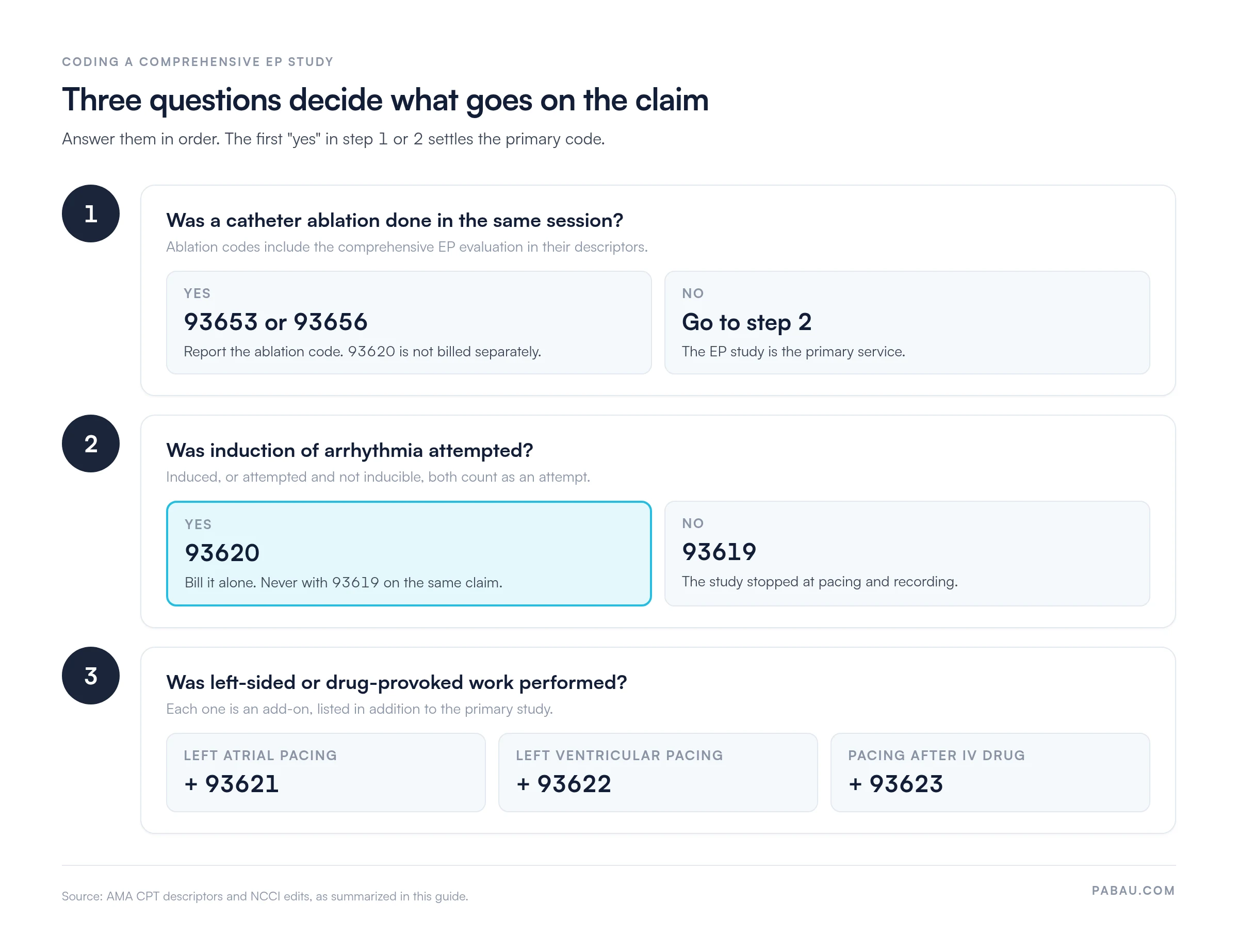
Left-sided pacing and drug-provoked testing are not part of 93620. When the physician performs them, they are reported with add-on codes listed in addition to the primary study.
Catheter ablation codes include a comprehensive EP evaluation in their descriptors. As a result, 93620 is not separately reportable when the ablation happens in the same session. The same holds for 93654, the comprehensive EP study that ends in ventricular tachycardia ablation.
Practical rule: modifier 59 does not unlock 93620 beside an ablation code in the same session. Instead, it applies only when a distinct diagnostic study took place at a separate session on a different date, and the record shows it.
Modifier choice depends on who bills the study and how it ended, because the wrong modifier leads to reduced payment or a denial.
Write the induction outcome into the procedure note in plain words: induced, attempted but not inducible, or not attempted. That one line decides between 93619 and 93620, and it is the first line a reviewer looks for.
The procedure report is the audit document for 93620. Reviewers look for each component in turn, and the induction statement matters most because it decides the code.
However, a complete superbill does not replace the procedure report. The report should include:
For clean claim submission, record the components in the same order every time. Thus, a fixed order lets a reviewer confirm the induction statement quickly.
Payers expect a billable ICD-10-CM code that explains why the study was needed. Report the most specific code the record supports, since category headers such as I49.0 or I47.1 are not billable.
For an unexplained-syncope indication, document the noninvasive workup that came before the study, since payer criteria vary. Also, our guide to R55 covers when that code fits.
Medicare pays 93620 under the CMS Physician Fee Schedule, which updates each year. Geographic practice cost indices (GPCIs) adjust the payment for each locality, so the amount differs by region.
Pull 2026 amounts straight from the CMS look-up tool rather than a third-party summary. After all, CMS can correct rates during the year, and summaries often lag behind.
Prior authorization rules for 93620 vary by payer and plan year. Original Medicare generally does not require prior authorization for a medically necessary EP study, but many commercial plans do.
In short, running insurance eligibility verification before the study surfaces authorization needs while there is still time to act.
Denials on 93620 fall into a short list of patterns. Thus, knowing them ahead of time cuts write-offs and speeds up denial management workflows.
Most compliance risk on 93620 comes from three errors. However, each one is preventable with a check before the claim goes out.
Sound medical billing compliance for EP studies starts before submission. Also, review your electronic remittance advice regularly to spot denial patterns by payer early.
Many EP billing teams still key study details into a separate billing system after the procedure. As a result, each re-keyed field is a chance to drop an add-on code or a diagnosis.
Pabau, the practice management platform we build, keeps the treatment record and the claim in one place. Its claims management software pulls the details already on the record into a pre-filled claim. It then sends the claim through Claim.MD and tracks its status.
Remittances post back against the claim, so your team sees which 93620 claims were paid and which need work. Coders still choose the codes and modifiers, while Pabau saves them the re-keying.

Pabau pulls the study details already on the patient record into a pre-filled claim, sends it through Claim.MD, and tracks it until the remittance posts.

The induction statement decides this code. Indeed, every comprehensive EP study carries the same catheters and recordings. Whether induction was attempted is the one question that moves a claim between 93619 and 93620. So a note that answers it in plain words protects the claim on review.
Keep 93620 off claims that carry 93619, 93653, or 93656 for the same session. Instead, report left-sided pacing and drug infusion with their add-on codes. Book a demo to see how Pabau helps your EP billing team send and track claims without re-keying.

Sending EP claims through a clearinghouse? Our Claim.MD clearinghouse guide explains how Pabau sends claims through Claim.MD and tracks their status.
Struggling with medical billing denial patterns? Denial codes in medical billing breaks down the most common CARC reason codes and how to build an appeal workflow around them.
Want to understand the broader revenue cycle for EP labs? What is revenue cycle management covers the end-to-end process from eligibility check through payment posting.
Billing the facility side of an EP study? HCPCS code C1730 explains how diagnostic EP catheters with 19 or fewer electrodes are reported.
Is anesthesia billed for the EP lab session? CPT code 00537 covers anesthesia for cardiac electrophysiologic procedures, including radiofrequency ablation.
CPT code 93620 is a comprehensive electrophysiologic evaluation with induction or attempted induction of arrhythmia. It includes insertion and repositioning of multiple electrode catheters, right atrial and right ventricular pacing and recording, and His bundle recording. An electrophysiologist performs it to find the mechanism of an arrhythmia and plan treatment.
93621 adds left atrial pacing and recording from the coronary sinus or left atrium. 93622 adds left ventricular pacing and recording. 93623 adds programmed stimulation and pacing after intravenous drug infusion. Each is an add-on, so it is never billed without its primary code.
The most common reason is a procedure note that never states whether induction was attempted. Others include billing 93619 and 93620 together, or billing 93620 with an ablation code that includes the study. Missing prior authorization and unsupported ICD-10 codes also cause denials. Check the CARC on the remittance advice to see which one applies.
Medicare pays 93620 under the Physician Fee Schedule, and the rate changes each year and by locality. Geographic practice cost indices (GPCIs) adjust the payment for each locality. Use the CMS Physician Fee Schedule look-up tool to see the 2026 professional, technical, and global amounts for your locality.



