

HCPCS Code L0472: Hyperextension TLSO billing guide
HCPCS code L0472: Official descriptor and device definition HCPCS code L0472 des...

Last Updated: Nov 5, 2026
93453 is the CPT code for combined right and left heart catheterization including intraprocedural injection(s) for left ventriculography, imaging supervision and interpretation, when performed.
It reports a study of pressures on both sides of the heart in one session, without coronary angiography. When coronary angiography is added, the encounter moves to 93460, or to 93461 when bypass grafts are also imaged.
Let Pabau's smart automation suggest the right codes, reduce claim denials, and keep your practice compliant—effortlessly.
Automate repetitive tasks and focus on what matters most—your patients.
Reduce coding errors and ensure compliance with the latest regulations.
Clean claims, fewer denials, and faster reimbursements.
Powerful insights and reporting to help your practice thrive.
HIPAA compliant SOC 2 certified GDPR-compliant Trusted by 4,000+ clinics worldwide

CPT code 93453 reports combined right and left heart catheterization, including left ventriculography with imaging supervision and interpretation when performed.
Coronary angiography is not part of 93453. When it is performed with right and left heart catheterization, report 93460, or 93461 with bypass graft imaging, instead of 93453.
The most common denial is 93453 coded when the report documents only left heart access, which is 93452. Confirm both sides were catheterized before coding.
Pabau, our practice management and billing platform, sends electronic CMS-1500 claims to thousands of US payers through Claim.MD and tracks ERA remittances.
CPT code 93453 reports a combined right and left heart catheterization performed in one session. Left ventriculography, with its imaging supervision and interpretation, is included when performed. Coronary angiography is not, and adding it moves the encounter to a different code.
The table below summarizes the key billing facts for 93453. Payment varies by MAC locality and contract, so verify current-year rates in the CMS Physician Fee Schedule lookup tool before submitting claims.
CPT code 93453 describes combined right and left heart catheterization including intraprocedural injection(s) for left ventriculography, imaging supervision and interpretation, when performed. According to the American Medical Association CPT code set, the code covers one session. In it, the cardiologist reaches the right and left heart chambers through separate venous and arterial approaches.
In the right heart component, a catheter goes in through a central vein, typically femoral or internal jugular. It records pressures in the right atrium (RA), right ventricle (RV), pulmonary artery (PA), and pulmonary capillary wedge position (PCWP). The left heart component uses retrograde arterial access to measure left ventricular end-diastolic pressure (LVEDP) or aortic pressure.
93453 covers hemodynamic assessment, plus left ventriculography when performed. It does not include coronary artery imaging. When coronary angiography happens in the same session, a different code replaces 93453 rather than joining it. The 93454-93461 codes carry their own catheterization components. Right and left heart catheterization with coronary angiography is therefore 93460, or 93461 when bypass grafts are imaged.
The table below separates what 93453 includes from what is reported separately or with a different code.
A left heart procedure sometimes records a right-sided pressure in passing. That incidental measurement does not qualify the encounter for CPT code 93453. Both sides must be intentionally catheterized and separately documented to support the combined code.
The 93451-93461 family splits on two questions: which sides of the heart were catheterized, and whether coronary or bypass graft angiography was performed. Right heart catheterization alone is 93451, and left heart catheterization alone is 93452. Each combination of sides and imaging maps to exactly one code, as the grid below shows.
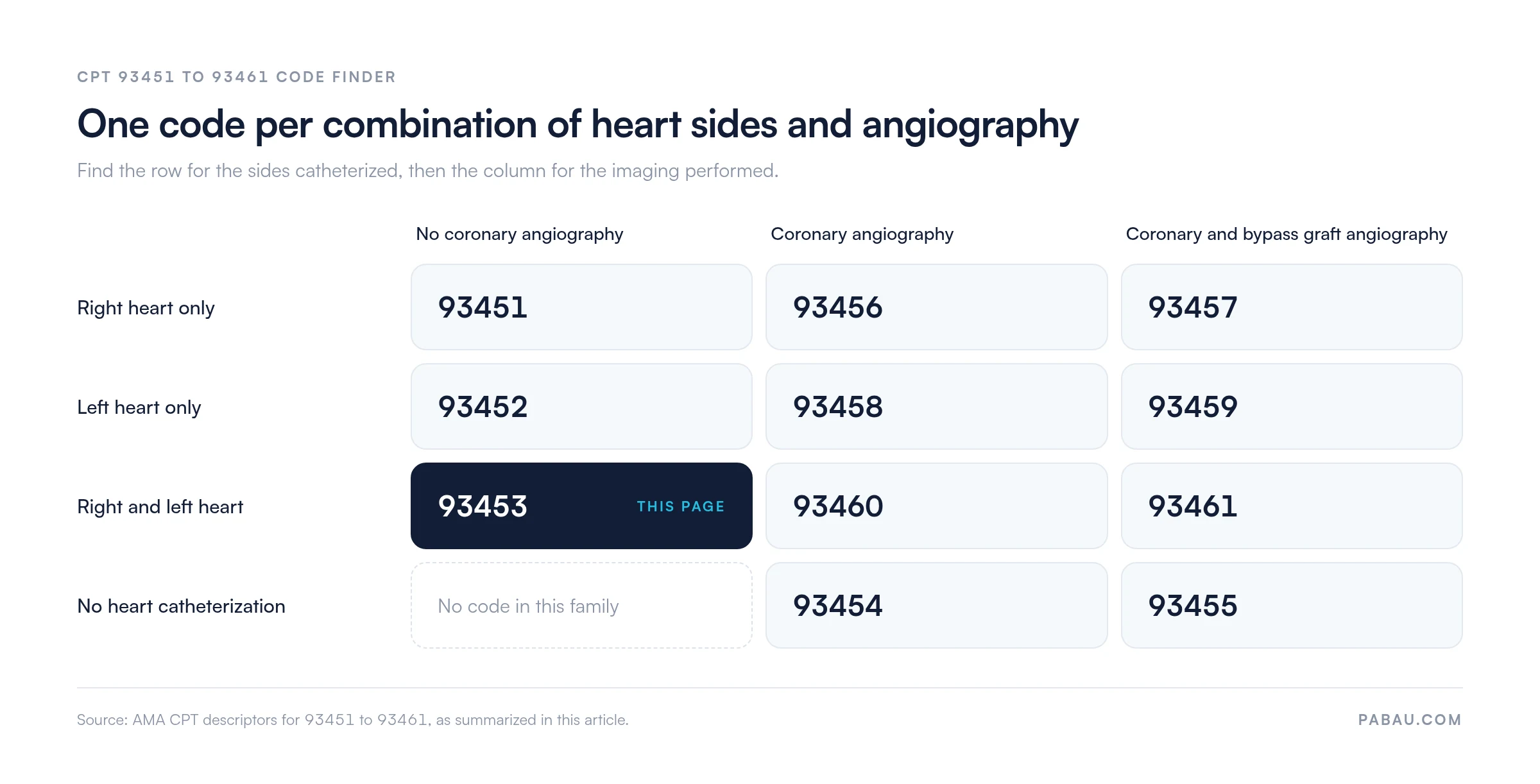
The matrix below gives the same answer code by code, so you can check a claim against the operative report.
Decision rule: Read the operative report and answer two questions in order. First, were both the right and left heart catheterized, with recorded chamber pressures on each side? If not, 93453 does not apply. Second, was coronary angiography performed? If yes, move to 93460 or 93461, depending on bypass graft imaging. CPT code 93453 and CPT 93458 are mutually exclusive on the same date for the same patient by the same provider. Billing both triggers an NCCI bundling edit.
Several supplemental procedures in the same cath session may be reported alongside CPT code 93453. Most are add-on codes, but endomyocardial biopsy (93505) is a standalone primary code. Each needs its own documentation in the operative note. NCCI edits for these pairs change quarterly, so verify current edit status using the AAPC Codify CPT lookup before submission. One of those add-ons is HCPCS code G0278, for non-selective iliac or femoral angiography through the existing catheter.
Before appending any add-on code to 93453, confirm the operative note names the supplemental procedure as a distinct step. A pressure measurement taken in passing does not support a separate add-on line. Route any claim pairing 93462 or 93463 with 93453 to coder review before submission.
Modifier selection determines whether the professional or technical component is billed, and whether a reduced or discontinued procedure is appropriately represented. Applying the wrong modifier is one of the fastest paths to a CO-4 denial.
The -26/-TC split is the most consequential modifier decision on 93453 claims. In a hospital cath lab, the physician bills 93453-26. The hospital bills the technical component through its own claim. Billing 93453 without -26 in that setting causes a duplicate-service denial.
A complete operative note is the single most effective denial prevention tool for CPT code 93453. Supporting clean claim submission means the cath lab report must address all of the following before the claim is coded.
If the report documents only left heart access, the correct code is 93452 (left heart catheterization only) rather than 93453. Coding 93453 when the note does not support bilateral access is upcoding, which creates audit exposure.
Medical necessity for CPT code 93453 is governed by MAC Local Coverage Determinations (LCDs). The right heart component is usually the contested part. MACs expect documentation linking the right heart assessment to a diagnostic question that left heart catheterization alone cannot answer. Medical billing compliance for cath procedures depends on matching ICD-10-CM codes to the indication documented in the operative note.
ICD-10-CM diagnoses commonly supporting medical necessity for combined right and left heart catheterization include the following. Verify against the specific MAC LCD for your jurisdiction, as covered-diagnosis lists vary by contractor.
Most CPT code 93453 denials share one pattern. The operative report does not match what the code asserts. Strong denial management workflows catch those mismatches before submission. The table below maps the top denial scenarios to their CARC codes and prevention actions.
See common billing denial codes for a broader reference on CARC and RARC code meanings across claim types.
Medicare reimbursement for CPT code 93453 is calculated using the Medicare Physician Fee Schedule (MPFS) RVU methodology. The total RVU (work + practice expense + malpractice) is multiplied by the annual CMS conversion factor. The geographic practice cost index (GPCI) then adjusts it for the billing locality. The conversion factor and GPCI values change every year. Verify current-year rates directly in the CMS PFS lookup tool rather than relying on figures from prior-year articles or secondary sources.
Use the FastRVU 2026 lookup tool to retrieve the work RVU, practice expense RVU, and malpractice RVU for 93453, then apply your locality’s conversion factor. The non-facility rate is higher than the facility rate. In a hospital or ASC, the facility absorbs the practice-expense costs.
Commercial payer rates vary by contract. Some Blues plans require precertification for elective combined right and left heart catheterization when performed in an outpatient setting. Verify pre-authorization requirements with each payer before scheduling elective procedures. For facility billing, CPT 93453 is grouped under an OPPS APC. The facility rate follows OPPS Addendum B rather than the MPFS.
Run a pre-submission eligibility verification for every 93453 claim. Some Medicare Advantage plans apply more restrictive LCD criteria than traditional Medicare for the right heart component. Catching a coverage exclusion before submission prevents a CO-50 denial. The appeal that follows one can delay payment on a cardiac cath claim by 60-90 days.
In many cardiology practices, a 93453 claim passes through several hands. A coder reads the cath report, someone keys the claim into a clearinghouse portal, and payments get matched to ERA files by hand. Each handoff is another chance for a coverage problem or a missed remittance to slip through.
Pabau’s claims management software sends electronic CMS-1500 claims to thousands of US payers through Claim.MD, our US clearinghouse partner. Real-time eligibility checks (270/271) run before the procedure, so a coverage issue surfaces before the cath lab date.
Claim status and ERA remittances are tracked in Pabau. Your billing team follows each 93453 claim to payment without reconciling ERA files in a separate system. That shortens the time between service and payment, which is the point of revenue cycle management in a cardiology practice.

Pabau sends 93453 claims to thousands of US payers through Claim.MD, checks eligibility in real time, and tracks claim status and ERA remittances. Your billing team sees coverage problems before the cath lab date, not after the denial.

93453 is the right code only when the report proves both sides of the heart were catheterized and no coronary angiography was done. Change either fact and the code changes, to 93451, 93452, 93460 or 93461. So code from the numbers in the report: pressures from both sides first, then the imaging.
Two habits prevent most avoidable denials on this code. Append -26 in every facility cath lab, and get the reason for the right heart study written into the note. Settle both before the claim leaves the practice, because a cath claim appeal can hold payment for 60 to 90 days.
Book a demo to see how Pabau sends cardiology claims through Claim.MD and tracks every remittance back to the claim.

Need to understand how claims move from submission to payment? What is medical billing explains the end-to-end revenue cycle process for practice billing teams.
Confused by 837P file requirements for cardiology claims? 837 file guide covers the electronic transaction format used to submit professional claims to clearinghouses.
Looking to verify insurance before the cath lab date? Insurance eligibility verification outlines how real-time eligibility checks prevent coverage-related denials.
CPT code 93453 covers combined right and left heart catheterization in one session, including left ventriculography with imaging supervision and interpretation when performed. It does not include coronary angiography. When coronary angiography is added, report 93460, or 93461 with bypass graft imaging, in place of 93453.
CPT 93453 covers combined right and left heart catheterization without coronary angiography. CPT 93458 covers left heart catheterization with coronary angiography and no right heart access. The key difference is right heart involvement: 93453 requires documented bilateral access, while 93458 is left-heart-only with imaging. The two codes are mutually exclusive and cannot be billed together on the same date for the same patient.
Add-on codes that may be reported with 93453 include 93462 (transseptal left heart catheterization), 93463 (pharmacologic agent administration) and 93464 (physiologic exercise study). Injection add-ons 93566 and 93568 cover right-sided and pulmonary angiography. 93565 applies only to left atrial angiography, because left ventriculography is already part of 93453. Endomyocardial biopsy (93505) is a separate primary code, not an add-on.
Yes, hemodynamic measurements are included in CPT code 93453 and are not billed separately. Right heart pressures (RA, RV, PA, PCWP), left heart pressures such as LVEDP, oximetry and cardiac output are part of the combined procedure. Pharmacologic or exercise studies with repeat measurements are the exception, reported with add-on codes 93463 and 93464.
The most common Medicare denial reason for CPT code 93453 is a documentation mismatch. The operative report supports only left heart access, which makes 93453 an upcode. Other frequent drivers are missing right heart pressures, a missing -26 modifier in a facility, and 93453 billed with 93458 on one date. Medical necessity denials follow when the right heart rationale is not documented. Payer-specific LCD criteria for the right heart component also vary by MAC jurisdiction.
Right heart catheterization without left heart access is reported with CPT code 93451, and left heart catheterization alone is 93452. When both sides are catheterized in the same session without coronary angiography, the code is 93453. Right and left heart catheterization with coronary angiography is 93460, or 93461 when bypass grafts are also imaged.



