CCSD code K2800: Pulmonary valve replacement
CCSD code K2800: Definition and procedure scope CCSD code K2800 is defined by it...

Last Updated: Nov 2, 2026
G0278 is the HCPCS Level II add-on code for non-selective iliac and/or femoral angiography done during cardiac catheterization or coronary angiography. It covers ipsilateral or bilateral imaging, with the catheter placed in the distal aorta or the ipsilateral femoral or iliac artery. Dye injection, permanent images, and radiologic supervision and interpretation are included.
Most denials for this code trace back to one of three mistakes. The first is billing it without a modifier on an NCCI-bundled pair. The others are omitting the vessel findings from the operative note and documenting no separate indication for the angiography.
Let Pabau's smart automation suggest the right codes, reduce claim denials, and keep your practice compliant—effortlessly.
Automate repetitive tasks and focus on what matters most—your patients.
Reduce coding errors and ensure compliance with the latest regulations.
Clean claims, fewer denials, and faster reimbursements.
Powerful insights and reporting to help your practice thrive.
HIPAA compliant SOC 2 certified GDPR-compliant Trusted by 4,000+ clinics worldwide

HCPCS Code G0278 covers non-selective iliac and/or femoral angiography done during a cardiac catheterization, as an add-on to the primary coronary procedure.
G0278 and CPT 93566 cover different anatomy, so they are not duplicates. Each needs its own documentation and an NCCI check.
NCCI edits bundle G0278 with many cardiac cath codes. Modifier 59 or XS unbundles the pair only when the modifier indicator is 1 and the op note supports it.
Most G0278 denials are settled by the op note: a named vessel, a separate indication, and interpreted findings.
Pabau, the practice management platform we build, supports insurance billing in the US through its claims management.
HCPCS Code G0278 is the add-on code for non-selective iliac and/or femoral angiography performed during the same session as a cardiac catheterization. The physician uses the catheter already in place from the primary procedure.
According to the Centers for Medicare and Medicaid Services (CMS), G-codes are temporary HCPCS Level II codes assigned by CMS rather than the AMA. They are used mainly for Medicare billing, and commercial payers vary in how they treat them.
The code covers two vessels, the iliac artery and the femoral artery. The usual reason is to check for peripheral arterial disease (PAD) before or after the cardiac procedure. The other is to evaluate the arterial access site for complications such as dissection or stenosis. Because the catheter is already in the arterial system, no separate vascular access is needed.
The cath lab physician positions the existing catheter in the distal aorta or the ipsilateral femoral or iliac artery. They inject contrast and capture permanent images of one side (ipsilateral) or both sides (bilateral). The study is non-selective, so the catheter is not steered into a branch vessel.
The primary procedure images the coronary arteries, while G0278 captures the iliac and femoral segments.
Two scenarios drive this code in practice:
The operative note must clearly describe which vessel was imaged, the clinical reason, and the physician’s interpretation of findings. Without that separation from the primary procedure narrative, payers treat the angiography as incidental to the cardiac cath and deny it as bundled.
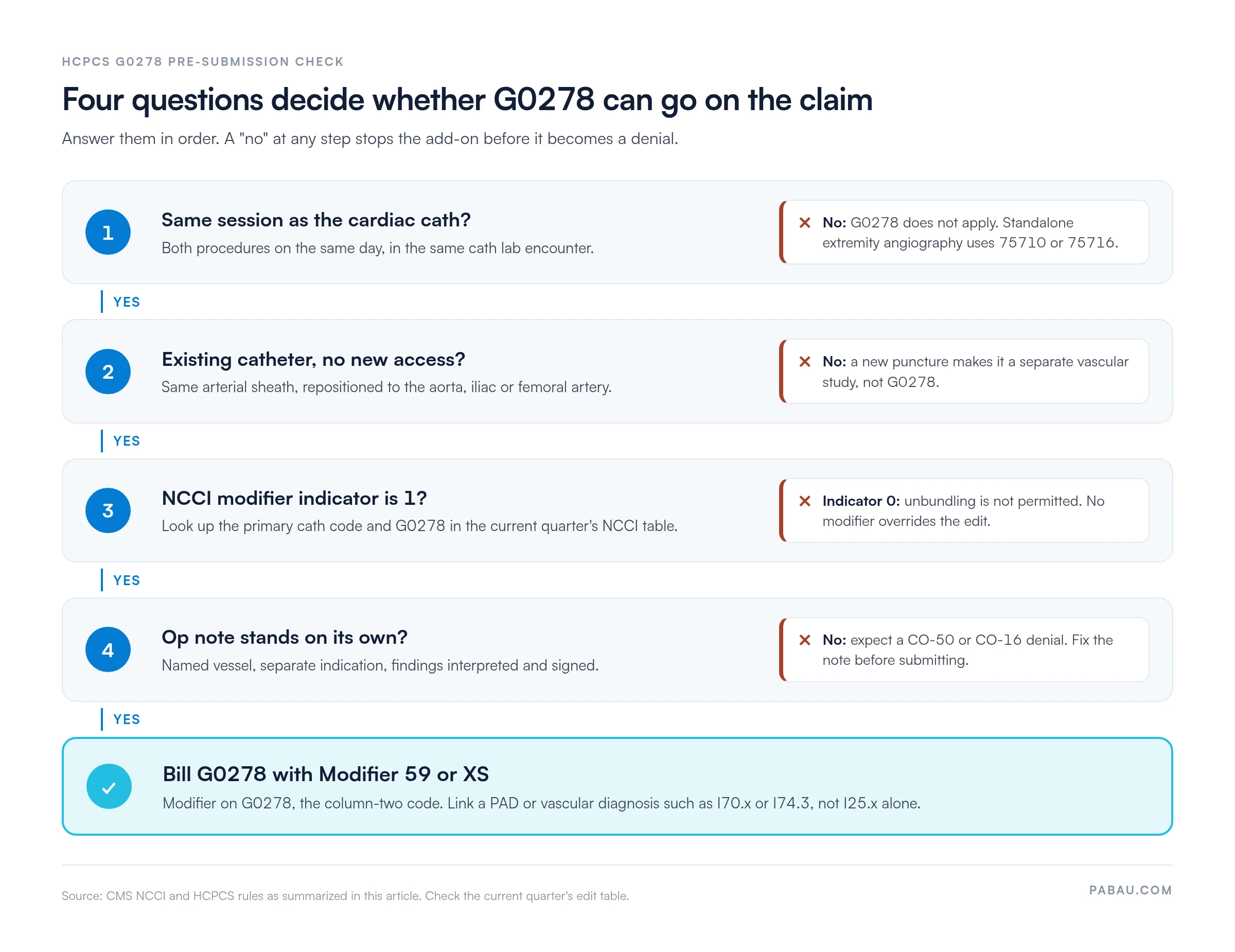
Four conditions must all be present before G0278 is separately reportable. Missing any one of them turns a payable claim into a denial.
G0278 and CPT 93566 both describe imaging during a cardiac cath, but they cover different anatomy. CPT 93566 is the injection for selective right ventricular or right atrial angiography. G0278 is non-selective imaging of the iliac and femoral arteries.
Neighboring injection codes cover other structures. Pulmonary angiography is 93568, and supravalvular aortography is 93567. When the procedure note documents both G0278 and 93566 studies, neither duplicates the other. Each still needs its own documentation and an NCCI check before both go on one claim.
Several other codes surface regularly in the same cath lab encounter. Each has a different descriptor and different NCCI relationship with G0278.
Always verify the current CMS NCCI edit table before reporting any of these alongside G0278. NCCI edits are updated quarterly, and a pair that was separately reportable last year may now be bundled. When the extremity study happens outside a cath session, it is reported as standalone angiography with 75710 for one side or 75716 for both.
Check the CMS NCCI edit table for the current quarter before submitting any cardiac cath claim that includes G0278. Download the table directly from cms.gov, filter for G0278 in column A or B, and note the modifier indicator. A ‘0’ means the edit cannot be overridden by any modifier. A ‘1’ means Modifier 59 or an XE/XS/XP/XU modifier may apply if documentation supports distinctness.
The National Correct Coding Initiative (NCCI) bundles G0278 with several cardiac catheterization codes. In many clinical scenarios, CMS treats the iliac and femoral angiography as incidental to the primary procedure.
When a modifier indicator of ‘1’ applies to the code pair, Modifier 59 or a more specific X-modifier can unbundle the edit. That only holds when the clinical circumstances support it.
Appropriate use of Modifier 59 requires all three of the following:
The OIG has flagged improper Modifier 59 use as a persistent billing risk. Applying the modifier without supporting documentation to override a ‘0’ modifier indicator edit (unbundling not permitted) can be treated as improper billing and invites audit.
Cardiology billing teams should audit G0278 claims quarterly to confirm that every unbundled instance has a corresponding procedure note that would withstand a post-payment review.
Sound billing compliance documentation for G0278 must contain seven specific elements. Each missing element maps to a predictable denial reason.
Cath lab reports that combine the coronary and peripheral findings into a single undifferentiated narrative are the most common documentation failure. Payers cannot determine from a merged note whether the angiography was clinically separate, so they default to bundling.
Medicare pays HCPCS Code G0278 under Part B, with rates set each year through the CMS Physician Fee Schedule. Check the current rate in the PFS lookup tool before quoting a figure to clinical staff, since rates change each January 1.
Several coverage nuances apply:
G0278 denials tend to arrive under a handful of common denial codes. The table below maps each one to its root cause and corrective action.
A structured denial management workflow sends each G0278 denial to the team that can fix it:
Work through these seven steps before a G0278 claim leaves the practice. They slot into your wider medical billing process, and four of them decide whether the add-on is payable at all, as the flow below shows.
Payers match the diagnosis codes on the claim against their local coverage determination (LCD) or coverage policy. That match confirms the iliac or femoral imaging was medically indicated. Each Medicare Administrative Contractor (MAC) maintains its own LCDs, so a diagnosis one MAC accepts may not be covered by another.
Verify each ICD-10-CM code against the current fiscal year’s code file from CMS’s ICD-10 coding page before submitting. Always reference your MAC’s applicable LCD for the covered diagnosis list relevant to your jurisdiction.
When a G0278 claim returns a CO-50 medical necessity denial, check the ICD-10 codes on the original claim before writing an appeal. A common cause is a coronary artery disease diagnosis (I25.x) listed as the only supporting code. That diagnosis does not establish medical necessity for peripheral vascular imaging. Add the appropriate I70.x or I74.x code that directly corresponds to the documented indication in the op note.
In many cardiology practices, the op note lives in one system and the claim is keyed into another. A rejected G0278 line then waits in a clearinghouse portal until someone remembers to look.
Pabau’s medical billing software raises the claim from the patient’s invoice and sends it through a clearinghouse. Each claim is checked for missing or invalid details before submission. A dashboard then tracks it from pending to paid.
Rejected claims are flagged as needing action, with a link to the field that needs fixing. In the US, payments can be settled from ERA files. Your coders spend their time on the NCCI pair and the op note rather than chasing status.

Pabau’s claims management checks each claim for missing or invalid details before it reaches the clearinghouse. Rejected claims are flagged for action, so your billing team fixes them before they age.

Whether G0278 gets paid is mostly settled in the cath lab, before a coder ever sees the case. A note that names the vessel, gives its own indication, and records interpreted findings gives the claim something to stand on.
So start with the op note template rather than the denial queue. Add a separate peripheral angiography section, and check the NCCI pair before each claim goes out. The cost is a few extra lines per case, and the return is a clean claim on the first pass.
Book a demo to see how Pabau handles insurance billing for cardiology practices, from the procedure note to the paid claim.

Need a reference for handling claim denials at scale? Denial management in healthcare covers systematic workflows for tracking, appealing, and preventing recurring claim denials across specialties.
Want to understand how clearinghouse claim files work? 837 file guide explains the electronic claim format that carries HCPCS and CPT codes from practice management systems to payers.
Looking for a broader billing compliance framework? What is revenue cycle management walks through the end-to-end process from patient encounter to final payment posting, including where coding errors typically enter the cycle.
HCPCS Code G0278 bills non-selective iliac and/or femoral angiography performed during a cardiac catheterization session. The physician uses the catheter already in arterial position. It is payable when the angiography is clinically distinct from the coronary procedure and documented separately in the operative report.
G0278 is separately reportable when the iliac or femoral imaging happens in the same session and uses the existing catheter without new vascular access. The operative note must also document a distinct indication and separately interpreted findings. If the note merges the peripheral imaging into the coronary narrative, expect a bundling denial.
G0278 covers non-selective imaging of the iliac and femoral arteries during cardiac catheterization. CPT 93566 is the injection for selective right ventricular or right atrial angiography. The two cover different anatomy, so they are not duplicates. Each needs its own documentation and an NCCI check before both go on one claim.
Yes, but only when the NCCI edit has a modifier indicator of ‘1’. The operative note must also show the iliac or femoral angiography was clinically distinct. Applying Modifier 59 to a ‘0’ indicator edit (unbundling not permitted), or without supporting documentation, can be treated as improper billing and invites audit.
Peripheral arterial disease codes in the I70.x category, such as I70.213 and I70.299, support medical necessity. So do I74.3 (embolism and thrombosis of lower-extremity arteries) and the arterial stenosis code I77.1. Check your MAC’s local coverage determination for the accepted diagnosis list, since criteria vary by jurisdiction.
G-codes are used mainly for Medicare billing, so commercial coverage of G0278 is not guaranteed. Some commercial payers follow Medicare’s criteria. Others require a CPT equivalent or do not recognize HCPCS G-codes at all. Check each payer’s billing policy or contract before submitting G0278 on a commercial claim.