HCPCS Code Q4185: Cellesta flowable amnion billing guide
HCPCS Code Q4185: definition and official descriptor HCPCS Code Q4185 is the Lev...

Last Updated: Nov 20, 2026
93463 is the CPT add-on code for pharmacologic agent administration during cardiac catheterization, such as inhaled nitric oxide, nitroprusside, dobutamine or milrinone. It covers the hemodynamic measurements taken before, during and after the agent, including repeat doses, and is reported once per catheterization.
It is never billed alone. Its listed primary codes are right, left or combined heart catheterization (93451-93453) and coronary angiography with heart catheterization (93456-93461). A typical claim is pulmonary vasoreactivity testing, coded 93451 plus 93463. Pharmacologic stress for coronary flow reserve is a different service, reported with 93571 and 93572.
Let Pabau's smart automation suggest the right codes, reduce claim denials, and keep your practice compliant—effortlessly.
Automate repetitive tasks and focus on what matters most—your patients.
Reduce coding errors and ensure compliance with the latest regulations.
Clean claims, fewer denials, and faster reimbursements.
Powerful insights and reporting to help your practice thrive.
HIPAA compliant SOC 2 certified GDPR-compliant Trusted by 4,000+ clinics worldwide

CPT code 93463 reports pharmacologic agent administration during cardiac catheterization, such as inhaled nitric oxide, nitroprusside, dobutamine or milrinone, with hemodynamic measurements.
It is an add-on code, reported once per catheterization with a primary code: 93451, 93452, 93453 or 93456 to 93461.
Pulmonary vasoreactivity testing during a right heart catheterization is the classic claim, coded as 93451 plus 93463.
It is not a pharmacologic stress test. Coronary flow reserve under induced stress is 93571 or 93572, and exercise during catheterization is 93464.
Pabau, a practice management platform with US insurance billing, keeps the catheterization note and the claim in one patient record.
CPT code 93463 is the add-on code for giving a pharmacologic agent during cardiac catheterization and measuring the hemodynamic response. The SCAI coding guidelines for catheterizations list it with nine primary heart catheterization codes and set out when it may be billed.
The official descriptor reads:
Pharmacologic agent administration (eg, inhaled nitric oxide, intravenous infusion of nitroprusside, dobutamine, milrinone, or other agent) including assessing hemodynamic measurements before, during, after and repeat pharmacologic agent administration, when performed (List separately in addition to code for primary procedure)
CPT +93463, as listed in the SCAI coding guidelines
The agents named in the descriptor are vasodilators and inotropes: Inhaled nitric oxide, nitroprusside, dobutamine and milrinone. The code covers the measurements taken before, during and after each dose, so the response to the drug is on record. Repeat doses in the same procedure fall under the same single unit.
The descriptor does not name dipyridamole, adenosine or regadenoson, and it describes no stress test. Coronary flow reserve measured under pharmacologically induced stress has its own codes, 93571 and 93572.
The descriptor is broad on the drug and strict on the measurements. Use the two lists below to check a 93463 charge before it goes out.
SCAI lists nine primary codes for 93463, and each one includes a right, left or combined heart catheterization. The coronary angiography codes without heart catheterization, 93454 and 93455, are not on the list.
Report 93463 on the line after the primary code, with the same date of service and one unit. A right heart catheterization with an inhaled nitric oxide challenge is coded 93451 and +93463. Because the descriptor covers repeat administration, a second agent or dose in the same procedure adds no units.
The AMA has revised the 93463 parenthetical more than once since the code was introduced. Check the current CPT codebook before you pair it with a structural or congenital procedure code.
Build a charge rule that holds any 93463 line without one of the nine primary codes on the same claim. Add a second check that stops a second unit of 93463 on the same date of service.
93463 fits a catheterization where the physician gives a drug to see how pressures and cardiac output respond. Three common scenarios are below.
The diagnosis comes from the reason for the catheterization, not from the drug. The codes below are frequent pairings, but code to the highest specificity the note supports. Reserve I27.20 for a note that names pulmonary hypertension without its type.
These four codes are easy to confuse, but each one describes a different service. Choose by what was done in the cath lab, not by which number sits closest.
93462 and 93463 share six primary codes: 93452, 93453 and 93458 to 93461. SCAI’s guidelines set no rule against reporting both when both services are performed and documented. Check the current National Correct Coding Initiative (NCCI) edits for your date of service before the claim goes out. The CPT 93462 guide covers the transseptal side, and the CPT 93571 guide covers flow reserve.
SCAI says to bill 93463 only when hemodynamic and function measures are taken before, during and after the agent. The study must serve as a diagnostic test or evaluate a potential therapy, and the note has to show both.
A drug given only as treatment, with no measured response, does not meet that standard. List 93463 under the primary code on the superbill or charge sheet, so the add-on is not lost at charge entry.
Medicare pays 93463 under the Medicare Physician Fee Schedule (MPFS), on top of the primary catheterization code. As an add-on code, it has no global period of its own. Check the current rate for your locality in the CMS Physician Fee Schedule Look-Up Tool.
Payment changes every year with the conversion factor and the Geographic Practice Cost Indices. A figure quoted in an article goes stale quickly, so price from the CMS tool for your date of service.
The errors below come up when 93463 is read as a stress test code, or billed without its measurements. Each row pairs the error with its fix.
The decision path below covers all six errors. It picks the add-on code from what happened in the cath lab, then runs three checks on a +93463 line.
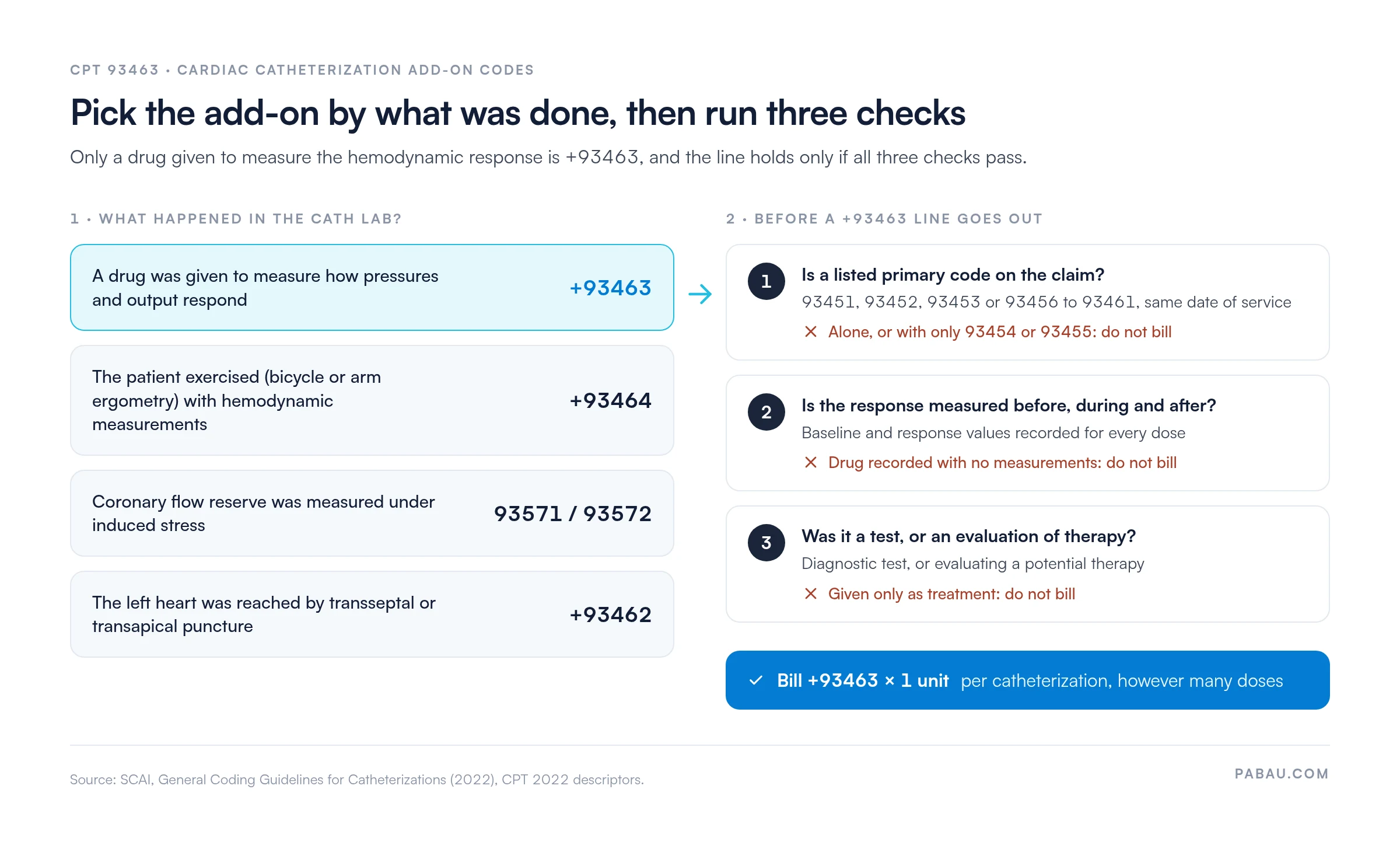
If a 93463 line comes back denied, the denial codes in medical billing on the remittance show whether to resubmit or appeal. A short denial management log by error type shows which fix your team needs first.
Log every denied 93463 line by error type and primary code for one quarter. The pattern shows whether to fix charge entry, coder training or the procedure note template.
In many cardiology practices, the drug challenge lives in the cath lab report while the claim is built later from a charge sheet. If the sheet has no line for the add-on, 93463 never reaches the claim. If the report leaves out the response measurements, the line is hard to defend in an audit.
Pabau keeps the procedure note and the claim in the same patient record. Its claims management software sends CMS-1500 and 837P claims through Claim.MD, with eligibility checks and electronic remittance advice (ERA). Your billing team can read the documented study before it adds the 93463 line.
The result is fewer missed add-on lines and fewer claims sent back for missing documentation. Remittances post against the same record, so an unpaid 93463 line is easy to spot.

Pabau keeps the catheterization note, the charge and the claim in one patient record. US claims go out through Claim.MD with eligibility checks and ERA remittances, so add-on lines are easy to track to payment.

Once 93463 is read as a hemodynamic drug study, the coding choices follow. The add-on rides on one of nine heart catheterization codes, once per procedure. It holds up only when the note shows the response before, during and after the agent.
The trade-off is a few minutes of documentation in the cath lab against a line that pays on the first pass. A report template with fields for agent, dose and measured response makes that trade easy. Book a demo to see how Pabau carries the catheterization note through to a clean claim for your cardiology practice.

Coding the left heart study that carries the add-on? CPT code 93452 covers left heart catheterization, one of the nine primary codes for 93463.
Pairing 93463 with coronary angiography? CPT code 93456 explains what is bundled into angiography with right heart catheterization.
Want to understand how claim denials are classified? Denial codes in medical billing explains CARC and RARC codes and how to use them for faster appeal routing.
Looking for a revenue cycle overview? What is revenue cycle management covers the end-to-end process from eligibility verification through payment posting.
CPT code 93463 means pharmacologic agent administration during cardiac catheterization, with hemodynamic measurements before, during and after the agent. Examples in the descriptor are inhaled nitric oxide, nitroprusside, dobutamine and milrinone. It is an add-on code, reported once per catheterization.
Yes. CPT 93463 is an add-on code and is never reported alone. It follows a primary heart catheterization code on the same claim and date of service. It is reported once per catheterization, even when several agents or doses are given.
SCAI lists nine primary codes for 93463: 93451, 93452, 93453, 93456, 93457, 93458, 93459, 93460 and 93461. Each one includes a right, left or combined heart catheterization. The angiography-only codes 93454 and 93455 are not on the list.
Yes. Medicare pays 93463 under the Physician Fee Schedule when a listed primary catheterization code is on the same claim and the note supports it. The rate changes each year and by locality. Check the CMS Physician Fee Schedule Look-Up Tool for your date of service.
CPT 93463 reports a drug given during catheterization to measure the hemodynamic response. CPT 93462 reports left heart catheterization by transseptal puncture through an intact septum, or by transapical puncture. Both are add-on codes and share six primary codes. SCAI’s guidelines set no rule against reporting both when both services are documented.
No. CPT 93463 does not describe stress testing, and its descriptor names no stress agents such as adenosine, dipyridamole or regadenoson. Coronary flow reserve measured under pharmacologically induced stress is reported with 93571 and 93572. An exercise study during catheterization is 93464.
The descriptor names inhaled nitric oxide, intravenous nitroprusside, dobutamine and milrinone, and it leaves room for other agents. The code pays for giving the agent and measuring the hemodynamic response. It is not tied to one specific drug list.
The note must state why the agent was given and name the drug, dose and route. It must record hemodynamic measurements before, during and after administration, plus any repeat doses. It should end with the physician’s interpretation, and the primary catheterization must be documented separately.