HCPCS code J3471: Hyaluronidase ovine injection billing guide
HCPCS code J3471: Descriptor, code type, and quick-reference data HCPCS code J34...

Last Updated: Oct 14, 2026
93297 is the CPT code for remote interrogation of an implantable cardiovascular monitor system, covering up to 30 days of recorded physiologic data. It is a global code, so one claim pays for both the data collection and the professional review.
Denials cluster on three patterns. One is a monitoring period shorter than 30 days. Another is confusion with 93296, the pacemaker and defibrillator code. The third is global billing when a monitoring company owns the equipment.
Let Pabau's smart automation suggest the right codes, reduce claim denials, and keep your practice compliant—effortlessly.
Automate repetitive tasks and focus on what matters most—your patients.
Reduce coding errors and ensure compliance with the latest regulations.
Clean claims, fewer denials, and faster reimbursements.
Powerful insights and reporting to help your practice thrive.
HIPAA compliant SOC 2 certified GDPR-compliant Trusted by 4,000+ clinics worldwide

CPT Code 93297 is a global code for remote interrogation of an implantable cardiovascular monitor over a period of up to 30 days.
Split it with modifier 26 for the review work and modifier TC for the equipment and data collection. There is no separate technical-component CPT code.
93296 is the technical code for remote pacemaker and defibrillator monitoring over 90 days. It is not the technical partner to 93297.
93298 is a standalone global code for subcutaneous cardiac rhythm monitors, including loop recorders. It is not an add-on to 93297.
Pabau, our practice management software, tracks 93297 documentation and claim status so no 30-day period gets billed twice.
CPT Code 93297 covers remote interrogation of an implantable cardiovascular monitor system over a period of up to 30 days. The American Medical Association publishes the long descriptor below. It is set out here in the four parts that carry the billing logic, in the order the AMA prints them.
93297 is a global code. One claim covers the technical work of collecting and transmitting the data, plus the professional work of reading it and signing the report. Modifier 26 and modifier TC split those halves when two entities share them. No separate technical-component CPT code exists for this service.
The technical-only codes that once accompanied 93297 have been retired. CPT deleted 93299 in 2020. CMS then published HCPCS code G2066 as an interim replacement and deleted that code effective January 1, 2024. The 2024 Medicare Physician Fee Schedule final rule assigned technical values to 93297 itself.
CPT Code 93297 applies to implantable cardiovascular monitor (ICM) systems. These devices sit inside the heart or the vasculature and record physiologic measurements rather than rhythm strips alone. Pulmonary artery pressure is the most familiar example, used to guide heart failure management between office visits.
Loop recorders belong to a different code. A subcutaneous cardiac rhythm monitor, which is the current CPT name for an implantable loop recorder, is interrogated remotely under 93298. Check the implant code in the chart if you are unsure. CPT 33285 marks a subcutaneous cardiac rhythm monitor, which points to 93298 rather than 93297.
External event monitors are not implanted, so they sit outside this code family. The recording component of an external cardiac event monitor with a symptom-related memory loop bills under 93270, with analysis and physician review reported separately.
Run insurance eligibility verification before submitting 93297 claims. Some commercial payers apply monitor-specific prior authorization rules that differ from Medicare policy. Confirm with your Medicare Administrative Contractor (MAC) whether a local coverage determination (LCD) modifies national coverage in your jurisdiction.
A physician or another qualified health care professional may report CPT Code 93297. The official descriptor names both, so a nurse practitioner or physician assistant who performs and signs the review can be the reporting professional. What decides the claim is the split between equipment and review, not the reviewer’s credential alone.
Cardiologists and cardiac electrophysiologists report 93297 most often. A practice that owns the monitoring equipment and employs the reviewing professional reports the global code. Where an independent diagnostic testing facility or a device manufacturer runs the monitoring service, that entity reports 93297-TC and the reading practice reports 93297-26.
Duplicate global billing is the error to watch for. If the monitoring company has already billed the technical half, a global 93297 from the practice overlaps it. One of the two claims will be denied, and the overlap usually surfaces months later on audit.
Before your first 93297 claim, confirm in writing who reports the technical component for each monitored patient. Monitoring companies and device manufacturers often bill 93297-TC directly to Medicare. A practice that then submits the global code duplicates that charge, and MACs recoup the difference on audit.
Medicare pays CPT Code 93297 under the CMS Physician Fee Schedule (MPFS). The amount depends on which modifier you append and on your geographic practice cost index locality. Several MACs still price elements of this code at contractor level, so a published national average can differ from what lands in your remittance.
Check the work RVU, practice expense RVU, and malpractice RVU for each billing form before you set revenue expectations. Locality adjustment moves the payment meaningfully above or below any national figure. Rates change every January 1, so read the current year’s file rather than a cached number.
A third-party tool such as the FastRVU RVU lookup speeds up that check. The CMS fee schedule search still gives the figure a payer will honor, so treat any other lookup as a shortcut rather than a source.
Tracking electronic remittance advice responses for 93297 is the fastest way to spot rate discrepancies. It also catches MAC-level adjustments and underpayments before they build up across a billing cycle.
CPT Code 93297 is reported once per 30-day period. CPT instructs that the code is not reportable for a period shorter than 30 days, so a partial month cannot be submitted early. CMS also applies a medically unlikely edit of one unit per date of service.
Good medical billing workflows set the next 93297 due date from each patient’s own period end date. A calendar-month trigger drifts out of step with the 30-day rule and produces early submissions that payers reject.
Missing documentation is the primary trigger for 93297 denials. CMS and most commercial payers expect a complete package before they accept the claim. The record has to show that a qualified professional reviewed the transmitted data and reached a clinical interpretation from it.
Thorough medical billing compliance treats that checklist as a pre-submission gate rather than a post-denial fix. A well-structured superbill process captures the signed review, the date range, and the device report reference in one step.
Modifier 26 and modifier TC are the two that matter on CPT Code 93297. They split the global code between the entity that owns the monitoring equipment and the professional who reads the data. Telehealth modifiers rarely apply, because 93297 already describes remote data review rather than a patient encounter.
Appending a telehealth modifier to 93297 is a common error. The service is remote by definition, so GT and 95 carry no meaning here and can trigger a claim edit. Confirm current requirements with your MAC and the AAPC coding reference before you append a third modifier.
The ICD-10-CM diagnosis paired with CPT Code 93297 has to match the indication documented for the implanted monitor. The codes below cover the conditions that most often justify ongoing hemodynamic monitoring.
Check the official wording against the ICD-10-CM codes index before you submit. These are examples rather than mandated pairings, and the chart must support whichever code you send.
Rhythm indications sit with a different code. Syncope, cryptogenic stroke workup, and atrial fibrillation surveillance point to a subcutaneous cardiac rhythm monitor, which is reported under 93298. Submitting one of those diagnoses against 93297 signals a device mismatch to the payer.
Place of service (POS) determines whether Medicare applies the facility or non-facility rate to CPT Code 93297. The POS must reflect where the reviewing professional did the work. It is not the patient’s location, and it is not where the implanted device sits.
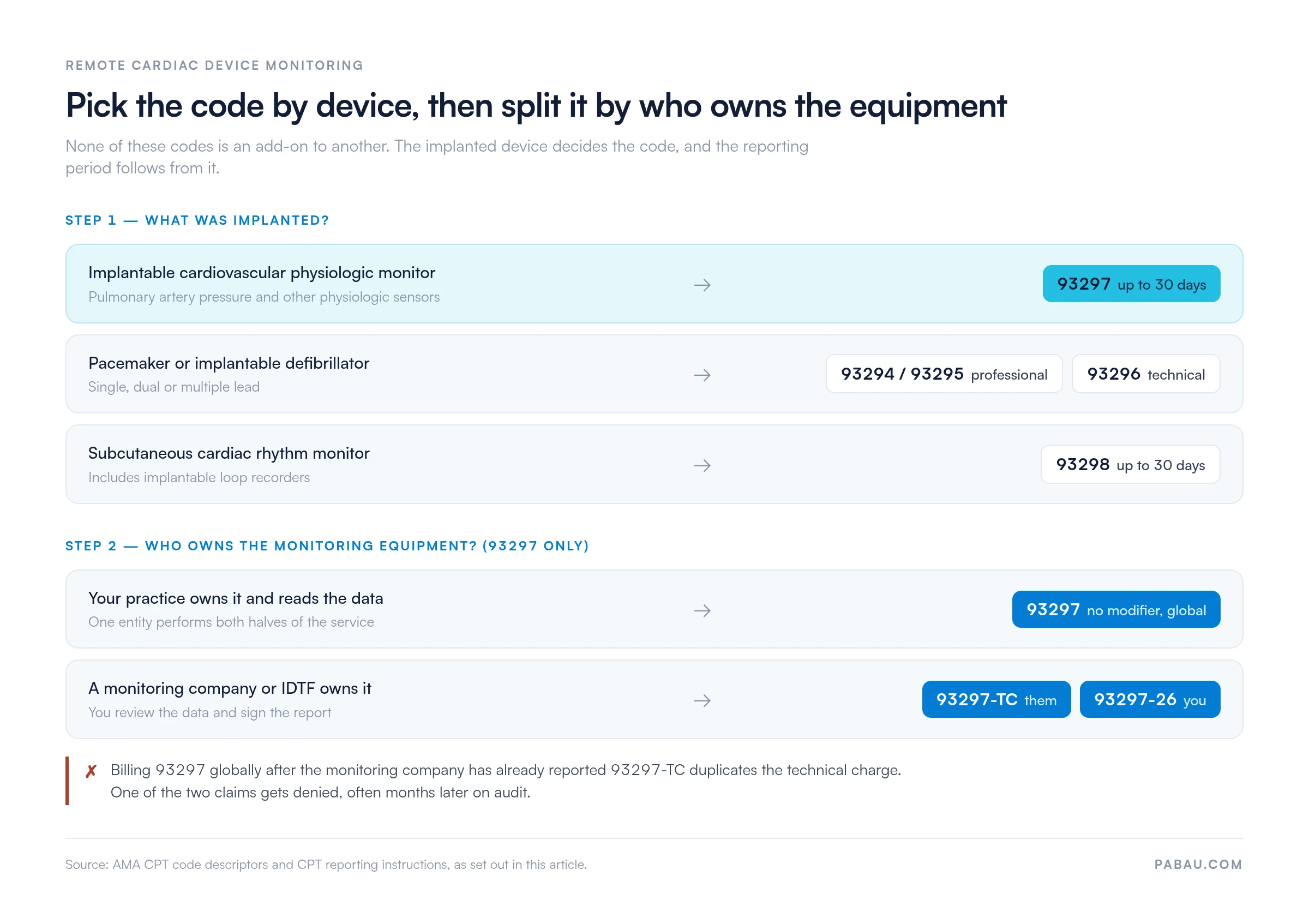
CPT Code 93297 sits inside a family of remote cardiac device monitoring codes. Each one is tied to a device class and a reporting period, and none of them is an add-on to another. Choosing by device first and period second removes most of the confusion in this range.
Two mistakes come up repeatedly in this range. The first treats 93296 as the technical partner to 93297. 93296 carries the technical work for remote pacemaker and defibrillator monitoring over 90 days, alongside professional codes 93294 and 93295. It has no bearing on implantable cardiovascular monitors.
The second mistake treats 93298 as an add-on to 93297. 93298 carries no add-on symbol and no primary-code instruction. It is a standalone global code for a different device, so you report one or the other according to what was implanted. Reporting both for the same device is a duplicate.
Both mistakes disappear once the two decisions are taken in order. The chart below settles the device question first, then the component question for 93297.
Most CPT Code 93297 denials fall into a small number of predictable categories. Proactive denial management workflows catch them before submission rather than after the remittance advice arrives.
Reviewing denial codes each month gives practices early warning on 93297 patterns. Each denial type above maps to a Claim Adjustment Reason Code (CARC) on the remittance advice.
Remote cardiac monitoring is operationally heavy. A cardiologist following 200 monitored patients runs 200 separate 30-day cycles, each starting on its own date. Every cycle needs a documentation package, a signed review, and a correctly coded claim.
Pabau, our practice management software, gives cardiac practices one workflow for that load. Its claims management software holds the signed review and the period dates in a structured record attached to the patient. Period tracking flags a second 93297 inside the same 30-day window before the claim leaves the practice.
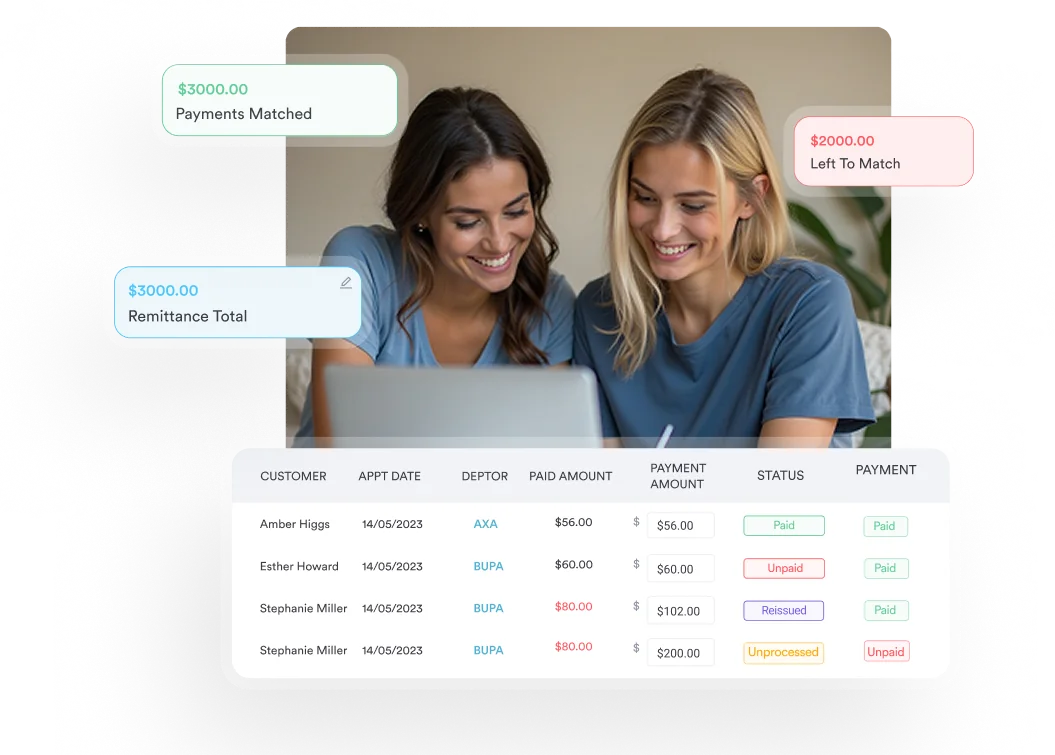
Submitting 93297 claims through Claim.MD, our integrated US clearinghouse, adds payer eligibility checks and 837 validation before the claim goes out. Catching a missing signature or the wrong POS there saves weeks of follow-up per denied claim.
Revenue cycle management improves for 93297-heavy practices when period tracking, documentation checks, and 837 claim file submission live in one system. Reconciling remittance responses against expected 93297 payments becomes a report rather than a manual cross-reference.
Set each patient’s next 93297 task from their own period end date rather than from the first of the month. A patient implanted on the 12th has periods that close on the 11th. A calendar trigger would submit that patient’s claim early on every cycle.

Pabau centralizes cardiac monitoring documentation, tracks claim status, and flags 30-day period conflicts before they reach a payer. See how practices cut remote monitoring denials with structured workflows.

CPT Code 93297 produces steady revenue for cardiology and electrophysiology practices, and its denial rate is higher than it needs to be. Short periods, duplicate global billing, and unsigned reviews are all preventable before the claim goes out.
Pabau’s documentation templates and its Claim.MD connection give cardiac practices the structure to bill 93297 accurately across a full monitored panel. To see how Pabau handles remote cardiac monitoring billing, book a demo with the team.

Need to understand how clearinghouse claim validation works? Claim.MD clearinghouse overview explains how electronic claim scrubbing catches errors before they reach a payer.
Struggling with claim denial follow-up workflows? Submitting a clean claim covers the elements every 93297 submission needs to pass payer edits on the first attempt.
Want a deeper look at cardiac billing reimbursement data? Best medical billing software in the US reviews platforms that support remote monitoring billing workflows for cardiology practices.
CPT Code 93297 reports remote interrogation of an implantable cardiovascular monitor over a period of up to 30 days. It is a global code. One claim covers the equipment and data collection as well as the clinical review and signed report. Report it once per 30-day period per patient.
They describe different devices over different periods. CPT 93296 is the technical component code for remote pacemaker and implantable defibrillator monitoring across a 90-day period, paired with professional codes 93294 and 93295. CPT 93297 covers implantable cardiovascular monitors across 30 days. 93296 is not the technical partner to 93297.
No. Append modifier TC to 93297 itself. CPT deleted the former technical code 93299 in 2020, and CMS deleted the interim HCPCS code G2066 effective January 1, 2024. The 2024 Medicare Physician Fee Schedule final rule assigned technical values directly to 93297.
No. CPT 93298 is a standalone global code for remote interrogation of a subcutaneous cardiac rhythm monitor, which includes implantable loop recorders. It carries no add-on symbol and no primary-code instruction. Report 93297 or 93298 according to the implanted device, never both for the same device.
Once per 30-day period. CPT states that the code is not reportable for a period shorter than 30 days. CMS also applies a medically unlikely edit of one unit per date of service. Track each patient’s own window, because a calendar-month trigger submits some claims early.
Use POS 11 when the reviewing professional interprets the data at the practice, which applies the higher non-facility rate. Use POS 22 or POS 19 when the review happens in a hospital outpatient context, which applies the lower facility rate. The POS reflects where the review was performed, not where the patient or the device is.
Five denials dominate. The period ran shorter than 30 days. A monitoring company already reported 93297-TC, so the global claim duplicated it. The signed review was missing, the place of service was wrong, or the ICD-10 pairing was unsupported. Each one appears as a specific CARC code on the electronic remittance advice.