



CCSD code G5100: Bypass of duodenum billing guide
CCSD code G5100 bills a bypass that leaves the duodenum in place CCSD code G5100...

Last Updated: Oct 16, 2026

CPT code 93298 covers remote interrogation of a subcutaneous cardiac rhythm monitor, better known as an implantable loop recorder or insertable cardiac monitor.
The descriptor covers up to 30 days of monitoring, so 93298 is reported once per 30-day period, not once per quarter.
93298 is not a defibrillator code. Remote ICD interrogation is billed with 93295 and 93296, which do run on a 90-day interval.
The 2026 Medicare national average is about $103 for the global service, and it pays the same in office and facility settings.
Modifiers 26 and TC split 93298 into professional and technical components. CMS started recognizing that split in 2024, when it deleted HCPCS code G2066.
CPT code 93298 covers the remote interrogation of a subcutaneous cardiac rhythm monitor, better known as an implantable loop recorder. Its descriptor runs up to 30 days, so the code is payable once per 30-day monitoring period. The costliest 93298 error is treating it as a defibrillator code billed quarterly.
A cardiology team billing on a quarterly cycle files four claims a year where twelve were payable. No amount of claim scrubbing fixes a code chosen for the wrong device, so the descriptor is where this has to start.
This guide walks the official CPT 93298 descriptor, the devices it applies to, and Medicare rates. It then covers the 30-day reporting interval, modifiers, documentation, payer policy, and the neighboring codes in the 93293-93298 family.
CPT code 93298 describes a remote interrogation device evaluation of a subcutaneous cardiac rhythm monitor system. It covers up to 30 days of recorded heart rhythm data. A physician or other qualified healthcare professional (QHP) analyzes that data and signs a report.
A subcutaneous cardiac rhythm monitor is the device most practices call an implantable loop recorder (ILR) or an insertable cardiac monitor (ICM). The three terms describe the same hardware. The patient is not present for the service, which is what makes it remote.
The American Medical Association (AMA) maintains the CPT code set. The official 93298 descriptor has two parts, divided at the semicolon in standard CPT style.
Only one device family qualifies under CPT code 93298, the subcutaneous cardiac rhythm monitor. Device mismatch is the fastest way to lose a claim on this code.
Several implanted and wearable devices are excluded from 93298, and each has its own code family.
Billing 93298 for a defibrillator patient is the most common version of this error, and it is denied as a device mismatch. Pull the implant documentation before you select the code. If the implant was billed with CPT code 33285, the device is a subcutaneous cardiac rhythm monitor. That makes 93298 the correct remote code.
External monitors split into components as well. Within the 93224 to 93272 range, 93225 covers the recording itself, up to 48 hours, billed by whoever supplies and connects the device. The physician who reviews that recording and signs the interpretation bills 93227 instead.
Remote monitoring stops once the loop recorder is explanted. UK private practices bill that removal episode under CCSD code 20143, which bundles the device retrieval and the findings report.
The CMS Medicare Physician Fee Schedule (MPFS) sets the national average payment for CPT code 93298. For 2026, CMS finalized two conversion factors for the first time. Qualifying APM participants are paid at $33.5675, and everyone else at $33.4009.
At the non-qualifying conversion factor, 93298 pays about $103.21 nationally. Qualifying APM participants see about $103.72. The office and facility amounts are identical, because the practice expense RVUs do not change by setting.
That parity is unusual, and it matters for a hospital-based cardiology group. Moving the service into an outpatient department does not reduce the fee schedule amount for the global code.
Rates still vary by locality through the Geographic Practice Cost Index (GPCI). Check your own locality with the FastRVU 2026 RVU lookup tool, which draws on CMS MPFS data.
When the components are split, each modifier draws its own share of these RVUs. Confirm the split amounts on the MPFS lookup before you bill. The remittance advice then shows what the payer allowed.
CPT code 93298 is reported once per 30-day monitoring period. The interval comes from the descriptor itself, which reads up to 30 days. This is not a surgical global period, and no post-operative day count applies.
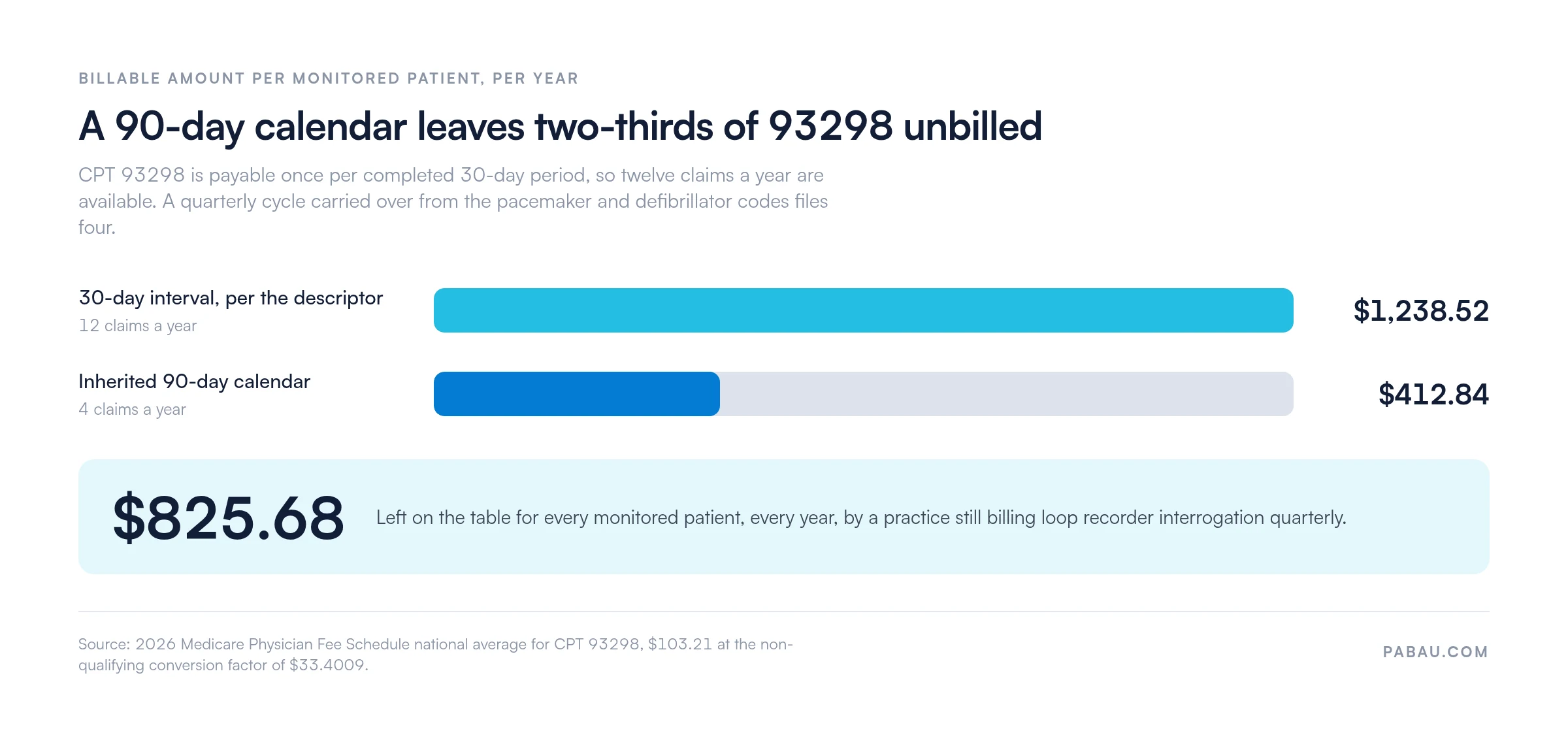
Practices that inherited a 90-day billing calendar from the pacemaker and defibrillator codes underbill 93298 badly. Twelve reporting periods a year become four. At the 2026 national average, that costs roughly $825 per monitored patient per year. The comparison below puts the two calendars side by side.
CMS did not always allow a technical component on 93298. Until the end of 2023, practices reported the technical work with HCPCS code G2066. CMS deleted G2066 effective January 1, 2024, and assigned a technical component to 93297 and 93298 instead.
That change is why older billing guides for this code still tell you to report G2066. Take the habit out of your rules engine.
Hospital-based cardiologists usually bill 93298 with modifier -26, because the hospital submits its own claim with modifier -TC. Independent offices that run their own monitoring usually bill the global code. Confirm the split with your facility before submitting, and record which setting applies to each patient.
A signed physician interpretation supports every 93298 claim. Missing paperwork is a clean-claim failure rather than a clinical one, and it is correctable before submission. Five elements have to be in the chart.
Device vendor printouts alone do not satisfy the interpretation requirement. The physician has to add a clinical impression. One signed sentence noting a normal rhythm and no intervention is enough. Unsigned reports draw recoupment audits even after the claim pays.
Build a short check into your remote monitoring workflow. Before any 93298 claim goes out, confirm four things in the chart. You need the transmission timestamp, a documented 30-day period, the physician narrative, and a signature dated to the date of service. A 30-second review prevents most audit triggers on this code.
There is no national Medicare article that sets a frequency rule for 93298. Novitas LCD L34833 and its billing article A56602 cover cardiac rhythm device evaluation, but they address 93293 through 93296 only. The 30-day limit on 93298 comes from the CPT descriptor and the AMA reporting rules.
That matters when you appeal. Citing an LCD that does not name your code weakens the appeal, so quote the CPT descriptor and your own MAC guidance instead.
A clearinghouse with real-time eligibility verification lets your team confirm coverage before the physician writes the interpretation. Catching a lapsed policy at that point is cheaper than appealing a denial three weeks later.
CPT code 93298 sits in a tightly grouped family of remote interrogation codes for implanted cardiac devices. Picking the wrong member of that family is among the top coding errors flagged by the AAPC. The table below shows what separates them.
This is the mix-up that produces most wrong-code denials on 93298. CPT 93295 covers the professional component of remote defibrillator interrogation, on an interval of up to 90 days. CPT 93298 covers a subcutaneous rhythm monitor on a 30-day interval.
The devices are not interchangeable. A defibrillator delivers therapy, and a rhythm monitor only records. Billing 93298 for a defibrillator patient is denied as a device mismatch. So is billing 93295 for a loop recorder patient.
Both codes run on a 30-day interval, and both allow the -26 and -TC split. That makes them look almost identical on a claim form. The difference is what the implant records.
CPT 93297 covers an implantable cardiovascular physiologic monitor, which reports hemodynamic data such as pulmonary artery pressure. CPT 93298 covers a subcutaneous cardiac rhythm monitor, which records heart rhythm. A heart failure patient with a pressure sensor gets 93297. A syncope patient with a loop recorder gets 93298.
Denial work on remote monitoring starts with knowing which errors cause the rejections. These six account for most 93298 denials.
Tracking denial codes across your remote monitoring population shows which of these recurs. Fixing the process behind the pattern is worth more than reworking single claims. Review the reasons monthly rather than once a quarter.
Run a monthly audit of denied 93298 claims and sort them by reason code. If frequency rejections dominate, your monitoring calendar is still set to 90 days somewhere. If device-mismatch denials dominate, the problem is code selection at charge capture, not the biller.
The two costliest 93298 errors, wrong device and wrong interval, happen at charge capture rather than in the billing office. By the time the claim reaches a scrubber, the wrong code is already on it. A cardiology team can only catch that upstream, in the chart.
Practice management software like Pabau closes that step. Pabau’s tools for cardiology billers work on remote monitoring codes in three ways.
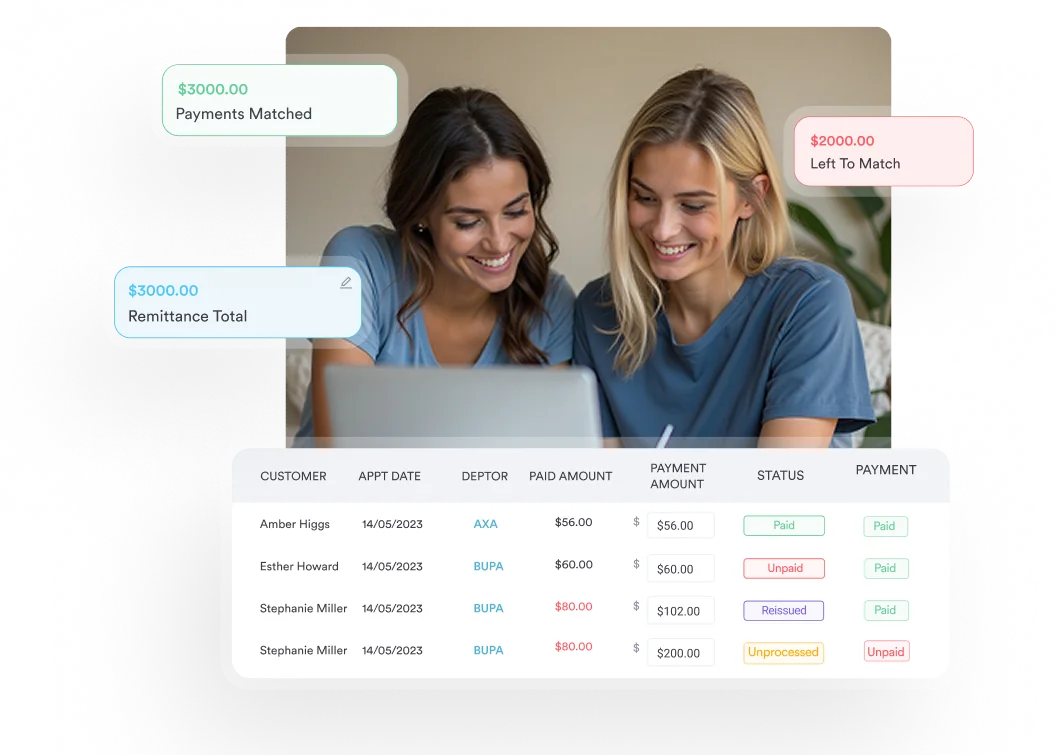
None of that replaces a coder who knows the descriptor. It removes the re-keying step where the device and the interval usually get lost.

Pabau keeps the clinical note, the charge, and the claim on one patient record. Remote monitoring claims leave with the right code and a signed report attached. See how it works for your team.

CPT code 93298 is a loop recorder code, not a defibrillator code, and it runs on a 30-day interval. Practices that carry the 90-day habit over from 93295 and 93296 leave most of the year unbilled. At the 2026 national average, that shortfall is worth roughly $825 per monitored patient per year.
Getting it right takes three habits. Check the implant record, report once per completed 30-day period, and confirm the report is signed before the claim is created. If you want to see how Pabau handles this end to end, book a demo. We will walk through the remote cardiac monitoring workflow with you.

Billing other cardiology diagnostics this quarter? CPT code 93015 walks the cardiovascular stress test, its component split, and the 2026 Medicare rates.
Want fewer 93298 denials before the payer sees them? What is a clean claim in medical billing covers the coding and documentation elements first-pass acceptance needs.
Seeing the same denial reason on remote monitoring claims? Denial management in healthcare walks root-cause analysis and the prevention steps that follow it.
Not sure how cardiac claims reach the payer? Claim.MD clearinghouse review explains 837P submission and how remittance files close the payment loop.
CPT code 93298 bills the remote interrogation of a subcutaneous cardiac rhythm monitor, also called an implantable loop recorder. The physician or QHP analyzes the recorded heart rhythm data and signs an interpretation report. The patient is not present. The descriptor covers up to 30 days, so the code is reported once per 30-day monitoring period.
No. CPT 93298 is a rhythm monitor code only. Remote interrogation of an implantable cardioverter-defibrillator is billed with 93295 for the professional component and 93296 for the technical component. Those codes run on an interval of up to 90 days. Pacemaker remote interrogation uses 93294 and 93296.
For 2026, CPT 93298 carries 3.09 total RVUs, made up of 0.51 work, 2.54 practice expense, and 0.04 malpractice. At the non-qualifying conversion factor of $33.4009, the national average is about $103.21. Qualifying APM participants are paid at $33.5675, which works out to about $103.72. The office and facility amounts are the same, and locality GPCI adjustments still apply.
Once per 30-day monitoring period. The interval comes from the CPT descriptor, which reads up to 30 days. Do not report 93298 when the monitoring period ran shorter than 30 days. A second claim inside the same window is rejected as a duplicate or a frequency violation.
Three options apply. Use modifier -26 when the physician bills only for the analysis and signed report. Use modifier -TC when a separate entity bills the data acquisition and technician review. Bill the code with no modifier when one entity does both. CMS assigned a technical component to 93298 on January 1, 2024, when it deleted HCPCS code G2066.
Five elements are required. The chart needs proof that a completed remote transmission was received, with a timestamp and the correct patient and device. It needs evidence that the monitoring period covered the full 30 days. It needs a review of the recorded rhythm data and any stored or patient-triggered episodes. It needs a physician-authored interpretation rather than a vendor printout. Finally, it needs a signature and date matching the date of service on the claim.



