HCPCS Code V2208: Spherocylinder bifocal lens billing guide
HCPCS Code V2208: Definition and code attributes HCPCS Code V2208 is a Level II ...

Last Updated: Oct 7, 2026
V2113 is the HCPCS Level II code for a single vision spherocylinder lens, billed per lens. It covers sphere power from ±7.25D to ±12.00D with cylinder power from 4.25D to 6.00D. The lens corrects nearsightedness or farsightedness together with high astigmatism.
Let Pabau's smart automation suggest the right codes, reduce claim denials, and keep your practice compliant—effortlessly.
Automate repetitive tasks and focus on what matters most—your patients.
Reduce coding errors and ensure compliance with the latest regulations.
Clean claims, fewer denials, and faster reimbursements.
Powerful insights and reporting to help your practice thrive.
HIPAA compliant SOC 2 certified GDPR-compliant Trusted by 4,000+ clinics worldwide

HCPCS Code V2113 classifies one single vision spherocylinder lens with ±7.25D to ±12.00D sphere and 4.25D to 6.00D cylinder, billed per lens.
V2111, V2112, and V2113 share one sphere band, so the cylinder power alone decides between them.
Medicare does not cover routine vision care. It pays for V2113 under Part B only for post-cataract aphakic or pseudophakic patients.
Most V2113 denials come from the wrong sphere or cylinder band, a missing modifier, or no prior authorization where the payer requires one.
Pabau’s claims management software tracks vision supply codes, modifiers, and payer eligibility, so V-code errors surface before submission.
HCPCS Code V2113 is the Level II code for one single vision spherocylinder lens with ±7.25D to ±12.00D sphere and 4.25D to 6.00D cylinder. It sits in the V2100–V2199 single vision lens range of the HCPCS Level II code set. Its official descriptor reads: “Spherocylinder, single vision, plus or minus 7.25 to plus or minus 12.00d sphere, 4.25 to 6.00d cylinder, per lens.”
The Centers for Medicare & Medicaid Services (CMS) maintains the code set and publishes its updates.
The table below summarizes the key attributes of HCPCS Code V2113. Check the descriptor against the HCPCS file in effect on the date of service, since CMS can revise codes between releases.
A spherocylinder lens corrects two things at once. The sphere power corrects nearsightedness or farsightedness equally in every meridian. The cylinder power corrects astigmatism along one axis. V2113 needs both values inside its bands: sphere from ±7.25D to ±12.00D and cylinder from 4.25D to 6.00D.
A lens with the same sphere but no cylinder is a sphere-only lens, which V2102 covers. Prism is not part of the V2113 descriptor. Where a prescription adds prism, it is reported separately under the payer’s rules rather than folded into V2113.
V2113 has a hard edge on both powers, and every neighboring combination has its own code. The inclusions and exclusions below come straight from the descriptors.
V2111, V2112, and V2113 share one sphere band, ±7.25D to ±12.00D, and only the cylinder band separates them. V2114 breaks the pattern, covering spherocylinder lenses with sphere over ±12.00D. Picking the wrong band is a common reason V2113 claims deny.
To select the code, read the sphere and the cylinder for each eye on the dispensed prescription. Find the sphere band first, then the cylinder band inside it, as the grid below lays out. Code each lens on its own, because the two eyes often land in different codes.
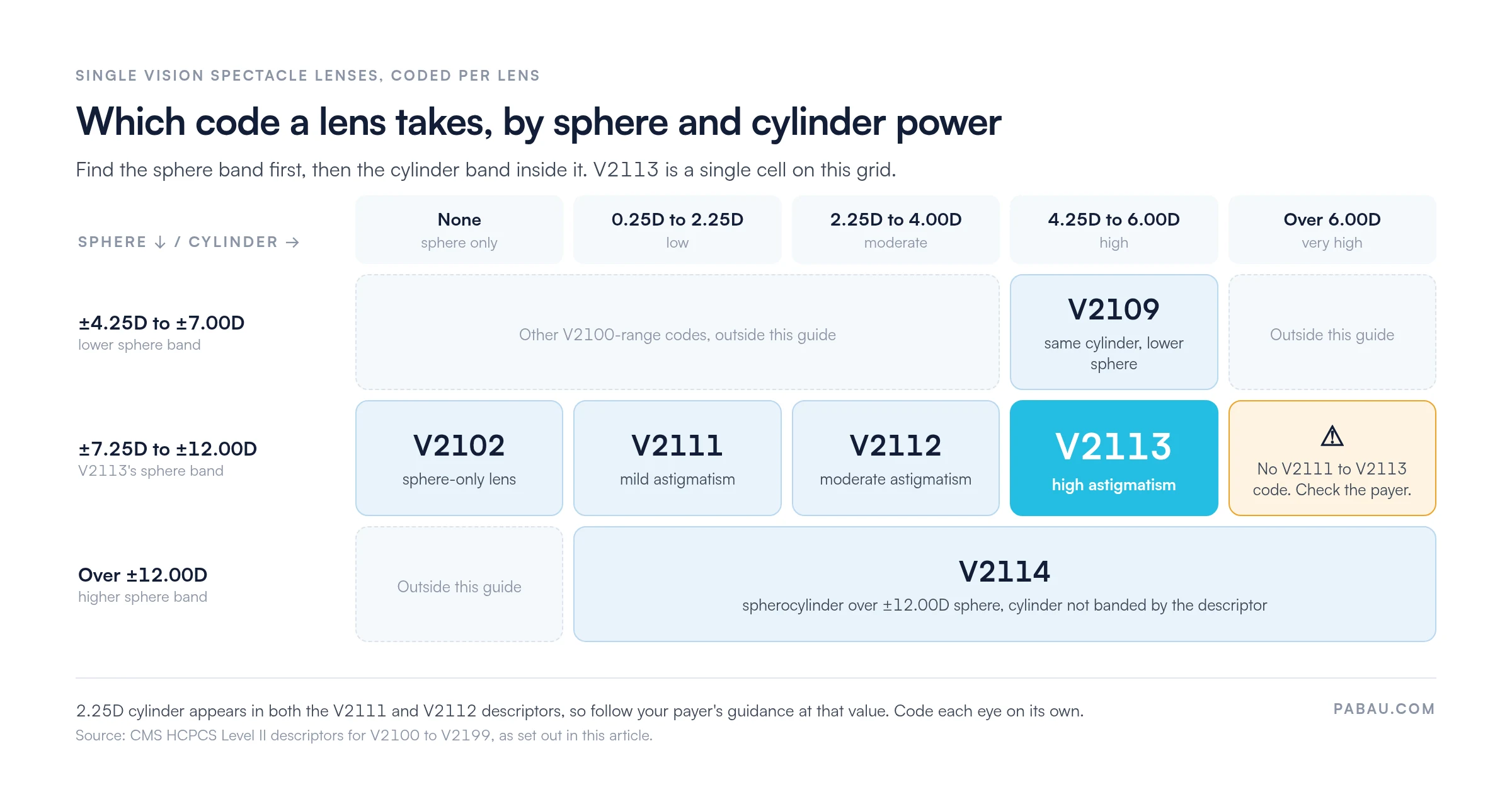
Two edge cases need care. The published V2111 and V2112 descriptors both list 2.25D cylinder, so follow your payer’s guidance at that value. No V2111–V2113 code covers cylinder above 6.00D, so check how your payer wants that lens reported.
V2199 is the not otherwise classified (NOC) code for single vision lenses. It applies only when no specific code in the V2100 range describes the dispensed lens. Defaulting to V2199 when V2113 fits is a coding error. NOC claims also need extra documentation and often pay less. Use V2113 whenever the sphere and cylinder both fall inside its bands.
Before submitting a V2100-series claim, circle both the sphere and the cylinder power for each eye on the dispensing prescription. V2111, V2112, and V2113 share the same sphere band, so the cylinder value alone decides between them.
Medicare does not cover routine vision care under Part B. V2113 is reimbursable under Medicare only when the patient needs corrective lenses after cataract surgery. That means aphakia (no natural lens) or pseudophakia (an implanted intraocular lens that does not fully correct vision). CMS policy confirms this coverage exception under Medicare Part B for post-cataract patients needing one pair of spectacle lenses or contact lenses.
Misapplying the post-cataract exception to routine prescription eyeglasses is a Medicare compliance risk. Document the operative report or discharge summary confirming cataract extraction and the resulting visual diagnosis before billing V2113 to Medicare. Medicare allowable amounts for V-code lenses appear in the CMS DMEPOS fee schedule, which lists rates by state.
Medicaid is the primary payer for V2113 claims in most optometry practices. Medicare restricts coverage to post-cataract cases. Medicaid vision benefits in many states go further and cover routine spectacle lenses, V2113 included, for eligible beneficiaries. Coverage scope, frequency limitations, and reimbursement rates vary significantly by state.
Never rely on a fee schedule rate from a prior year. Medicaid programs update their fee schedules annually and sometimes mid-year. Check the current state provider manual or fee schedule portal directly before estimating patient cost-sharing or submitting claims.
Practices billing several state programs need payer-rule claims management, so each plan’s frequency limits and modifier rules are checked before submission.

A clean V2113 claim starts with complete documentation before the optical lab order is placed. Payers audit these records on post-payment review, and missing documentation is a frequent denial trigger.
Conducting insurance eligibility verification before the patient picks up their glasses prevents a common scenario. The patient’s Medicaid coverage lapses during fabrication, and the payer denies the claim for non-covered dates of service. Verify on the date of dispense, not only at the exam appointment.
Prior authorization (PA) requirements for V2113 depend entirely on the payer. Medicare does not require PA for post-cataract spectacle claims but does require the medical necessity documentation described above. State Medicaid programs vary. Some require PA for all eyeglass claims above a defined frequency. Others require it only for non-standard prescriptions, or when the patient already received glasses within the coverage cycle.
The diagnosis on the claim has to explain why the patient needs a high-cylinder lens. Payers look for a refractive error code. Medicare also looks for the post-cataract condition that makes the lens covered.
Code to the highest specificity the record supports, including laterality. Check each payer’s policy for the diagnosis codes it accepts with vision supply codes.
Billing V2113 follows the standard vision supply workflow. Steps 3 to 5 carry the code-specific checks that prevent most wrong-band and modifier denials.
Modifiers are required on almost all V2113 claims. Missing a mandatory modifier is a clean-claim failure that payers reject before adjudication. The table below covers the modifiers most commonly applied to single vision lens claims.
Check the specific payer’s modifier requirements. Some Medicaid programs accept bilateral billing on a single line with a quantity of 2 rather than separate RT and LT lines. Submitting RT/LT when the plan expects a single line with quantity 2 causes a duplicate-claim edit.
Denial patterns on V2113 are predictable. When the same CARC code repeats across batches, the cause usually sits in one workflow step, such as coding the cylinder from memory. The table below maps the most common denial reasons to a resolution for each.
Practices that track denial patterns using structured denial management workflows fix V-code claim issues at the root cause. That beats chasing individual claims on appeal. Reviewing remittance advice by CARC code rather than by dollar amount surfaces the patterns faster.
Appeals on V2113 denials succeed when the supporting documentation directly contradicts the denial reason. Generic appeal letters without supporting documentation rarely reverse a technical denial.
Timelines, forms, and escalation paths vary by payer, so check the current payer contract and provider manual for binding requirements. Practices managing high claim volumes benefit from the clean claim practices that prevent denials from reaching the appeals stage in the first place.
Review the CMS HCPCS quarterly updates and the annual file that takes effect each January 1. Check the V2100-series descriptors for changes and update your code mapping before the new year’s first claims go out.
Many optical practices still code lens claims from a printed prescription and a code chart. That works until a 4.25D cylinder gets keyed as V2112, or a Medicaid eligibility lapse slips past the front desk between exam and dispense.
In Pabau, the practice management platform we build, the prescription, the dispensing record, and the claim sit in one patient file. Its claims management software helps your team attach the right V-code and verify eligibility on the date of dispense. It also flags a missing RT, LT, or NU modifier before the claim goes out.
The result is fewer wrong-band denials and less time spent rebilling corrected lens lines.

Pabau helps optometry and ophthalmology practices track HCPCS vision codes and verify eligibility before dispense. Submit clean claims with the right modifiers attached.

V2113 is a narrow code. It fits only a single vision lens that pairs ±7.25D to ±12.00D sphere with 4.25D to 6.00D cylinder. Every other combination belongs to a neighboring code.
Practices that read both powers before coding, and check eligibility on the day of dispense, avoid the denials that cost the most rework. To see how Pabau supports optical billing end to end, book a demo.

Want to understand how billing compliance affects your optical practice? Medical billing compliance covers the documentation and coding standards that reduce audit exposure for vision supply claims.
New to the full claim cycle? What is medical billing walks through the end-to-end process from code assignment through payment posting.
Want fewer eligibility-related V-code denials? Revenue cycle management explains how practices structure billing so payer rules are checked before dispense.
HCPCS Code V2113 covers one single vision spherocylinder spectacle lens. The sphere power must fall between ±7.25D and ±12.00D, and the cylinder power between 4.25D and 6.00D. It is billed per lens, so each eye is a separate unit. Sphere-only lenses (V2100–V2102), bifocals (V2200–V2299), and trifocals (V2300–V2399) use other codes.
V2111, V2112, and V2113 share the same sphere band of ±7.25D to ±12.00D and differ only by cylinder. V2111 covers 0.25D to 2.25D, V2112 covers 2.25D to 4.00D, and V2113 covers 4.25D to 6.00D. V2114 covers spherocylinder lenses with sphere over ±12.00D. Read both powers on the prescription before choosing among them.
Yes, but only in limited circumstances. Medicare Part B covers V2113 for post-cataract patients who have undergone cataract extraction and require corrective spectacle lenses due to aphakia or pseudophakia. Medicare does not cover V2113 for routine vision correction. The claim must include a diagnosis code documenting the post-cataract condition, and the optical provider must be enrolled as a Medicare supplier.
You need a signed prescription from a licensed optometrist or ophthalmologist showing the sphere and cylinder powers. You also need a dispensing order confirming the lens matches it, plus proof of eligibility on the date of dispense. Medicare claims additionally require an operative note or discharge summary documenting cataract extraction. Some state Medicaid programs also require a plan-specific optical dispensing form, listed in the current provider manual.
The most common reason is a sphere or cylinder power outside V2113’s bands. Others are a missing RT, LT, or NU modifier, or no prior authorization where one was required. Billing Medicare for routine vision rather than a qualifying post-cataract case is another. Frequency denials occur when Medicaid has already covered a pair within the current cycle. Review the CARC code on the remittance before appealing.
Yes, in many state Medicaid programs the lens code (V2113) is billed separately from the fitting or dispensing fee. Some programs pay fitting through a CPT code such as 92340, while others use a state-specific code. Check the current state provider manual for which fee codes are payable alongside V-series lens codes.
Reimbursement rates for V2113 vary by state and are updated periodically. States such as Texas (TMHP), Virginia (DMAS), and Louisiana cover V-series lens codes but publish their own fee schedules. Verify rates from the current state fee schedule or provider manual, never from a prior year. Medicare rates come from the CMS DMEPOS fee schedule, but state Medicaid rates must come from the state source.
The authoritative source is the CMS HCPCS Level II code set, published by the Centers for Medicare and Medicaid Services. CMS releases an annual file effective January 1, with quarterly updates during the year. Use the file in effect on the date of service, not the current file, for prior-year claims.