HCPCS Code V2208: Spherocylinder bifocal lens billing guide
HCPCS Code V2208: Definition and code attributes HCPCS Code V2208 is a Level II ...

Last Updated: Oct 7, 2026
V2309 is the HCPCS Level II code for one spherocylinder trifocal spectacle lens with a ±4.25D to ±7.00D sphere and a 4.25D to 6.00D cylinder. It is an eyeglass lens code, billed per lens, and the lens must meet both ranges.
A lower cylinder at the same sphere belongs to V2307 or V2308, and a cylinder over 6.00D belongs to V2310. Contact lenses bill under the V2500 series instead. Most V2309 claims reach Medicare Part B under the post-cataract spectacle benefit, which allows one pair per surgery.
Let Pabau's smart automation suggest the right codes, reduce claim denials, and keep your practice compliant—effortlessly.
Automate repetitive tasks and focus on what matters most—your patients.
Reduce coding errors and ensure compliance with the latest regulations.
Clean claims, fewer denials, and faster reimbursements.
Powerful insights and reporting to help your practice thrive.
HIPAA compliant SOC 2 certified GDPR-compliant Trusted by 4,000+ clinics worldwide

V2309 covers one spherocylinder trifocal spectacle lens with a sphere of ±4.25 to ±7.00D and a cylinder of 4.25 to 6.00D. Both ranges must be met.
It is an eyeglass lens code. Contact lenses bill under the V2500 series, so V2309 never describes a toric contact lens.
A lower cylinder at the same sphere moves the lens to V2307 or V2308. A cylinder over 6.00D moves it to V2310.
Medicare Part B covers one pair of post-cataract spectacles per surgery. Trifocals prescribed for routine refractive correction are non-covered.
Bill each eye as a separate line item with an RT or LT modifier. A single line with 2 units is a common denial trigger.
HCPCS code V2309 describes a spherocylinder, trifocal spectacle lens, billed per lens. The official descriptor reads: Spherocylinder, trifocal, plus or minus 4.25 to plus or minus 7.00d sphere, 4.25 to 6.00d cylinder, per lens.
The code sits in the Lenses, Trifocal section (V2300-V2399) of the HCPCS Level II code set. CMS maintains HCPCS Level II for the supplies and services that CPT does not cover.
The descriptor sets two conditions, and the lens has to meet both. The sphere must fall between ±4.25D and ±7.00D. The cylinder must fall between 4.25D and 6.00D. That cylinder band is what makes V2309 the high-astigmatism code in its sphere row.
“Spherocylinder” means the lens corrects spherical refractive error and astigmatism at the same time. “Trifocal” means the lens has three focal zones for distance, intermediate, and near vision. Both terms describe a lens mounted in a frame, never a lens worn on the eye.
V2309 covers the physical spectacle lens for a spherocylinder trifocal inside both of its power ranges. It does not cover the frame, the fitting service, or the dispensing fee. Those are billed under their own HCPCS or professional service codes.
Earlier coding resources sometimes described V2309 as a contact lens code. It never has been. If the patient left with contact lenses, V2309 is the wrong code, whatever the prescription powers. A progressive lens still bills under its trifocal or bifocal base code, such as V2309. V2781 is added on a separate line as the enhancement, never in place of that base code.
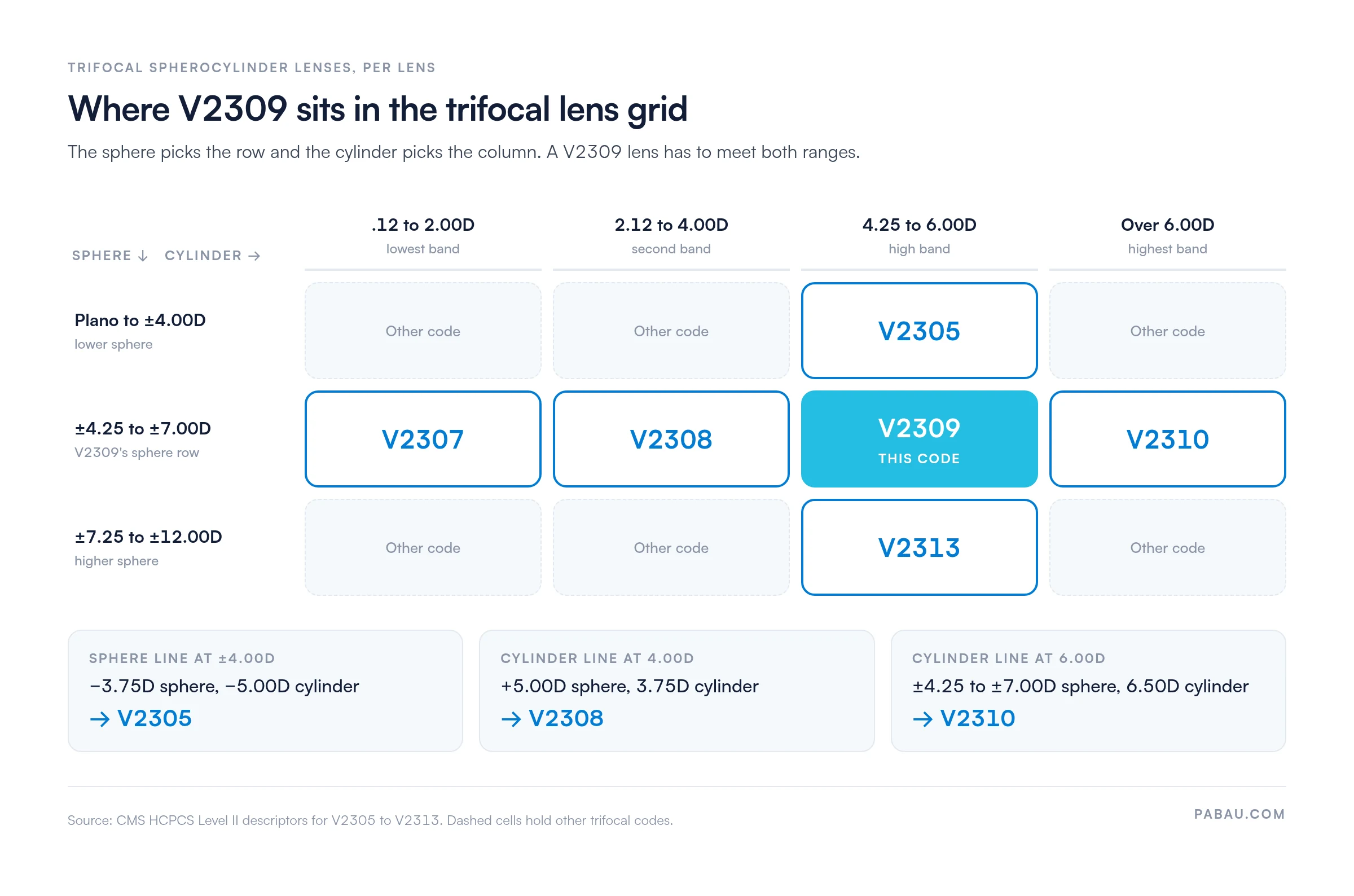
Trifocal spherocylinder codes are built on a grid. The sphere range picks the row, and the cylinder range picks the code within it. V2307, V2308, V2309, and V2310 share a sphere of ±4.25D to ±7.00D.
Within that row, V2309 holds the 4.25D to 6.00D cylinder band. V2307 and V2308 take the lower cylinders, and V2310 takes any cylinder over 6.00D.
Three boundaries cause most V2309 errors. The first is the sphere line at ±4.00D. A lens with a -3.75D sphere and a -5.00D cylinder is V2305, not V2309.
The second is the cylinder line at 4.00D. A lens with a +5.00D sphere and a 3.75D cylinder is V2308. The third is the line at 6.00D, where a 6.50D cylinder moves the lens to V2310. The grid below plots all three lines around V2309.
Pull the lens lab invoice alongside the post-cataract prescription before you assign V2309. The invoice confirms the lens style and both powers as made. Auditors check it against the prescription first, so resolve any mismatch before the claim goes out.
Medicare Part B covers one pair of eyeglasses or one set of contact lenses after each cataract surgery with an implanted intraocular lens (IOL). This post-cataract benefit, set out in the CMS Medicare Benefit Policy Manual, is the main pathway for V2309 reimbursement.
Outside that context, Medicare does not cover spectacle lenses for routine refractive correction. Billing V2309 to Medicare for a patient with no cataract surgery on record is a compliance risk. Verify eligibility and surgical history first.
Pabau, the practice management platform we build, handles medical claims management for ophthalmic practices. It tracks each post-cataract dispense against the original surgery date, so coverage is checked before the lens is ordered.
Medicare pays V2309 through the DMEPOS fee schedule, not the Physician Fee Schedule. DMEPOS stands for Durable Medical Equipment, Prosthetics, Orthotics and Supplies. Rates vary by state, so there is no single national allowable for the code.
Pull the current-year rate for your state from the CMS DMEPOS fee schedule before you quote coverage amounts to patients.
State Medicaid programs set their own vision appliance rates and coverage rules. Never apply a Medicare rate to a Medicaid claim without checking the state schedule first.
Four modifiers apply to V2309 claims. RT and LT must sit on separate line items when you bill both eyes. A single V2309 line with 2 units will deny, because Medicare processes lens codes per eye.
Every V2309 claim needs a supporting ICD-10-CM diagnosis code. Most covered claims follow cataract surgery, so the status codes come first. Refractive error codes then describe what the lens corrects.
Select the most specific lateralized code available. A right-eye diagnosis on a line billed with LT is a common cause of automated denials. Verify each pairing against your DME MAC’s current policy before you submit.
Billing V2309 correctly takes five steps, each tied to a documentation element. Skipping one raises the denial risk under Medicare’s DMEPOS claim edits.
Only CMS-enrolled DMEPOS suppliers may bill V-codes to Medicare, so confirm enrollment before the first claim. If no fixed descriptor fits the dispensed lens, bill V2399 by report instead.
A V2309 claim needs documentation that proves three facts. The patient had cataract surgery, the dispensed lens meets both V2309 power ranges, and the patient received the lens. Missing any one of these is enough for a post-payment audit finding.
A cylinder of 4.25D or more is high, so keep the refraction that produced it on file. The optical superbill should capture laterality, sphere, cylinder, lens style, and surgery date as standard fields.
Most V2309 denials trace back to a short list of causes. A sphere-and-cylinder check before submission prevents the most frequent one.
Build a pre-claim checklist for every V2309 line. Confirm the lens is a spectacle lens, not a contact lens. Confirm the sphere is ±4.25 to ±7.00D and the cylinder is 4.25 to 6.00D. Then check for IOL documentation, separate RT and LT lines, and no prior claim for the same surgery.
In many optical practices the V2309 claim is assembled by hand. Someone reads the lab invoice, picks the code, and adds the laterality modifier. Then they go looking for the operative report when a payer queries it.
Pabau holds the dispense record, the claim, and the supporting documents in one patient record. Modifier rules sit on the service itself, so a V2309 line carries its RT or LT modifier before anyone submits it.
Billing staff can see which lens lines still lack a modifier or a diagnosis, and remittances post back against the line they paid. When a payer asks for the prescription, the surgery record, or the ABN, it sits in the same record as the claim.

Pabau helps optical and ophthalmic practices document dispensing events, manage claim lines with the right modifiers, and track post-cataract spectacle benefits across patients.

V2309 is a spectacle lens code, and the first check on every claim is that the patient left with glasses. After that, two measurements decide the code. The sphere has to sit between ±4.25D and ±7.00D, and the cylinder between 4.25D and 6.00D.
Coverage then rests on the post-cataract benefit, which needs the surgery documentation on file before the claim is built. Bill each eye on its own line, and issue an ABN for the patients Medicare will not cover.
Build those checks into the claim rather than a reviewer’s memory, and V2309 denials stop recurring. Book a demo to see how Pabau handles optical billing from the dispense record to remittance.

Need a framework for handling Medicare billing denials? Denial management in healthcare walks through a systematic approach to tracking, categorizing, and appealing claim denials.
Seeing a denial code on a V2309 remittance? Denial codes in medical billing explains what each common code means and which correction it calls for.
Want every lens claim accepted on first submission? What is a clean claim sets out the fields and checks a claim needs before it reaches the payer.
Want to understand how HCPCS claims flow through a clearinghouse? Medical claims clearinghouse explains how electronic claims are validated, routed, and confirmed before reaching the payer.
Looking to reduce billing errors at the source? Medical billing fundamentals covers how accurate documentation at the point of service prevents downstream coding errors.
HCPCS code V2309 covers one spherocylinder trifocal spectacle lens. The sphere must be plus or minus 4.25 to 7.00 diopters, and the cylinder 4.25 to 6.00 diopters. It covers the lens only. The frame, fitting, and dispensing fee are billed separately.
No. V2309 is a trifocal eyeglass lens code in the V2300-V2399 family. Contact lenses bill under V2500-V2599, and a hydrophilic toric contact lens uses V2521. Billing V2309 for contact lenses is a coding error.
All four share a sphere of ±4.25 to ±7.00D, and the cylinder decides the code. V2307 covers .12 to 2.00D and V2308 covers 2.12 to 4.00D. V2309 covers 4.25 to 6.00D, and V2310 covers any cylinder over 6.00D.
Medicare Part B covers V2309 after cataract surgery, limited to one pair of eyeglasses or one set of contact lenses per surgery. The lens must correct post-surgical refractive error. The operative report must be on file.
Yes, but each eye needs its own claim line. Bill V2309-RT and V2309-LT as two line items, each with a unit count of 1. A single V2309 line with 2 units will deny.
You need the cataract operative report and the post-cataract spectacle prescription showing sphere and cylinder powers. You also need the dispensing record, plus an ABN with modifier -GA if coverage is uncertain. Many MACs also ask for the lens lab invoice.
Medicare pays V2309 through the DMEPOS fee schedule, which varies by state. CMS publishes the annual update each December and revises rates quarterly. Check the CMS DMEPOS fee schedule for your state’s current allowable.
Common pairings are Z96.1 (presence of intraocular lens) and Z98.41-Z98.42 (cataract extraction status by eye). Refractive codes then describe the correction, such as H52.221-H52.223 for regular astigmatism. Match the diagnosis laterality to the RT or LT modifier.