CCSD code H4430: Examination of rectum under anaesthetic
CCSD code H4430 pays for the examination alone CCSD code H4430 is the UK private...

Last Updated: Oct 20, 2026
90750 is the CPT code for zoster (herpes zoster) vaccine (HZV), recombinant, sub-unit, adjuvanted, for intramuscular use. That product is Shingrix, the two-dose shingles vaccine for adults 50 and older and immunocompromised adults 19 and older. The code covers the vaccine only, so each dose also needs its administration billed.
The payer decides where the claim goes. For Medicare patients, Part D pays for both the vaccine and its administration, and Part B pays for neither. Commercial plans take 90750 with 90471 on one claim. This guide covers both routes, the codes that travel with them, and the denials to prevent.
Let Pabau's smart automation suggest the right codes, reduce claim denials, and keep your practice compliant—effortlessly.
Automate repetitive tasks and focus on what matters most—your patients.
Reduce coding errors and ensure compliance with the latest regulations.
Clean claims, fewer denials, and faster reimbursements.
Powerful insights and reporting to help your practice thrive.
HIPAA compliant SOC 2 certified GDPR-compliant Trusted by 4,000+ clinics worldwide

CPT code 90750 covers the Shingrix vaccine product only, not the live zoster vaccine that CPT 90736 describes.
For Medicare patients, Part D pays for both the vaccine and its administration, and Part B pays for neither.
On commercial and other non-Medicare claims, bill 90750 with 90471 or 90472, Z23 and the NDC from the vial.
Bill 90750 once per dose across the two-dose series, given 2 to 6 months apart, with no dose 2 modifier.
Pabau’s claims management software pre-fills the claim from the patient record and checks required fields before it goes to Claim.MD.
CPT code 90750 reports zoster vaccine recombinant, sub-unit, adjuvanted, given by intramuscular injection. That product is Shingrix, made by GlaxoSmithKline (GSK). The AMA CPT code set places it in the Vaccines, Toxoids subsection (90476-90759) of the Medicine section. The code covers the vaccine itself, not the act of giving it.
Administration is billed separately with 90471 or 90472. A 90750 line with no administration code leaves the injection itself unpaid. For Medicare patients, both pieces go to Part D instead, as the Medicare section below explains.
CPT 90736 describes Zostavax, Merck’s live-attenuated zoster vaccine. Merck stopped selling Zostavax in the US in November 2020. That leaves Shingrix, billed with 90750, as the only shingles vaccine available in the United States.
CPT 90736 is still an active code. Even so, payers will typically deny it on a current claim, since the vaccine is no longer supplied. Use 90750 for every Shingrix dose.
Practices that stock Shingrix use a buy-and-bill model. You buy the vaccine from a distributor, give it, then bill the payer. A clean claim for a commercial Shingrix visit carries each of these elements.
CPT code 90750 is billed once per dose. Each shot in the two-dose series gets its own claim with its own 90750 line. There’s no dose 2 modifier and no separate code for the second injection.
CDC guidance puts dose 2 two to six months after dose 1. Some payers deny dose 2 as a duplicate when the interval isn’t documented. So chart the dose 1 date, the lot number and the planned dose 2 window. Both claims carry Z23 as the primary diagnosis.
Medicare treats Shingrix as a Part D drug. Part D covers both the vaccine and its administration, and Part B covers neither. That puts it outside the Part B rules behind most Medicare billing in a physician office.
A 90750 or 90471 claim sent to Part B for Shingrix will deny. The patient’s Part D plan won’t pick it up on its own, either. Insurance eligibility verification before the visit tells you which Part D plan the patient has.
The route depends on who’s paying, and the diagram below maps all three cases side by side.
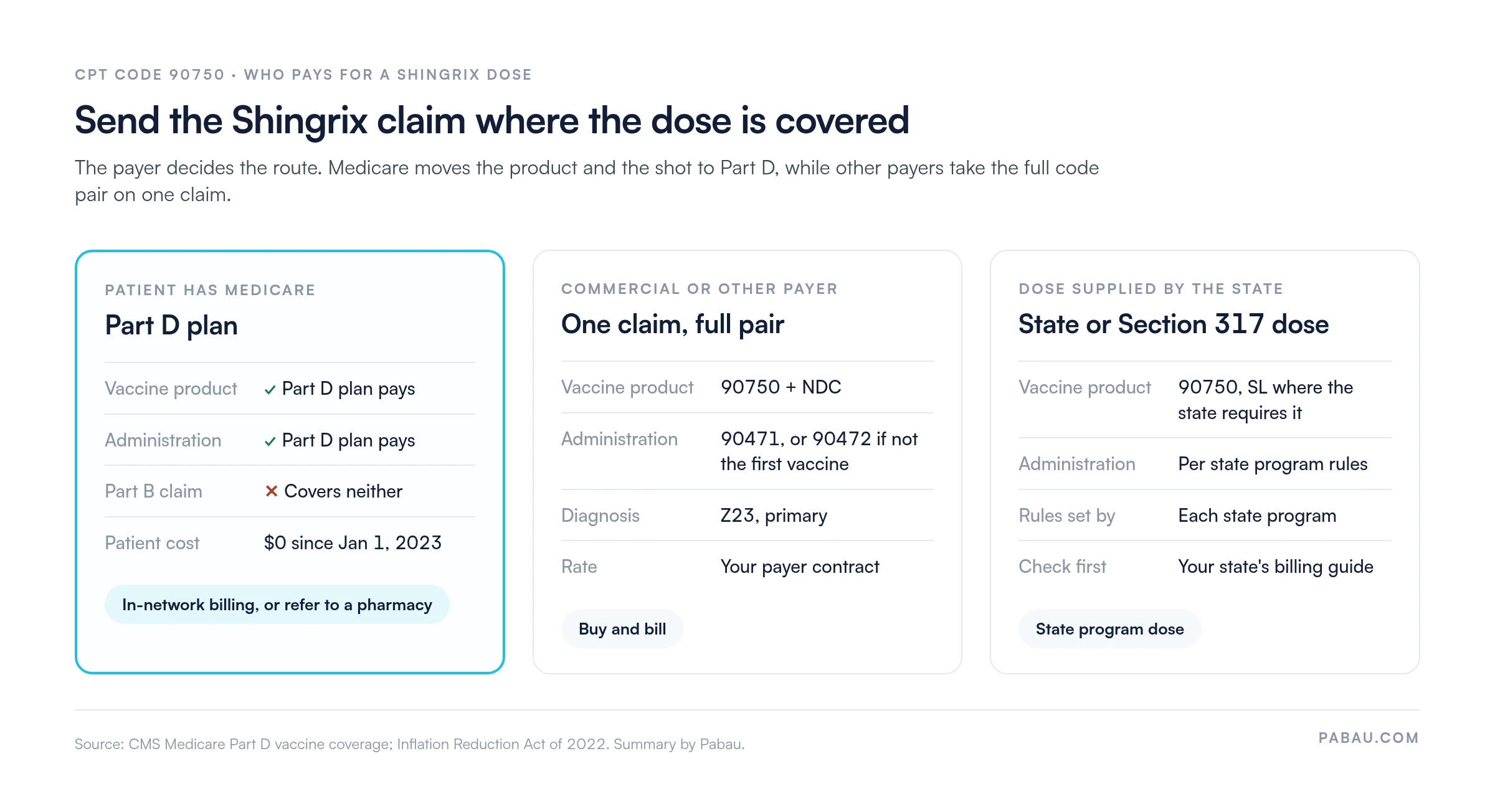
You have two workable routes for a Medicare patient:
Either way, the office sends no Part B claim. In-office billing keeps the product margin, but only if the front desk records the Part D plan at intake.
Most 90750 claims need no modifier at all. SL and 59 are the two you may meet, each in a specific payer context.
SL rules come from each state’s program, not a national standard. Check your state’s Medicaid or immunization program billing guide before you append it.
Every CPT code 90750 claim should list Z23 as the primary diagnosis. Z23 reports an encounter for immunization, and most payers deny a vaccine claim without it. The CMS ICD-10-CM coding resources carry the current code set.
Keep Z23 in the lead. Add a secondary code only when the chart documents it, since speculative codes raise audit risk without raising payment.
Medicare pays Shingrix through Part D, so the Physician Fee Schedule sets no Medicare rate for it. Each Part D plan sets its own rate with pharmacies and in-network billers. The same plan also pays the administration.
Commercial payers pay 90750 and 90471 at contract rates. If you benchmark a contract, the CMS Physician Fee Schedule lookup lists the 90471 allowable by locality.
Commercial rates for the vaccine product vary widely and aren’t published. Confirm them with each payer or your contracting team before you project Shingrix revenue.
Each denial below maps to a step in the claim walkthrough above. Recognizing the Claim Adjustment Reason Code (CARC) on the remittance narrows the fix quickly.
Denial management workflows for vaccine codes work best with one owner. That person reviews ERA remittances weekly and categorizes denials by reason code. Five Part B denials in one week point to intake, where the front desk isn’t recording Part D plans.
Run a 90-day look-back on all 90750 claims before implementing a new vaccine billing workflow. Filter for denials where Medicare Part B is the payer and the denial reason code indicates non-covered service. Those are the Part D routing errors. Quantify the write-off total first so you have a baseline to measure improvement against after correcting payer identification at intake.
A Shingrix visit record should hold each item below to stand up to a payer audit.
Good medical billing compliance builds a vaccine checklist into the nursing workflow. Then the lot number and NDC land in the chart before the patient leaves the room. Rebuilding them later from purchase records is unreliable and raises audit exposure.
Run through these seven checks before a Shingrix claim leaves the practice.
Each denial in the table above starts before the claim is built. The NDC never reached the chart, Z23 was left off, or nobody recorded the Part D plan.
Pabau, the practice management platform we build, includes claims software for practices that pre-fills each claim from the patient record. The CPT code attached to the service lands on the charge line. Built-in CPT and ICD-10 lookup libraries let your team confirm 90750 and Z23 without leaving the record.
Pabau also checks that required fields, such as membership numbers, are complete before the claim can be sent. Claims then go out through Claim.MD, with real-time eligibility checks and ERA remittances posted back to the claim. Recall reminders set for the 2 to 6 month window help bring patients back for dose 2.
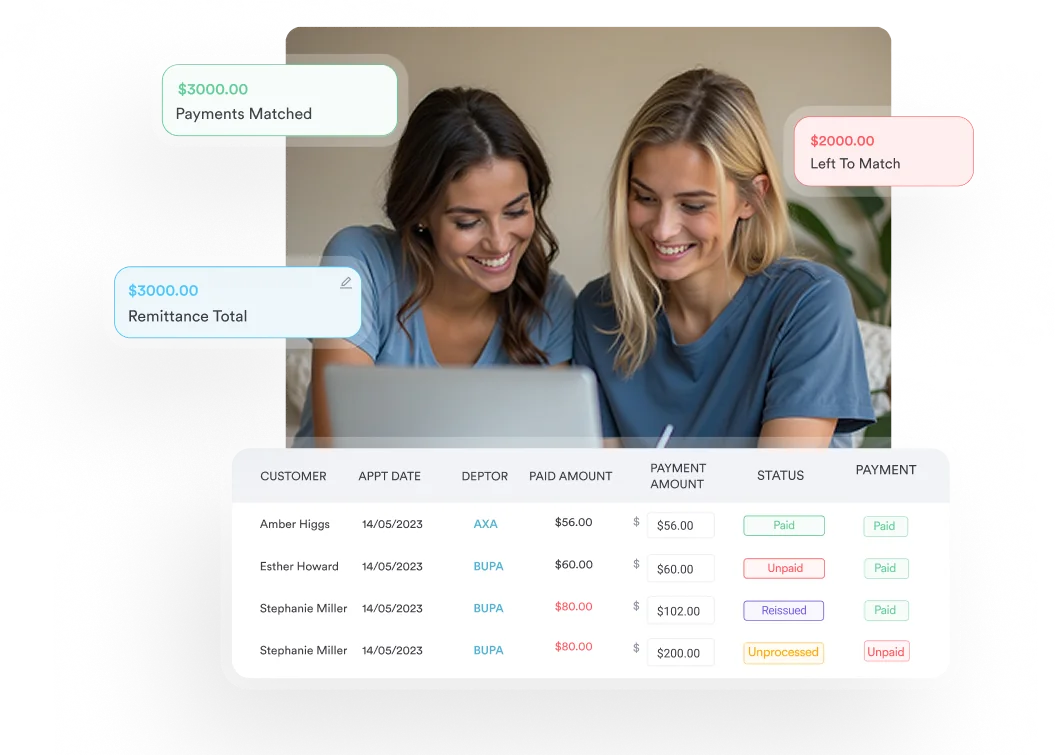

Pabau pre-fills claims from the patient record and checks required fields before sending. Claims go out through Claim.MD with eligibility checks and ERA posting.

Get the payer route right and the rest of a 90750 claim follows. On Medicare, both the product and the administration go to the Part D plan, and Part B gets no claim. On commercial and other non-Medicare claims, pair 90750 with 90471, Z23 and the NDC from the vial.
The trade-off worth weighing is in-office billing for Medicare patients. It keeps the product margin, but only if intake reliably captures the Part D plan. If yours can’t yet, referring those patients to a network pharmacy costs less than the write-offs.
Pabau pre-fills claims from the record, checks required fields, and submits through Claim.MD with ERA tracking. Book a demo to see how it handles Shingrix claims in your practice.

Need to understand how clearinghouse claim submission works? Medical claims clearinghouse guide walks through how 837 files, eligibility checks, and ERA remittances connect your practice to payers.
Want to reduce claim errors before submission? Claim.MD clearinghouse overview explains how eligibility checks and claim validation catch billing issues at the front end.
Looking for a structured approach to billing denials? Denial codes in medical billing covers the CARC codes behind most vaccine claim rejections and how to action each one.
Want a cleaner handoff from visit to claim? Superbill guide explains what a superbill holds and how it feeds the insurance claim.
New to the revenue cycle? What is medical billing shows how a claim moves from the visit to payment.
Don’t restart the series. CDC advises giving dose 2 as soon as possible, and you still bill it with 90750 and Z23. Chart both dose dates so a reviewing payer can see the interval.
Yes. CDC recommends Shingrix for adults who previously received Zostavax, with at least eight weeks between them. The earlier Zostavax dose does not change how you code Shingrix.
Yes. Shingrix can be given with other adult vaccines at a different injection site. On non-Medicare claims, bill 90471 for the first vaccine and 90472 for each additional one.
Yes. CDC recommends Shingrix for adults who have had shingles, once the rash has cleared. Z23 stays the primary diagnosis.
Pharmacies bill the Part D plan through the pharmacy claims system, using the NDC rather than CPT code 90750. So when you refer a Medicare patient to a pharmacy, the office has nothing to bill.