

HCPCS Code L0472: Hyperextension TLSO billing guide
HCPCS code L0472: Official descriptor and device definition HCPCS code L0472 des...

Last Updated: Nov 5, 2026
88344 is the CPT code for immunohistochemistry or immunocytochemistry, per specimen; each multiplex antibody stain procedure.
Labs bill 88344 when two or more antibodies are applied to one slide and each is detected separately. A cocktail sharing one detection system is reported as 88342 instead, and mixing the two up is a common cause of denial.
Let Pabau's smart automation suggest the right codes, reduce claim denials, and keep your practice compliant—effortlessly.
Automate repetitive tasks and focus on what matters most—your patients.
Reduce coding errors and ensure compliance with the latest regulations.
Clean claims, fewer denials, and faster reimbursements.
Powerful insights and reporting to help your practice thrive.
HIPAA compliant SOC 2 certified GDPR-compliant Trusted by 4,000+ clinics worldwide

CPT code 88344 covers each multiplex antibody stain procedure, per specimen, in immunohistochemistry (IHC) and immunocytochemistry (ICC).
It applies when two or more antibodies sit on the same slide and each one is detected separately, usually with its own chromogen.
A cocktail of antibodies sharing one detection system is reported as 88342, and quantified markers such as ER, PR and HER2 take 88360 or 88361.
Documentation must name every antibody, state the multiplex detection method, give the clinical indication, and carry a pathologist’s interpretation.
Medicare pays 88344 under the MPFS, with Palmetto GBA LCD L35922 governing coverage in its Southeast jurisdiction, while BCBS NC requires notification or prior authorization.
CPT code 88344 is “Immunohistochemistry or immunocytochemistry, per specimen; each multiplex antibody stain procedure,” as defined by the American Medical Association’s CPT code set. Each unit of service is one multiplex stain procedure on one pathology specimen.
Four conditions decide whether a stain qualifies:
Common clinical contexts include lymphoma workups, such as a dual CD20/CD3 stain, and lung carcinoma typing with p40 and TTF-1 on one slide. Breast ER, PR, HER2 and Ki-67 profiling is usually quantitative IHC, reported with 88360 or 88361 instead. CPT revised the IHC code family in 2015, giving 88342 and 88341 their current single-antibody definitions.
CPT 88344 covers one multiplex stain: Two or more antibodies applied to the same slide of one specimen, with each antibody read separately. “Multiplex” is the operative word. Antibodies mixed into a cocktail with one shared detection system give the pathologist a single result. That stain is reported as 88342.
Several related procedures fall outside 88344, and each has its own code.
The three most confused IHC codes share the same per-specimen billing logic but differ by antibody count and detection method. Choose based on exactly what was run on each specimen.
A common coding error is billing 88342 and 88341 units to describe a multiplex stain. When two or more antibodies on one slide are each read separately, report 88344, one unit per multiplex stain. A cocktail sharing one detection system can’t be read antibody by antibody, so it’s reported as 88342. Single-antibody stains on separate slides map to 88342 plus 88341 add-ons.
Run each stain through the four questions below before you pick a code.
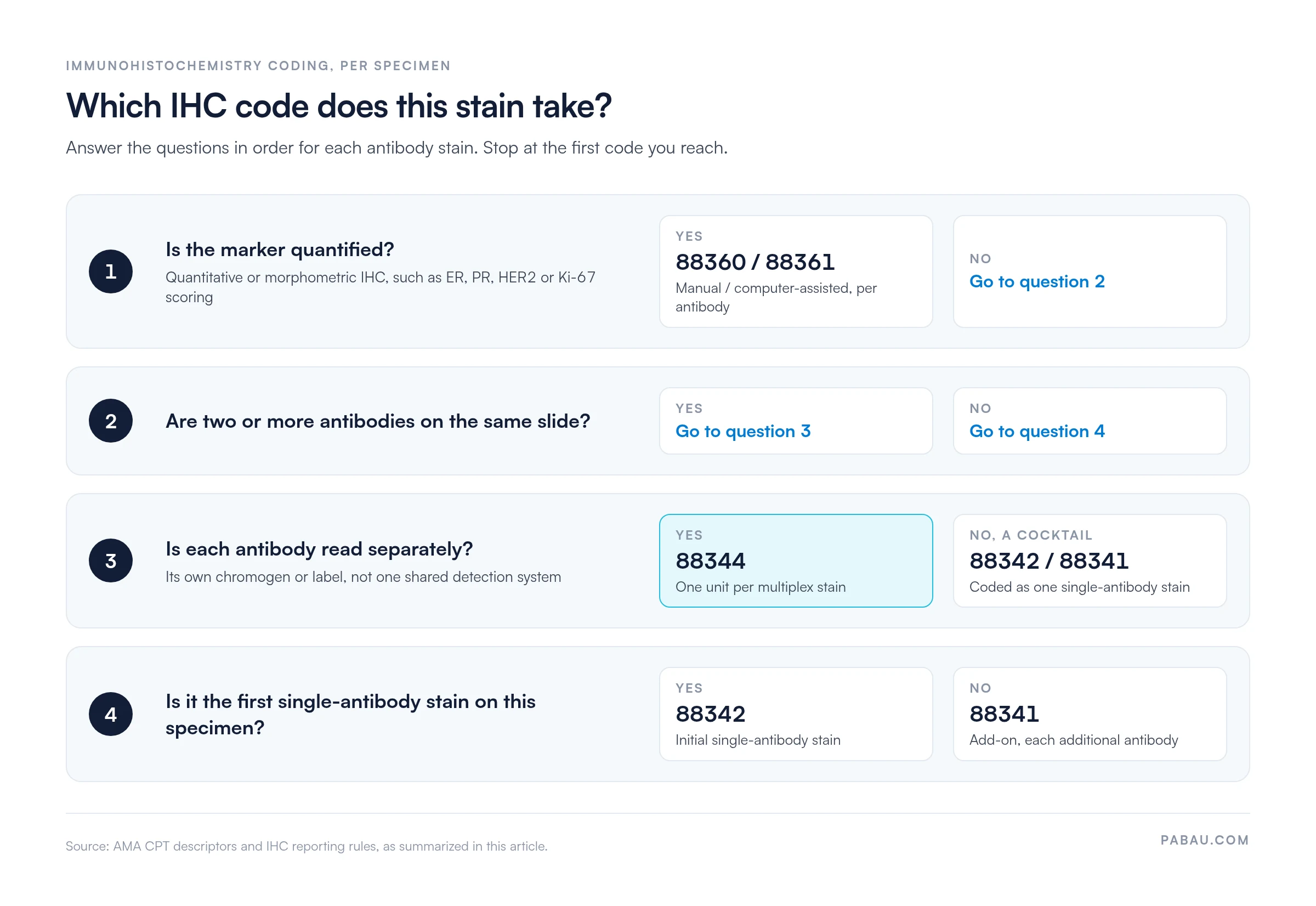
Understanding the laboratory workflow helps coders check that what was billed matches what was performed. A pathologist’s interpretation of the results is required for billing in all cases.
Ask the lab two questions before coding. Were the antibodies on the same slide, and was each one detected with its own chromogen? Two yeses mean 88344. Separate slides mean 88342 plus 88341 add-ons, and a shared chromogen means a cocktail reported as 88342.
A claim for CPT code 88344 rises or falls on the pathology report. Payers, including CMS, expect the report to show that each antibody was applied to one slide and read separately. When building a clean claim for 88344, confirm each of these documentation elements is present before submission.
Build these six elements into the LIS report template as required prompts. Each one is then captured when the pathologist signs out the case, not chased after a denial.
Medicare pays for CPT code 88344 under the CMS Medicare Physician Fee Schedule (MPFS). Payment rates are updated annually. Check the current rate in the MPFS Look-Up Tool, using the non-facility rate for independent laboratory settings.
Coverage in the Southeast US Medicare jurisdiction is governed by Palmetto GBA Local Coverage Determination L35922. It covers special histochemical and immunohistochemical stains, including 88344. The LCD lists the ICD-10-CM diagnosis codes that establish medical necessity. It also limits the number of IHC stains billable per specimen in certain clinical contexts.
Prior authorization for CPT code 88344 is not universal, but several major payers require it. A missing prior auth leads to a non-covered denial that clinical grounds alone rarely overturn. Confirm requirements before the specimen is accessioned, not after the report is signed.
BCBS NC requires notification or prior authorization for IHC procedures under policy AHS P2018. Labs can check current requirements in the Blue Cross NC immunohistochemistry policy. Other regional BCBS plans keep similar policies under their own policy numbers. Approval from one BCBS affiliate doesn’t carry over to another.
Medicare generally does not require prior authorization for 88344. Medical necessity must still be established through ICD-10-CM diagnosis coding that maps to the applicable LCD. For commercial payers, build a payer-by-payer authorization matrix for your most frequently billed IHC codes, and update it whenever a payer issues a policy notice.
Build a payer authorization matrix for your top 10 IHC CPT codes, including 88344. List each payer, its policy number, whether prior auth is required, the request method, and the turnaround time. Review it quarterly and whenever a payer sends a policy update notice.
CPT code 88344 denials tend to fall into five categories. Catching the pattern before submission costs less than working denials after the fact. A strong denial management workflow starts with prospective coding review, not reactive appeals.
Labs that track denial codes in medical billing by CPT code can see which of these patterns drives the most write-offs. That tells them which upstream fix to make first.
The ICD-10-CM diagnosis code linked to a CPT code 88344 claim establishes medical necessity. Payers use the diagnosis to confirm that multiplex IHC was clinically appropriate for the specimen. The diagnosis must reflect the clinical question behind the IHC order, not a presumed final diagnosis.
These examples reflect commonly paired codes. They are not payer-mandated combinations. Always select the ICD-10-CM code that reflects why the multiplex IHC was ordered, and for Medicare, confirm it is on the LCD’s covered diagnosis list. The AAPC Codify CPT lookup tool provides CPT-to-ICD-10 crosswalk data for checking that link.
Many IHC denials start before the claim is built. A multiplex stain gets coded as two single stains, or a prior authorization never gets logged. The error only surfaces weeks later, when the remittance comes back.
Pabau, the practice management platform we build, keeps the claim and the visit in one record. Its claims management software sends 837P claims through our Claim.MD integration. You can check payer eligibility before submission and track each claim’s status after it goes out.
When the payer responds, the electronic remittance advice comes back into Pabau with its reason codes. A denied 88344 line shows up next to its claim. Your team can then correct the code or chase the authorization while the case is still fresh.

Pabau helps pathology and specialty labs manage claims, track denials, and submit electronically through Claim.MD. See how integrated billing workflows reduce coding errors and accelerate reimbursement.

Code 88344 from the slide, not from the order. Two or more antibodies on one slide, each read separately, means 88344. A shared chromogen means 88342, and quantified markers belong under 88360 or 88361.
The trade-off is a minute more work at sign-out. Naming every antibody and the detection method in the report is what decides whether a medical review goes your way.
Pair that report discipline with a payer authorization matrix, and most avoidable 88344 denials never reach your remittance. Book a demo to see how Pabau tracks each IHC claim from submission to payment.

Need to understand how lab denials get resolved? Denial management in healthcare walks through the full denial workflow from root cause analysis to successful appeals.
Want to verify denial codes on rejected claims? Denial codes in medical billing is a reference guide to CARC and RARC codes used on 835 remittances.
Looking for guidance on clearinghouse claim submission? Medical claims clearinghouse explains how 837P transactions reach payers and where errors surface.
Coding a special stain instead of an antibody? CPT code 88313 covers group II special stains such as trichrome and iron, and how they differ from IHC.
CPT code 88344 is the procedure code for immunohistochemistry or immunocytochemistry, per specimen, for each multiplex antibody stain procedure. It applies when two or more antibodies are applied to one slide and each is detected separately. A pathologist’s interpretation of the results is required to support billing.
CPT 88342 covers the first single-antibody IHC stain on a specimen. CPT 88344 covers a multiplex stain, where two or more antibodies on one slide are each detected separately. The detection method decides it. A cocktail that shares one detection system is still reported as 88342, while separately read antibodies on one slide map to 88344.
Yes, Medicare covers CPT code 88344 under the Medicare Physician Fee Schedule when appropriate ICD-10-CM diagnosis coding establishes medical necessity. In Palmetto GBA’s Southeast US jurisdiction, LCD L35922 governs coverage. Rates are updated each January, so check the current amount in the CMS MPFS Look-Up Tool annually.
Five reasons come up most often. The first is billing 88342 units instead of 88344 for a multiplex stain. The second is missing prior authorization from commercial payers such as BCBS NC. Third, the pathology report fails to confirm that each antibody was detected separately. Fourth, 88344 is paired with 88341 for the same staining event. Fifth, the ICD-10-CM diagnosis isn’t on the payer’s covered list for IHC.
Prior authorization requirements vary by payer. Medicare generally doesn’t require prior auth for 88344, but ICD-10 coding aligned to the applicable LCD must document medical necessity. Major commercial payers including BCBS NC require notification or prior authorization for IHC under policies such as AHS P2018. Confirm each payer’s requirements before the procedure is ordered.
Yes, if distinct staining procedures were performed on the same specimen. Bill 88344 for each multiplex stain and 88342 for a separate single-antibody stain on its own slide. Never bill both codes for the same staining event. NCCI edits may apply, so record each procedure’s technical details in the lab worksheet and pathology report.



