



CCSD code G5100: Bypass of duodenum billing guide
CCSD code G5100 bills a bypass that leaves the duodenum in place CCSD code G5100...

Last Updated: Oct 16, 2026
CPT Code 88341 covers each additional single antibody stain performed during an immunohistochemistry or immunocytochemistry procedure, reported per specimen. It is an add-on code, so it never stands alone on a claim. It is also reported alongside primary code 88342, which covers the initial single antibody stain on that specimen.
According to the American Medical Association (AMA), 88341 sits in the Surgical Pathology section and carries the plus (+) add-on designation. Its official descriptor reads: Immunohistochemistry or immunocytochemistry, per specimen; each additional single antibody stain procedure (List separately in addition to code for primary procedure).
This reference covers the code description, the add-on and bundling rules, and the 2026 Medicare reimbursement basis. It then covers medical necessity, documentation, and the billing errors that cost labs the most.

CPT Code 88341 describes immunohistochemistry or immunocytochemistry, per specimen, for each additional single antibody stain procedure.
88341 is an add-on code, so it must always be paired with primary code 88342 and never billed alone.
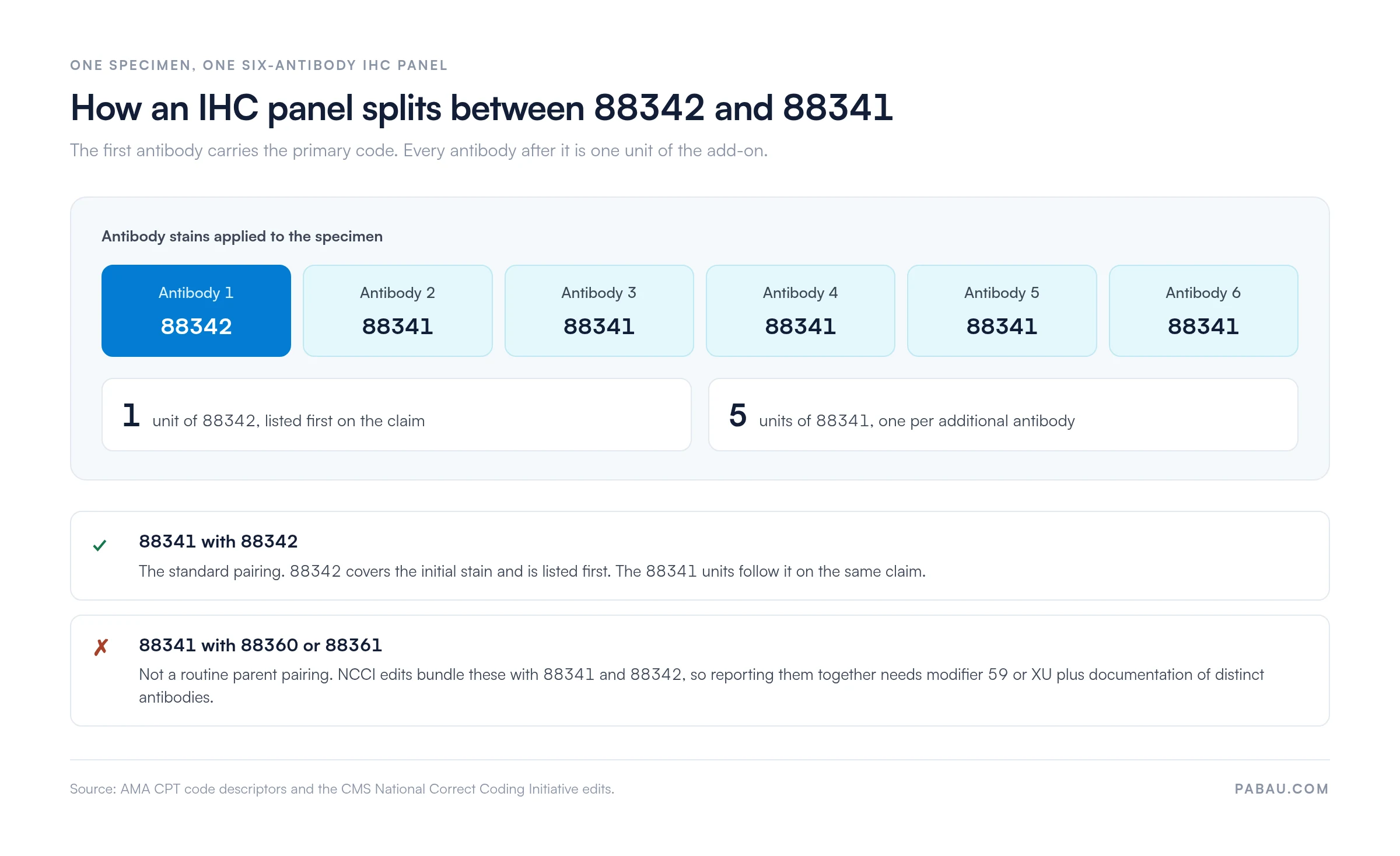
Indeed, 88360 and 88361 are not routine alternate parents, because NCCI edits bundle them with 88341 and 88342.
Each unit of 88341 represents one additional antibody stain per specimen, and the unit count must match the antibodies named in the pathology report.
Medicare coverage follows CMS Coverage Article 57611, so each claim needs a supported ICD-10-CM diagnosis and a signed pathology report.
Coders often encounter 88341 when a pathologist orders a panel of immunohistochemical stains on a single specimen. Specifically, the table below captures the structured code details most billing teams need at a glance.
Immunohistochemical staining uses antibody-antigen interactions to identify specific proteins in tissue sections. Overall, pathologists rely on IHC panels to characterize tumor type, grade, and origin. A single biopsy specimen can therefore generate several units of 88341 when multiple markers are applied. Flow cytometry panels are counted the same way, with each marker after the first billed as 88185.
The plus (+) designation on 88341 carries a strict billing rule. As a result, it must appear on the same claim as a qualifying primary procedure code. Indeed, billing it without the parent code is the single most common denial trigger for IHC claims.
Specifically, the split below shows how one six-antibody panel turns into a single primary code and five add-on units, and which pairing the NCCI edits block.
The AMA’s CPT codebook instructs coders to report 88341 in addition to the primary IHC procedure code. Sequence still matters on the claim form. List the primary code first, then the add-on units beneath it.
When a pathologist runs a six-antibody IHC panel on one specimen, you bill one unit of 88342 for the first antibody. As a result, the remaining five antibodies are five units of 88341. Document each antibody name in the pathology report to support the unit count at audit.
The distinction between these two codes trips up coders at every experience level. In fact, both cover a single antibody stain procedure for immunohistochemistry, and both are reported per specimen. What separates them is billing role, and 88342 is the one that can stand alone.
*Verify current rates using the CMS Medicare Physician Fee Schedule lookup tool, since reimbursement amounts are updated each January.
88341 belongs to a family of surgical pathology and immunohistochemistry codes that billers meet together on pathology claims. Overall, knowing which of them bundle against each other saves a round of appeals.
The table above lists Group I stains for microorganisms under 88312. Group II histochemical stains, such as iron and trichrome, are reported under 88313 instead.
The AAPC Codify CPT lookup gives searchable access to the full surgical pathology and IHC code family, including bundling edits and modifier applicability. In addition, Pabau’s CPT code library covers the same range one code at a time, in plain language.
Medicare reimbursement for 88341 is set annually through the CMS Medicare Physician Fee Schedule (MPFS). In addition, rates vary by geographic locality and are updated each January. Verify current figures against the CMS RVU file before you change an internal fee schedule.
Labs billing multiple units of 88341 should track reimbursement per unit rather than per claim. For example, a six-antibody panel produces six separately priced lines, and the add-on units pay less than the primary code. Reconciling those lines against the remittance advice is where underpayments on IHC panels usually surface.
CMS Coverage Article 57611 governs Medicare coverage for IHC codes including 88341. Specifically, medical necessity is the threshold question. The panel has to be ordered and interpreted in the context of a covered clinical indication.
The following ICD-10-CM diagnosis categories commonly support medical necessity for 88341. Billers should verify current code validity against the applicable year’s ICD-10-CM tables, since codes are updated annually by CMS.
Per CMS article 57611, coverage is subject to medical necessity documentation. Instead, private payers including Blue Cross Blue Shield apply their own LCD equivalents, and policies vary. Consult the applicable payer portal before assuming identical coverage to Medicare. The CMS ICD-10-CM annual update files are the authoritative source for verifying that listed diagnosis codes remain valid.
Incomplete documentation is the leading cause of post-payment audits for IHC codes. A unit count that outruns the antibodies named in the report is the discrepancy a reviewer can spot without clinical judgment. Overall, a short checklist, completed before submission, keeps that count defensible.
A structured charge sheet that pre-populates antibody names and specimen identifiers reduces transcription errors at claim submission. Sending IHC claims as a structured electronic claim file also creates an audit-ready transaction record for the lab.
Most 88341 denials and audits trace back to a short list of recurring mistakes. Indeed, identifying these patterns is the fastest way to improve first-pass claim rates for IHC services.
A systematic review of rejected IHC claims reveals which of these errors recur in a specific lab’s workflow. In fact, addressing the top two or three patterns typically lifts first-pass rates by a noticeable margin.
Run a quarterly audit comparing the number of 88341 units billed per specimen against the antibody names listed in pathology reports for the same period. Overall, any mismatch points to a documentation or coding workflow problem worth fixing before a payer reviews the claims.
Medicare coverage through CMS Coverage Article 57611 sets the floor for IHC reimbursement, but private payers often apply different rules. Blue Cross Blue Shield policies, for example, may limit the billable 88341 units per specimen or require prior authorization for larger panels. Overall, these limits are payer-specific and are not always published openly.
Where payer-specific guidance is unclear, fall back on the data elements every payer requires. Specifically, a complete IHC claim carries the primary code, the add-on units, a supported diagnosis, and the rendering provider’s details.
Most pathology billing teams work the 88341 unit count by hand. Someone opens the signed report, counts the antibody names, then types the units into the claim, and trusts that the chargemaster entry already carries 88342. The count is correct until the day it isn’t.
Practice management software like Pabau keeps the encounter, the charge, and the claim in one record. Pabau’s claims management software checks that the required billing fields are present, submits the claim electronically, and tracks it through to remittance. Overall, the code pairing stays a coder’s judgment, but no data is rekeyed between systems.
The result is a shorter loop between the pathologist signing the report and the lab seeing the payment. Rejections come back into the same record, so the biller corrects the claim where the original charge already lives.

Pabau’s claims management software checks required billing fields, submits claims electronically, and tracks each one through to remittance. Your billers work every IHC claim from the record that already holds the encounter.

CPT Code 88341 is straightforward in concept and unforgiving in execution. In fact, three mistakes drive most of the denials. The 88342 pairing goes missing, the unit count outruns the antibodies documented, or the diagnosis code fails to support medical necessity.
Fixing those three is a workflow change more than a coding change. Overall, reconcile units against the signed report rather than the requisition, and most of the rework on IHC claims disappears. The bundling edits on 88360 and 88361 are worth a standing note in the chargemaster, because they are the one pairing nobody remembers under pressure.
Precision at the coding desk still needs a clean path to the payer. Book a demo to see how Pabau submits and tracks pathology claims from the record that holds the encounter.

Need to understand how claims move through a clearinghouse? Medical claims clearinghouse explained covers how electronic claim routing, eligibility checks, and ERA processing work in a lab billing context.
Want to reduce IHC claim denials upstream? Getting credentialed with insurance companies walks through the payer enrollment steps that affect whether your lab’s claims are accepted at all.
Working a backlog of rejected pathology claims? Denial management in healthcare sets out how to triage rejections by reason code and rework the ones worth appealing.
Building the charge sheet behind the claim? What a superbill is and what it must contain explains the fields that carry codes and units from the record onto the claim form.
Coding the surgical pathology exam alongside the stains? CPT code 88305 covers the Level IV gross and microscopic exam that often precedes an IHC panel.
CPT Code 88341 is used to bill for each additional single antibody stain applied during an immunohistochemistry (IHC) or immunocytochemistry procedure, per specimen. Pathologists use it when a diagnostic IHC panel requires more than one antibody beyond the first, which is reported under the primary code 88342.
No. CPT 88341 is a designated add-on code (+) and cannot be reported as a standalone service. It must appear on the same claim as primary code 88342, the initial single antibody stain. Claims submitted without 88342 will be denied. NCCI edits bundle 88341 and 88342 with 88360 and 88361, so reporting those together requires modifier 59 or XU plus documentation of distinct antibodies.
Yes, Medicare covers CPT Code 88341 when medical necessity is documented and the claim meets the requirements of CMS Coverage Article 57611. Coverage requires a supported ICD-10-CM diagnosis code, a signed pathology report listing each antibody by name, and pathologist attestation. MAC-specific LCDs may add further requirements depending on the provider’s region.
ICD-10-CM codes from the malignant neoplasm chapter (C00-C96) and the lymphoma categories (C81-C96) commonly support medical necessity for CPT Code 88341. In situ neoplasms (D00-D09) and neoplasms of uncertain behavior (D37-D48) also qualify. Verify current-year code validity against the CMS ICD-10-CM annual update files, as codes are revised each October.



