

CCSD code G5100: Bypass of duodenum billing guide
CCSD code G5100 bills a bypass that leaves the duodenum in place CCSD code G5100...

Last Updated: Oct 16, 2026
Billable Code
88313 is the CPT code for a Group II special stain, including the pathologist's interpretation and report. Group II covers histochemical stains such as iron and trichrome.
The code excludes stains for microorganisms (88312), stains for enzyme constituents (88319), and immunocytochemistry or immunohistochemistry (88342 and 88341). Bill one unit per distinct stain, and only when the signed report records the pathologist's findings for that stain.
Let Pabau's smart automation suggest the right codes, reduce claim denials, and keep your practice compliant—effortlessly.
Automate repetitive tasks and focus on what matters most—your patients.
Reduce coding errors and ensure compliance with the latest regulations.
Clean claims, fewer denials, and faster reimbursements.
Powerful insights and reporting to help your practice thrive.
HIPAA compliant SOC 2 certified GDPR-compliant Trusted by 4,000+ clinics worldwide

CPT code 88313 covers Group II special stains, such as trichrome and iron (Prussian blue), with a required pathologist interpretation and formal written report.
Group I stains for microorganisms (GMS, PAS, AFB, Gram) are billed under CPT 88312, not 88313. Sending them to the wrong group is the most common miscoding in this code family.
Immunohistochemistry is billed under 88342 (primary antibody) or 88341 (each additional). These stains are antibody-based and never fall under the 88313 descriptor.
Practice management software like Pabau validates claim details before submission and sends pathology claims through Claim.MD, so errors surface before the payer sees them.
CPT code 88313 is the American Medical Association code for a Group II special stain, including the pathologist’s interpretation and report. Group II means all other special stains, such as iron and trichrome. The descriptor excludes stains for microorganisms, stains for enzyme constituents, and immunocytochemistry or immunohistochemistry.
The code sits in the 88300–88399 surgical pathology range of the CPT code set. Its neighbors are the gross and microscopic examination codes (88300 through 88309) and the other histochemical and immunohistochemical stain codes.
The phrase “including interpretation and report” decides whether the stain is billable. A stain processed in the histology lab but never interpreted by a pathologist and documented in writing cannot be billed under 88313. The code covers both the technical work of preparing the slide and the pathologist’s professional read. When different providers perform each part, report modifier -TC or -26 as your payer’s rules allow.
Group II covers the special stains left once three families are ruled out. If the stain detects a fungus, mycobacterium, bacterium, or other microorganism, it belongs in Group I under CPT 88312. Enzyme constituent stains, such as NADH-TR, ATPase, and SDH on muscle biopsies, are Group III and bill under CPT 88319.
Antibody-based stains bill under the immunohistochemistry codes instead. The decision path below runs those checks in the order a coder should ask them.
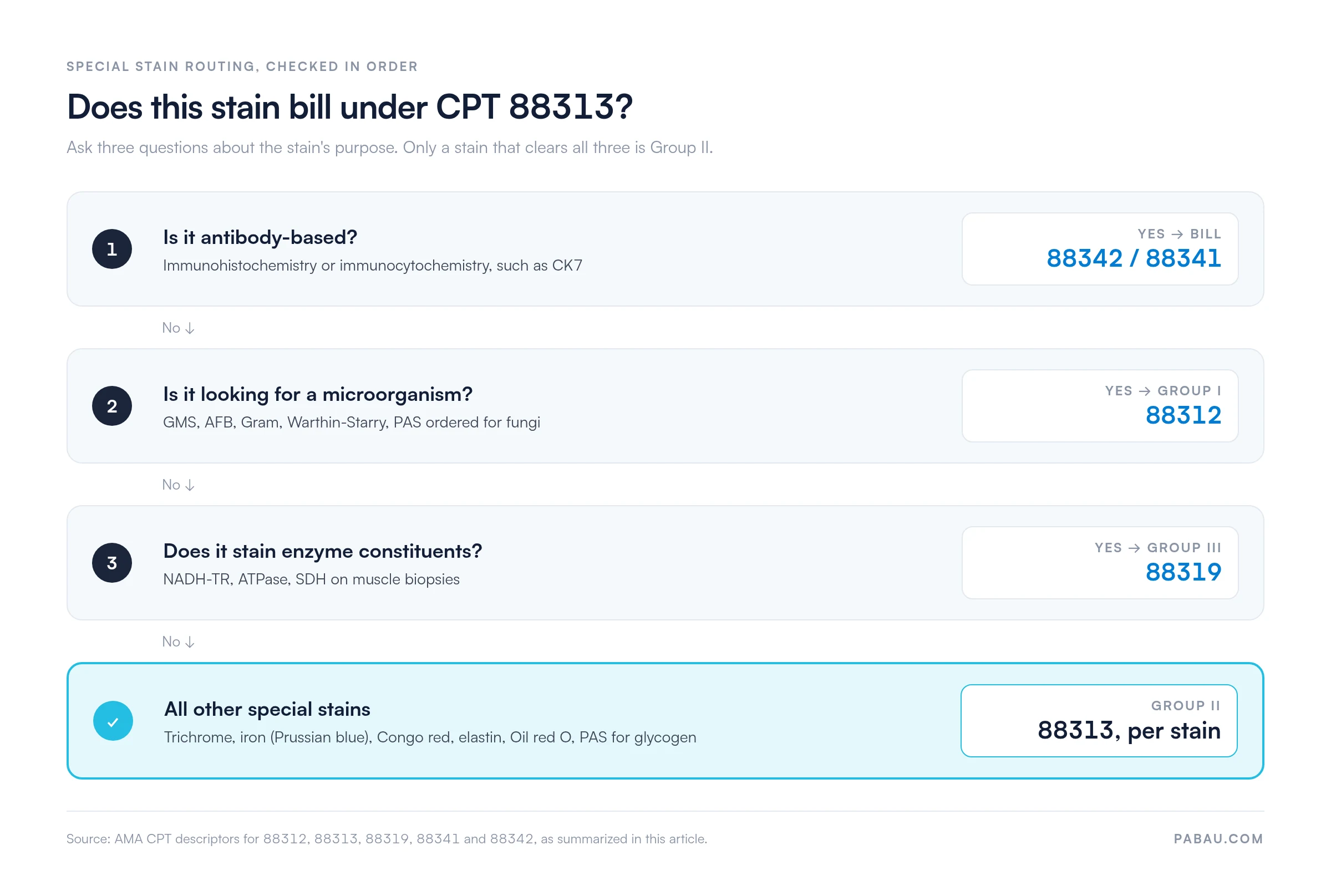
Common stains billed under CPT code 88313 include the following. Each qualifies as a separately reportable unit when performed on the same specimen, provided the pathologist interprets and reports each one.
Across the 883xx family, three elements anchor a clean claim: The stain’s name, the clinical indication, and the pathologist’s interpretive report. If any one of them is missing, expect a denial.
Group I (CPT 88312) covers stains specifically designed to detect microorganisms. Group II (CPT 88313) covers all other special stains. This single distinction is where most miscoding errors originate.
PAS is the stain that trips up the most labs. PAS without diastase, used to highlight basement membranes or glycogen, is a Group II stain (88313). PAS with diastase, performed to detect and differentiate fungi, is a Group I stain (88312). The reagent differs, but the code follows the clinical purpose rather than the stain chemistry alone.
Immunohistochemistry uses antibodies to detect specific antigens in tissue. That mechanism is fundamentally different from histochemical staining, so the CPT code set gives IHC its own codes. IHC is never billed under CPT code 88313. The first antibody on a specimen bills under CPT 88342, and each additional antibody under 88341.
The Office of Inspector General (OIG) has flagged the 88313-versus-IHC boundary as a high-risk area for laboratory billing. Picture a lab that bills trichrome as 88313 on Monday and CK7, an IHC marker, as 88313 on Tuesday. To a payer, those two claims look the same. Keep the distinction sharp in your charge description master and in training for histology staff who enter orders.
The pathologist’s report is the claim’s evidentiary backbone. Missing or incomplete documentation is the second most common denial driver for CPT code 88313, after wrong group assignment.
Every 88313 claim needs these five elements in the pathology report before it’s submitted.
CPT code 88313 is billable per stain, not per specimen. Each different Group II stain performed on a specimen is separately reportable when the pathologist interprets and documents each one individually.
A liver biopsy receiving both Masson trichrome and Prussian blue iron stain can generate two units of 88313. Both stains must be interpreted and reported independently. Three stains, three units. The stains must differ. You cannot bill the same stain type twice on the same specimen.
Practical limits to keep in mind:
Special stains are almost never billed in isolation. The specimen generating the stain workup has already been examined under CPT 88305 or a higher-level surgical pathology code. Understanding the pairing rules reduces bundling denials.
Check current AAPC CPT code resources for up-to-date NCCI edit pairs involving 88313. Edit tables update quarterly; never rely on a prior-year table to confirm bundling status.
Confirm Medicare payment rates for CPT code 88313 under the 2026 Physician Fee Schedule with the CMS Physician Fee Schedule lookup tool. Rates depend on your MAC locality and on whether the setting is facility or non-facility. Hardcoding a dollar figure here would misrepresent locality-adjusted rates that vary across the country.
The FastRVU 2026 RVU lookup provides work, practice expense, and malpractice RVU components for 88313 alongside national and locality-adjusted conversion factor calculations. Use it alongside the CMS MPFS data for the most accurate rate estimate. Running a real-time eligibility check before submission also cuts coverage-related denials.
Run the CMS MPFS lookup with your specific MAC locality code before each contract negotiation or annual fee schedule review. The national non-facility rate and your locality-adjusted rate can differ by 15-25% in high-cost markets like California or New York.
Medicare does not currently publish a National Coverage Determination (NCD) specific to CPT code 88313. Coverage is therefore governed by MAC-level LCDs, and not all MACs have an active LCD for special stains. When no LCD applies, medical necessity is evaluated on a claim-by-claim basis using the submitted diagnosis codes.
Commercial payer behavior varies substantially, so keep each payer’s current policy documents on file. High-volume workups, such as five or more 88313 units on a single specimen, often trigger additional documentation requests from commercial carriers.
Most 88313 denials cluster around the five scenarios below. Labs that prevent them work upstream, in documentation and charge capture, rather than in the appeals queue.
The National Correct Coding Initiative publishes code-pair edits that identify when two codes billed together count as components of a single service. CMS updates these tables quarterly. When a pathology claim comes back with a CO-97 or CO-4 adjustment, pull the NCCI edit table first. Our guide to common denial codes explains what each of those reason codes means.
When modifier 59 (or the appropriate X-modifier) overrides an NCCI edit on an 88313 claim, the documentation must show the stain was a distinct service. Blanket use of modifier 59 without documentation support is an OIG audit trigger. Apply it only when the report supports a distinct service, and accept the bundling edit when it doesn’t.
Pathology billing errors in the 883xx family are almost always documentation and charge-capture problems. The stain itself was performed correctly. The claim fails because the interpretation was incomplete, the wrong code was assigned, or it hit an edit nobody checked for.
Those failures usually start where the laboratory information system (LIS) hands a case over to billing. Three weak points come up again and again:
Practice management software like Pabau takes care of the last weak point with cleaner claims management software. Validation checks run every time you send a claim, confirming that details such as membership numbers and authorization codes are in place.
In the US, claims go to payers through Claim.MD, with real-time eligibility checks before submission. Each claim then moves through five tracked stages, from pending to paid or error. Your billing team fixes and resubmits errors from the same dashboard and posts ERA remittances there too.
Audit your 88313 denial rate by stain type quarterly. If trichrome denials spike, the issue is usually the interpretation template. If iron stain denials spike, check whether the diagnosis codes submitted are pulling a medical necessity flag from a specific payer LCD.

Pabau validates claim details before you send them, submits through Claim.MD with real-time eligibility checks, and tracks every claim to payment. See how it fits your pathology billing workflow.

The fix for CPT code 88313 denials sits upstream of the claim. Map every stain to its group in your charge description master, and require a findings statement for each stain before sign-out. Those two controls handle the wrong-group and missing-interpretation denials that dominate this code.
The trade-off is setup time. Auditing your stain menu against 88312, 88313, 88319, and the IHC codes takes effort up front. It still costs less than working the same denials through the appeals queue every quarter.
To see how Pabau checks pathology claims before submission and tracks them to payment, book a demo with the team.

Need a reference for denial codes and what they mean? Denial codes in medical billing explains the most common CARC and RARC codes labs encounter when 88313 claims are returned.
Exploring how a clearinghouse fits into pathology billing? Medical claims clearinghouse guide covers how clearinghouses validate, route, and report on claims before and after payer adjudication.
Looking for guidance on the revenue cycle beyond the claim? What is revenue cycle management maps the full journey from patient encounter to payment posting.
Billing the specimen exam behind the stains? CPT code 88305 covers the Level IV surgical pathology exam that most 88313 claims pair with.
CPT code 88313 covers Group II special stains, including the pathologist’s interpretation and report, on surgical pathology specimens. Group II includes histochemical stains that don’t target microorganisms or enzyme constituents. Examples are trichrome (fibrosis), iron or Prussian blue (hemosiderin), Congo red (amyloid), and elastin stains. Each different Group II stain on a specimen is separately billable when the pathologist interprets and documents it in a formal written report.
CPT 88312 covers Group I special stains that target microorganisms, such as GMS for fungi, AFB for mycobacteria, Gram stain, and Warthin-Starry for spirochetes. CPT 88313 covers the other histochemical special stains (Group II). The same chemistry can cross the boundary depending on purpose. PAS with diastase targeting fungi is 88312, while PAS without diastase for glycogen or basement membrane is 88313. The clinical purpose decides the code.
Bill one unit per different Group II stain, provided the pathologist interprets and reports each one independently. A liver biopsy with trichrome and iron stains generates two billable units. Some Medicare Administrative Contractors publish LCDs capping stain volume per diagnosis, so check the applicable MAC policy. Document medical necessity for each stain, because high stain volumes without per-stain rationale are a common audit target.
The 2026 Medicare rate for CPT 88313 varies by MAC locality and by facility or non-facility setting. Confirm it against the CMS Physician Fee Schedule lookup tool for your geography. The FastRVU 2026 RVU lookup, used alongside the CMS MPFS data, gives the most accurate locality-adjusted estimate. Private payers typically set rates as a percentage of MPFS, which varies by contract.
Yes. “Including interpretation and report” is part of the official code language. A stain performed in the lab but not interpreted and documented in a signed pathology report cannot be billed under 88313. The report must state the pathologist’s findings from the stain. “Trichrome performed” doesn’t satisfy this requirement, but “Trichrome: Grade 2 fibrosis” does.
Yes, 88313 and 88342 can generally be billed on the same specimen. They’re distinct procedures with different mechanisms: Histochemical staining versus antibody-based immunohistochemistry. Check current NCCI edit tables before submitting, because pairing rules update quarterly. Each code needs its own interpretation in the pathology report, and the two should never both be billed for the same stain result.



