CCSD Code C7920: Pars plana vitrectomy with tamponade, buckling and retinopexy
CCSD Code C7920: Definition and official descriptor CCSD Code C7920 is the CCSD ...

Last Updated: Nov 11, 2026
88377 is the CPT code for morphometric analysis, in situ hybridization (quantitative or semi-quantitative), manual, per specimen; each multiplex probe stain procedure. It covers a pathologist's manual signal count on a stain that runs two or more probes together.
One unit applies per specimen for each multiplex stain, however many probes it carries. A single probe stain counted by hand is 88368, and a computer-assisted count on a multiplex stain is 88374. Denials usually come from units billed per probe or from reports without signal counts.
Let Pabau's smart automation suggest the right codes, reduce claim denials, and keep your practice compliant—effortlessly.
Automate repetitive tasks and focus on what matters most—your patients.
Reduce coding errors and ensure compliance with the latest regulations.
Clean claims, fewer denials, and faster reimbursements.
Powerful insights and reporting to help your practice thrive.
HIPAA compliant SOC 2 certified GDPR-compliant Trusted by 4,000+ clinics worldwide

CPT code 88377 reports a pathologist’s manual morphometric analysis of a multiplex in situ hybridization stain, per specimen, for each multiplex probe stain procedure.
NCCI policy allows one unit of 88366, 88374 or 88377 per specimen for each multiplex probe stain procedure, however many probes the stain carries.
A single probe stain counted by hand is coded 88368, and a computer-assisted count on a multiplex stain is coded 88374.
The 2026 Medicare Physician Fee Schedule assigns 88377 a work RVU of 1.37, and the final payment varies by MAC locality.
Pabau, the practice management platform we build, sends 837P claims through Claim.MD and posts eligibility responses and remittances to the patient record.
CPT code 88377 reports a pathologist’s manual morphometric analysis of a multiplex in situ hybridization (ISH) stain. The AMA places it in the Surgical Pathology range, 88300-88399, inside the pathology and laboratory section.
The AMA’s CPT code set gives the full descriptor: Morphometric analysis, in situ hybridization (quantitative or semi-quantitative), manual, per specimen; each multiplex probe stain procedure.
Three parts of that descriptor control billing. “In situ hybridization” names the staining technique, and “manual” means the pathologist personally performs the count. “Each multiplex probe stain procedure” sets the unit of service.
The code is reported per specimen, for each multiplex probe stain procedure. A biopsy block stained with two probes in one multiplex procedure takes one unit of 88377 under NCCI, not two. A single probe stain counted by hand is reported with 88368 instead.
CPT code 88377 covers the pathologist’s manual reading of a quantitative or semi-quantitative morphometric result from a multiplex ISH stain. The pathologist performs and attests the count, without an automated image analysis system.
Included under 88377: FISH (fluorescence in situ hybridization), chromogenic ISH and silver ISH, when two or more probes run in one stain. The pathologist counts and reports the signals by hand.
Excluded from 88377:
A common coding error is billing 88377 when an automated scanner generated the signal count. If the pathologist reviews digitally captured image data instead of counting signals at the microscope, 88374 is the correct code.
Several codes in the 88300-88399 range sit close to 88377. They split on the staining method (ISH or immunohistochemistry), on whether a morphometric count was made, and on how it was made. Picking the wrong code from this cluster is a common cause of NCCI bundling denials.
The 88374/88377 split is the one that creates audit exposure. Labs increasingly use whole-slide imaging platforms.
If the instrument produces the signal count and the pathologist only reviews the output, 88374 applies. Billing 88377 in that scenario creates a documentation mismatch that payers flag on post-payment review.
Across the ISH family, two questions decide the code: how the count was done, and how many probes the stain carries. Manual counts use 88368, 88369 and 88377, while computer-assisted counts use 88367, 88373 and 88374. A stain read without a count uses 88365, 88364 and 88366. The grid below lays the nine codes out side by side.
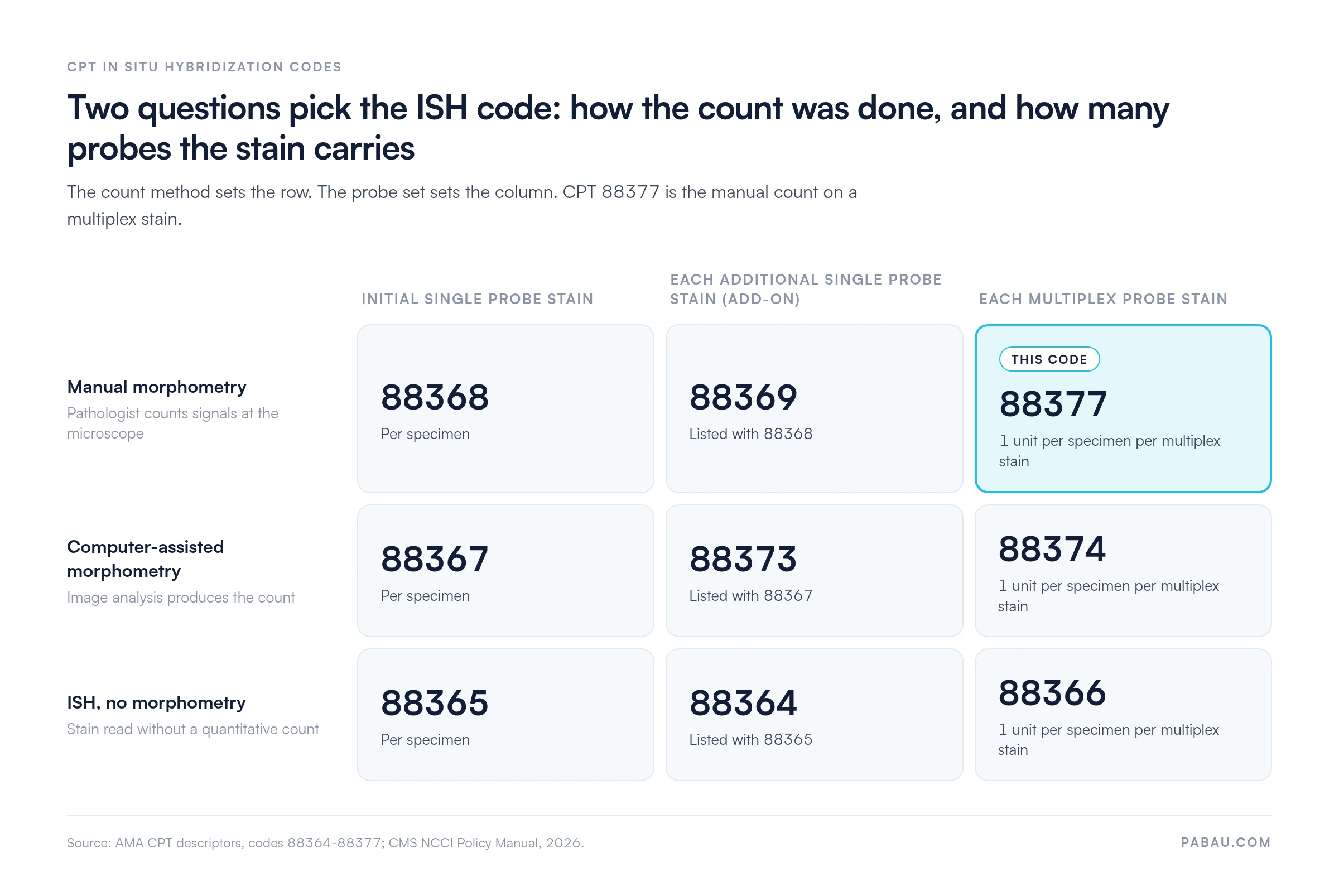
Immunohistochemistry sits outside this grid. A tumor IHC stain scored by hand, such as HER2 or ER/PR, is billed with 88360 for each single antibody stain.
The CMS NCCI Policy Manual (2026 edition) restricts all three multiplex ISH codes. Providers may not report more than one unit of 88366, 88374 or 88377 per specimen for each multiplex probe stain procedure. The limit holds even when the stain tests several probes.
The one-unit cap applies per specimen per multiplex procedure, not per probe. A five-probe multiplex stain on a single lung adenocarcinoma specimen is one unit of 88377, not five. Send it through a medical claims clearinghouse with a report that documents every probe in the stain.
Key NCCI editing points for 88377:
Before submitting a claim with multiple units of 88377, confirm each unit maps to a separately identified specimen in the pathology report. NCCI edits are updated quarterly. Check the current edit table at CMS before assuming a modifier will pass, particularly for multiplex panels.
A claim for CPT code 88377 needs a pathology report that supports each part of the descriptor. That means the ISH technique, the multiplex probe stain, the morphometric analysis and the manual interpretation.
A report that leaves one out hands the payer a reason to deny or recoup payment. Clean claim submission for ISH codes depends on a more specific report than routine surgical pathology needs.
Required documentation elements:
Payer audits for 88377 tend to center on two documentation failures. The first is a report that names the probe only generically (“HER2 FISH performed”) with no quantitative signal data. The second is a missing statement that the pathologist personally interpreted the count instead of relying on automated output.
The 2026 Medicare Physician Fee Schedule assigns CPT code 88377 a work RVU (wRVU) of approximately 1.37, based on published CMS RVU data files.
Total RVUs are higher when practice expense and malpractice components are added, and the final reimbursement amount varies by Medicare Administrative Contractor (MAC) locality. Use the CMS Physician Fee Schedule lookup tool to retrieve the non-facility and facility rates for your specific geographic location.
Use FastRVU’s 2026 RVU lookup to retrieve the full component breakdown and apply your locality’s geographic practice cost index (GPCI). The 1.37 wRVU figure comes from published CMS RVU data. Confirm it against the final 2026 MPFS file before year-end reconciliation.
Most 88377 denials fall into one of five categories. Each has a corrective action that prevents a repeat through a process change, without an individual appeal.
Denial management workflows for pathology labs treat these as systemic edits instead of one-off rework. The CARC denial codes reference lists the adjustment reason codes payers attach to each denial type.
Four common pathology lab encounters show which ISH workflows support a valid 88377 claim and which belong under a different code.
HER2 FISH on breast core biopsy: A core biopsy from a breast mass returns an equivocal HER2 IHC result (2+). The lab runs a dual-probe HER2/CEP17 FISH stain, and the pathologist counts signals in 20 cells by hand to calculate the ratio. Both probes share one hybridization, so the stain is one multiplex procedure and takes one unit of 88377. If image analysis produced the count, the code is 88374.
ALK FISH on lung adenocarcinoma: After an IHC screen, a pathologist runs ALK FISH on a lung biopsy to confirm a rearrangement. The signals are counted by hand. 88377 applies only when the lab reports the probe set as a multiplex stain. A stain the lab reports as a single probe procedure is coded 88368. Name the probe kit in the report so the payer can see which code fits.
Kappa/lambda light chain ISH for small lymphocytic lymphoma: This scenario is a frequent source of NCCI confusion for 88377. When kappa and lambda probes run together as one multiplex ISH stain on a specimen, NCCI allows one unit of 88377, not one per probe. Bill one unit, with documentation covering both probe results.
B-cell lymphoma FISH panel: A panel tests three probes (CCND1, BCL2 and MYC) on a single lymph node specimen. When the probes are hybridized together in one stain, the panel is one multiplex procedure and takes one unit of 88377 under NCCI. Break-apart and fusion probes in that stain do not create separate units. Probes run as separate stains are separate procedures, coded with 88368 and 88369.
Some clinical indications call for both ISH and IHC morphometric analysis on the same specimen. Then 88377 and 88360 may both be reportable, because they cover distinct staining techniques. Confirm that the pathology report documents separate procedures and separate interpretations for each. Run the combination through your NCCI edit checker before submission.
Anatomic pathology billing carries more NCCI edits than most specialties. Code 88377 shares its one-unit rule with 88366 and 88374, so probe count, stain type and place of service all affect the claim.
Labs running ISH panels every day cannot review each claim by hand, so accuracy depends on the medical billing workflow itself.
Pabau keeps the pathology report and the claim in one patient record. The biller works from the signed report, not a re-keyed summary.
Its claims management software sends CMS-1500 and 837P claims through the Claim.MD clearinghouse, which reaches thousands of US payers. Eligibility responses and electronic remittance advice come back against that same record.
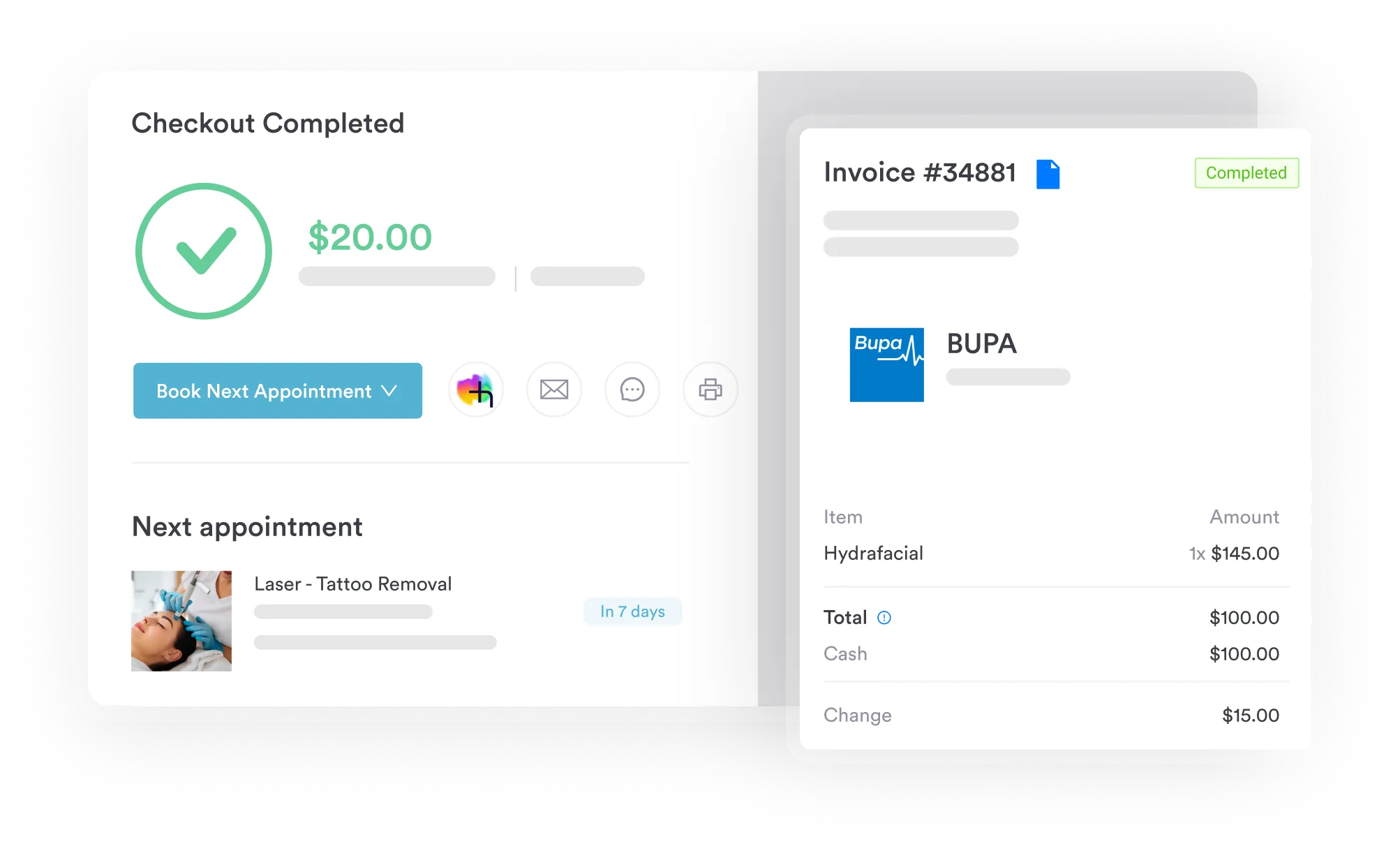
A unit rejection on a multiplex stain then shows up as soon as the payer returns it. The slide and the report are still easy to pull. Keeping reports to medical billing compliance standards also leaves the lab ready if a MAC requests records after payment.

Pabau’s claims management software sends 837P claims through Claim.MD, checks patient eligibility, and posts remittances against the patient record. See how it handles pathology code combinations like 88377.

Before you bill 88377, check two facts against the report. Each unit should map to one multiplex stain on one specimen, and a pathologist should have made the count by hand. If either fact fails, another code in the ISH family fits better, and the claim is safer under that code.
The report carries the rest of the claim. Signal counts, the probe kit and a manual interpretation statement are what a payer looks for when it reviews a multiplex panel. Book a demo to see how Pabau keeps pathology reports and claim submission in one patient record.

Confused by denial adjustment reason codes on your 88377 remittance? Understanding electronic remittance advice (ERA) walks through how to read 835 files and act on CARC codes.
Billing the IHC stain that often comes before FISH? CPT code 88342 covers immunohistochemistry per specimen for the initial single antibody stain.
Looking for a broader reference on surgical pathology billing? Revenue cycle management in healthcare covers the end-to-end billing workflow from charge capture through final payment posting.
CPT code 88377 covers a pathologist’s manual morphometric analysis of a multiplex in situ hybridization (ISH) stain. It is reported per specimen, for each multiplex probe stain procedure. A computer-assisted count on the same stain is coded 88374, and a single probe stain counted by hand is coded 88368.
CMS NCCI policy limits CPT 88377 to one unit per specimen for each multiplex probe stain procedure, however many probes the stain carries. Separate specimens can each support a unit. Billing several units for a kappa/lambda or multi-probe stain on a single block is a common denial trigger for this code.
The difference between CPT 88374 and 88377 is how the morphometric count is made. Under 88374, computer-assisted image analysis produces the count. Under 88377, the pathologist counts the signals by hand at the microscope. If a whole-slide imaging platform produces the count and the pathologist only reviews it, 88374 is the correct code.
The 2026 Medicare rate for CPT code 88377 varies by MAC locality, and the work RVU is approximately 1.37. Payment is the total RVUs (work, practice expense and malpractice), adjusted by the GPCI, multiplied by the annual conversion factor. Use the CMS Physician Fee Schedule lookup tool or FastRVU to find the facility and non-facility rates for your location.
No, CPT codes 88366, 88374 and 88377 generally cannot be billed together for one multiplex stain on the same specimen. Each describes a different way of reading that stain, so only one applies. Modifier 59 or XU fits only when the procedures ran on separate specimens with distinct accession numbers, never for separate probes on one tissue block.
A valid CPT 88377 claim needs a pathology report with the full probe names, the target genes and the ISH technique. It should also note that the probes ran as one multiplex stain. It also needs quantitative signal counts or ratios and a statement that the pathologist interpreted the count by hand. Add the specimen accession number and confirm the lab holds a CLIA certificate covering the test.