

CCSD code G5100: Bypass of duodenum billing guide
CCSD code G5100 bills a bypass that leaves the duodenum in place CCSD code G5100...

Last Updated: Oct 16, 2026
88360 is the CPT code for manual morphometric analysis of tumor immunohistochemistry, reported quantitatively or semiquantitatively per antibody tested. The code turns on how the staining was measured. A manual count or a validated scoring system belongs to 88360, while a computer-assisted count belongs to 88361.
Payers downcode 88360 to 88342 when the pathology report never names the scoring method. The wording of that report is what decides the claim.
Let Pabau's smart automation suggest the right codes, reduce claim denials, and keep your practice compliant—effortlessly.
Automate repetitive tasks and focus on what matters most—your patients.
Reduce coding errors and ensure compliance with the latest regulations.
Clean claims, fewer denials, and faster reimbursements.
Powerful insights and reporting to help your practice thrive.
HIPAA compliant SOC 2 certified GDPR-compliant Trusted by 4,000+ clinics worldwide

CPT Code 88360 covers manual quantitative or semiquantitative morphometric analysis of tumor IHC, billed per antibody tested.
Computer-assisted counting of the same stain is reported under CPT 88361, not under 88360.
The report must name the manual method used, such as an H-score, an Allred score, or a counted percentage.
CPT 88360 and 88342 cannot be billed together for the same antibody on the same specimen.
Medicare coverage is LCD-dependent by jurisdiction, and medical necessity has to be documented for each oncology diagnosis.
The American Medical Association (AMA) publishes the official descriptor for CPT Code 88360. It reads: Morphometric analysis, tumor immunohistochemistry (eg, Her-2/neu, estrogen receptor/progesterone receptor), quantitative or semiquantitative, each antibody; manual. The code sits in the Surgical Pathology section of the CPT codebook, under the Morphometric Analysis, Tumor Immunohistochemistry subheading.
Morphometric analysis means the pathologist measures the staining instead of reading it by eye. Quantitative or semiquantitative describes the output, which is either a counted percentage of positive cells or a defined score. An H-score, an Allred score, and a Quick score all qualify. Purely subjective visual grading does not.
The last word in the descriptor carries the most billing weight. “Manual” is what separates 88360 from CPT 88361, the companion code for computer-assisted counting. Where image analysis software produces the number, the service is reported under 88361 regardless of the antibody tested.
“Each antibody” means the code is reported once per antibody analyzed, not once per specimen. A pathology report analyzing Ki-67, HER2, ER, and PR morphometrically generates four units of 88360.
The table below summarizes the key billing parameters for CPT Code 88360. For current reimbursement figures, verify against the CMS Physician Fee Schedule lookup tool, as rates are subject to annual adjustment.
The choice between 88360 and 88342 is where IHC claims most often go wrong. CPT 88342 covers qualitative immunohistochemistry analysis of a single antibody, where the pathologist reads staining as positive, negative, or weakly positive. CPT Code 88360 requires a manual measurement, so a defined and reproducible scoring method has to appear in the pathology report.
The audit risk here is upcoding: billing 88360 when the pathology report only documents a qualitative interpretation. CGS Medicare and other MACs review IHC claims for this pattern. If the report says “positive” without a numeric result or a scoring system, 88342 is the correct code, whatever the antibody tested.
CPT Code 88360 belongs to a family of immunohistochemistry codes that differ by method rather than by antibody. Reading them in that order prevents both unbundling errors and underbilling. The diagram below maps each documented method to the code it earns.
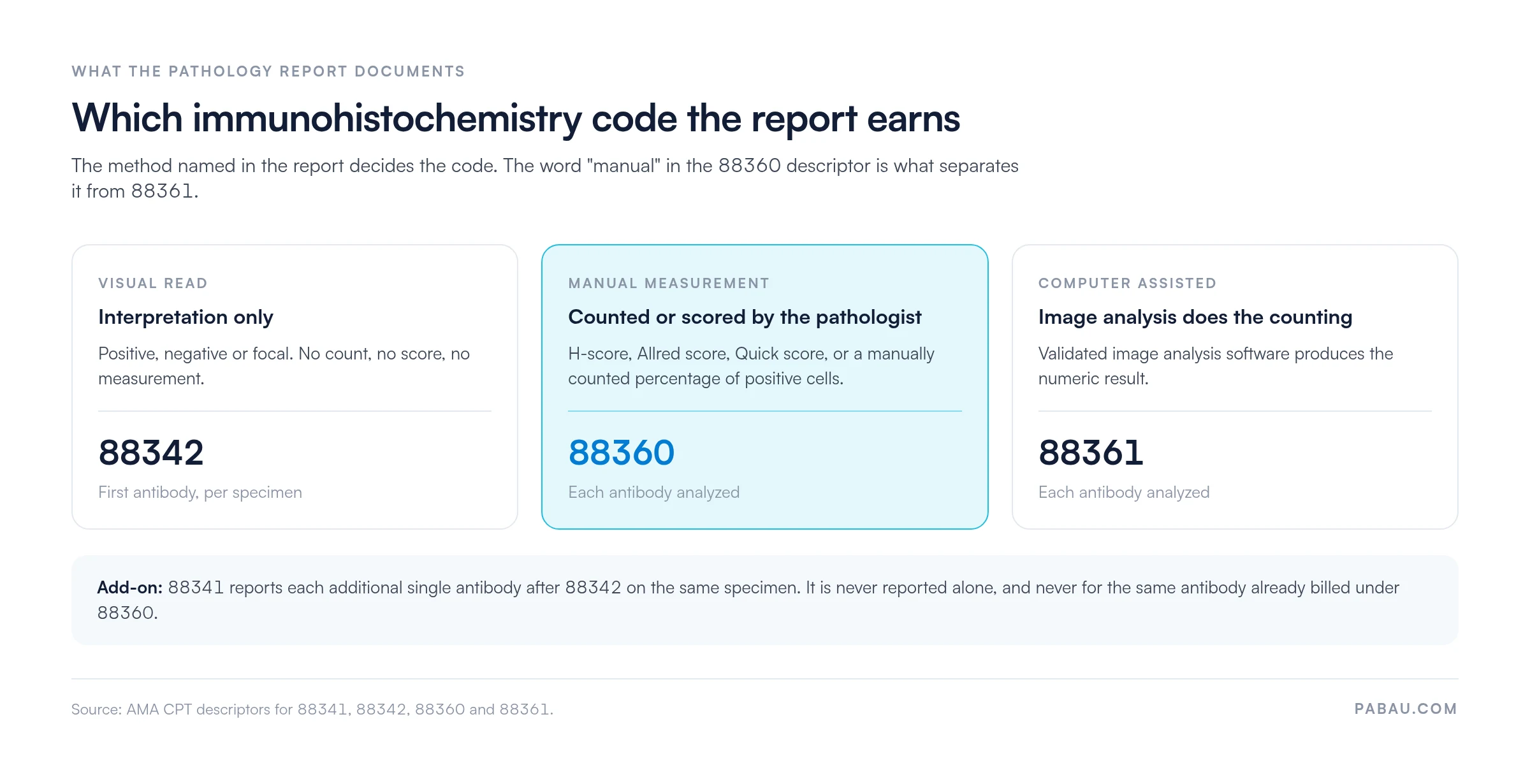
One bundling rule carries most of the risk. CPT 88341 is an add-on code, and it cannot be reported on a specimen where 88360 is billed for the same antibody. The two codes describe different types of analysis, so they are not two billing levels of one service. Verify current National Correct Coding Initiative (NCCI) edits when billing multiple IHC codes on the same date of service.
Histochemical stains sit outside this family altogether. A Group II stain such as iron or trichrome is reported under CPT 88313, which excludes immunohistochemistry by descriptor.
Documentation is where most CPT Code 88360 claims fail. The pathology report has to carry all of the following elements for the code to be defensible under audit.
A compliant claim starts with the pathology report rather than with the billing system. When the report and the claim agree on methodology, antibody, and result, denial risk drops substantially.
Run a monthly audit of your 88360 claims against pathology reports. Flag any claim where the report lacks a numeric result or a methodology statement. Downcode those to 88342 before submission, not after a denial. Proactive self-auditing is cheaper than appeal processing.
Medicare covers CPT Code 88360 under Medicare Part B when medical necessity is documented for an oncology-related diagnosis. Coverage is not universal, because Local Coverage Determinations (LCDs) vary by Medicare Administrative Contractor (MAC) jurisdiction. CGS Medicare, which administers Jurisdiction 15 (Kentucky and Ohio), and Noridian Healthcare Solutions each publish their own LCD guidance for IHC services. Check the LCD for your jurisdiction before billing.
The CMS list of CPT/HCPCS codes and the Medicare Coverage Database article (Article ID 57611) confirm that 88360 is covered under three conditions. First, the specimen has to be neoplastic tissue requiring biomarker quantification. Second, the quantitative result has to inform treatment planning directly. Third, the documentation has to satisfy the morphometric methodology standard.
Cosmetic, screening-only, and non-malignant diagnoses typically do not meet medical necessity for 88360 under Medicare. Tracking denials by payer and by jurisdiction is worth the effort here. LCD wording is what most often separates a paid 88360 claim from a rejected one.
CPT Code 88360 is almost always billed alongside oncology ICD-10-CM diagnosis codes, because quantitative IHC morphometry is a cancer biomarker service. The diagnosis code has to support medical necessity for the specific antibody tested.
Payers may deny 88360 claims paired with non-specific or benign diagnosis codes. Always use the most specific ICD-10-CM code available for the confirmed malignancy. Avoid “rule-out” and “suspected” codes. Where pathology is establishing the diagnosis, use the confirmed histologic finding as the primary code.
The correct modifier depends on how the technical and professional components of the analysis are split between the performing laboratory and the interpreting pathologist. Verify modifier applicability against current MAC guidance, since some MACs restrict modifier 91 on laboratory codes.
Where a hospital-based pathology department performs both the staining and the interpretation under a global billing arrangement, no modifier is needed. Use modifier 26 or TC only when the technical and professional components are genuinely split between different billing entities.
The Office of Inspector General (OIG) includes IHC billing in its annual work plan, which keeps CPT Code 88360 a consistent audit target. The errors below account for the majority of denials and compliance findings.
For practices with recurring 88360 rejections, denial management workflows are worth building. Tracking IHC denials by code, payer, and reason surfaces systemic documentation problems faster than case-by-case appeals.
Check your 88360 claim volume against your morphometric IHC test volume monthly. If units billed consistently exceed the number of antibodies manually counted or scored, you have a documentation-coding mismatch. Correct it before the next MAC review.
Most IHC billing references stop at the code definition. The part that decides whether an 88360 claim is paid sits further downstream. It comes down to how quickly the billing team sees what the payer sent back, and why.
In a typical practice, the pathology report lives in one system, the claim is keyed into another, and the remittance arrives in a third. Nobody sees the pattern until a quarter’s worth of 88360 denials has stacked up. Pabau, an all-in-one practice management system, keeps those three records together on the patient’s file.
Pabau’s cleaner claims management submits claims electronically through our Claim.MD integration and tracks each one through to remittance. The biller can see which 88360 claims were paid, which were downcoded, and which payer sent them back, without exporting anything to a spreadsheet.
The coding decision itself stays with the pathologist and the billing team. What the software changes is the feedback loop. The practice learns that its 88360 documentation is falling short while it can still fix the reports, not after a MAC review.

Pabau submits claims electronically through our Claim.MD integration and tracks each one back to the patient record. Downcoded 88360 claims surface while the documentation can still be corrected.

CPT Code 88360 pays more than 88342 because it describes more work, and the claim only holds up where the report shows that work. Read the descriptor as an instruction to the pathologist rather than as a billing label. Name the manual method, give the number per antibody, and pair the claim with a specific oncology diagnosis.
The one distinction worth carrying away is the last word of the descriptor. A counted score is 88360, a software-generated count is 88361, and a visual read is 88342. Practices that get this wrong rarely do so once. A monthly reconciliation of claims against reports is worth more than any single appeal.
Book a demo to see how Pabau submits and tracks IHC claims alongside the patient record they came from.

Need guidance on submitting clean IHC claims electronically? Medical claims clearinghouse guide covers how clearinghouse validation catches code-level errors before claims reach payers.
Want to understand how denial codes map to 88360 rejection reasons? Denial codes in medical billing explains the CARC and RARC codes most commonly returned on IHC claim denials.
Exploring how to structure a compliant billing process? Revenue cycle management fundamentals covers how to build a workflow where documentation, coding, and claim submission stay aligned.
Building a superbill that supports the codes you report? How to build a compliant superbill walks through the fields a payer expects to see on every line.
CPT Code 88360 covers manual morphometric analysis of tumor immunohistochemistry, performed quantitatively or semiquantitatively and billed per antibody. It applies when the pathologist counts or scores the staining by hand, using a system such as an H-score or a counted Ki-67 percentage. Counting performed by image analysis software is reported under CPT 88361 instead.
Yes, Medicare Part B covers CPT Code 88360 when medical necessity is established for an oncology diagnosis. The pathology report also has to document the manual morphometric methodology. Coverage sits under LCD policies that vary by MAC jurisdiction, so check the LCD for your area before billing.
Modifier 26 (professional component) is used when the pathologist bills the interpretation separately from the laboratory. TC (technical component), by contrast, is used by the laboratory billing the staining separately. Modifier 59 applies when 88360 is performed on a distinct specimen on the same date, while modifier 91 covers a repeat test performed for a clinical reason on the same day, subject to MAC policy.
The most frequently paired ICD-10-CM codes are malignant neoplasm codes: C50.x (breast), C18.x (colon), C34.x (lung), C61 (prostate), and C85.x (non-Hodgkin lymphoma). The diagnosis must support medical necessity for the specific antibody being analyzed. Non-specific or benign diagnoses are common denial triggers.



