

CCSD code G5100: Bypass of duodenum billing guide
CCSD code G5100 bills a bypass that leaves the duodenum in place CCSD code G5100...

Last Updated: Oct 16, 2026
86376 is the CPT code for a microsomal antibody test (for example, thyroid peroxidase or liver-kidney microsomal), reported per antibody. In most practices, it's the anti-TPO test ordered to look for Hashimoto's thyroiditis or another autoimmune thyroid condition.
Two details decide whether the claim pays. Only the lab that runs the assay bills 86376, and the claim needs a diagnosis that shows why the test was ordered. Get those right and the code pays from Medicare's Clinical Laboratory Fee Schedule. Below, you'll find the ICD-10 pairings, look-alike codes, denial fixes and a pre-submission checklist.
Let Pabau's smart automation suggest the right codes, reduce claim denials, and keep your practice compliant—effortlessly.
Automate repetitive tasks and focus on what matters most—your patients.
Reduce coding errors and ensure compliance with the latest regulations.
Clean claims, fewer denials, and faster reimbursements.
Powerful insights and reporting to help your practice thrive.
HIPAA compliant SOC 2 certified GDPR-compliant Trusted by 4,000+ clinics worldwide

CPT 86376 reports a microsomal antibody test, most often anti-TPO, and it’s billed once per antibody tested.
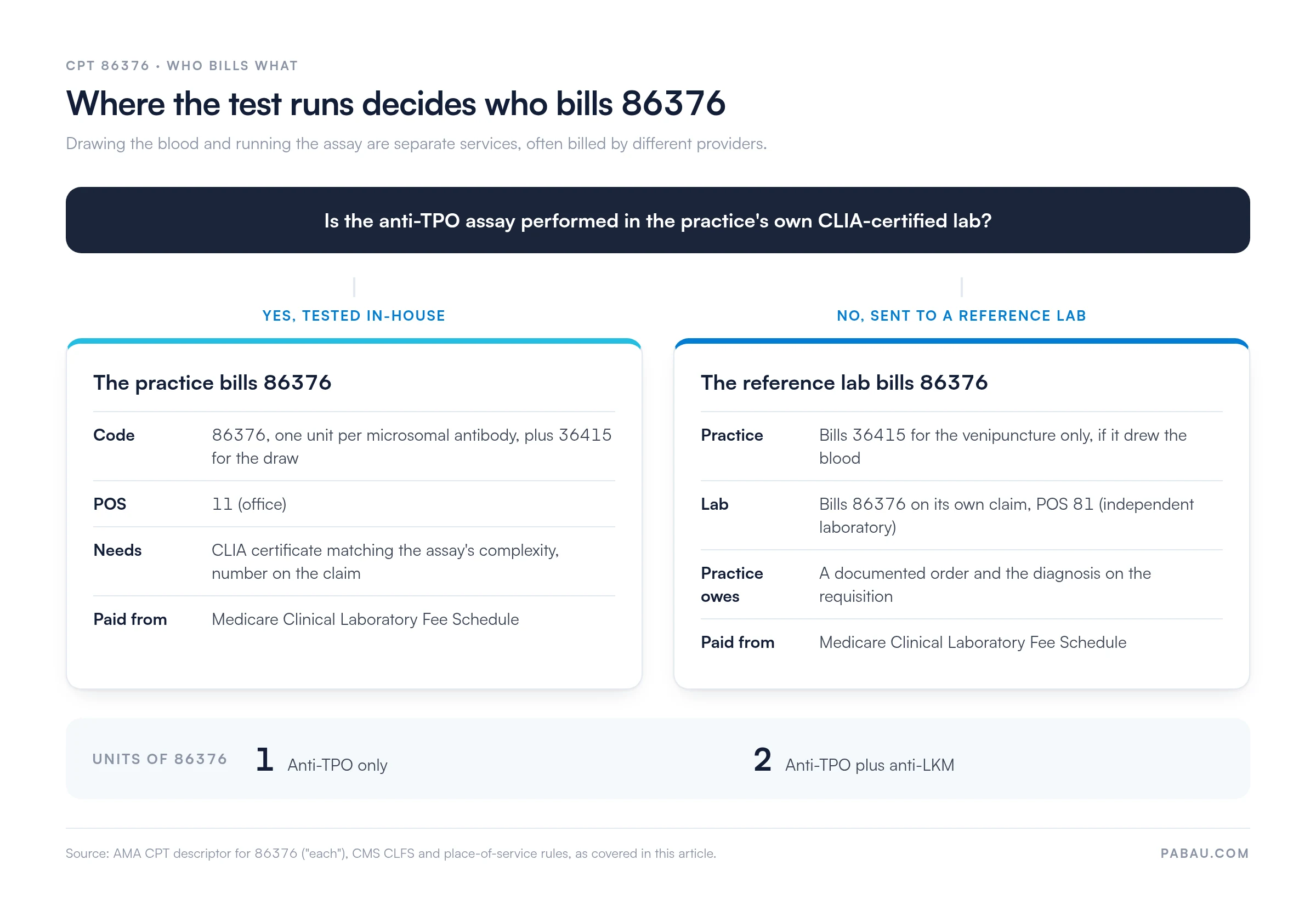
Only the lab that performs the assay bills 86376, so a practice that sends blood out bills 36415 for the draw instead.
Code what the chart confirms: a raised TSH supports R94.6, while E06.3 needs a documented autoimmune thyroiditis diagnosis.
CO-50 and CO-11 point to the diagnosis, while CO-4 flags a modifier problem rather than a wrong code.
Medicare pays 86376 from the Clinical Laboratory Fee Schedule, so check the current CMS file instead of quoting a remembered figure.
CPT code 86376 is the procedure code for a microsomal antibody test. The official descriptor reads “Microsomal antibody (eg, thyroid or liver-kidney), each.” It sits in the 86000-86849 immunology range of the AMA CPT code set.
In practice, that means two antibodies. Anti-TPO (thyroid peroxidase) antibodies point to autoimmune thyroid disease, such as Hashimoto’s thyroiditis. Anti-LKM (liver-kidney microsomal) antibodies help diagnose type 2 autoimmune hepatitis. The word “each” matters here. A lab that runs both antibodies reports two units.
The test runs on serum from a routine blood draw. Most labs use an automated immunoassay and report a quantitative result in IU/mL. A qualitative result uses the same code.
One naming quirk still trips billers up. “Microsomal antibody” is the older name, and some requisitions and payer policies still print it. Clinicians usually say “anti-TPO” or “TPO antibody.” For thyroid testing, all three names lead to 86376.
Think of 86376 as one antibody, one unit. The table shows where its scope ends, because that edge is where unbundling errors and missed charges start.
Payers want a diagnosis that explains why anyone needed the antibody result. A specific code tells that story faster than an unspecified one. These are the pairings billers reach for most often, but always check the local coverage determination for your jurisdiction.
Two of these codes have their own guides. E03.9 explains when the unspecified code holds up, and E02 covers the iodine-deficiency picture.
Whichever code you choose, the diagnosis on the order must match the one on the claim. A mismatch between the two is a quick route to a CO-50 denial.
A wrong antibody code rarely bounces at the clearinghouse. It’s a valid code, so it either pays for the wrong test or draws a medical-necessity denial later. These are the mix-ups worth watching.
86200 is the one to fear. It’s the anti-CCP test for rheumatoid arthritis, so billing it for a thyroid patient claims a test nobody ran. 86800 is the honest neighbor. Both test thyroid antibodies, but against different targets. When both appear on the same date, check the current NCCI edits before you bill them together.
Run a monthly report of claims that carry 86200 with a thyroid diagnosis. 86200 is the anti-CCP test for rheumatoid arthritis, so each hit is likely a coding error. Catching it before payment saves an appeal and a refund request later.
Medicare covers CPT code 86376 under the Clinical Laboratory Fee Schedule (CLFS) when the test is reasonable and necessary. There’s no automatic pass. The diagnosis on the claim has to support the test under your contractor’s rules.
Check the LCD or billing article published by the practice’s own MAC jurisdiction. The Medicare Coverage Database lets you search by CPT code. Before you bill, confirm these five points:
Reimbursement questions come up on every lab code. Here are the short answers for 86376.
Which fee schedule applies? The CLFS, not the Physician Fee Schedule. 86376 is a lab test, so the performing lab bills it on the CLFS.
Where do I find the current rate? CMS posts the payment limit for every lab code in its Clinical Laboratory Fee Schedule files. The file updates each January, with quarterly revisions.
What about commercial payers? Their rates depend on your contract. Some contracts reference the CLFS, so it’s a useful benchmark when you negotiate.
Can I quote a patient from memory? Better not. Pull the current CLFS line before you quote patients or set internal benchmarks.
With coverage and payment settled, here’s the path itself. A clean 86376 claim follows the same six steps every time, from the exam room to the remittance.
Step three is where most confusion starts, so here’s the split at a glance.
Run through this list before the claim leaves the building. Each item maps to a denial you’d otherwise see weeks later.
For the wider picture, our guide to submitting a clean claim covers the fields every payer checks.
Even with the checklist done, some claims come back. These six reason codes cover most 86376 denials, and each one has its own fix.
Patterns matter more than one-off denials. A run of CO-50s across several patients usually points to an order template problem, not a coder. Our guide to medical billing denial codes explains every code you will meet on a remittance.
86376 usually travels with TSH (84443) and free T4 (84439) in a thyroid workup. Those are separate lab codes, and they are typically payable on the same date. The bundling question comes up with 86800.
The NCCI edit files are version-dated, so check the current quarter rather than a saved copy. Reviewing electronic remittance advice for CO-97 patterns shows where a modifier or a separate-indication note is missing.
Filter your remittance data each quarter for CO-97 adjustments on 86000-series codes. A recurring CO-97 on 86376 paired with 86800 usually points to an active NCCI edit. Confirm the edit, then either add the modifier with documentation or bill only the test the record supports.
Rules are easier to remember with a patient attached. A family physician sees a patient with fatigue and a raised TSH. The physician orders anti-TPO to check for Hashimoto’s, and the practice sends the blood to a reference lab.
Here is how that one claim can go wrong:
Fix those four and the claim moves cleanly through every step above.
Lab claims pass through several hands. The clinician documents the reason, the lab returns the result, and the biller builds the claim. Each handoff is a chance for the diagnosis or the order to drift.
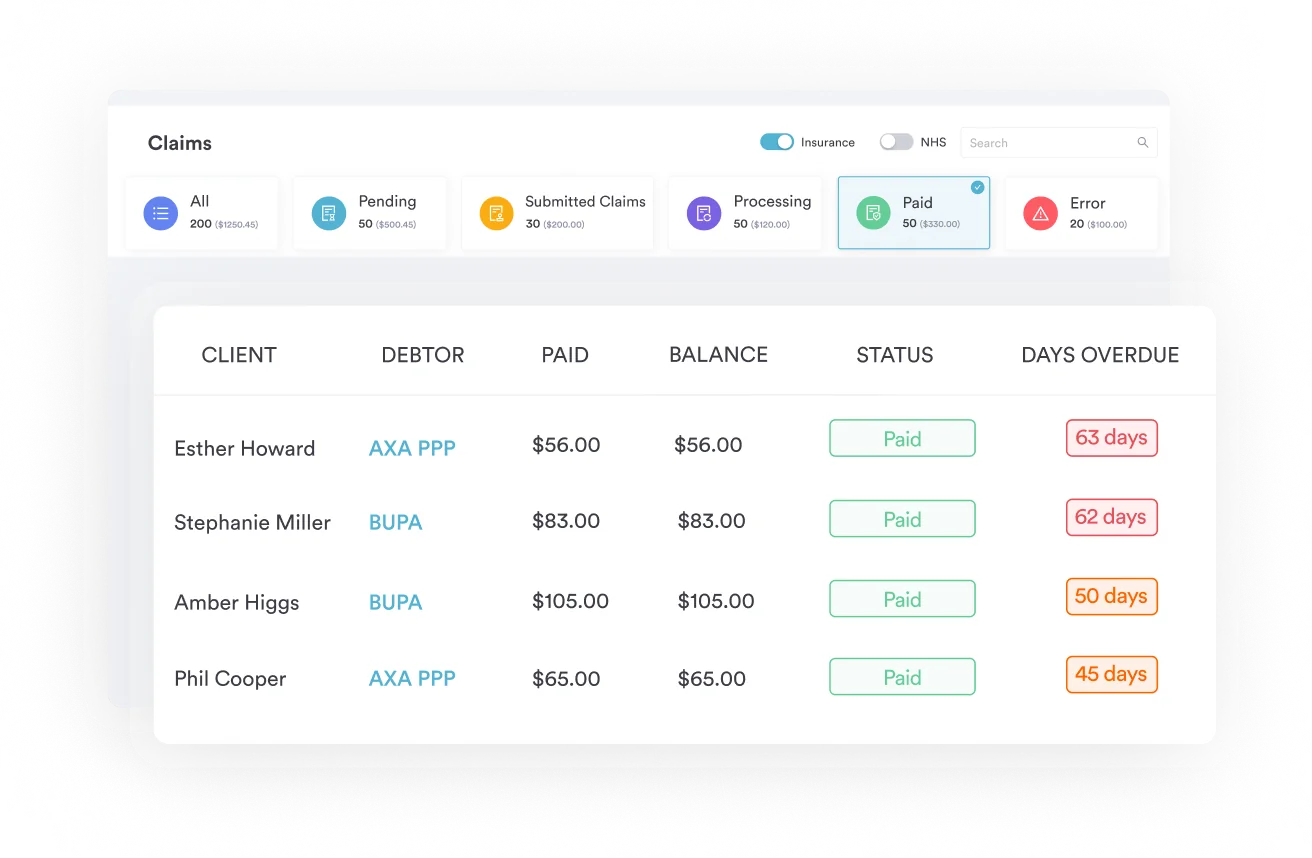
Pabau, the practice management platform we build, keeps those pieces in one patient record. Its claims management software pre-fills the claim from the record. The CPT code attached to the service lands on the charge line, and ICD-10 slots are seeded from the patient’s problem list.
Required fields are checked before the Send button unlocks. US claims then go through Claim.MD, with ERA posting and claim-status tracking.
Pabau doesn’t evaluate NCCI edits or medical necessity. The bundling and diagnosis checks above stay with your coder.

Pabau pre-fills claims from the patient record, checks required fields before sending, and submits them through Claim.MD. See how it fits your lab billing workflow.

Most 86376 problems start before the claim exists. Decide who runs the assay, code what the chart confirms, and count one unit per antibody. Do those three and most of the denials above never show up.
The trade-off is a little more discipline at the order stage. It takes a minute per patient, and it’s far cheaper than an appeal. Want to pre-fill claims from the patient record and send them through Claim.MD?
Book a demo to see Pabau with your own lab workflow.

Wondering what happens after you press Send? Pabau’s Claim.MD clearinghouse guide walks through how US claims are checked and routed to payers.
Seeing the same denial every month? Denial management in healthcare shows how to trace a pattern back to its root cause.
New to clearinghouses? Medical claims clearinghouses explained covers what they check before a claim reaches the payer.
Want fewer coverage surprises? Insurance eligibility verification explains what to confirm before the visit.
Comparing billing platforms? The best medical billing software for US practices sets the options side by side.
Yes. The descriptor covers microsomal antibodies “eg, thyroid or liver-kidney,” each. Anti-LKM testing usually supports an autoimmune hepatitis workup, coded K75.4 once confirmed. If the lab runs anti-TPO and anti-LKM for the same patient, it reports two units.
No. Anti-TPO assays on automated analyzers are categorized as moderate complexity, so a certificate of waiver doesn’t cover them. A practice running the test in-house needs a CLIA certificate of compliance or accreditation.
It depends on the assay. Upper reference limits run from roughly 6 to 35 IU/mL, depending on the manufacturer. Read each result against the range on the lab report. A positive result supports, but doesn’t confirm, Hashimoto’s thyroiditis.
Yes. The practice that collects the specimen can bill 36415 for the venipuncture. The reference lab then bills 86376 on its own claim. Both claims should carry the same diagnosis from the order.



