CPT Code 88311: Decalcification billing guide for pathology
CPT Code 88311: Official descriptor and definition CPT Code 88311 is the add-on ...

Last Updated: Oct 13, 2026
86038 is the CPT code for antinuclear antibodies (ANA), the qualitative ANA test reported by any method. Indirect fluorescent antibody (IFA) testing is the common method, and a positive IFA screen is reported with its fluorescence pattern.
The titer is a separate code, 86039. Medicare pays 86038 under the Clinical Laboratory Fee Schedule when it is linked to an ICD-10 diagnosis that meets the MAC's Local Coverage Determination.
Let Pabau's smart automation suggest the right codes, reduce claim denials, and keep your practice compliant—effortlessly.
Automate repetitive tasks and focus on what matters most—your patients.
Reduce coding errors and ensure compliance with the latest regulations.
Clean claims, fewer denials, and faster reimbursements.
Powerful insights and reporting to help your practice thrive.
HIPAA compliant SOC 2 certified GDPR-compliant Trusted by 4,000+ clinics worldwide

CPT code 86038 covers the qualitative ANA test by any method, with IFA as the common method. It reports presence or absence, not a titer.
86039 is the companion titer code, and billing both on the same day needs separate clinical justification and may trigger NCCI bundling review.
Medicare coverage requires an ICD-10 diagnosis supported by your MAC’s Local Coverage Determination, and an unsupported diagnosis is a common denial cause.
An ABN does not prevent a denial. It lets you bill the patient when Medicare denies a test ordered for a non-covered diagnosis.
Pabau, the practice management software we build, checks required claim details before each 86038 claim is sent and tracks it through to payment.
CPT code 86038 describes antinuclear antibody (ANA) testing by any method, as defined by the American Medical Association’s CPT code set. Indirect fluorescent antibody (IFA) testing is the common method, but ELISA and multiplex immunoassay results are reported under 86038 too. The test is qualitative: it reports whether antinuclear antibodies are present or absent. On a positive IFA result, the laboratory also identifies the fluorescence pattern (homogeneous, speckled, nucleolar, centromere). It does not report a quantitative titer.
The IFA method uses fluorescently labeled antibodies to detect binding to nuclear antigens on a substrate (typically HEp-2 cells). Positive screens are then reported with pattern information, which guides whether follow-on confirmatory testing is clinically warranted.
The line between the screen, the titer and the specific antibody tests decides which code each result goes under.
Included under 86038:
Excluded from 86038:
A lab may run the screen and then reflexively quantify the titer on a positive result. In that case, both 86038 and 86039 may be billable, but only with separate clinical documentation supporting each service. Bundling both without justification triggers NCCI edit review.
CPT 86039 describes the ANA titer. It quantifies the antibody concentration on a positive screen and confirms the fluorescence pattern. The two codes describe distinct analytic steps — a screen and a measurement — so each result maps to one code.
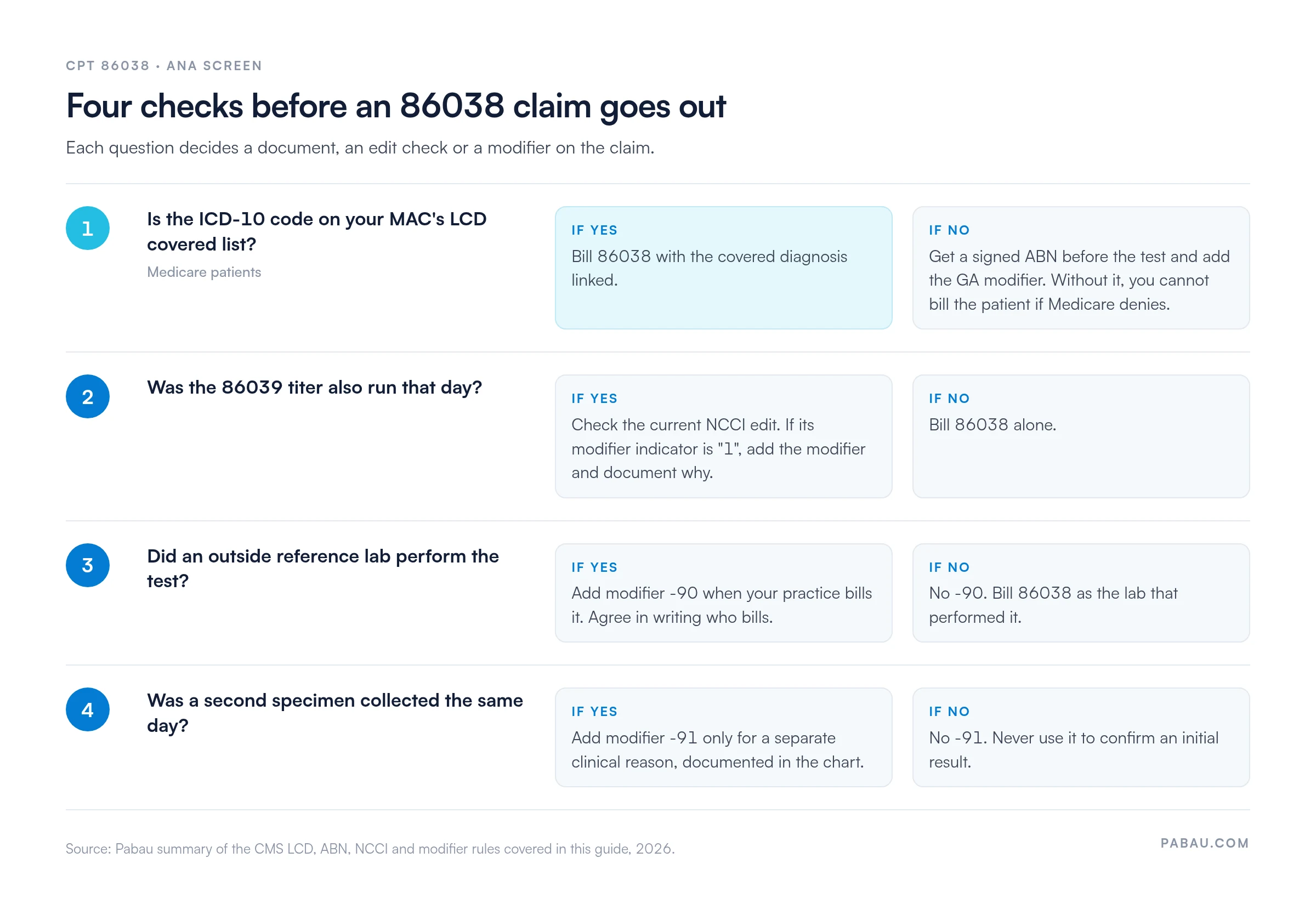
Check the current NCCI edit file before billing both codes same-day. NCCI edits are updated quarterly by CMS, and the edit status between 86038 and 86039 can change. If an edit exists with a modifier indicator of “1,” appending the appropriate modifier with documented clinical justification allows both codes to process.
Rheumatology workups rarely order 86038 in isolation. The following codes are commonly co-ordered, and each has its own NCCI edit profile and medical necessity requirements. See the AAPC’s CPT code reference for full descriptors on each.
Panels that follow a positive ANA often add 86225 for anti-dsDNA and 86235 for each extractable nuclear antigen tested. These are distinct analytes and are generally billable together with 86038. Still, check the NCCI edit table for each pairing before claim submission. When the picture could be allergic rather than autoimmune, the provider may order 86003 instead.
Medical necessity for CPT code 86038 is established by linking it to an ICD-10 diagnosis code that reflects the clinical indication. Medicare contractors apply LCD criteria, and a diagnosis outside the covered list is denied. Use the CDC’s ICD-10-CM web tool to confirm current code descriptions. Pabau’s ICD-10-CM code guides explain each diagnosis code in more depth.
LCD policies vary by Medicare Administrative Contractor (MAC) jurisdiction. A diagnosis accepted by Noridian may not be listed under Novitas or CGS. Always verify the active LCD number for your MAC before submitting claims with less common ICD-10 codes. When the ICD-10 code does not appear on the covered list, an Advance Beneficiary Notice (ABN) is needed to bill the patient if Medicare denies.
When SLE is already confirmed, the order usually carries M32.9. A rule-out workup with no confirmed diagnosis more often carries a symptom code such as R68.89.
Before billing CPT code 86038 for a Medicare patient, confirm the ordering provider’s chart notes document at least one of the covered ICD-10 diagnoses. For a rule-out with no confirmed diagnosis yet, R68.89 is the most defensible sign-and-symptom code for many MACs. Check your specific LCD before relying on it.
Medicare pays CPT code 86038 under the Clinical Laboratory Fee Schedule (CLFS), not the Medicare Physician Fee Schedule (MPFS). That holds whether an independent laboratory or a physician office lab runs the test. The CLFS sets one national payment amount per code. Medicare pays the lower of that amount and the laboratory’s actual charge. Use the CMS Clinical Laboratory Fee Schedule files to confirm current rates for your setting.
Reimbursement rates for lab codes change annually. The CLFS rate for 86038 has historically fallen in the $10 to $20 range. Confirm it against the current CMS CLFS file rather than estimating from a prior year.
Documentation is the other common denial trigger alongside ICD-10 linkage. The chart must support the medical necessity of ordering an ANA screen. For medical billing compliance, the record should carry each of these elements.
Payers audit 86038 claims when the ordering pattern shows high volume relative to practice specialty. A rheumatology practice ordering ANA screens is expected. A dermatology practice ordering them without a documented connective tissue disease workup attracts review.
Two modifiers apply to CPT code 86038 in specific billing scenarios. Using either incorrectly increases denial risk and audit exposure.
Modifier -91 has a precise rule. It applies only when a separate specimen is collected on the same date of service for an independent clinical reason. CMS and the AMA both prohibit using -91 to reconfirm or verify an initial test result. Documentation must clearly state the clinical rationale for the repeat specimen.
A clean CPT 86038 claim gets five details right. A mismatch on any one of them can trigger a denial or an audit flag.
Modifiers -90 and -91 follow their own rules, which are covered in the billing modifiers section above.
CPT code 86038 denials follow a few predictable patterns, and four questions asked before submission address each of them. For the denials that still get through, denial management workflows cut the rework.
Run a quarterly audit of your 86038 claims against your MAC’s current LCD. LCD policies update, and a diagnosis that was covered under last year’s LCD may no longer qualify. Flag any active claims still carrying retired covered diagnoses and update them before the MAC’s next edit cycle.
Checking ICD-10 linkage, NCCI edits and LCD coverage by hand for every 86038 claim takes time, and errors creep in at volume. Re-keying patient and payer details and chasing claim status add more manual work on top.
Pabau keeps the patient’s insurer and policy on the patient record, so each invoice routes to the right payer without re-keying. Its claims software for practices runs validation checks every time you go to send a claim. If a required detail such as the member ID or a prior authorization number is missing, the claim can’t be sent until it’s fixed.
For US practices, Pabau connects to Claim.MD, its US clearinghouse partner. Each invoice becomes an electronic CMS-1500 claim for thousands of US payers. You can run a real-time eligibility check before the test is ordered, follow the claim’s status and post ERA remittances against the invoice.
Coding decisions stay with your team. Pabau doesn’t check a diagnosis against your MAC’s LCD or the NCCI table, so the four checks above still apply. What it removes is the re-keying and the chasing, and denied claims are flagged for rework in the same dashboard. See clean claim submission for the full pre-submission checklist.

Pabau checks required claim details before each 86038 claim is sent, then tracks it through Claim.MD to ERA posting. Billing staff spend less time re-keying and chasing claims.

CPT code 86038 itself rarely causes the denial. It fails on a diagnosis outside your MAC’s LCD, an 86039 billed without the NCCI check, or a -91 used to confirm a result.
So fix the order upstream. Put the LCD check and the ABN decision where the requisition is written, not at billing. An ABN signed after the test cannot shift liability to the patient.
The trade-off is a few minutes per order against a test you may never be able to bill. Book a demo to see how Pabau keeps 86038 claims, eligibility checks and ERA posting in one dashboard.

Need to understand how denials are tracked and resolved? Denial management in healthcare covers workflows for identifying, appealing, and preventing recurring claim rejections.
Want the full picture on medical billing processes? Revenue cycle management explained breaks down how each billing step connects from patient registration to payment posting.
Looking for denial code definitions? Denial codes in medical billing is a reference guide to common CARC and RARC codes returned on remittances.
Running an RA workup alongside the ANA? ICD-10 code M06.9: rheumatoid arthritis guide explains when the unspecified rheumatoid arthritis code supports the order.
Evaluating mixed connective tissue disease? ICD-10 code M35.1: other overlap syndromes covers the code used for MCTD and other overlap presentations.
CPT code 86038 covers qualitative antinuclear antibody (ANA) testing by any method, and indirect fluorescent antibody (IFA) testing is the common method. It reports a positive or negative result, with the fluorescence pattern on IFA. It does not include titer quantification, which is reported separately under CPT 86039.
CPT 86038 is the ANA screen — a qualitative present-or-absent result with a pattern. CPT 86039 is the ANA titer — a quantitative dilution result, such as 1:80 or 1:320. Use 86038 for the initial workup and 86039 when titration follows a positive screen. Billing both on the same day requires separate clinical documentation and is subject to NCCI bundling review.
Commonly accepted ICD-10 codes include M32.9 (systemic lupus erythematosus), M06.9 (rheumatoid arthritis), M35.00 (Sjogren syndrome) and M35.1 (mixed connective tissue disease). R68.89 (other general symptoms and signs) covers rule-out workups. Accepted diagnoses vary by MAC jurisdiction and active LCD, so check your MAC’s LCD before submitting.
Yes, Medicare covers CPT code 86038 when the submitted ICD-10 diagnosis meets the medical necessity criteria in the applicable MAC Local Coverage Determination (LCD). Coverage depends on the MAC jurisdiction and whether the patient’s diagnosis appears on that MAC’s covered diagnosis list.
Modifier -90 (reference laboratory) applies when the ordering practice bills for a test sent to an outside lab. Modifier -91 (repeat clinical diagnostic test) applies when a separate specimen is collected same-day for a distinct clinical reason. CMS and AMA guidelines prohibit using it to confirm an initial result.
Yes, but only with separate clinical documentation justifying each service. The pair may be subject to an NCCI bundling edit, so check the current quarterly NCCI edit file. If an edit exists with modifier indicator “1”, document the distinct clinical rationale and append the appropriate modifier to allow both codes to process.