CPT code 93503: Swan-Ganz catheter billing and modifiers
CPT code 93503: Official descriptor and procedure overview In the AMA CPT code s...

Last Updated: Oct 23, 2026
82533 is the CPT code for cortisol; total. It reports a quantitative measurement of total cortisol, both protein-bound and free, in serum or plasma.
The code sits in the Chemistry Procedures section of the CPT code set. It covers most adrenal workups, from morning cortisol screens to ACTH stimulation tests. Free cortisol, usually measured in urine, is reported with 82530 instead.
Let Pabau's smart automation suggest the right codes, reduce claim denials, and keep your practice compliant—effortlessly.
Automate repetitive tasks and focus on what matters most—your patients.
Reduce coding errors and ensure compliance with the latest regulations.
Clean claims, fewer denials, and faster reimbursements.
Powerful insights and reporting to help your practice thrive.
HIPAA compliant SOC 2 certified GDPR-compliant Trusted by 4,000+ clinics worldwide

CPT 82533 reports total cortisol from serum or plasma, while CPT 82530 reports free cortisol, usually from urine, so the two codes aren’t interchangeable.
Panel code 80400 must include two cortisol measurements, so those two draws are never billed again as separate 82533 lines.
A third draw in an ACTH stimulation test goes on its own 82533 line with modifier 59, which marks it as a distinct specimen.
Medicare pays 82533 through the Clinical Laboratory Fee Schedule at a national rate of $16.30 per unit, unchanged since January 1, 2020.
Pabau’s claims management software checks ICD-10 codes, modifiers, and ordering provider details before a cortisol claim leaves the practice.
CPT code 82533 is a chemistry procedure code with the official descriptor “Cortisol; total.” It covers the quantitative measurement of total cortisol in serum or plasma using immunoassay or liquid chromatography-tandem mass spectrometry (LC-MS/MS) methodology.
The code belongs to the Chemistry Procedures subsection of the Pathology and Laboratory section of the CPT code set, maintained by the American Medical Association.
Accepted specimen types are serum and plasma. Whole blood and saliva are not valid specimens for 82533. Salivary cortisol has separate billing implications covered further below.
Total cortisol includes both the protein-bound fraction (approximately 90-95% of circulating cortisol, bound to cortisol-binding globulin and albumin) and the unbound free fraction.
This differs from the free cortisol measured by CPT 82530, which captures only the biologically active unbound fraction from urine. Most clinical protocols for adrenal disorders and stimulation testing use total serum cortisol, making 82533 the more frequently ordered of the two codes.
A frequent coding error on cortisol claims is using 82530 when the specimen is serum. These two codes cover different analytes, different specimen types, and different clinical purposes.
When the order reads “serum cortisol” or “plasma cortisol,” use 82533. When the order specifies “free cortisol” or “24-hour urine cortisol,” use 82530. Mixing these codes on a claim results in a medical necessity mismatch between the submitted code and the ordered test.
The ACTH stimulation test, also called a cosyntropin stimulation test, is the most common reason 82533 appears more than once on one date of service.
Many protocols draw cortisol at three time points: baseline before the cosyntropin injection, then 30 and 60 minutes after it. Each draw is a separate specimen, but the panel code decides how many of them reach the claim as 82533.
Panel code 80400 is the ACTH stimulation panel for adrenal insufficiency. Its CPT descriptor says it must include cortisol (82533 x 2), so it bundles exactly two cortisol measurements into one panel line. Those two draws are never billed again as separate 82533 units.
A three-draw protocol leaves one specimen outside the panel. Report that third draw as its own 82533 line with modifier 59, as the diagram below shows. Panel policies still differ by payer, so check your MAC’s local coverage determination and commercial contracts before submitting.
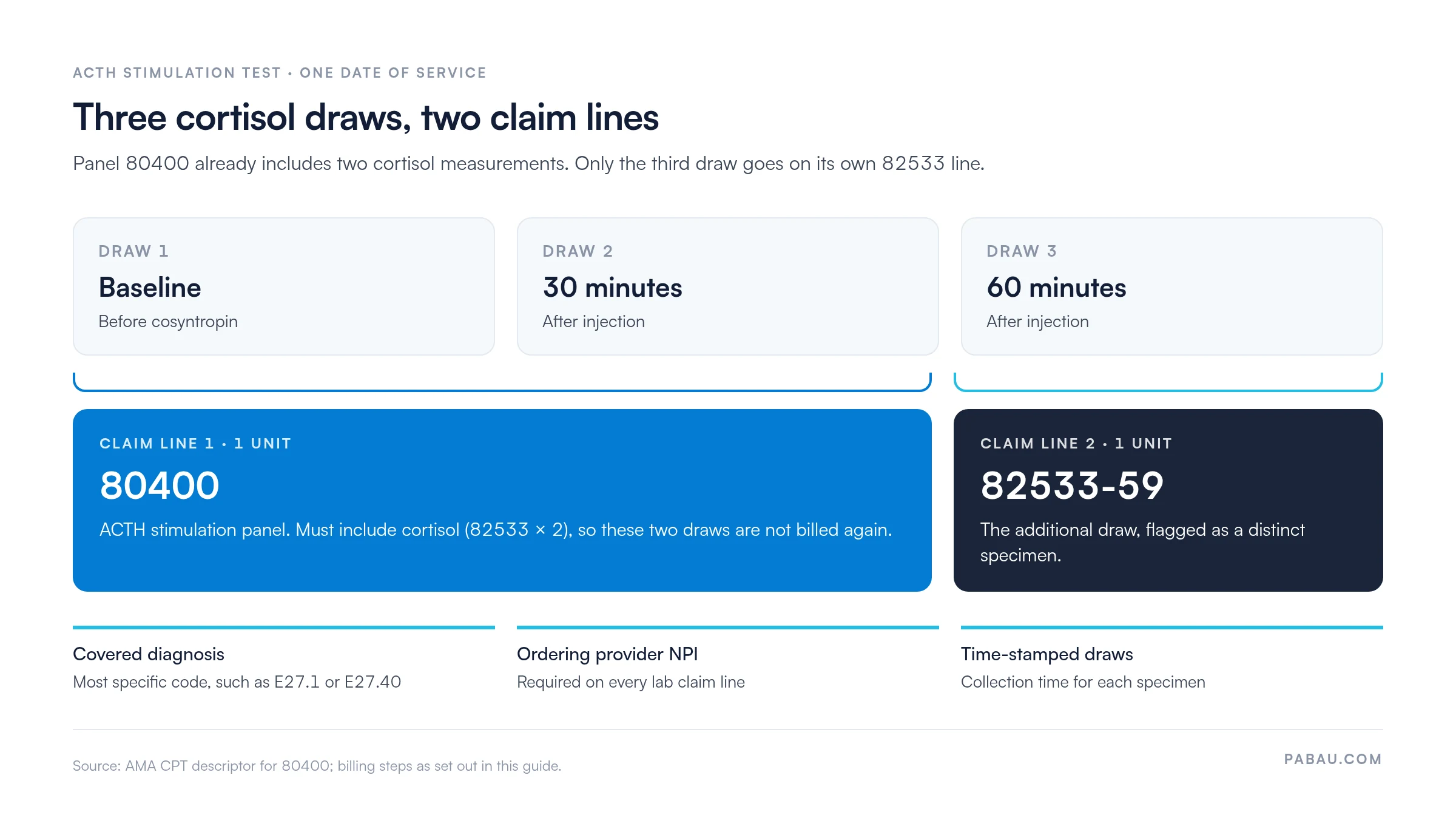
Modifier 59 tells the payer that the extra cortisol test is a distinct service and sits outside the panel. AAPC guidance states that modifier 59 is necessary in this combination. Submitting 82533 with 80400 without modifier 59 triggers an automatic bundling edit and a denial.
Each specimen draw requires documentation in the medical record to support separate billing. Record the collection time for each draw (e.g., 08:00 baseline, 08:30 post-injection, 09:00 final).
Document the cosyntropin dose administered, the route, and the clinical indication that prompted the stimulation test. Without time-stamped collection notes for each draw, a payer reviewing a multi-unit claim has no basis to confirm separate specimens were collected.
Every CPT 82533 claim requires a linked ICD-10-CM diagnosis code that establishes medical necessity. Functional medicine practices and endocrinology offices order cortisol testing frequently, but the diagnosis must appear on the claim before the payer will adjudicate.
The following codes are the primary ICD-10-CM pairings recognized under most Medicare LCDs and commercial payer policies.
Payer policies vary by MAC jurisdiction. Some LCDs restrict coverage to confirmed adrenal diagnoses (E27.x, E24.x codes) and do not cover 82533 for fatigue or stress screening alone. Review your MAC’s specific LCD before submitting R53.83 as the primary diagnosis.
Always link the most specific ICD-10 code available to the cortisol order. A claim submitted with E27.40 (unspecified adrenocortical insufficiency) is more likely to clear than one with a general symptom code like R53.83. Specificity reduces the chance of a medical necessity denial on the first pass.
Medicare covers CPT 82533 under Part B as an outpatient clinical laboratory service. It needs an order from a treating physician and an appropriate ICD-10-CM diagnosis. Coverage for serum and plasma cortisol is well established.
Salivary cortisol faces much tighter Medicare restrictions. The current reference is coverage article A57612, which absorbed the retired article A57613 on October 16, 2025. Never bill salivary cortisol with CPT 82533, because the specimen mismatch invites both denial and audit exposure.
Medicare pays CPT 82533 through the Clinical Laboratory Fee Schedule (CLFS), not the Physician Fee Schedule. The national CLFS rate for 82533 is $16.30 per unit, and it hasn’t changed since January 1, 2020.
CMS publishes updated CLFS files each year, so confirm the current figure on the CMS Clinical Laboratory Fee Schedule page before billing.
Medicare does not require prior authorization for CPT 82533 as a standalone laboratory test. Medicare Part B covers clinical laboratory services without pre-authorization when the ordering physician documents medical necessity with an appropriate ICD-10 diagnosis.
Commercial payers vary significantly. Most do not require prior authorization for a single cortisol measurement. However, some commercial and Medicare Advantage plans require it when 82533 is ordered as part of a stimulation panel.
That usually means multiple units on a single date of service. Check payer-specific requirements before scheduling the ACTH stimulation protocol, particularly for Medicare Advantage plans, which set their own prior authorization rules independent of traditional Medicare.
When a payer requires prior authorization and it is not obtained, the resulting denial is non-appealable in most contract scenarios. Always verify requirements for multi-unit claims in advance.
Cortisol claims trip up practices that order them infrequently, because the modifier and panel rules often surface only after a denial lands. A strong denial management workflow catches these patterns before they accumulate.
When cortisol claims return unpaid, check the medical billing denial codes, especially CO-4 (incorrect or missing modifier) and CO-50 (not medically necessary).
Both are addressable through appeals with supporting documentation. Understanding clean claim submission standards for laboratory codes reduces first-pass denials substantially.
Documentation requirements for 82533 are straightforward for a single baseline cortisol measurement. They become more complex when multiple units are billed for a stimulation protocol. The medical record must support every unit submitted.
Insufficient documentation is a common cause of medical necessity denials on 82533 claims. A lab requisition alone does not satisfy documentation requirements. The clinical note must record why the test was ordered, not just that it was ordered.
Billing 82533 correctly in a practice management system (PMS) or EHR requires linking several claim elements before submission. Missing any one of them is enough to generate a denial. Understanding medical billing fundamentals for laboratory codes helps avoid the most common setup errors.
For practices using a standalone lab-order workflow, confirm that the PMS passes the collection time and specimen type fields to the clearinghouse. Some older PMS configurations drop these fields from lab claims, so the payer never sees them even when the chart note is complete.
Use the AAPC Codify CPT lookup or PGM Billing’s CPT code search to confirm 82533 is still active each January.
Run a quarterly audit on all 82533 claims submitted in the prior 90 days. Filter for: claims with units greater than 1, claims billed alongside 80400, and claims denied under CO-4 or CO-50. This 15-minute review catches modifier omissions and ICD-10 pairing errors before they compound across hundreds of encounters.
In many practices, a cortisol claim is still built by hand. Someone picks the code, remembers the panel rule, and adds modifier 59 from memory. When a step slips, the denial shows up weeks later on the remittance.
Pabau, the practice management platform we build, checks that work before the claim leaves the practice. The claims software for practices inside Pabau scrubs every claim for missing or invalid details, such as an absent modifier or diagnosis. US claims then go out through the Claim.MD clearinghouse to thousands of payers.
Eligibility checks run before the visit, and electronic remittance advice files settle payments without manual posting. Your billing team spends its hours on new claims instead of reworking denied lab lines.

Pabau’s claims management checks ICD-10 codes, modifiers, and ordering provider details before submission, so cortisol claims reach the payer complete.

Settle how an ACTH stimulation test will be reported before the first draw. If panel 80400 applies, it carries two cortisol measurements, and only a third draw earns its own 82533 line with modifier 59. That one decision removes the bundling denial from your cortisol claims.
The remaining fixes are routine: match the specimen to the code, pair the most specific adrenal diagnosis, and time-stamp every draw. A few extra minutes at order entry cost far less than reworking a denied claim weeks later.
Book a demo to see how Pabau checks modifiers, diagnoses, and ordering provider details on lab claims before they reach the clearinghouse.

Getting repeated CO-50 denials on lab codes? Medical billing compliance for clinical practices covers documentation standards and audit-readiness for laboratory services.
Want to understand how remittance data helps prevent future denials? What is revenue cycle management covers how ERA data feeds into denial pattern analysis and claim rework prioritization.
CPT code 82533 covers the quantitative measurement of total cortisol in serum or plasma. It includes both protein-bound and free fractions of cortisol, measured by immunoassay or LC-MS/MS. It does not cover free cortisol from urine (CPT 82530) or salivary cortisol.
CPT 82530 covers free cortisol, typically from a 24-hour urine collection. CPT 82533 covers total cortisol from serum or plasma. They measure different analytes from different specimen types and are not interchangeable. Billing 82530 when a serum cortisol was ordered is a specimen mismatch that results in denial.
It depends on whether panel 80400 is reported. The panel must include two cortisol measurements, so those draws are not billed again as 82533. A three-draw protocol adds one 82533 unit with modifier 59 for the third draw. Check your MAC’s LCD and payer contracts before submitting.
Yes. Modifier 59 is required when billing CPT 82533 alongside panel code 80400 on the same date of service. Use it only on a cortisol draw beyond the two the panel already includes. Without modifier 59, the payer’s bundling logic treats 82533 as a component of 80400 and denies it as a duplicate. AAPC guidance confirms this modifier requirement.
The national Medicare Clinical Laboratory Fee Schedule rate for CPT 82533 is $16.30 per unit, unchanged since January 1, 2020. Confirm the current figure in the CLFS files CMS publishes each year before billing.
No. CPT 82533 is specific to serum and plasma specimens. Salivary cortisol uses different coding and faces much tighter Medicare coverage criteria under coverage article A57612, which replaced article A57613 in October 2025. Billing a salivary specimen under 82533 is a specimen mismatch and may trigger audit scrutiny beyond the initial denial.