

CPT Code 98981: RTM Treatment Management Billing Guide
CPT code 98981: Definition and official descriptor CPT code 98981 is an add-on c...

Last Updated: Nov 9, 2026
82627 is the CPT code for dehydroepiandrosterone-sulfate (DHEA-S), a quantitative blood test for the sulfated adrenal androgen.
It's billed once per test, usually from a serum sample, to investigate androgen excess such as PCOS or hirsutism, or an adrenal disorder. It is separate from 82626, which reports dehydroepiandrosterone (DHEA), the unconjugated form. Match the code to the analyte named on the lab report.
Let Pabau's smart automation suggest the right codes, reduce claim denials, and keep your practice compliant—effortlessly.
Automate repetitive tasks and focus on what matters most—your patients.
Reduce coding errors and ensure compliance with the latest regulations.
Clean claims, fewer denials, and faster reimbursements.
Powerful insights and reporting to help your practice thrive.
HIPAA compliant SOC 2 certified GDPR-compliant Trusted by 4,000+ clinics worldwide

CPT code 82627 reports one quantitative DHEA-S (dehydroepiandrosterone sulfate) test, the sulfated adrenal androgen measured in serum or plasma.
Bill 82627 when the lab report names DHEA-S or DHEA sulfate, and 82626 when it names DHEA, the unconjugated form.
Each claim needs an ICD-10-CM code that matches the indication in the note, such as E28.2 for PCOS or L68.0 for hirsutism.
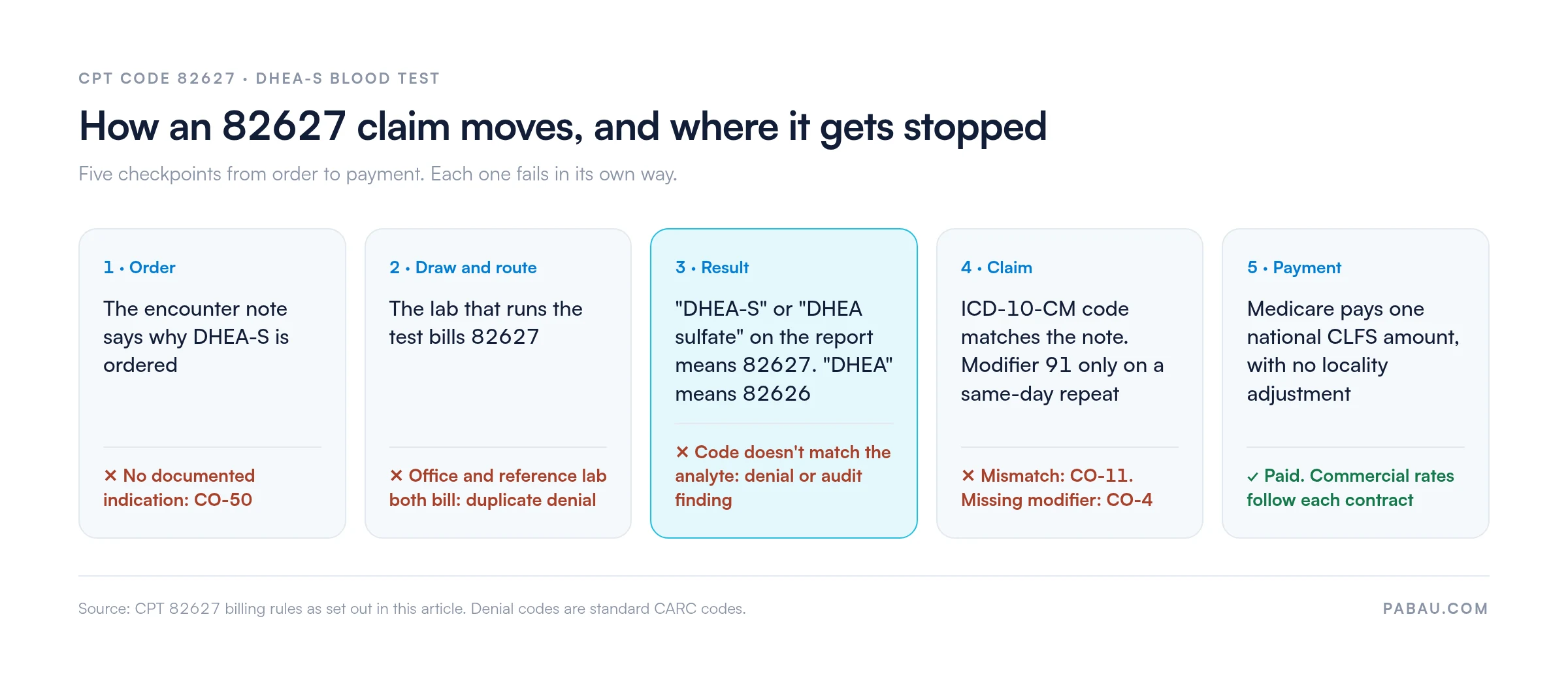
Medicare pays lab tests on the Clinical Laboratory Fee Schedule, which sets one national amount with no locality adjustment.
Pabau, the practice management platform we build, pre-fills the claim from the patient record and checks required fields before you send it.
CPT code 82627 reports a quantitative measurement of dehydroepiandrosterone-sulfate (DHEA-S), usually from a serum or plasma sample. You bill it once per test, on its own line, because no standard organ or disease panel includes it.
The AMA CPT code set places 82627 in the chemistry section of pathology and laboratory. Here’s the reference data worth keeping on file.
Nearly all circulating DHEA-S is made by the adrenal cortex. DHEA also comes partly from the ovaries and testes. That makes DHEA-S the cleaner read on adrenal androgen output. A high result points to the adrenal gland rather than the gonads, which is why clinicians order it.
Collection is a routine venous draw, and fasting usually isn’t needed. Some labs ask for a morning sample. Because it runs on the same platforms as other endocrine markers, 82627 often shares a requisition with testosterone, cortisol or SHBG.
Medical necessity for 82627 starts with a clinical question about adrenal androgens. These are the indications you’ll see most on the order:
A broad hormone panel ordered without a reason for each test is where trouble starts. Link every test on the requisition to its own indication in the encounter note, and the diagnosis codes follow naturally.
Every 82627 claim needs at least one ICD-10-CM code that states why the test was ordered. The codes below match the indications above. Payer policies vary, so check the one that applies before you bill.
Codes change every October 1, and a deleted code gets the claim rejected outright. Confirm descriptors in the CDC ICD-10-CM browser, or browse related diagnoses in our ICD-10-CM code library.
Bill 82627 when the report names DHEA-S or DHEA sulfate. Bill 82626 when it names DHEA, the unconjugated form. They’re different analytes, and a claim whose code doesn’t match the report is open to denial or an audit finding.
What if the report just says “DHEA” but the order asked for DHEA-S? Call the lab before you submit. Coding from the order instead of the result is how the wrong code reaches the payer.
DHEA-S rarely travels alone. Androgen source, adrenal output and reproductive hormones are usually checked together, so expect these codes on the same order.
Total testosterone goes on its own line as 84403, with its own diagnosis pointer. A cortisol drawn at two time points on the same day is billed as 82533 twice, with modifier 91 on the repeat.
Edit pairs change every quarter. Before you bill a combination you haven’t billed before, check the current tables on the CMS NCCI edits page.
Give each test on a multi-code requisition its own reason in the encounter note. One sentence does it: ‘DHEA-S to evaluate an adrenal source of androgen excess; cortisol to evaluate adrenal sufficiency.’ An auditor can then match every line on the claim to the chart.
An 82627 claim passes five checkpoints, and each one fails in its own way. The flow below shows where each denial comes from.
Medicare covers 82627 when a documented diagnosis supports it. There’s no national coverage determination for DHEA-S, so medical necessity is judged by your Medicare Administrative Contractor (MAC). Search your MAC’s local policies and billing articles before you assume a code is covered.
Payment for 82627 comes from the CMS Clinical Laboratory Fee Schedule, not the Physician Fee Schedule. The CLFS sets one national payment amount, so it does not vary by locality. CMS publishes updated CLFS files each quarter, so check the current file rather than quoting an old figure.
Commercial rates are set by contract and vary. Load each payer’s contracted rate into your billing system, so a short payment stands out when the remittance arrives.
Payers audit lab claims by pulling the record. These five items are what they look for on an 82627 claim.
Run this list on every claim before it leaves. It takes a minute and covers what a clean claim needs for this test.
When an 82627 claim comes back unpaid, it often carries one of these three codes. Each traces to a specific step you can fix upstream.
Three habits tend to sit behind them. Coders take the diagnosis from the order form instead of the note. A whole panel goes out under one generic code. A same-day repeat is billed as a duplicate. A denial management workflow that tags each denial by cause shows you which of these your practice repeats.
The lab that performs the test bills 82627, wherever it was ordered. Practices that send samples out and then bill the test themselves are the usual source of duplicate denials.
If your practice draws the blood and ships it out, the venipuncture (36415) may be yours to bill. Specimen handling under 99000 is bundled by Medicare, so don’t count on it. If you also bill 82627 while the lab bills it, the second claim to arrive is denied as a duplicate.
Before your first DHEA-S sample goes out, ask the reference lab one question. Does it bill the payer directly, or bill your practice for the test? The answer tells you whether 82627 belongs on your claim at all.
In many practices, the 82627 claim is built by hand. Someone copies the code from the lab report and the diagnosis from the note, then re-keys the patient’s insurance details into a clearinghouse portal.
Pabau’s faster claims management pre-fills the claim from the patient record. ICD-10-CM and CPT lookup libraries sit inside the claim form. Send only unlocks once the payer’s required fields are complete.
US claims go out through Claim.MD, with eligibility checks before the visit, ERA posting when the payer pays and status tracking in between. Your team stops re-typing claims and can see which lab claims are still waiting.
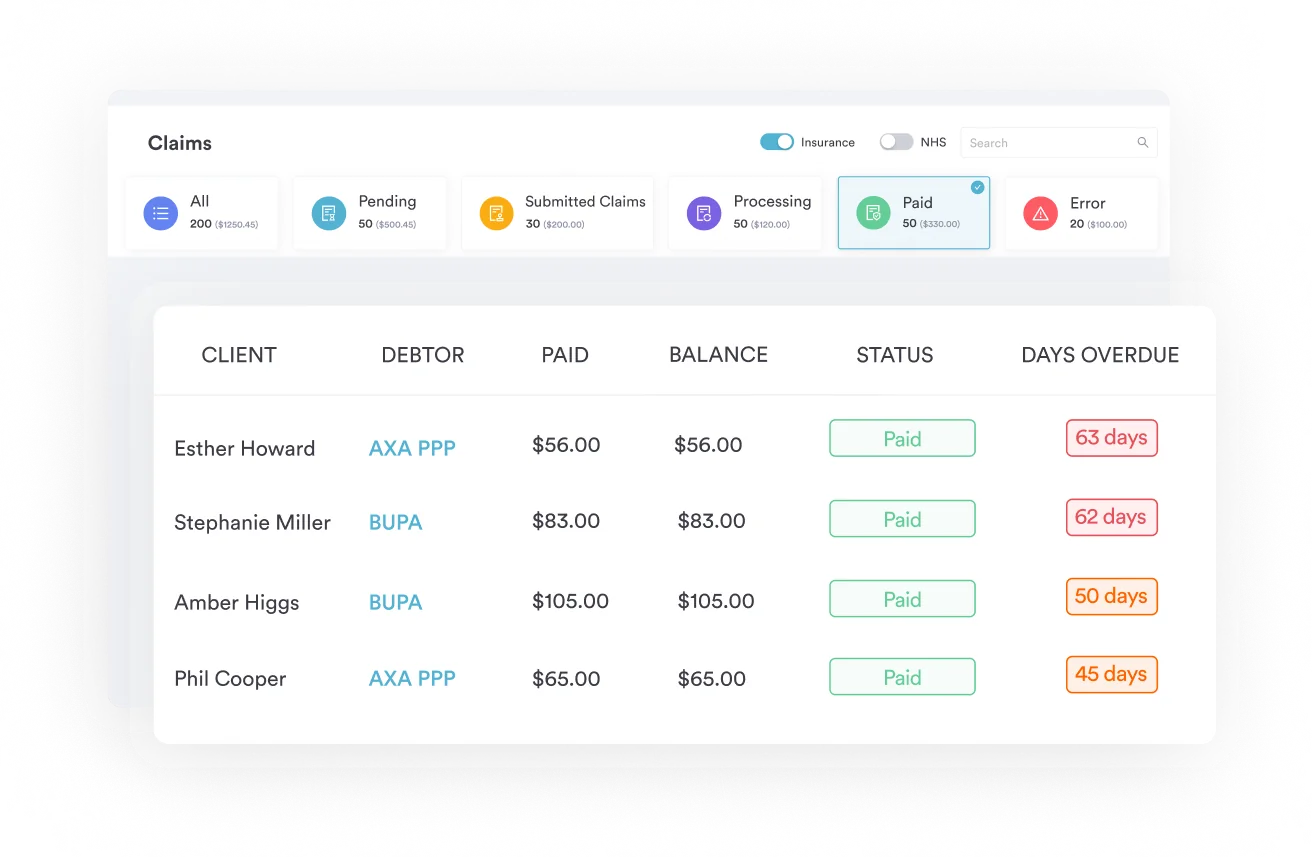

Pabau pre-fills each claim from the patient record and checks required fields before it goes out. US claims run through Claim.MD with eligibility checks, ERA posting and status tracking.

Most 82627 problems are settled before the claim exists. Code from the lab report, not the order, and make sure the note says why DHEA-S was needed.
The trade-off is a little more writing at the point of ordering. That one sentence in the note is what stands between a paid claim and a CO-50 appeal months later.
Book a demo to see how Pabau builds each lab claim from the patient record and tracks it until it’s paid.

Sending US lab claims through a clearinghouse? Claim.MD clearinghouse explains how claims, eligibility checks and remittances move through Claim.MD.
Want one page that links each service to its diagnosis? Encounter form captures the services and diagnosis codes from each visit in one place.
Comparing billing tools for your practice? Medical practice billing software weighs the features that matter for in-house billing teams.
New to the billing cycle? What is medical billing walks through each step from patient intake to payment.
Not usually. Most DHEA-S immunoassays are moderate- or high-complexity tests. An office lab running one needs a CLIA certificate that covers that complexity, so check your analyzer in the FDA CLIA database.
Only with a documented clinical reason the payer accepts. Medicare doesn’t cover checks for wellness or supplement use alone. If you expect a denial, give an ABN first or offer the test as self-pay.
CPT sets no frequency limit, but a payer policy may. Each repeat needs its own reason in the note, such as tracking a treated adrenal condition. Repeats without a new reason invite medical necessity denials.
Not much. DHEA-S has a long half-life, so it varies far less through the day than DHEA or cortisol. Age matters more, because levels peak in early adulthood and fall with age. Read each result against the lab’s age- and sex-specific range.
Medicare pays 82627 from the Clinical Laboratory Fee Schedule. The CLFS sets one national payment amount, so it does not vary by locality. CMS publishes updated CLFS files each quarter, so check the current file.




