CCSD Code B2710: Radical mastectomy including block dissection
CCSD Code B2710: Definition and clinical scope CCSD Code B2710 is the UK private...

Last Updated: Nov 13, 2026
J0834 is the HCPCS Level II code for injection, cosyntropin, 0.25 mg. One billing unit equals one 0.25 mg vial, the dose used in the rapid ACTH stimulation test for adrenal insufficiency.
J0834 claims are usually denied over the details around the code. Common causes are a missing NDC, a deleted or outdated code such as J0833, or no supported ICD-10 diagnosis.
Let Pabau's smart automation suggest the right codes, reduce claim denials, and keep your practice compliant—effortlessly.
Automate repetitive tasks and focus on what matters most—your patients.
Reduce coding errors and ensure compliance with the latest regulations.
Clean claims, fewer denials, and faster reimbursements.
Powerful insights and reporting to help your practice thrive.
HIPAA compliant SOC 2 certified GDPR-compliant Trusted by 4,000+ clinics worldwide

HCPCS Code J0834 covers cosyntropin injection, 0.25 mg, and one billing unit equals one 0.25 mg vial.
J0833 was a not-otherwise-specified 0.25 mg cosyntropin code, deleted January 1, 2019, so J0834 is the code to report.
The NDC in 11-digit format with the N4 qualifier is required by Medicaid and many commercial payers.
The most common denial triggers are a missing or unsupported ICD-10 diagnosis code, an omitted NDC, and billing the deleted code J0833.
Pabau, the practice management platform we build, supports insurance billing and electronic claims through its claims management tools.
HCPCS Code J0834 is the HCPCS Level II code for injection, cosyntropin, 0.25 mg. CMS’s JW and JZ modifier code list prints the official descriptor as Injection, cosyntropin, 0.25 mg. One unit equals one 0.25 mg dose, which is the standard vial size for the rapid ACTH stimulation test. The Centers for Medicare and Medicaid Services maintains this HCPCS Level II drug code set.
Cosyntropin is a synthetic analogue of adrenocorticotropic hormone (ACTH). It stimulates the adrenal cortex to produce cortisol, making it the agent of choice for diagnosing adrenal insufficiency. The brand name is Cortrosyn, manufactured by Amphastar Pharmaceuticals. The generic is also available from other suppliers.
Cosyntropin is administered primarily to diagnose primary and secondary adrenal insufficiency through the rapid ACTH stimulation test. The test measures serum cortisol before the injection and at 30 and 60 minutes after. A peak cortisol below 18-20 mcg/dL generally indicates adrenal insufficiency, so verify the exact threshold against your payer’s LCD.
The cortisol draws are lab work billed on their own claim lines, and the panel for this test is CPT 80400. The CRH stimulation test for Cushing’s syndrome is a separate workup, and its drug billed under corticorelin code J0795 until December 31, 2025.
FDA-approved indications include evaluation of adrenocortical function and diagnosis of adrenal insufficiency. Clinicians also use cosyntropin to evaluate the hypothalamic-pituitary-adrenal (HPA) axis after steroid withdrawal and to screen for congenital adrenal hyperplasia.
One unit of HCPCS Code J0834 equals one 0.25 mg dose of cosyntropin. Because the standard cosyntropin vial contains exactly 0.25 mg, one vial equals one unit in almost every clinical scenario. Bill one unit per injection unless the administering clinician documents a clinical reason for a different quantity.
A J0834 claim needs several fields beyond the code itself, and the same pattern holds across payers. The diagram after the list shows how the lines fit together on one claim.
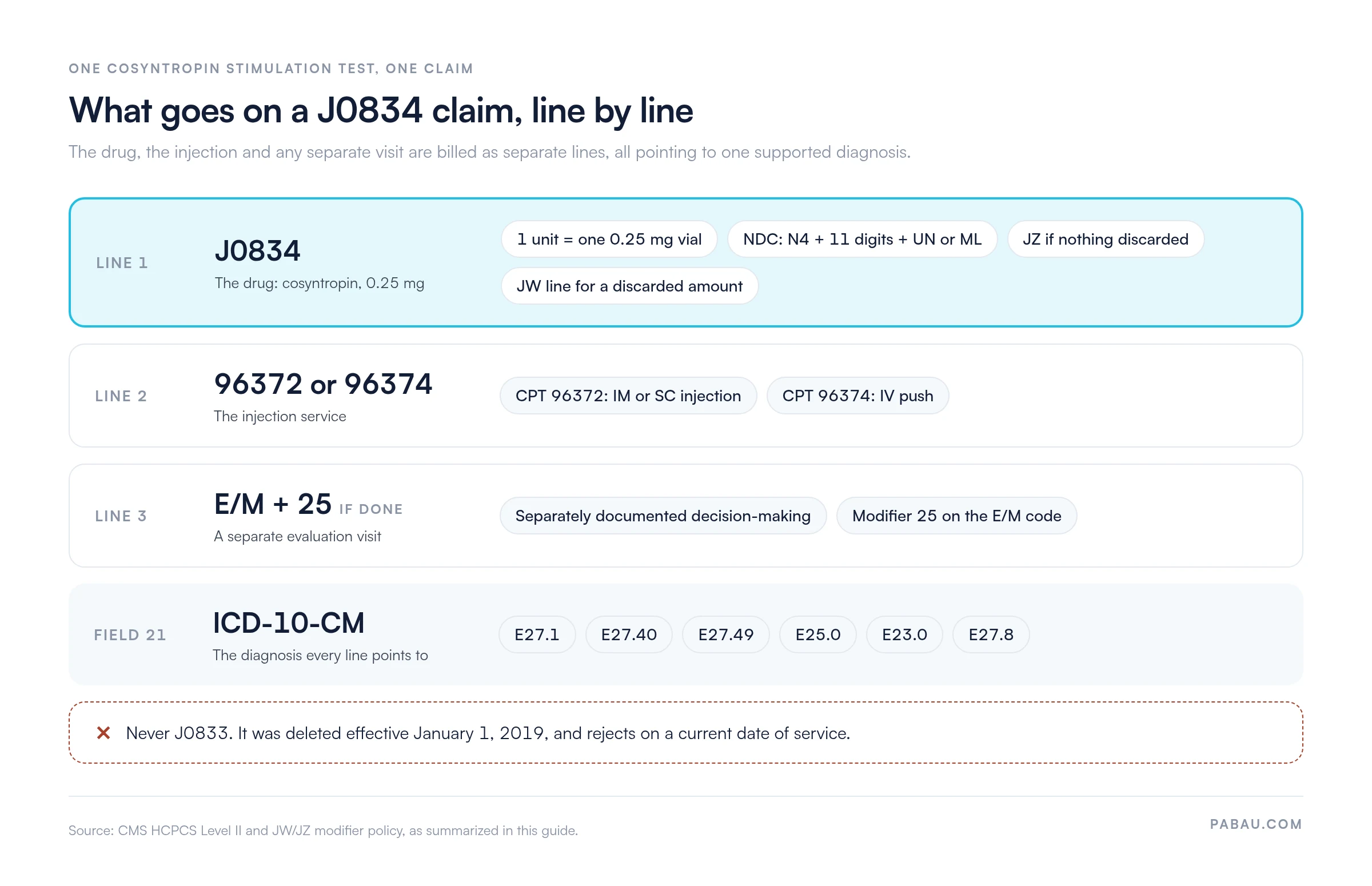
Medicaid requires an 11-digit NDC for every drug claim, and many commercial payers impose the same requirement. On the claim, the NDC takes the N4 qualifier, then the 11-digit number, then a unit of measure qualifier (ML for milliliters, UN for units). Do not use the NDC as printed on the vial label without reformatting. Drug manufacturers print NDCs in a 10-digit hyphenated format, so you zero-pad the correct segment to reach 11 digits.
Verify the exact NDC from the cosyntropin package labeling you dispensed from, since different manufacturers and lot presentations carry different NDCs. Never copy an NDC from a reference guide. Transcribe it from the vial used in that encounter.
Always photocopy or scan the vial label at the time of administration and attach it to the encounter record. This creates an auditable NDC source and eliminates the most common NDC-related denial: a submitted NDC that does not match the product dispensed.
Medical necessity for HCPCS Code J0834 must be established by an ICD-10-CM diagnosis code that directly supports the clinical use of cosyntropin. The codes below are the most commonly accepted diagnoses, and you can check each one in our full ICD-10-CM code library. Local Coverage Determinations (LCDs) from your Medicare Administrative Contractor (MAC) may specify a narrower or broader list.
Always verify the final code selection against your MAC’s LCD for adrenal function testing. Using E27.40 on a claim where the payer’s LCD requires a more specific code is a common medical necessity denial trigger.
J0833 was the HCPCS code for injection, cosyntropin, not otherwise specified, 0.25 mg. It was deleted effective January 1, 2019, and J0834 is the active code for cosyntropin. Both codes used the same 0.25 mg unit, so only the code on the claim changes.
A claim that uses the deleted code J0833 on a current date of service will reject, so bill J0834. Check charge masters, superbill templates and saved order sets for the old code, because a stale template keeps resubmitting it.
Medicare Part B reimburses J0834 under the Average Sales Price (ASP) methodology. For non-facility settings (POS 11, physician office), the standard payment rate is ASP plus 6%. For facility settings (POS 22, outpatient hospital), payment runs through the Hospital Outpatient Prospective Payment System (OPPS). Depending on its current packaging status, cosyntropin may be separately payable or packaged into the APC rate.
CMS updates ASP-based drug payment rates quarterly. Never rely on a static figure from a reference guide. Before quoting a reimbursement amount, verify the current allowable in the CMS Physician Fee Schedule lookup tool and the quarterly ASP Drug Pricing file.
Place-of-service selection directly affects the payment rate, so confirm that the POS code matches where the drug was physically administered.
Traditional Medicare generally does not require prior authorization for J0834. However, Medicare Advantage plans and many commercial payers impose their own PA requirements, and these vary significantly by plan. Never assume Medicare’s traditional policy applies to a Medicare Advantage patient.
Cosyntropin comes in a 0.25 mg per 1 mL single-dose vial. Because one vial equals one billing unit, wastage arises only when part of the vial goes unused. A full 0.25 mg dose given as intended leaves no wastage to report. When partial use or vial loss does occur, two modifiers govern how to report it on a Medicare claim.
The JW modifier identifies the unused portion of a single-dose vial that is discarded in accordance with FDA labeling. With the JW modifier, the administered amount goes on the primary J0834 line. The discarded amount goes on a separate J0834 line with JW appended. The JW line does not change the total payment but documents that the disposal was legitimate and compliant.
The JZ modifier, introduced by CMS effective January 1, 2023, is an attestation that there was zero wastage from the vial. If the entire 0.25 mg was administered and nothing was discarded, append the JZ modifier to the J0834 line. This modifier eliminates the need to file a separate JW line and simplifies the claim while still satisfying CMS documentation requirements.
Yes, J0834 can be billed with an Evaluation and Management (E/M) code on the same date of service. The E/M visit must be a separately identifiable medical service beyond the drug administration itself.
Three codes typically appear on the same J0834 claim. First, J0834 covers the cosyntropin drug. Second, an administration code covers the act of injecting it: CPT 96372 for an intramuscular or subcutaneous injection, or CPT 96374 for an intravenous push. Third, an E/M code with Modifier 25 covers the separate clinical evaluation, if one was provided.
The documentation in the medical record must support all three services as distinct. A chart note that describes only the stimulation test protocol will not support the E/M code, even with Modifier 25 appended. It needs a separate clinical decision-making encounter.
J0834 denials cluster around a predictable set of documentation and coding errors. Effective denial management for this code starts with catching these before submission.
When appealing a denied J0834 claim, attach the physician order and the pre-stimulation and post-stimulation cortisol results. Add the drug administration record showing the vial NDC and dose, plus the clinical note documenting the indication. A complete clean claim submission with all supporting documentation reduces the appeal burden significantly.
Every J0834 claim needs a corresponding medical record that answers six core questions a payer auditor will ask. Missing any one of these elements is enough to trigger a medical necessity denial or a post-payment audit request.
Good medical billing compliance processes tie documentation capture directly to claim creation. The chart then supports every line the claim bills.
Run a quarterly J0834 internal audit. Pull the last 20 claims and check each for NDC presence, correct ICD-10 linkage and the active code J0834. Where Modifier 25 was used, confirm a separate E/M is documented. Denials usually cluster in one or two of these checks, which keeps the fix targeted.
Without a connected system, the drug line, the NDC and the administration code get rekeyed from the chart after the visit. Each rekeyed field is another chance to submit a deleted code or a mismatched NDC.
Pabau supports insurance billing through its claims management tools. In the US, claims go out electronically through Claim.MD as CMS-1500/837P claims, and eligibility checks and ERA remittances come back into the same system.
Prior authorization is tracked on the patient’s case, with the auth code, dates and sessions recorded and a warning when one is missing. Stock carries a batch number and an expiry date, both recorded against the patient and the appointment. The vial behind each cosyntropin claim stays on file.

Pabau’s claims management supports insurance billing and electronic claims, so practices can submit cosyntropin claims from the system that holds the patient record.

J0834 is simple to code and easy to deny. The code carries one unit per 0.25 mg vial, and J0833 is no longer an option. Denials come from the claim around it: a missing NDC, an unsupported diagnosis, or a deleted code left in a charge template.
Search your charge master for J0833 this week and replace it with J0834. Then make the vial NDC and a linked ICD-10 code required before a cosyntropin claim leaves the practice.
Pabau keeps insurance billing and electronic claims in the same system as the patient record. Book a demo to see how it handles cosyntropin drug claims for endocrinology and internal medicine practices.

Need a full picture of how claims move from encounter to payment? Medical billing fundamentals explains the end-to-end claims workflow for physician practices.
Seeing repeat claim rejections across your drug codes? Denial management in healthcare covers systematic approaches to reducing and appealing claim denials.
Want to submit J-code claims through a clearinghouse? Medical claims clearinghouses explains how clearinghouses validate and route drug claims before they reach the payer.
HCPCS Code J0834 covers cosyntropin (synthetic ACTH) 0.25 mg per unit. It is the injectable used in the rapid ACTH stimulation test to diagnose adrenal insufficiency and evaluate adrenocortical function. It does not cover the drug administration service, which is billed separately with CPT 96372 or 96374.
One unit equals 0.25 mg of cosyntropin. Because the standard cosyntropin vial contains exactly 0.25 mg, one vial equals one unit in almost every clinical scenario. Bill only the vials administered, and never bill extra units for the cortisol draw timepoints.
The primary supported codes are E27.1 (primary adrenocortical insufficiency/Addison’s disease), E27.40 (unspecified adrenocortical insufficiency), E27.49 (other adrenocortical insufficiency), E25.0 (congenital adrenal hyperplasia), and E23.0 (hypopituitarism). Always verify against your MAC’s Local Coverage Determination, as covered diagnoses may vary by contractor.
Traditional Medicare generally does not require prior authorization for J0834, but Medicare Advantage plans and many commercial payers do impose PA requirements. Always verify the specific plan’s requirements before administering cosyntropin to avoid a retrospective denial.
J0833 was a not-otherwise-specified 0.25 mg cosyntropin code, deleted January 1, 2019. Use J0834 for 0.25 mg. A claim that still carries J0833 rejects as an invalid code.
If the full 0.25 mg vial is administered with no wastage, append the JZ modifier (zero-wastage attestation, effective January 1, 2023) to the J0834 line. If a portion is discarded, report the administered amount on the primary J0834 line. Report the discarded amount on a separate J0834 line with the JW modifier. JW and JZ rules apply to Medicare, so verify Medicaid and commercial payer policies separately.
You must report the specific 11-digit NDC from the vial administered, using the N4 qualifier followed by the NDC and the unit of measure. Do not use a generic reference NDC. Transcribe it from the vial label used in the encounter, because different manufacturers and lot presentations carry different NDCs. Medicaid requires this for every drug claim.