CCSD code L5910: Femorofemoral bypass billing guide
CCSD code L5910: What the code covers CCSD code L5910 is the billing code for a ...

Last Updated: Nov 12, 2026
J0795 is the HCPCS Level II code for injection, corticorelin ovine triflutate, 1 microgram. CMS discontinued it with an end date of December 31, 2025, and named no replacement code.
Corticorelin (Acthrel) is the diagnostic drug given in the CRH stimulation test for ACTH-dependent Cushing's syndrome. Bill J0795 only for dates of service on or before December 31, 2025, at one unit per microgram. Methylprednisolone acetate is a different drug and bills under J1010, per 1 mg.
Let Pabau's smart automation suggest the right codes, reduce claim denials, and keep your practice compliant—effortlessly.
Automate repetitive tasks and focus on what matters most—your patients.
Reduce coding errors and ensure compliance with the latest regulations.
Clean claims, fewer denials, and faster reimbursements.
Powerful insights and reporting to help your practice thrive.
HIPAA compliant SOC 2 certified GDPR-compliant Trusted by 4,000+ clinics worldwide

HCPCS code J0795 is injection, corticorelin ovine triflutate, 1 microgram, the Acthrel dose given in the CRH stimulation test for Cushing’s syndrome.
CMS discontinued J0795 with an end date of December 31, 2025, and named no crosswalk code to replace it.
For dates of service through December 31, 2025, one unit equals 1 mcg, so a 70 mcg dose bills as 70 units.
Methylprednisolone acetate never billed under J0795. Since April 1, 2024, it bills under J1010, per 1 mg.
Medicare accepts a claim for up to 12 months after the date of service, so the last J0795 claims close on December 31, 2026.
HCPCS code J0795 is the Level II code for injection, corticorelin ovine triflutate, 1 microgram. CMS ended it on December 31, 2025, and CGS Medicare lists it among its January 2026 discontinued codes, with no crosswalk code.
Corticorelin ovine triflutate was sold as Acthrel by Ferring Pharmaceuticals. Endocrinologists give it intravenously in the corticotropin-releasing hormone (CRH) stimulation test. The test helps show whether the excess ACTH behind Cushing’s syndrome comes from the pituitary or from a tumor elsewhere.
You can still report J0795 for a test given on or before December 31, 2025. AAPC lists it as a deleted code, effective the same date. There is no grace period for later dates of service.
An earlier version of this page described J0795 as methylprednisolone acetate, 20 mg. That was an error. Methylprednisolone acetate bills under J1010, as the section on J1010 below explains.
The reference data below come from the CMS HCPCS descriptor and the Acthrel prescribing information on DailyMed.
No. J0795 cannot be billed for any date of service from January 1, 2026, onward. CMS removed it in the January 2026 quarterly HCPCS update, and Medicare Administrative Contractors (MACs) carried the change into their claim edits. A 2026 claim line with J0795 comes back as an invalid procedure code.
The deletion does not reach back. A CRH stimulation test performed on December 31, 2025, still bills as J0795, even when you submit the claim in 2026. The date of service decides which code is valid, not the date you send the claim.
Search your charge master and order sets for J0795 and for corticorelin. A 2026 test booked from an older order set will carry a code the payer no longer accepts.
CMS named no replacement for J0795, so there is no one-to-one crosswalk. For a 2026 date of service, ask the payer how it wants corticorelin reported before the test is booked. The diagram below shows how the test date sets the code, the units and the filing deadline.
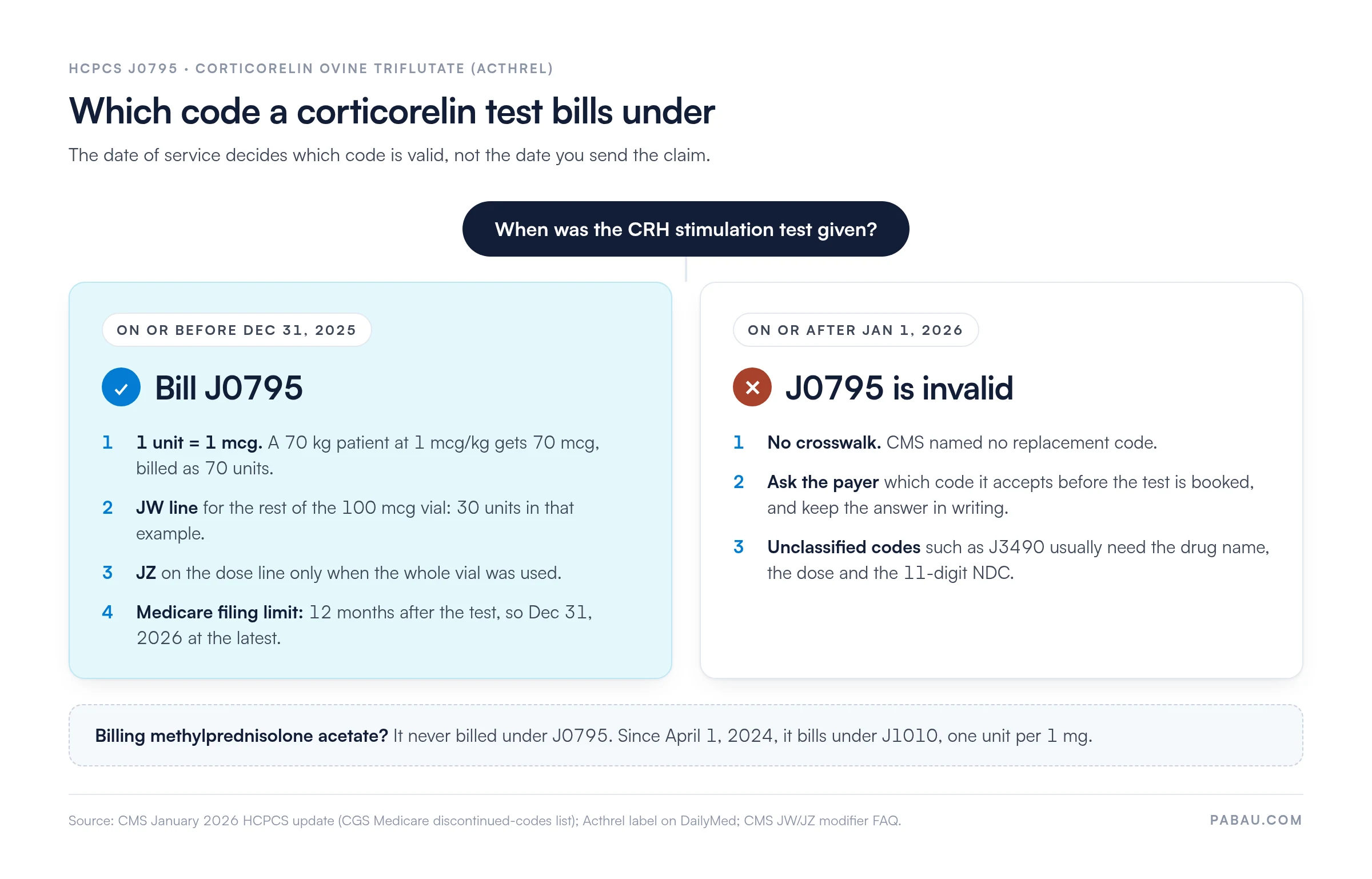
Drugs without a specific HCPCS code usually go under an unclassified code such as J3490. Those claims generally need the drug name, the dose and the 11-digit NDC, and the payer prices them manually. Five steps keep the claim clean:
If you are looking for methylprednisolone acetate (Depo-Medrol), the code you need is J1010, injection, methylprednisolone acetate, 1 mg. CMS added J1010 on April 1, 2024. It replaced the dose-based codes J1020 (20 mg), J1030 (40 mg) and J1040 (80 mg), which ended on March 31, 2024.
J1010 bills per milligram, so a 40 mg dose is 40 units, not 2. Our J1030 guide walks through the switch from the old codes to J1010.
Methylprednisolone sodium succinate is a separate drug again. It bills under J2920 (up to 40 mg) or J2930 (up to 125 mg), never under J0795 or J1010.
Corticorelin ovine triflutate is a synthetic form of sheep corticotropin-releasing hormone. Given intravenously, it prompts the pituitary to release ACTH, which in turn raises cortisol. DailyMed now lists the Acthrel NDC, 55566-0302-1, as inactivated under an FDA-initiated compliance action.
The FDA label approves it for one job. It helps tell pituitary from ectopic ACTH production in patients with ACTH-dependent Cushing’s syndrome. Pituitary-driven disease (Cushing’s disease) usually shows a rise in ACTH and cortisol after the injection. An ectopic tumor usually shows little or no response.
The label sets a single IV dose of 1 mcg/kg and does not recommend higher doses. The vial is reconstituted with 2 mL of saline, giving 50 mcg/mL. Giving the dose as an infusion over 30 seconds reduces some side effects.
Plasma ACTH peaks 15 to 60 minutes after the dose, and cortisol peaks 30 to 120 minutes after it. That is why the test calls for timed blood draws over about two hours.
One unit of J0795 equals 1 mcg of corticorelin. Because the dose is 1 mcg/kg, the unit count usually matches the patient’s weight in kilograms. Bill the dose given, then report what was left in the 100 mcg vial.
Acthrel came in a single-dose vial, so Medicare’s discarded-drug rules apply. Report the discarded amount on its own line with modifier JW. When nothing is discarded, add modifier JZ to the dose line instead. CMS sets out both rules in its JW and JZ modifier FAQ.
With a 100 mcg vial, JZ fits only when the dose uses the whole vial, so most J0795 claims carry a JW line. Record the discarded amount in the chart so the JW units match it.
J0795 covered only the drug. The injection and the lab work billed separately, often by different providers.
Our CPT 96374 guide covers IV push timing and modifiers. The CPT 82533 and CPT 36415 guides cover the cortisol assay and the blood draws. Check current NCCI edits before you pair 36415 with 96374 on one claim.
The diagnosis on a J0795 line had to explain why the test was run. In practice, that meant a code from the Cushing’s syndrome category, E24.
Code only what the record supports, and read our E24.4 guide before you use the pseudo-Cushing’s code. Payer coverage rules differ, so check each payer’s policy for the date of service.
Medicare gives you 12 months from the date of service to file a claim. A CRH stimulation test given on December 31, 2025, must therefore be filed by December 31, 2026. Commercial payers often set shorter limits, so check each contract.
Before you file a late-2025 claim, make sure the record holds:
Tag each denial with the reason code on its remittance, and our billers’ denial code guide explains what each one means. After a month of tagging, you can see which of these denials keeps coming back.
When a code is deleted, the risk sits in old order sets and charge lists. A test booked from a 2025 template can carry J0795 into a 2026 claim, and the denial arrives weeks later on a remittance.
Pabau, the practice management and billing platform we build, sends US claims as CMS-1500/837P files through Claim.MD. ERA remittances come back into Pabau, so your billing team sees each denial reason next to its visit. Our claims management software page shows the full workflow.
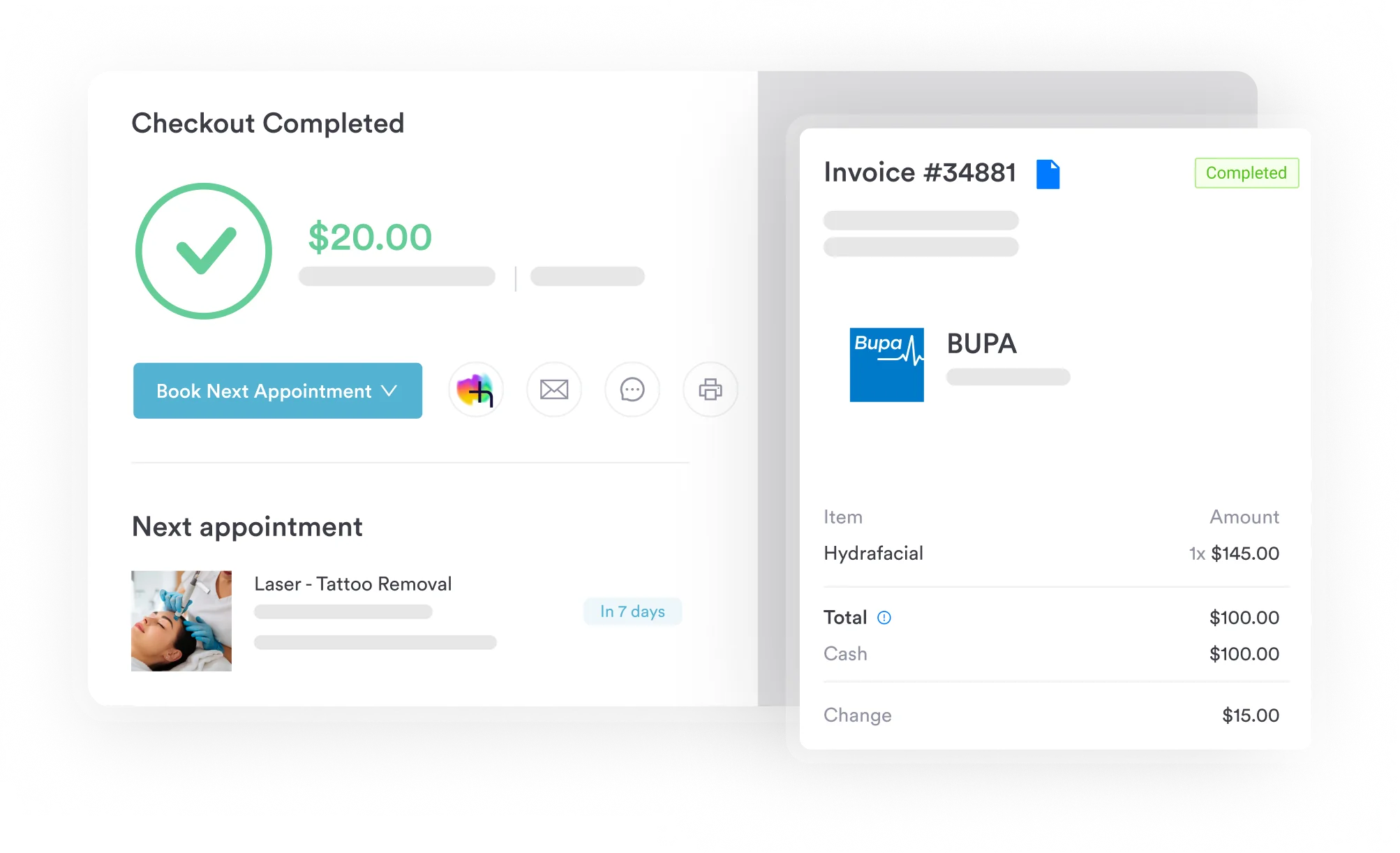
Stock in Pabau carries a batch number and an expiry date, and the lot is recorded against the patient and the appointment. That gives auditors the NDC and lot trail a drug line needs. Practices that switch on Labs can order Quest tests from the patient record, and results import automatically.

Pabau links every drug line to its visit, lot record and remittance. Your team can trace a denied line back to the appointment behind it.

Treat J0795 as a closed code with one open window. A CRH stimulation test given in 2025 can still be billed under it, but Medicare stops accepting each claim 12 months after its test date. Work through unbilled late-2025 tests first, with units in micrograms and a JW line for the rest of the vial.
For 2026 tests, settle the code with the payer before the patient arrives. If your search was about methylprednisolone, move your charge list to J1010 and bill per milligram. Book a demo to see how Pabau links drug codes, lot records and remittances for your billing team.

Need a full picture of how claims flow from encounter to payment? What is revenue cycle management explains the end-to-end billing lifecycle for outpatient practices.
Want to understand the clearinghouse layer between your practice and payers? Medical claims clearinghouse guide covers how 837P files reach Medicare and commercial payers.
Looking for a structured approach to working remittances? Electronic remittance advice (ERA) guide explains CARC codes, CO denials, and PR adjustments on drug-code claims.
J0795 is the HCPCS Level II code for injection, corticorelin ovine triflutate, 1 microgram. Corticorelin (Acthrel) is the diagnostic drug given in the CRH stimulation test for ACTH-dependent Cushing’s syndrome.
No. CMS discontinued J0795 with an end date of December 31, 2025, and named no crosswalk code. Bill it only for dates of service on or before that date.
One unit equals 1 mcg. A 70 kg patient dosed at 1 mcg/kg receives 70 mcg, so you bill 70 units. Report the 30 mcg left in the 100 mcg vial on a JW line.
No code replaced it. For a 2026 test, ask the payer which code it accepts. Many payers route drugs without a specific code to J3490, unclassified drugs, with the NDC and dose.
No. Since April 1, 2024, methylprednisolone acetate bills under J1010, injection, methylprednisolone acetate, 1 mg. A 40 mg dose is 40 units of J1010.
Yes, for a test given on or before December 31, 2025. Medicare must receive the claim within 12 months of the date of service. Commercial payers often allow less time.