Pabau Engage inbox

Pabau Engage is here: every patient conversation in one inbox.

Learn more
CCSD Code

CCSD code E0340 – Nasal septal perforation repair


Code Definition

E0340 is the CCSD code for closure of perforation of septum of nose. UK private ENT surgeons use it to bill insurers such as Bupa and AXA Health for surgical repair of a septal hole.

It covers flap or graft closure of the defect itself. The CCSD schedule bars it with septoplasty and septal cautery on the same claim.

Group
5 Ear, nose and throat
Category
5.4 Nose and nasal cavity
Subcategory
E03 Nasal septum procedures
Save time. Improve accuracy. Get paid faster.
Automate coding with Pabau

Let Pabau's smart automation suggest the right codes, reduce claim denials, and keep your practice compliant—effortlessly.

  • AI-powered code suggestions
  • Real-time compliance checks
  • Faster claims, fewer denials
Why practices choose Pabau
Save hours every week

Automate repetitive tasks and focus on what matters most—your patients.

Improve accuracy

Reduce coding errors and ensure compliance with the latest regulations.

Get paid faster

Clean claims, fewer denials, and faster reimbursements.

Grow with confidence

Powerful insights and reporting to help your practice thrive.

HIPAA compliant SOC 2 certified GDPR-compliant Trusted by 4,000+ clinics worldwide

Key takeaways

Key takeaways

CCSD Code E0340 covers surgical closure of a nasal septal perforation, distinct from septoplasty or cosmetic rhinoplasty.

ICD-10 code J34.8 (Other specified disorders of nose and nasal sinuses) is the most commonly paired diagnosis; verify it against the insurer’s clinical policy.

The CCSD schedule bars E0340 with septoplasty codes E0360 and E0390 and with septal cautery E0380 on the same claim.

UK private insurers expect pre-authorization before E0340 surgery, and a claim without an authorization reference is likely to be refused.

Pabau’s claims management software supports CCSD-coded invoicing, pre-authorization tracking, and denial follow-up for UK private ENT practices.

CCSD Code E0340: Definition and clinical scope

CCSD Code E0340 is the procedure code for closure of perforation of the septum of the nose in the UK private healthcare sector. CCSD stands for Clinical Coding and Schedule Development. The CCSD schedule gives private hospitals, consultants, and insurers one standard set of procedure and diagnostic test codes.

It is maintained by the CCSD Group, which includes representatives of Bupa, Vitality, AXA Health, and Aviva.

E0340 applies when a surgeon performs a definitive surgical repair of a hole in the nasal septum. That repair may use local mucosal flaps, interposition grafts, or a combination of techniques. It does not apply to non-surgical management such as septal button placement, which is coded separately.

The code sits in chapter 5 of the CCSD schedule (ear, nose and throat), in the nose and nasal cavity section. Its neighbors include codes for submucous resection, septal cautery, turbinate reduction, and rhinoplasty.

Correct use of E0340 requires that the operative indication is septal perforation, not deviation or cosmetic deformity. Before submitting, confirm that the operative report names the perforation as the target pathology.

The procedure: Closure of perforation of the septum of the nose

A nasal septal perforation is a full-thickness defect in the cartilaginous or bony septum, leaving a communication between the two nasal cavities. Symptoms include crusting, nosebleeds, whistling, and, in large perforations, saddle-nose deformity. Surgical closure aims to restore the mucosal lining on both sides of the septum with a tension-free repair.

Common causes relevant to medical necessity documentation

Insurers assess medical necessity before authorizing E0340. Documenting the etiology strengthens both the pre-authorization request and the operative report. Common causes include:

  • Iatrogenic: Complication of prior septoplasty or submucous resection (SMR), the most frequent cause
  • Cocaine use: Vasoconstrictive necrosis of septal cartilage
  • Nasal spray overuse: Prolonged decongestant or corticosteroid spray misuse
  • Trauma: Septal hematoma with subsequent cartilage loss
  • Granulomatous disease: Granulomatosis with polyangiitis (formerly Wegener’s granulomatosis), sarcoidosis, or syphilis
  • Idiopathic: No identifiable cause after full workup

Surgical techniques covered under E0340

The choice of technique depends on perforation size and location. All of the following approaches fall within the scope of E0340 when performed for definitive septal perforation repair:

  • Local mucosal advancement flap: Bipedicled or unipedicled mucosal flaps rotated to cover the defect from both sides. It is the most common approach for perforations under 2 cm
  • Interposition graft: Temporoparietal fascia, perichondrium, or acellular dermis placed between the two mucosal layers to bridge larger defects
  • Endonasal approach: Endoscopic or headlight-assisted repair without an external incision
  • Open (external rhinoplasty) approach: Used for large or posteriorly positioned perforations that need wider exposure

When graft material is harvested from a remote site, such as tragal, auricular, or rib cartilage, check the schedule for a separate harvest code. The harvest is not included in E0340.

Pro Tip

Record the perforation size in millimeters in the pre-operative assessment and the operative report. Insurers use clinical detail like this to judge surgical necessity and complexity. A measurement in the notes lowers the risk of a refusal for insufficient clinical justification.

What CCSD Code E0340 includes and excludes

Understanding the scope of CCSD Code E0340 prevents both undercoding (missing separately billable components) and overcoding (billing components that are already part of the closure). The schedule’s combination rules settle most of it, as the chart below shows.
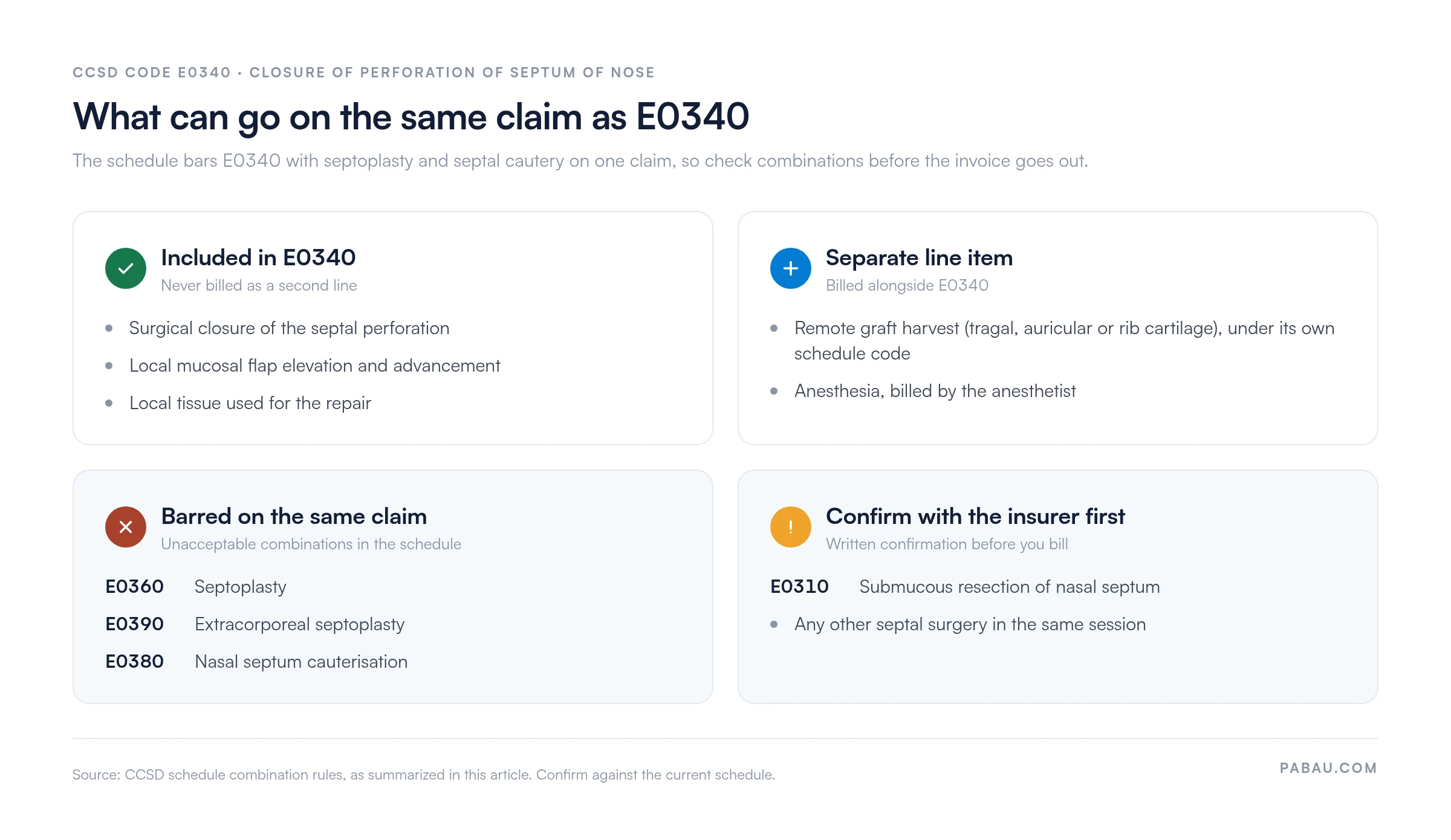
Four-panel chart of what can go on the same claim as CCSD code E0340: included are the closure, local mucosal flaps and local tissue; remote graft harvest and anesthesia are separate lines; E0360, E0390 and E0380 are barred on the same claim; E0310 and other same-session septal surgery need the insurer's written confirmation
Septoplasty and septal cautery codes cannot share a claim with E0340, while remote graft harvest goes on its own line. The chart follows the CCSD schedule’s combination rules.

The table below gives the detail behind each category.

CategoryWhat it means for E0340 billing
IncludedThe surgical closure itself; local mucosal flap elevation and advancement; use of local tissue for the repair (anesthesia is billed separately by the anesthetist)
Not included, bill separatelyRemote graft harvest (tragal, auricular, or rib cartilage), under its own schedule code. Nasal reconstruction for a cosmetic deformity
Excluded entirelySeptal button (obturator) insertion, a device placement coded separately; purely cosmetic rhinoplasty; closed management without surgical entry
Concurrent septoplastyThe schedule lists E0340 as an unacceptable combination with septoplasty (E0360), extracorporeal septoplasty (E0390), and septal cautery (E0380). Same-session septal surgery needs the insurer’s written confirmation before it goes on a claim

Several CCSD codes sit in the same nose and nasal cavity section as CCSD Code E0340. Miscoding is common when a septal perforation repair happens alongside other nasal procedures. The table below shows the codes most often confused with it.

For how one of the CCSD Group insurers applies the schedule, see our guide to Bupa CCSD procedure codes.

CCSD codeProcedureKey differentiator from E0340
E0340Closure of perforation of septum of noseThe primary code, for surgical repair of a full-thickness septal defect
E0310Submucous resection of nasal septumTreats septal deviation or obstruction, not a perforation. Whether it can share a claim with E0340 is unconfirmed, so get the insurer’s written confirmation first
E0380Nasal septum cauterisation (and bilateral)Cautery of the septal mucosa, usually for nosebleeds; the schedule lists it as an unacceptable combination with E0340
E02 rhinoplasty codesRhinoplasty and septorhinoplastyChanges nasal shape or the airway; purely cosmetic rhinoplasty is generally excluded from private medical insurance
Septal button codeInsertion of nasal septal button (obturator)Device placement without surgical closure; look up the exact code in the current CCSD schedule
Graft harvest codeRemote site graft harvest (tragal, rib)Billed separately when the graft comes from a site remote from the nose; not part of E0340

Note: Code ranges and labels other than E0340, E0310, and E0380 are descriptive pointers only. Always confirm exact codes and combination rules against the current CCSD schedule at ccsd.org.uk before billing.

ICD-10 diagnosis codes to use with E0340

Every CCSD Code E0340 claim should carry a valid ICD-10 diagnosis code. UK private insurers use it to check clinical necessity against the procedure billed. A mismatched ICD-10 code is one of the most common reasons E0340 claims are queried or refused. The WHO ICD-10 browser gives authoritative definitions for each code.

ICD-10 codeDescriptionUse with E0340 when…
J34.8Other specified disorders of nose and nasal sinusesNasal septal perforation not attributable to a more specific listed cause; most commonly used pairing for E0340
J34.0Abscess, furuncle and carbuncle of noseAvoid for routine septal perforation repair; only if a septic etiology is documented and the perforation is a direct consequence
T81.8Other complications of proceduresWhen the perforation is a documented complication of a previous surgical procedure (for example, prior septoplasty)
M31.3Granulomatosis with polyangiitis (Wegener’s granulomatosis)When the perforation is secondary to granulomatous vasculitis; the primary disease code should accompany E0340

Important: The ICD-10 selections above are clinically reasoned guidance. Insurers may name preferred codes in their clinical policies. Coders should verify each choice against the current ICD-10 edition and the relevant insurer’s policy before submitting.

Documentation requirements for a successful E0340 claim

Inadequate operative documentation is the most correctable cause of E0340 claim failure. The clinical record must support both medical necessity and the specific procedure performed. Practice software such as Pabau keeps structured operative notes that capture each detail an insurer is likely to ask for.
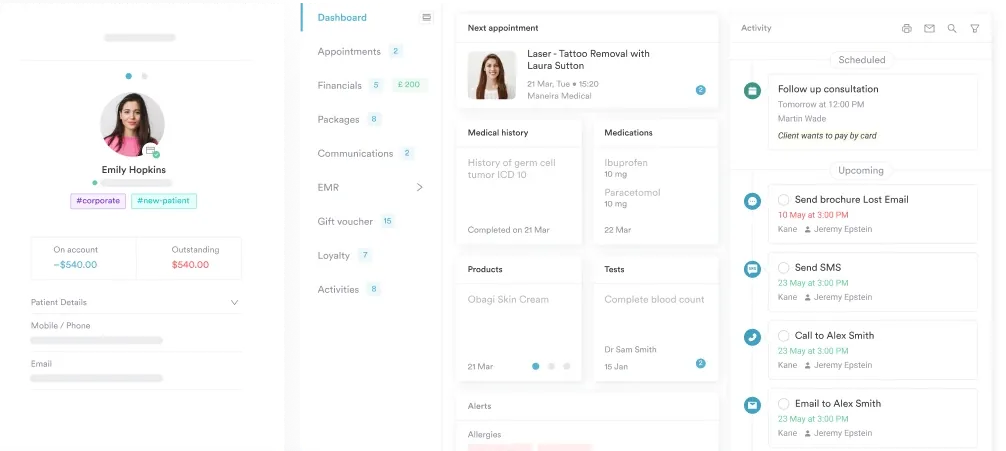
Detailed client records in Pabau
Detailed patient records in Pabau keep the assessment, operative note, and authorization reference together for each E0340 claim.

A complete E0340 claim file should contain:

  • Pre-operative assessment: Diagnosis of nasal septal perforation confirmed, with size in millimeters, location (anterior or posterior, cartilaginous or bony), and symptoms documented
  • Indication for surgery: A clear statement that conservative management, such as a septal button, was tried or considered and ruled out. Or a note on why surgery comes first
  • Operative report: Surgical approach named (endonasal or open), flap design described, graft material used, intraoperative findings, and confirmation that the perforation was the target pathology
  • ICD-10 code: Correctly matched to the documented etiology
  • Concurrent procedures: Any additional codes, such as graft harvest, listed with separate operative justification. Same-session septal surgery also needs the insurer’s written confirmation
  • Authorization reference: The insurer’s pre-authorization number, recorded on the invoice for the episode of care

Pre-authorization: What UK private insurers require before E0340

UK private medical insurers such as Bupa, AXA Health, Aviva, and Vitality expect pre-authorization before elective surgery like E0340. Insurers treat it as a condition of payment. A claim for surgery done without an authorization reference is likely to be refused, even when the procedure was clinically appropriate.

Requirements differ by insurer and by the patient’s policy, so check each one before booking surgery. The process usually runs like this:

  1. Patient contacts the insurer: The patient confirms their cover and gets a claim or authorization number before treatment starts
  2. Practice submits the clinical details: Send the proposed CCSD code (E0340), any concurrent codes, the ICD-10 diagnosis, perforation size, etiology, and the planned technique
  3. Insurer reviews the request: The insurer’s clinical team checks the request against its own policy terms and clinical criteria
  4. Authorization is confirmed: Keep the written confirmation and the reference number in the patient record
  5. Claim goes out with the reference: The authorization number appears on every invoice for the episode of care

Practical guidance: Start the request as soon as surgery is planned, not in the week of the operation. If the technique or the codes change during surgery, tell the insurer before you invoice. A claim that differs from what was authorized is a common trigger for a query.

Common claim denial reasons for E0340 and how to avoid them

E0340 claims fail for predictable, preventable reasons. The table below maps the most common denial causes to their fixes.

Denial reasonWhy it happensPrevention and resolution
Missing pre-authorizationSurgery performed before the insurer issued written authorizationGet the written authorization reference before the procedure date and keep a copy in the patient record
Incorrect or mismatched ICD-10 codeThe ICD-10 code does not match the documented diagnosis or the etiology in the clinical notesMap ICD-10 to the operative etiology and use the same code in the notes and on the invoice
Cosmetic classificationThe insurer’s reviewer treats the procedure as cosmetic, often because the notes do not state the symptomsDocument symptoms explicitly (crusting, nosebleeds, obstruction, whistling) and state that the procedure is functional
Code combination errorE0340 is billed with a code the schedule lists as an unacceptable combination, such as septoplasty E0360Check the schedule’s combination rules, and get the insurer’s written confirmation before billing any same-session septal surgery
Insufficient operative notesThe operative report does not name the technique, perforation size, or graft materialUse a structured operative note template; Pabau’s digital forms support custom procedure note templates
Duplicate claimA claim is submitted more than once for the same procedure dateTrack each claim’s status in one place so the team can see what has already gone out

Bilateral, staged, and assistant surgeon billing for E0340

CCSD codes are not billed with US-style modifiers, so check the CCSD technical guide and each insurer’s rules. Each insurer sets its own fees and its own rules for multiple procedures, staged surgery, and assistants. The table below shows how these scenarios usually affect E0340, but the insurer’s current fee schedule and policy terms decide the outcome.

ScenarioApplication to E0340What to check with the insurer
Bilateral workThe septum is a midline structure, so one E0340 covers a repair approached from both sides. It is not billed twice for left and rightQuery the insurer before invoicing if the notes describe a genuinely separate second procedure
Staged repairLarge perforations sometimes need two sessions: one creates the flap pedicle and a second completes closure. Each session needs its own operative noteTell the insurer at pre-authorization that a staged approach is planned; each stage usually needs its own authorization
Assistant surgeonIf an assistant surgeon takes part, any assistant fee is claimed by the assistant, not on the principal surgeon’s invoiceCheck whether the insurer pays an assistant fee for this procedure and whether it needs authorizing in advance
Multiple procedures in one sessionWhen E0340 is billed with other CCSD codes, such as graft harvest, each code appears as its own line itemCheck the insurer’s fee schedule for how a second procedure in the same session is paid, and the schedule’s combination rules

Pro Tip

When billing a staged E0340 repair, send a short covering letter with each later claim. Explain why the repair was staged, what this session completed, and what remains. This context stops the insurer from treating the second claim as a duplicate and supports authorization for the final stage.

How to bill E0340 in your practice management system

In many ENT practices, the authorization reference sits in an email, the operative note in another system, and the invoice in a spreadsheet. Each handover is a chance for the claim to go out incomplete. UK private practices using Pabau can manage the full CCSD Code E0340 billing cycle in one system, from pre-authorization to denial follow-up.

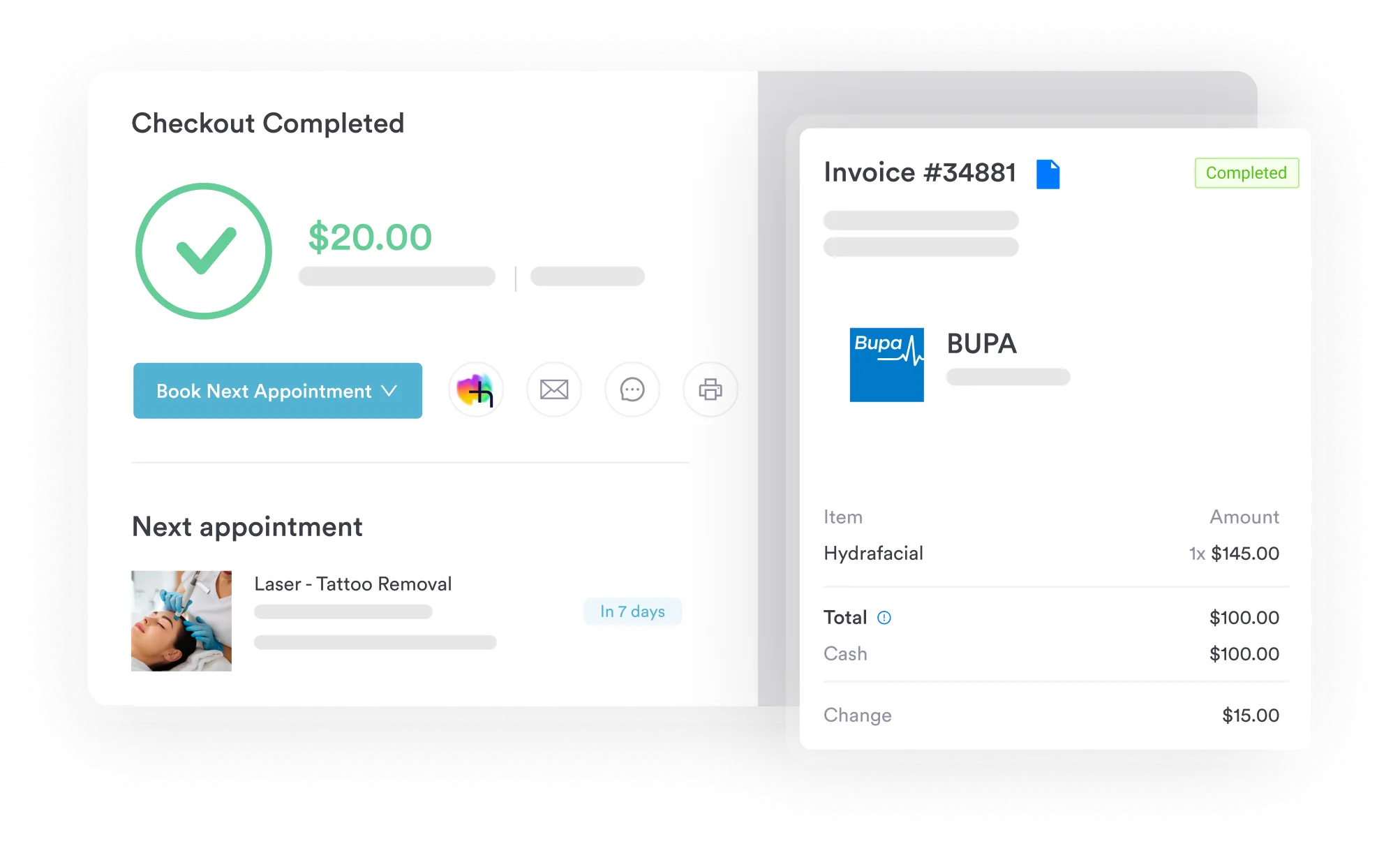
Pabau’s claims management software supports CCSD code entry, electronic claims through Healthcode, and claim tracking for private billing teams.
Automate claims through Healthcode
Sending claims through Healthcode from Pabau gets E0340 invoices to UK insurers with the code and authorization reference attached.
  1. Pre-consultation: Record the patient’s insurer and policy number, and check what the insurer needs before E0340 can be booked
  2. Pre-authorization: Send the CCSD code (E0340), any concurrent codes, the ICD-10 diagnosis, and the perforation size; record the authorization reference in the patient record
  3. Surgery and operative notes: Complete the operative report on the day of surgery, naming the technique, perforation size, graft material, and any separately billable procedures
  4. Coding and invoice creation: Add E0340 and any concurrent codes as separate line items, linked to the correct ICD-10 code and the authorization reference
  5. Claim submission: Submit electronically through Healthcode or the insurer’s own portal, with the operative report available if the insurer asks for it
  6. Follow-up and denial management: Track claim status, and if a claim is refused, check the reason against the documentation list above before you appeal

The result is a claim that leaves with its reference, code, and evidence attached. Your team spends less time answering insurer queries and more time with patients.

Manage CCSD billing from pre-authorization to payment

Pabau keeps authorization references, operative notes, and CCSD-coded invoices on one patient episode for UK private ENT practices. Book a demo to see how it works.

Pabau practice management software for UK private practices

Conclusion

E0340 claims rarely fail on the surgery. They fail on the paperwork around it: a missing authorization reference, a mismatched ICD-10 code, or an operative note that never names the perforation. Get those three right before the invoice goes out, and most insurer queries never happen.

That makes the billing workflow as important to a UK private ENT practice as the repair itself. Book a demo to see how Pabau handles CCSD billing end to end.

Continue your research

Continue your research

Need a broader CCSD billing reference? Bupa CCSD procedure codes covers how Bupa applies the CCSD schedule, with guidance on code structure and submission requirements.

Checking a septal cautery claim? CCSD code E0380 covers nasal septum cauterisation, one of the codes the schedule bars alongside E0340.

Billing other septal surgery? CCSD code E0310 covers submucous resection of the nasal septum, including when it can be billed alongside other nasal procedures.

Frequently asked questions

What does CCSD Code E0340 cover?

CCSD Code E0340 covers the surgical closure of a nasal septal perforation, including local mucosal flap elevation and advancement used to repair the defect. It does not cover septal button insertion or remote graft harvest, which are coded separately. The schedule also bars septoplasty codes E0360 and E0390 on the same claim.

Which ICD-10 diagnosis code should be used with E0340?

J34.8 (Other specified disorders of nose and nasal sinuses) is the most common ICD-10 pairing for a septal perforation of uncertain or idiopathic etiology. When the perforation is a complication of prior surgery, T81.8 may be appropriate. Always verify against the current ICD-10 edition and the insurer’s clinical policy before submitting.

Does E0340 require pre-authorization from private insurers?

Yes, UK private medical insurers such as Bupa, AXA Health, Aviva, and Vitality expect pre-authorization for elective surgery like E0340 before the patient is admitted. A claim for surgery done without an authorization reference is likely to be refused. Confirm the patient’s cover and the insurer’s requirements before booking the procedure.

Can E0340 be billed alongside septoplasty or rhinoplasty codes?

Usually not with septoplasty. The CCSD schedule bars E0340 with septoplasty (E0360), extracorporeal septoplasty (E0390), and septal cautery (E0380) on one claim. Same-session septal surgery needs the insurer’s written confirmation before you bill it. Purely cosmetic rhinoplasty is generally excluded from private medical insurance cover.

What are the most common reasons for E0340 claim denials?

The most frequent reasons are a missing pre-authorization reference and an ICD-10 code that does not match the documented etiology. Operative notes that omit the technique or perforation size are another. Cosmetic classification by the insurer’s reviewer also causes refusals. Each has a clear fix: obtain authorization in writing, map ICD-10 to the etiology, and document symptoms explicitly.

Is a septal button insertion billed under E0340?

No. A nasal septal button (obturator) is a device placed to occlude the perforation without formal surgical closure. It is a different procedure from E0340 surgical closure. Look up the correct code for button insertion in the current CCSD schedule at ccsd.org.uk before billing it.

How is a staged E0340 repair billed?

CCSD codes are not billed with US-style modifiers, so check the CCSD technical guide and each insurer’s rules. Each session needs its own operative note and, usually, its own authorization from the insurer. Tell the insurer at pre-authorization that a staged approach is planned, and explain why, so the second claim is not treated as a duplicate.
Tanja Lepcheska
Content Writer

Tanja is a Senior Content Writer who has a skill to turn complex med spa topics into easy, engaging reads that actually make sense. She loves helping clinic owners feel confident about growing their business. When she’s not writing, you’ll probably find her rewatching her favorite romantic movies, working on a new crochet project, or rearranging her home decor “just one more time.”
×