

HCPCS Code L0472: Hyperextension TLSO billing guide
HCPCS code L0472: Official descriptor and device definition HCPCS code L0472 des...

Last Updated: Nov 5, 2026
80400 is the CPT code for an ACTH stimulation panel for adrenal insufficiency, which includes two cortisol measurements (82533 x2). The panel captures a baseline cortisol and a stimulated cortisol after cosyntropin, billed as one line.
Most 80400 denials trace to two errors. One is billing the bundled cortisol analyte (82533) as a separate line. The other is submitting without an ICD-10-CM diagnosis that the Medicare Administrative Contractor (MAC) accepts as covered.
Let Pabau's smart automation suggest the right codes, reduce claim denials, and keep your practice compliant—effortlessly.
Automate repetitive tasks and focus on what matters most—your patients.
Reduce coding errors and ensure compliance with the latest regulations.
Clean claims, fewer denials, and faster reimbursements.
Powerful insights and reporting to help your practice thrive.
HIPAA compliant SOC 2 certified GDPR-compliant Trusted by 4,000+ clinics worldwide

CPT code 80400 is the ACTH stimulation panel for adrenal insufficiency, and it includes two total cortisol measurements (82533 x2).
Plasma ACTH (82024), the cosyntropin itself (J0834), its injection (96372 or 96374) and venipuncture (36415) all sit outside the panel.
Billing CPT 82533 as a separate line next to 80400 triggers an NCCI bundling edit and is the most common denial cause.
ICD-10-CM E27.1 (primary adrenocortical insufficiency) and E27.40 (unspecified adrenocortical insufficiency) are the most widely accepted diagnoses, though coverage varies by MAC.
In Pabau, our practice management platform, each 80400 charge carries its linked diagnosis, and the claim goes out through Claim.MD with its status tracked.
CPT code 80400 is the ACTH stimulation panel for adrenal insufficiency. The American Medical Association descriptor reads “ACTH stimulation panel; for adrenal insufficiency,” and the panel must include two total cortisol measurements (82533 x2). The code sits in the Evocative/Suppression Testing subsection of CPT (80400-80439). Those panels capture the lab work in hormonal challenge testing as one code, so the analytes are not billed one by one.
A resting cortisol level is often inconclusive when a physician suspects adrenal insufficiency. Giving synthetic adrenocorticotropic hormone (ACTH) and measuring the adrenal response shows how much reserve the gland has. The AMA’s CPT code set captures that two-specimen workflow as a single panel, so each cortisol draw is not billed on its own.
The subsection placement matters because every Evocative/Suppression Testing panel follows the same rule. Each panel includes only the analytes its descriptor lists. A test outside that list, or a service such as the drug or the injection, is coded on its own line.
The ACTH stimulation test evaluates the hypothalamic-pituitary-adrenal (HPA) axis. It measures how much cortisol the adrenal glands produce after a standardized dose of cosyntropin. Cosyntropin (Cortrosyn) is synthetic ACTH that stimulates the adrenal cortex directly, bypassing the pituitary. Alongside other tests, that helps separate primary from secondary adrenal insufficiency.
The standard short protocol runs as follows:
CPT 80400 captures two cortisol specimens, matching the baseline-plus-one-stimulated-draw protocol. If the provider collects a third cortisol specimen (baseline, 30 minutes and 60 minutes), that third draw is not separately billable under 80400. Code 80402 does not cover it either. 80402 is “ACTH stimulation panel; for 21 hydroxylase deficiency,” which measures cortisol x2 plus 17-hydroxyprogesterone x2.
Use the reference table below for quick-access billing details. The AAPC Codify CPT lookup provides additional code descriptor and crosswalk data for clinical coding teams.
Getting the bundle boundaries right prevents the most expensive denial category on this code. The panel includes exactly what its descriptor states. One test can still put up to six codes in front of the biller, and only one of them is the panel.
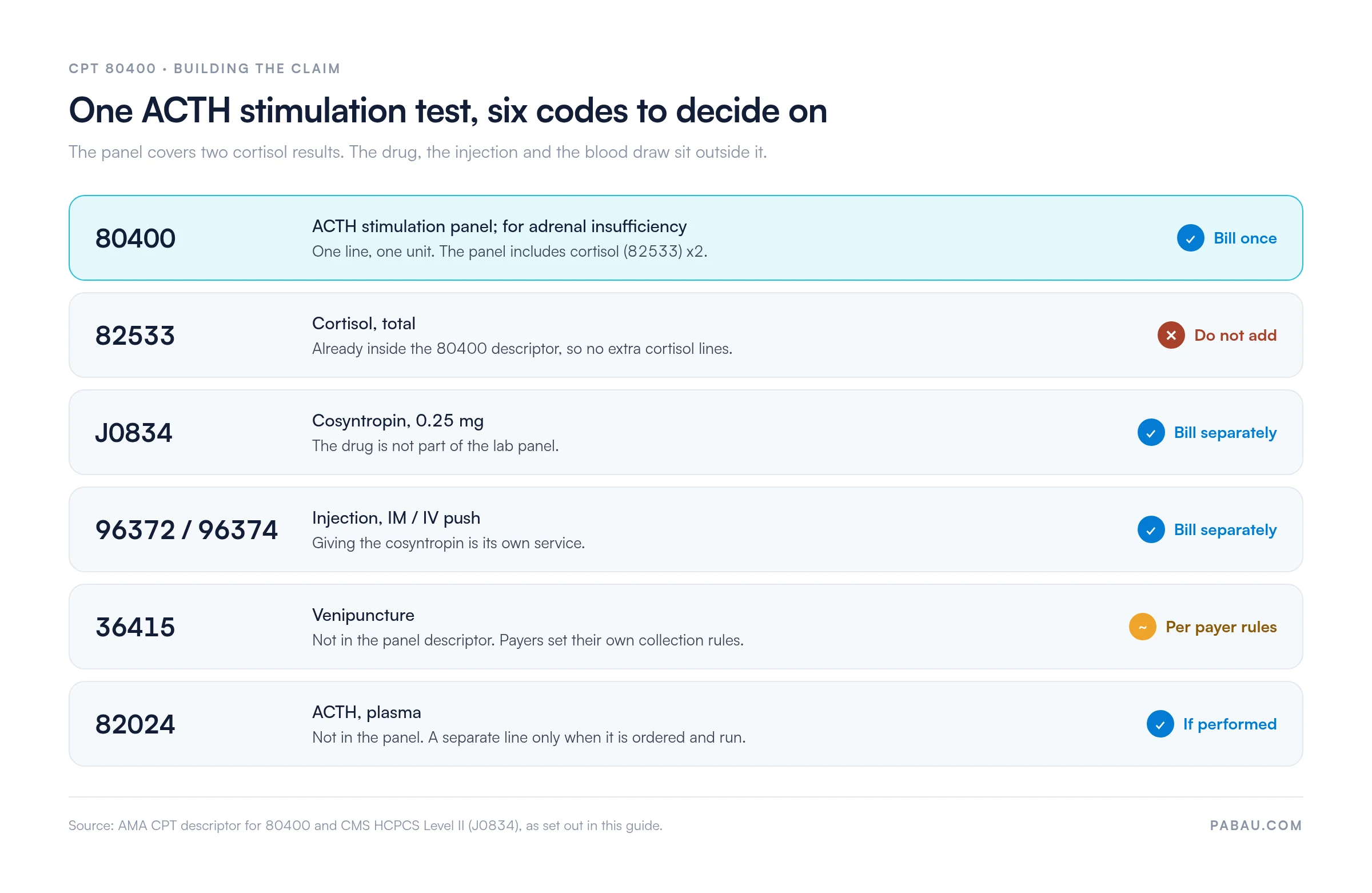
The evocative panels for adrenal testing form a family with the single-analyte cortisol codes. Knowing where each one starts and stops prevents upcoding and downcoding errors.
80400 and 80402 differ by indication and by the extra analyte. 80402 is the panel “for 21 hydroxylase deficiency,” and it adds two 17-hydroxyprogesterone (17-OHP) measurements to the two cortisol results. When the provider orders that panel to evaluate congenital adrenal hyperplasia, 80402 is the correct code.
Bill 82533 on its own only when a total cortisol level is drawn without a stimulation test. Inside a stimulation test, the panel code carries the cortisol results.
Every CPT 80400 claim needs a diagnosis code that tells the payer why the ACTH stimulation test was clinically necessary. Local Coverage Determinations (LCDs) from Medicare Administrative Contractors list the ICD-10-CM codes each MAC accepts. Coverage varies by jurisdiction, so confirm your MAC’s active LCD before submission.
Coverage for E27.1 and E27.40 is broadly consistent across MACs, though that assessment should be verified against your jurisdiction’s current LCD. Use the most specific code supported by documentation. Submitting E27.40 when the chart clearly documents Addison’s disease is under-coding and may draw audit scrutiny.
Medicare reimburses CPT code 80400 under the Clinical Laboratory Fee Schedule (CLFS), not the Physician Fee Schedule. CMS updates the CLFS rates every year. To find the current payment amount, download the annual public use file from the CMS Clinical Laboratory Fee Schedule page and look up 80400.
Key reimbursement considerations for this panel:
Pabau sends electronic claims through Claim.MD, our US clearinghouse partner, and tracks each claim’s status after submission.
Thin documentation is a common trigger for 80400 audits and retrospective recoupments. Medical billing compliance for lab panels requires the chart to support both the order and the result. These elements must be in the chart before the claim goes out:
A clean claim has every required field populated and an explicit diagnosis-to-procedure link. Payers auditing ACTH stimulation claims compare the clinical note date with the lab date. A specimen collected before the order is documented raises a red flag.
Run a quarterly internal audit on 80400 claims. Pull every submission and check that the cortisol draws in the chart match what was billed. Confirm a covered diagnosis appears on every claim. Catching a systematic mismatch internally costs less than a payer-initiated recoupment.
A solid denial management workflow starts with the most predictable triggers. The table maps each denial to its root cause and fix.
Match each CARC in remittance advice denial codes to its scenario. CO-97 and CO-234 mean the service is not paid separately, which points to bundling. CO-18 marks a duplicate claim. CO-11 or CO-50 means the payer did not accept the diagnosis as covered.
Each CARC has its own appeal path, so record it at posting time. Read the remittance line by line too. A payer can pay the panel and still deny a companion code, such as the drug or the injection.
A panel code like 80400 needs setup steps that single-analyte lab codes do not. Getting charge entry right the first time prevents the denials above.
Without diagnosis linking, a biller checks each 80400 charge against the chart and the LCD list by hand. Pabau’s claims management software attaches the diagnosis code at charge entry instead.
The claim then goes out electronically through Claim.MD, and your billers track its status from the same patient record. Fewer claims leave without a medical-necessity code, and fewer come back as denials to work.
Audit your 80400 charge master quarterly. Confirm no system update or staff change has split the code into component analytes. Check that the linked diagnosis list matches your MAC’s current LCD. Make sure the PA-required flag is active for commercial contracts that need it.

Pabau’s claims management software links the diagnosis to each 80400 charge and sends the claim through Claim.MD. Your billing team then tracks every claim’s status in one place.

Treat 80400 as one line that already holds both cortisol results, and decide the drug, the injection and the draw around it. Before each claim goes out, check the diagnosis against your MAC’s LCD list. Those two habits close off the denials this code is known for.
The trade-off is a few minutes more at charge entry for fewer appeals later. Book a demo to see how Pabau links diagnoses to lab panel charges and tracks each claim through Claim.MD.

Need to understand how claims move through the clearinghouse? Our Claim.MD clearinghouse guide explains the end-to-end submission and adjudication process for US lab claims.
Looking for the 837P file format used to transmit 80400 claims? 837 file format for medical billing covers the transaction set structure and common field-mapping errors.
Want a framework for reducing denials across all lab codes? Revenue cycle management in healthcare outlines the upstream steps that prevent downstream denial volumes.
CPT code 80400 is the ACTH stimulation panel for adrenal insufficiency. It covers two total cortisol measurements (82533 x2), one before cosyntropin and one after. Physicians use it to evaluate adrenal reserve and diagnose adrenal insufficiency.
CPT 80400 already includes total cortisol (CPT 82533) twice. Billing 82533 on a separate claim line alongside 80400 triggers an NCCI bundling edit, and the companion code will deny. Only bill 82530 (cortisol free) separately if free cortisol was independently ordered and performed.
Yes. Medicare covers CPT 80400 under the Clinical Laboratory Fee Schedule when the claim carries a covered ICD-10-CM diagnosis and documentation supports medical necessity. Your MAC’s Local Coverage Determination governs the details. E27.1 and E27.40 are the most broadly accepted diagnoses, though covered code lists vary by jurisdiction.
CPT 80400 is the ACTH stimulation panel for adrenal insufficiency and measures cortisol twice. CPT 80402 is the ACTH stimulation panel for 21 hydroxylase deficiency. It measures cortisol twice and 17-hydroxyprogesterone (17-OHP) twice, and it is used when evaluating congenital adrenal hyperplasia. If only cortisol is ordered, bill 80400. If the 21-hydroxylase panel is ordered, bill 80402.



