

CCSD code G5100: Bypass of duodenum billing guide
CCSD code G5100 bills a bypass that leaves the duodenum in place CCSD code G5100...

Last Updated: Oct 16, 2026
81256 is the CPT code for HFE (hemochromatosis) (eg, hereditary hemochromatosis) gene analysis, common variants (eg, C282Y, H63D).
It is a Tier 1 molecular pathology code, paid to the performing laboratory under the Clinical Laboratory Fee Schedule rather than the Physician Fee Schedule. Most 81256 denials trace back to three triggers: a diagnosis code that doesn't show medical necessity, missing prior authorization, or the wrong place-of-service code.
Let Pabau's smart automation suggest the right codes, reduce claim denials, and keep your practice compliant—effortlessly.
Automate repetitive tasks and focus on what matters most—your patients.
Reduce coding errors and ensure compliance with the latest regulations.
Clean claims, fewer denials, and faster reimbursements.
Powerful insights and reporting to help your practice thrive.
HIPAA compliant SOC 2 certified GDPR-compliant Trusted by 4,000+ clinics worldwide

CPT code 81256 reports HFE common-variant analysis (C282Y, H63D, S65C) for hereditary hemochromatosis, not full HFE gene sequencing.
It is a Tier 1 molecular pathology code in the 81105-81383 range, paid under the CMS Clinical Laboratory Fee Schedule.
E83.110 (hereditary hemochromatosis) is the primary ICD-10-CM pairing. Z13.88 is the wrong code altogether, because it describes screening for contaminant exposure.
The correct screening code is Z13.228, but most payers still deny a screen-only claim without a documented clinical indication.
The performing lab bills 81256 by default. The ordering practice appends modifier 90 only where the payer allows it to bill reference-lab work.
CPT code 81256 is defined by the American Medical Association (AMA) as HFE (hemochromatosis) (eg, hereditary hemochromatosis) gene analysis, common variants (eg, C282Y, H63D). It covers variant-specific genotyping of the HFE gene, the main genetic cause of hereditary hemochromatosis. The lab that performs the test bills it under the Clinical Laboratory Fee Schedule.
The code does not cover sequencing of the whole gene. Full HFE sequencing billed as 81256 is a coding mismatch that will generate a denial, so report it with 81479 instead. Before defaulting to the unlisted code, check the Tier 2 analyte lists, because 81404 names HFE among its analytes.
The HFE gene on chromosome 6 encodes a protein that regulates iron absorption. Pathogenic variants in this gene cause the body to absorb more iron than it needs, leading to progressive organ damage if untreated. Three variants are most clinically relevant for testing purposes.
CPT code 81256 is a Tier 1 molecular pathology code. Tier 1 codes (81105-81383) are gene-specific. Each one names a single gene and the analysis performed on it, so 81256 always means HFE common-variant testing. Laboratories are paid for it under the Clinical Laboratory Fee Schedule (CLFS), not the Physician Fee Schedule (PFS).
Tier 2 codes (81400-81408) cover less common gene analyses that have no code of their own. They are grouped into nine levels, Level 1 to Level 9, graded by the technical resources and interpretive work the test demands. The number of variants tested does not set the level, and 81256 does not appear on any Tier 2 list.
Each level maps to one code. Level 2 analyses report under 81401, which carries separate coverage and documentation rules. Further up the scale, CPT 81406 is the Level 7 code, covering sequence analysis of 11 to 25 exons.
Older guidance sometimes describes HFE testing with molecular “stacking” codes (83890-83914). Those codes were deleted in 2013. Bill HFE common-variant analysis as one unit of 81256, never as a Tier 2 level or a stack of method codes.
Selecting the correct ICD-10-CM diagnosis code is the single most preventable source of 81256 claim denials. The pairing must reflect the clinical reason for ordering the test, not a generic screen.
Payers cross-reference the submitted diagnosis code against their covered-indications list before adjudicating the claim. Medicare does this through Local Coverage Determinations issued by contractors such as CGS Medicare.
Z13.88 is the most common coding mistake on 81256 claims. It covers screening for disorders caused by contaminant exposure, so it never supports an HFE test. The screening code for this test is Z13.228, but that fixes only the code. Most payers, Medicare included, do not cover hereditary hemochromatosis genetic testing for screening alone.
The chart note must document a clinical indication. That means elevated transferrin saturation, elevated serum ferritin, or a first-degree relative with a confirmed HFE pathogenic variant.
Coders frequently confuse CPT 81256 with adjacent molecular pathology codes when panels or multiple gene tests are ordered at the same encounter. The table below separates the most commonly compared codes.
81255 and 81256 are both Tier 1 codes with adjacent numbers, which generates lookup errors. Verifying the gene name in the lab requisition before coding prevents this mismatch. When both tests are ordered at the same encounter for different clinical indications, they may be billed together with appropriate ICD-10 linkage for each.
81270 is another Tier 1 code, but it reports JAK2 V617F analysis for a suspected myeloproliferative neoplasm. It never substitutes for HFE testing. CPT 81257 is also Tier 1, but it covers HBA1/HBA2 deletion analysis for alpha thalassemia, a separate clinical indication.
CPT code 81256 is priced under the CMS Clinical Laboratory Fee Schedule rather than the Physician Fee Schedule. This matters because the CLFS is updated annually through a separate rulemaking process from the PFS. The performing laboratory bills directly to Medicare using their own NPI and billing entity.
CLFS rates for molecular pathology codes are adjusted every year, so a figure copied from last year’s schedule goes stale fast. Check the current calendar-year rate in the CMS CLFS download file or FastRVU’s 2026 RVU lookup before you submit claims.
CLFS rates for molecular pathology codes have been subject to multi-year phase-in reductions under the PAMA (Protecting Access to Medicare Act) framework. The rate for any given year may be lower than the prior year. Coders should pull the current CLFS file from cms.gov each January rather than relying on cached fee schedule data.
Download the CMS CLFS annual file in January each year and filter by code 81256 before building your fee schedule reference table. The PAMA-adjusted rates for molecular pathology codes change annually. Billing staff who rely on prior-year EHR fee schedules submit claims at outdated amounts, which risks underpayment or triggers automated edits.
Medicare covers CPT code 81256 when specific clinical criteria are met, as documented in Local Coverage Determinations issued by Medicare Administrative Contractors. CGS Medicare covers a multi-state jurisdiction. It requires the ordering provider to document at least one of the following in the chart note before the test is ordered.
Medicare does not cover 81256 for population-based screening in asymptomatic individuals without the above clinical indicators. A Medicare claim carrying only a screening code, whether the wrong Z13.88 or the correct Z13.228, is a near-certain denial. The chart note must reflect the clinical rationale in language that maps directly to LCD-covered indications.
Flag the tests that need LCD-based documentation at the point of order, not at billing. That habit prevents downstream denials that need costly appeals.
Prior authorization requirements for CPT code 81256 vary significantly by payer. Medicare itself does not require prior authorization, but its LCD criteria function as a de facto clinical documentation gate. Commercial payers increasingly route genetic testing through managed care organizations for authorization review.
The same payer split applies to other germline tests. Our billing guide for 81162, the BRCA1 and BRCA2 analysis code, sets out how each payer type handles authorization.
Verify the patient’s insurance eligibility before ordering, then request authorization straight after. A claim for a test that required PA but did not have one is a denial that cannot be appealed on clinical grounds alone.
eviCore’s MOL.TS.183.A guideline governs HFE genetic testing authorization for many BCBS and commercial plan members. A PA request that cites the guideline number and attaches the iron studies typically moves through review faster. A clinical narrative alone tends to stall.
Approvals typically expire 90 to 180 days after issue, so check the validity window on the payer portal. Record the expiration date alongside the order so the claim goes out while the approval still stands.
CPT code 81256 denials are almost always preventable. The most common triggers fall into six categories, each with a specific corrective action.
Reviewing electronic remittance advice at the claim level, not just the batch summary, gives billing staff the CARC and RARC codes. Those codes identify which of these triggers caused each denial. Our guide to denial codes explains what each one means and which appeal path it calls for.
The chart note is the primary defense in a 81256 claim audit. Payers that conduct retrospective medical necessity reviews look for specific data points. When these elements are absent, the claim is vulnerable regardless of whether it was paid initially.
Build this checklist into a standardized order template. The documentation then exists at the time of ordering instead of being reconstructed at audit time. A digital order form with required fields stops an order from going out until the iron studies and indication are recorded.
Place of service and modifier choices on CPT code 81256 claims depend on which entity performed the test. They also depend on whether the circumstances need extra billing context. A wrong combination generates automated edits that delay payment, even when the ICD-10 code and prior authorization are correct.
The CLIA certification requirement applies to in-house physician office laboratories. A practice that collects the specimen and sends it to Quest or LabCorp is the ordering entity, not the performing entity. By default it does not bill 81256. The reference lab bills using POS 81, and the practice bills only for the office visit.
Modifier 90 is the one exception. Some commercial payers let the ordering provider bill for reference-lab work, but many Medicare contractors don’t permit it. Get the payer’s approval in writing before you bill that way. The decision below shows which entity bills in each case.
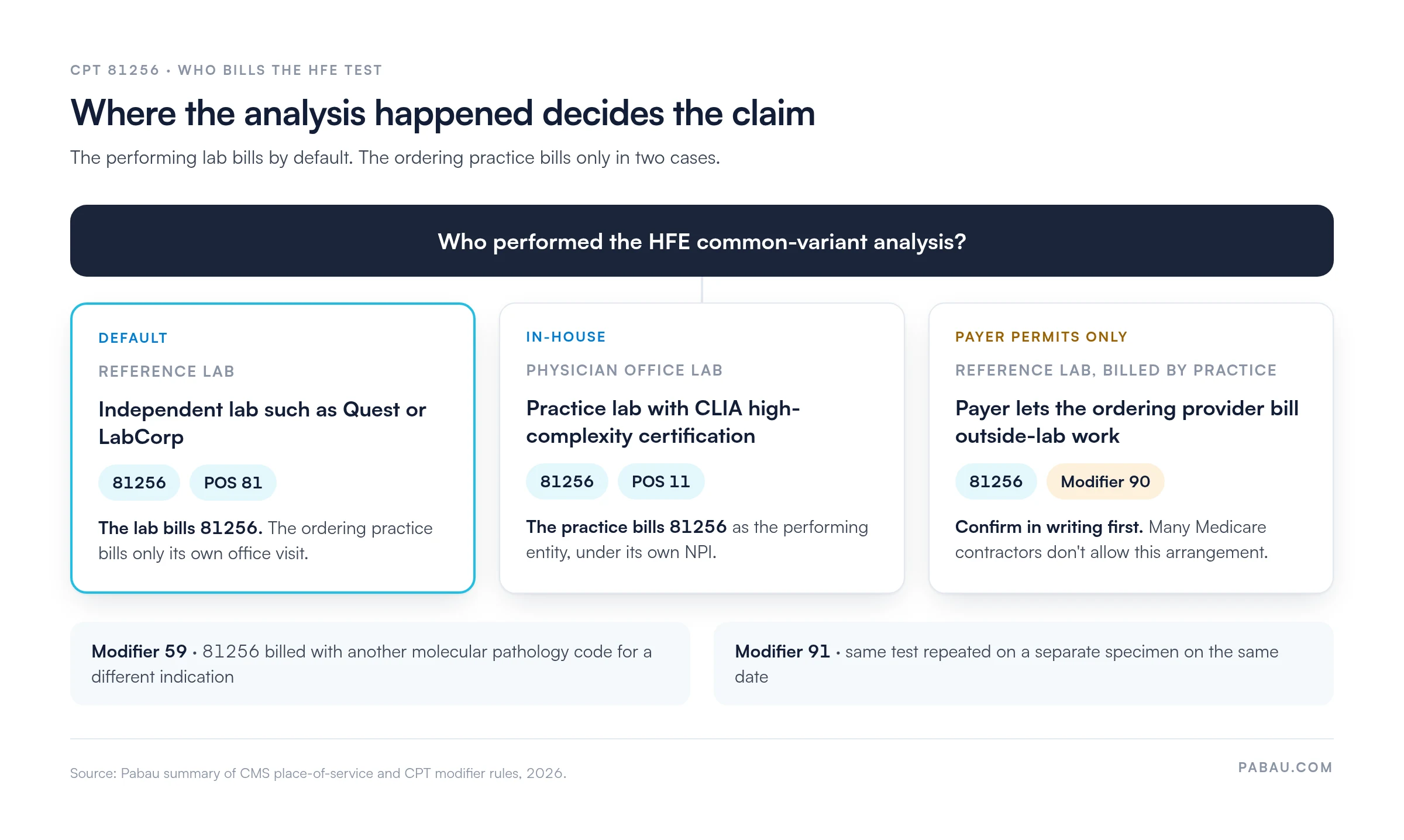
Claims management software can assign the POS from the performing-entity field on the lab order, which cuts manual selection errors. Capture POS codes and modifiers on the superbill at the time of service rather than reconstructing them at billing.
Audit your 81256 claims quarterly by pulling the performing NPI column from your clearinghouse reports. Paid claims may show your practice NPI as the performing NPI even though you are not a CLIA-certified lab. In that case your billing entity setup is incorrect, and you are exposed to a recoupment request. The performing entity must be the CLIA-certified lab.
HFE testing splits billing across two entities. The ordering practice records the iron studies, family history and clinical reasoning. The reference lab then bills 81256 against that record, so a thin chart note at the practice turns into a denial at the lab.
Practice management software like Pabau captures that documentation at the point of order, before the specimen leaves the office. It checks patient eligibility in real time and submits claims through its Claim.MD clearinghouse integration. ERA remittances post back against the original charge, so a denied or underpaid claim surfaces without a separate reconciliation step.

Pabau connects ordering practices with the Claim.MD clearinghouse for electronic submission, real-time eligibility checks, and ERA processing. CPT code 81256 claims move from lab requisition to paid claim without manual re-entry.

Treat 81256 as an order-stage decision. By the time the claim reaches billing, the diagnosis, the authorization and the performing entity are already fixed. A coder can only report what the chart and the requisition show.
So the work that pays off sits with the ordering provider. Document the iron studies or family history, and pair E83.110 or another covered diagnosis rather than a screening code. Then let the performing lab bill unless the payer has approved modifier 90.
The trade-off is a few extra minutes at the order against an appeal you may not win. To see how Pabau captures lab-order documentation and submits the claim in one workflow, book a demo.

Need to understand how claim submissions reach payers? Medical claims clearinghouse explained covers how clearinghouses validate, route, and track electronic claims before adjudication.
Want to see how your CPT and ICD-10 codes travel to the payer? 837 file format guide explains the transaction structure that carries your claim data.
Fighting denials on lab claims? Denial management in healthcare sets out a workflow for tracking, appealing, and preventing repeat denials.
Want fewer claims bounced at the first edit? What makes a clean claim lists the fields and checks a claim needs to pass first time.
Managing credentialing for the providers who order genetic tests? Credentialing with insurance companies walks through the enrollment steps required before claims can be processed.
CPT code 81256 covers HFE gene analysis for common variants associated with hereditary hemochromatosis, specifically C282Y, H63D, and S65C. It does not cover full HFE gene sequencing or analysis of secondary iron overload genes such as ALAS2 or TFR2. Those require CPT 81479 (unlisted molecular pathology) with an attached report.
Yes, Medicare covers CPT 81256 when the ordering provider documents a covered clinical indication in the chart note. The usual indications are elevated transferrin saturation or ferritin, symptomatic iron overload, or a confirmed HFE variant in a first-degree relative. Medicare does not cover the test for population screening in asymptomatic individuals. Coverage is governed by Local Coverage Determinations issued by the applicable Medicare Administrative Contractor.
The primary accepted codes are E83.110 (hereditary hemochromatosis), E83.118 (other hemochromatosis), and E83.19 (other iron metabolism disorders). Z84.89 (family history of other specified conditions) may be submitted as a secondary code when family history is the clinical driver. Never use Z13.88, which describes contaminant exposure and fails the diagnosis edit. Z13.228 is the correct screening code, but most payers, Medicare included, deny it as the sole code.
It depends on the payer. Medicare does not require prior authorization but enforces LCD documentation requirements. Most BCBS plans, including BCBS NC and BCBS MS, route HFE genetic testing through eviCore, which applies the MOL.TS.183.A clinical guideline. Always check the specific member’s plan before ordering, as PA requirements change annually and vary by product line.
CPT 81255 covers HEXA gene analysis for Tay-Sachs disease, while CPT 81256 covers HFE gene analysis for hereditary hemochromatosis. Both are Tier 1 gene-specific molecular pathology codes with adjacent numbers. They test different genes for different conditions, so one can never be substituted for the other.
Only laboratories holding the appropriate CLIA certification for high-complexity molecular testing may perform and bill 81256. Reference laboratories such as Quest Diagnostics and LabCorp are the most common performing entities. A physician office laboratory (POL) with CLIA high-complexity certification may bill under POS 11. Most ordering practices send the specimen to a reference lab, which bills directly under POS 81. The practice bills it with modifier 90 only where the payer permits that.



