CPT code 93503: Swan-Ganz catheter billing and modifiers
CPT code 93503: Official descriptor and procedure overview In the AMA CPT code s...

Last Updated: Oct 23, 2026
81270 is the CPT code for JAK2 (Janus kinase 2) (eg, myeloproliferative disorder) gene analysis, p.Val617Phe (V617F) variant. It is a Tier 1 molecular pathology code, billed as one unit whatever method the lab uses.
Labs report it to support a suspected myeloproliferative neoplasm, such as polycythemia vera, essential thrombocythemia or primary myelofibrosis. Medicare pays it under the Clinical Laboratory Fee Schedule, and coverage comes from local MAC policies rather than one national rule.
Let Pabau's smart automation suggest the right codes, reduce claim denials, and keep your practice compliant—effortlessly.
Automate repetitive tasks and focus on what matters most—your patients.
Reduce coding errors and ensure compliance with the latest regulations.
Clean claims, fewer denials, and faster reimbursements.
Powerful insights and reporting to help your practice thrive.
HIPAA compliant SOC 2 certified GDPR-compliant Trusted by 4,000+ clinics worldwide

CPT Code 81270 reports JAK2 V617F variant analysis and sits in Tier 1 of the AMA’s molecular pathology codes.
Medicare coverage is local, with LCD L35000 in Wellpoint Federal states and a MolDX LCD in MolDX states.
Supported diagnoses center on polycythemia vera (D45), essential thrombocythemia (D47.3) and primary myelofibrosis (D47.4), and symptom-only ICD-10 codes routinely trigger denial.
Labs billing Medicare in MolDX jurisdictions (Palmetto GBA, Noridian, WPS and CGS) need a DEX Z-code on the claim before 81270 is paid.
Pabau, the practice management platform we build, submits CMS-1500/837P claims through Claim.MD and tracks their status.
CPT Code 81270 reports a lab test that looks for the JAK2 V617F variant in peripheral blood or bone marrow. It is a Tier 1 molecular pathology code, paid by Medicare under the Clinical Laboratory Fee Schedule (CLFS). Coverage depends on the Medicare Administrative Contractor (MAC) that processes the claim.
CPT Code 81270 covers detection of the JAK2 V617F point mutation, whatever analytical platform the lab uses. Under the AMA’s CPT code set, each Tier 1 molecular pathology code reports analysis of one named gene or variant. 81270 is the Tier 1 code for the JAK2 V617F variant.
The code covers the test itself, not a separate interpretation. Every acceptable methodology bills as a single unit of 81270.
CPT Code 81270 does not cover other JAK2 variants. JAK2 targeted sequence analysis (for example, exons 12 and 13) is reported under CPT 81279. Exon 12 mutations turn up in a small subset of polycythemia vera cases that test V617F-negative. Billing 81270 for an exon 12 assay is a coding error.
CPT Code 81270 fits when a patient’s clinical picture suggests a myeloproliferative neoplasm (MPN), and the ordering physician documents the reason for testing. Covered indications center on BCR-ABL negative myeloproliferative disease, led by polycythemia vera, coded D45. The exact covered list sits in your MAC’s LCD: L35000 in Wellpoint Federal states, or the MolDX LCD elsewhere.
Because coverage is for BCR-ABL negative disease, chronic myeloid leukemia has to be excluded first. Labs bill that BCR/ABL1 major breakpoint analysis under CPT Code 81206.
CPT Code 81270 is not appropriate for routine oncology screening or family history-based genetic counseling. Payers deny claims where the ICD-10 code reflects only a symptom, such as R71.8 (other abnormality of red blood cells). Clinical documentation must support a confirmed or suspected MPN diagnosis.
Medicare coverage for CPT Code 81270 is local, so the rules depend on your MAC. Each contractor’s policy is listed in the CMS Medicare Coverage Database. Wellpoint Federal, formerly National Government Services (NGS), covers JAK2 V617F testing under LCD L35000 (Molecular Pathology Procedures). That LCD applies in Illinois, Minnesota, Wisconsin, Connecticut, New York, Maine, Massachusetts, New Hampshire, Rhode Island and Vermont.
MolDX contractors use their own LCD, MolDX: Non-Next Generation Sequencing Tests for the Diagnosis of BCR-ABL Negative Myeloproliferative Neoplasms (L39923 in JE, for example). It replaced the older Genetic Testing for BCR-ABL Negative Myeloproliferative Disease LCDs, such as L36180 (JE) and L36186 (JF), in August 2025. Novitas and First Coast claims follow those contractors’ own local policies.
MolDX is a MAC program run by Palmetto GBA, with Noridian, WPS and CGS participating. In MolDX jurisdictions, labs must register JAK2 tests in the DEX Z-code registry before Medicare will pay the claim. Non-MolDX jurisdictions apply their local policy without the registry step.
Labs that skip DEX Z-code registration in a MolDX jurisdiction will see 81270 denials, even when the indication and ICD-10 pairing are correct. Registration is free, but the lab must submit a technology assessment through the MolDX portal at dexzcodes.com before billing.
CPT Code 81270 is paid under the Clinical Laboratory Fee Schedule (CLFS), not the Physician Fee Schedule. CMS publishes the CLFS national limitation amount each year, and it caps Medicare payment. Check the current 2026 rate on the CMS Clinical Laboratory Fee Schedule page, since CLFS rates can shift between years.
Check the CMS CLFS file each January. The CLFS updates independently of the Physician Fee Schedule and follows a different annual publication cycle. Download the official CLFS data file from the CMS website and cross-reference your payer contracts against the national limitation amount. That catches rate changes before they hit your revenue.
CPT Code 81270 is V617F-specific, so billing it for any other JAK2 analysis is incorrect code assignment. The table below covers the codes most often confused with 81270.
Billing 81270 and 81279 on the same date of service is permissible when both analyses are independently ordered and documented. Append modifier 59 only if a payer or NCCI edit bundles the pair, and check the current NCCI table before you do.
Traditional Medicare does not require prior authorization for CPT Code 81270. Commercial managed care and Medicaid HMO plans often do.
Insufficient documentation causes most 81270 denials, even when the clinical indication is present. Medical billing compliance rules in L35000 and the MolDX LCD specify what must be in the record when the claim is submitted.
Submitting a clean claim for CPT Code 81270 requires both record sets to be complete before billing. Post-payment audits of molecular pathology claims look first at the ordering provider’s documentation.
CPT Code 81270 claims sit where genetic testing policy, ICD-10 specificity and, in MolDX states, a separate registry meet. Good denial management for JAK2 claims starts with six recurring denial patterns. Four of them can be caught at order entry, before the specimen is even run.
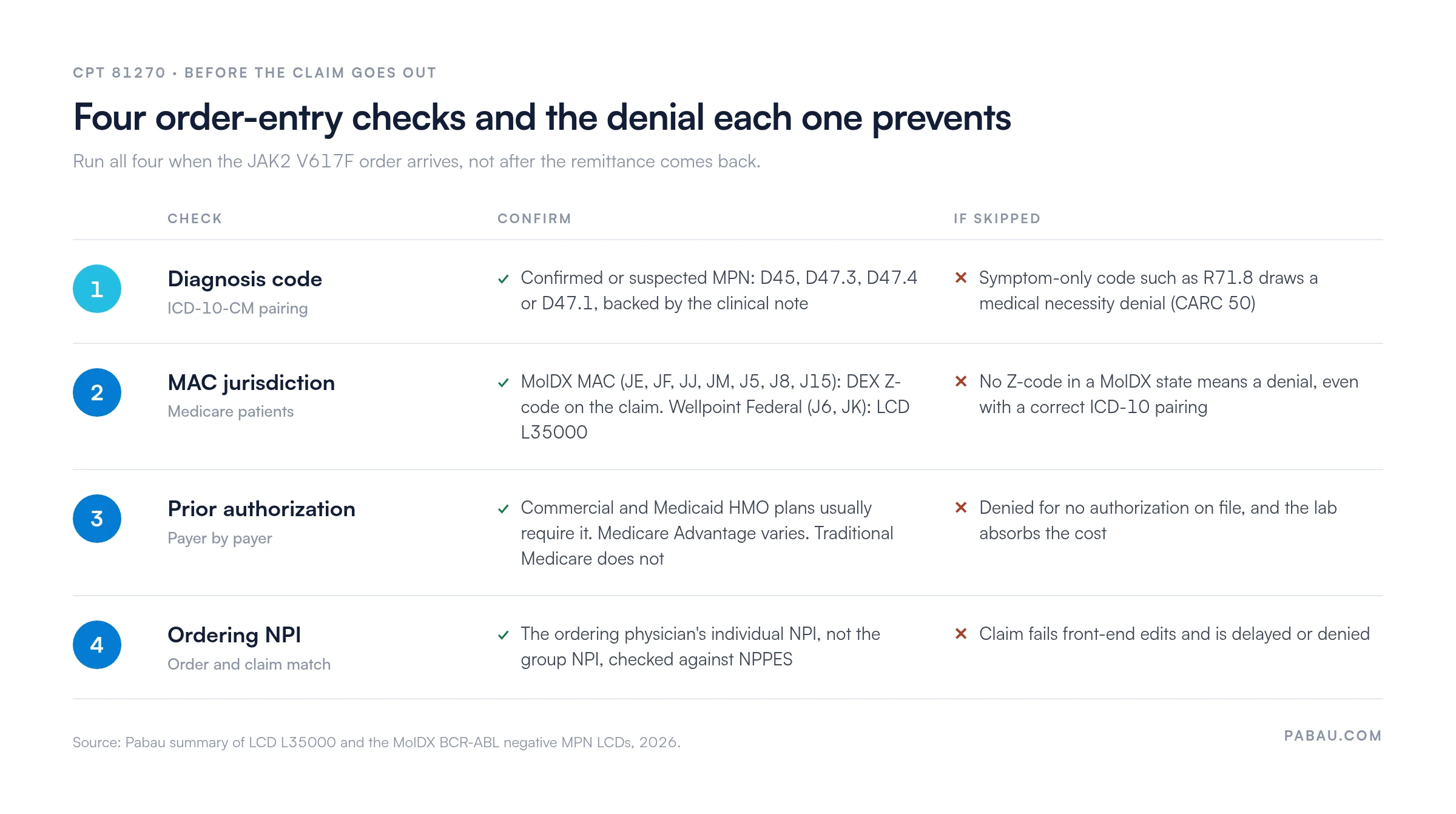
For appeals on non-covered ICD-10 denials, attach the ordering physician’s clinical note directly. On molecular pathology claims, the medical billing denial codes to watch are CARC 50 (not medically necessary) and CARC 4 (inconsistent with modifier used). CARC 50 is usually addressable with clinical documentation on first-level appeal, and CARC 4 with a corrected modifier.
CPT Code 81270 is a technical component-only code, which settles the two modifier questions coders ask most often.
Reviewing superbill practices for molecular pathology helps labs capture modifier decisions at order entry, rather than correcting them after a denial. The superbill or lab order form should state that -26 and -TC never apply to 81270.
Most of the checks above happen by hand today. A biller confirms the diagnosis code, the MAC and the payer’s authorization rule, then keys the claim into a clearinghouse portal. Each handoff is another chance for a wrong ICD-10 code or a missing Z-code to reach the payer.
Pabau, the practice management platform we build, keeps the order, the diagnosis and the clinical note in one patient record. Its claims management software pulls that existing record data into a pre-filled claim. Claim.MD, our claim submission integration, sends CMS-1500/837P claims and tracks their status.
Eligibility checks through Claim.MD confirm active coverage before the specimen is collected. The result is fewer 81270 claims coming back for data the practice already had on file.


Pabau keeps the order, diagnosis and clinical note in one record, then submits 837P claims through Claim.MD and tracks their status. Fewer 81270 claims come back for missing data.

CPT Code 81270 denials are almost always preventable, because the code itself is well defined. The errors come from the decisions around it: the ICD-10 pairing, MolDX registration in a MolDX jurisdiction, and modifiers on a technical-component-only code.
Start with your MAC. Once you know whether L35000 or the MolDX LCD governs your Medicare claims, the covered diagnosis list and the registry step follow from it. Build those rules into order entry, and the denials left over are the ones a clinical note can win on appeal. Book a demo to see how Pabau keeps molecular pathology claims complete from order to submission.

Need to understand how clearinghouse submission works for lab claims? Medical claims clearinghouse guide explains how electronic claim routing reduces denial rates for high-complexity lab codes.
Working through a claim denial on a molecular pathology code? Electronic remittance advice (ERA) explained covers how to read 835 remittances and identify CARC denial codes for appeals.
Want to understand how insurance eligibility verification affects lab billing? Insurance eligibility verification guide walks through the eligibility checks that confirm active coverage before specimen collection.
Coding the diagnosis behind the test? ICD-10 code D45 covers polycythemia vera, the primary indication for JAK2 V617F testing.
Running a molecular test with no specific CPT code? CPT code 81479 explains how to bill unlisted molecular pathology procedures.
CPT Code 81270 covers targeted analysis of the JAK2 gene for the V617F point variant. Labs use it to support diagnosis of myeloproliferative neoplasms, including polycythemia vera, essential thrombocythemia and primary myelofibrosis. The code applies whether the assay uses allele-specific PCR, pyrosequencing or NGS, as long as V617F is the variant analyzed.
Traditional Medicare does not require prior authorization for CPT 81270. Commercial managed care plans often do, and Medicare Advantage plan policies vary. Verify with the specific commercial or MA plan before specimen collection to avoid a denial for missing authorization.
Six denial reasons recur on 81270 claims. They are a non-covered ICD-10 pairing, missing or expired prior authorization on commercial plans, and no DEX Z-code on Medicare claims in MolDX jurisdictions. The others are a same-day 81279 line that an edit bundles and a missing or wrong ordering NPI. The last is 81270 billed separately from an 81450, 81451 or 81455 panel.
Yes. CPT Code 81270 is billable whether or not the V617F mutation is detected. The code reports the performance of the analysis, not a positive result. A negative result is still a completed procedure that used reagents, equipment time and lab expertise. It is billable when the clinical indication and documentation are present.