

CCSD code G5100: Bypass of duodenum billing guide
CCSD code G5100 bills a bypass that leaves the duodenum in place CCSD code G5100...

Last Updated: Oct 16, 2026
CPT code 81257 reports HBA1/HBA2 gene analysis for common deletions or variants associated with alpha thalassemia, Hb Bart hydrops fetalis syndrome and HbH disease. It is a Tier 1 molecular pathology code, billed by the performing laboratory.
The test uses gap-PCR or MLPA to detect the Southeast Asian, Thai, Filipino, Mediterranean, -α3.7, -α4.2, -α20.5 and Constant Spring variants. It does not cover a known familial variant (81258) or full gene sequencing (81259). Choosing between these codes is one of the most common denial triggers on these claims.
Let Pabau's smart automation suggest the right codes, reduce claim denials, and keep your practice compliant—effortlessly.
Automate repetitive tasks and focus on what matters most—your patients.
Reduce coding errors and ensure compliance with the latest regulations.
Clean claims, fewer denials, and faster reimbursements.
Powerful insights and reporting to help your practice thrive.
HIPAA compliant SOC 2 certified GDPR-compliant Trusted by 4,000+ clinics worldwide

CPT code 81257 covers HBA1/HBA2 analysis for common alpha thalassemia deletions and variants, not known familial variants or full gene sequencing.
Eight common deletions and variants are in scope: Southeast Asian, Thai, Filipino, Mediterranean, -α3.7, -α4.2, -α20.5 and Constant Spring.
Most claim denials stem from missing prior authorization, mismatched ICD-10 codes, or billing 81258 or 81259 when 81257 is correct.
Pabau’s claims management software routes CPT 81257 claims through Claim.MD with built-in CPT and ICD-10 catalogs to reduce submission errors.
CPT code 81257 is the American Medical Association code for HBA1/HBA2 gene analysis of common deletions or variants. The descriptor opens with “HBA1/HBA2 (alpha globin 1 and alpha globin 2) (eg, alpha thalassemia, Hb Bart hydrops fetalis syndrome, HbH disease), gene analysis.” Its scope clause then reads “common deletions or variant (eg, Southeast Asian, Thai, Filipino, Mediterranean, alpha3.7, alpha4.2, alpha20.5, Constant Spring).” That clause is what separates 81257 from the rest of the HBA1/HBA2 code family.
The code covers the listed common deletions plus Constant Spring, a point mutation in HBA2. Other point mutations fall outside its scope.
Deletions or variants not on this list require a different code. A patient with a rare or novel HBA1/HBA2 variant may need full gene sequencing under CPT 81259 instead.
Laboratories perform CPT 81257 using gap-PCR or multiplex ligation-dependent probe amplification (MLPA). The method choice depends on which deletion panel the lab runs, and both are within scope. From a billing perspective, the analytical method itself does not change the code, but the documentation must establish why the test was ordered.
CLIA (Clinical Laboratory Improvement Amendments) requirements apply to the performing laboratory regardless of payer. The ordering clinician’s documentation is what supports medical necessity on the claim side.
CPT 81257 is appropriate when a clinician needs to know whether a patient carries one of the common HBA1/HBA2 deletions. The same applies when the patient may be affected by one or could pass it on. Four clinical contexts account for the majority of orders.
Medical necessity requires that the ordering provider document which of these scenarios applies. A lab order that lists only “thalassemia workup” without clinical context will not satisfy most payer LCDs. Per the AAPC coding guidelines, the ordering encounter note must reflect the clinical indication driving the order.
Flag prenatal 81257 orders for prior authorization before the specimen is collected. Most commercial payers require PA on molecular pathology codes for prenatal indications, and a retroactive authorization request after the result is back is rarely approved.
Pairing CPT 81257 with the right ICD-10-CM code is the second most common denial point after prior authorization failures. Payers cross-check diagnosis specificity against their LCD coverage criteria. Use the most specific code the clinical documentation supports.
Palmetto GBA and Noridian both publish molecular pathology LCDs that list accepted diagnosis codes by procedure code and scenario. Check the payer-specific LCD before submitting, because the pairings above are general guidance.
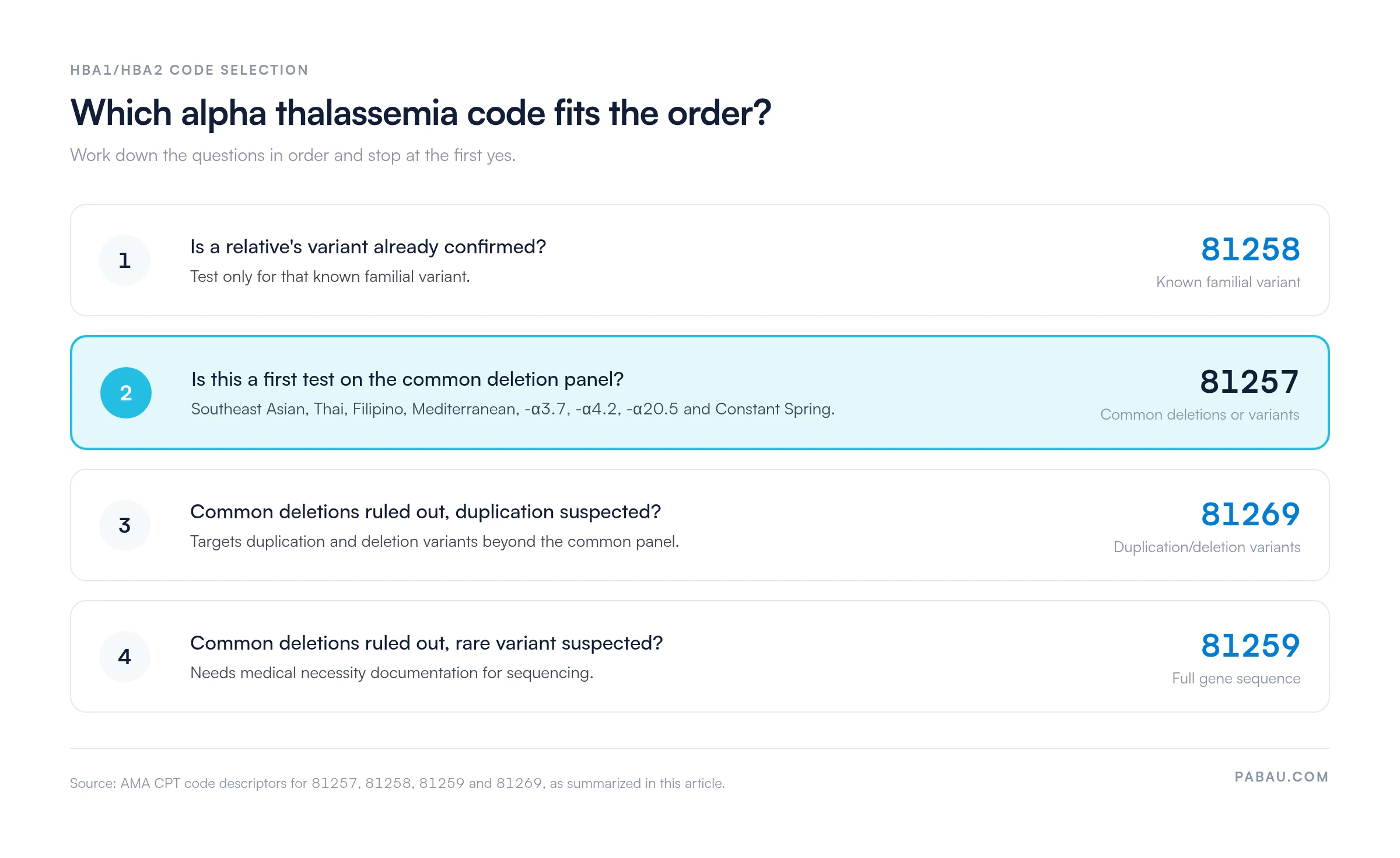
The HBA1/HBA2 code family includes four codes that coders routinely mix up. Selecting the wrong one results in a denial for incorrect procedure code, and upcoding to 81259 when 81257 applies can trigger a payer audit.
The 81257/81258 distinction is the most important. If the proband has already had 81257 testing and a specific deletion is confirmed, subsequent testing of at-risk relatives targets only that known variant. Billing 81257 for a family member when the variant is already identified is incorrect code selection, not a coverage question.
Asking four questions in order settles which HBA1/HBA2 code an order belongs to.
CPT 81257 is reimbursed under the Medicare Clinical Laboratory Fee Schedule (CLFS), not the Physician Fee Schedule. CMS set its CLFS rate through the crosswalk or gapfill process that followed the PAMA (Protecting Access to Medicare Act) pricing reforms. Pull the current rate from the CMS Clinical Laboratory Fee Schedule, as CLFS rates are updated annually.
Tier 1 molecular pathology codes like CPT 81257 carry a single national rate under the CLFS. Physician Fee Schedule codes use geographically adjusted RVUs instead. Key reimbursement considerations:
Practices billing on behalf of an in-house laboratory should confirm their CLIA certificate covers molecular pathology testing before submitting CPT 81257 claims. Submitting without the appropriate CLIA certification is a compliance risk flagged by OIG guidance on genetic testing.
Prior authorization requirements for CPT 81257 vary by payer and plan type. No single blanket rule applies. The safest practice is to check each payer’s molecular pathology or genetic testing policy before collecting the specimen.
Running insurance eligibility verification before ordering captures which plan the patient is on and whether the plan has genetic testing benefit restrictions. Confirming this at the point of ordering, rather than at billing, avoids the most expensive denials.
Six denial patterns account for most rejected 81257 claims, and each one has its own prevention step. Knowing the root cause of each type makes a structured denial management workflow far more effective than blanket appeals.
Review the medical billing denial codes to see which CARC codes payers attach to these rejections. CARC 50 (not medically necessary) and CARC 197 (precertification absent) are the two codes most often tied to 81257 denials.
Run a quarterly audit of 81257 denials grouped by CARC code. If CARC 197 (prior auth missing) accounts for more than 20% of denials, fix the authorization step at order entry. Extra documentation at the billing stage will not recover those claims.
Accurate CPT 81257 claims rely on the right information reaching the payer before the claim is submitted. These practical steps reduce re-work for billing staff and improve first-pass acceptance rates.
Practices running their own molecular pathology laboratory should route CPT 81257 claims through a clearinghouse that checks CPT and ICD-10 pairing before transmission. Aim for clean claim submission at the point of entry rather than correcting errors after a denial.
Many labs and practices still check 81257 claims by hand. A biller confirms the panel, matches the ICD-10 code and chases the prior authorization number before the claim goes out.
Pabau, the practice management platform we build, moves those checks into the claim itself. Its claims software for practices connects to Claim.MD for 837P electronic submission, with built-in CPT and ICD-10 catalogs. Mismatched code pairings get flagged before the claim reaches the payer.
Real-time eligibility checks confirm the patient’s active plan before you collect the specimen. The result is fewer 81257 claims returned for correction, so your billing team spends its time on new claims instead of appeals.

Pabau connects your lab billing workflow to Claim.MD, so CPT 81257 claims go out with validated ICD-10 pairings. Real-time eligibility checks mean fewer claims come back for correction.

CPT code 81257 is the right code only when a patient with no prior molecular diagnosis is tested against the common deletion panel. A confirmed familial variant moves the claim to 81258, and a suspected rare variant moves it to 81259.
Settle the code, the ICD-10 pairing and the prior authorization before the specimen is drawn. Those three decisions take minutes at order entry and weeks of appeals once a claim is denied. Teams new to lab billing can start with our medical billing fundamentals guide.
Book a demo to see how Pabau flags mismatched CPT and ICD-10 pairings before your 81257 claims reach the payer.

Need to understand how clearinghouse submissions work for molecular pathology? Claim.MD clearinghouse overview explains how electronic claim routing reduces manual entry errors on complex lab codes.
Want to see how ERA remittances map to denial reasons? Electronic remittance advice explained covers how to read 835 files and connect CARC codes back to root causes.
Getting credentialed with payers that require provider enrollment for genetic testing? Insurance credentialing guide walks through the enrollment process for laboratory and specialty providers.
Coding another Tier 1 gene test? CPT code 81240 covers F2 gene analysis, with its own coverage and billing rules.
Is no specific molecular code a match for the test? CPT code 81479 explains how to bill an unlisted molecular pathology procedure.
CPT code 81257 is used for HBA1/HBA2 gene analysis targeting common deletions and variants associated with alpha thalassemia. These include the variants behind hemoglobin H disease and hemoglobin Bart hydrops fetalis. It applies to carrier screening, diagnostic confirmation, prenatal testing and family studies that target one of the eight common deletions and variants.
The eight common deletions and variants in scope are Southeast Asian (–SEA), Thai (–THAI), Filipino (–FIL), Mediterranean (–MED), -α3.7, -α4.2, -α20.5 and Constant Spring (αCS). Deletions or variants not on this list require a different code, such as CPT 81259 for full sequencing.
Medicare covers CPT 81257 when it is medically necessary and the ICD-10-CM code on the claim matches the applicable Local Coverage Determination. Traditional Medicare fee-for-service generally does not require prior authorization, but Medicare Advantage plans often do. Verify coverage against the payer-specific LCD before ordering.
Commonly accepted codes include D56.0 (alpha thalassemia), D56.3 (thalassemia minor) and D56.8 (other thalassemias). Z84.89 (family history) works as a secondary code, and Z13.79 covers screening for genetic anomalies in an asymptomatic patient. Prenatal orders use O35.2XX0, where the 7th character identifies the fetus. Always verify against the payer-specific LCD before submitting.
CPT 81257 tests for common population-level HBA1/HBA2 deletions in a patient without a prior molecular diagnosis. CPT 81258 tests a family member for a specific variant that has already been confirmed in the proband. Billing 81257 when only the known familial variant is being tested is incorrect code selection.
Prior authorization requirements depend on the payer. Traditional Medicare FFS generally does not require PA for 81257, but Medicare Advantage, most commercial plans, and many state Medicaid programs do. Check the specific plan’s genetic testing policy before collecting the specimen to avoid post-service denials.



