

CCSD code G5100: Bypass of duodenum billing guide
CCSD code G5100 bills a bypass that leaves the duodenum in place CCSD code G5100...

Last Updated: Oct 16, 2026
81406 is the CPT code for a Level 7 molecular pathology procedure, one of nine Tier 2 levels from 81400 to 81408. Its examples include DNA sequence analysis of 11-25 exons and duplication/deletion analysis of 26-50 exons.
In practice, the code covers only the gene analyses CPT lists under it, such as NSD1 sequencing for Sotos syndrome. That list, not your exon count, decides the level. Code it wrong, or default to 81479, and the claim stalls before Medicare's lab fee schedule pays it.
Let Pabau's smart automation suggest the right codes, reduce claim denials, and keep your practice compliant—effortlessly.
Automate repetitive tasks and focus on what matters most—your patients.
Reduce coding errors and ensure compliance with the latest regulations.
Clean claims, fewer denials, and faster reimbursements.
Powerful insights and reporting to help your practice thrive.
HIPAA compliant SOC 2 certified GDPR-compliant Trusted by 4,000+ clinics worldwide

CPT code 81406 is the Level 7 code in the Tier 2 molecular pathology series, which runs from 81400 (Level 1) to 81408 (Level 9).
The AMA gene list decides when 81406 applies, so check the gene and analysis against this year’s CPT before you code.
Genes with their own Tier 1 code, such as CYP2D6 and PMP22, never report under 81406.
Medicare pays 81406 under the Clinical Laboratory Fee Schedule, while coverage comes from MAC LCDs and billing articles.
Pabau’s claims management software validates required claim fields, such as authorization numbers, before sending, with Claim.MD eligibility checks and ERA posting.
CPT code 81406 reports a Level 7 molecular pathology procedure. Its official examples cover three kinds of work. The first is DNA sequence analysis of 11-25 exons. The second is mutation scanning or duplication/deletion analysis across 26-50 exons. The third is cytogenomic array analysis for neoplasia.
Those examples describe the size of the job, not the billing rule. CPT assigns named gene analyses to each level, and only a listed analysis reports there. Sequence NSD1 for suspected Sotos syndrome, and the listing sends you to 81406. Your lab’s own exon count doesn’t override it.
Here’s where 81406 sits among its Tier 2 neighbors.
If a test looks only for known variants, check 81401 first. Shorter sequencing jobs of 2-5 exons often belong on 81404.
The AMA revises gene assignments with each annual CPT release, so treat any list as a starting point. The AMA’s CPT code set overview explains how those updates work.
CPT lists dozens of gene analyses under 81406, mostly full-gene sequencing for inherited conditions. These commonly ordered examples were checked against laboratory and payer coding references.
Other genes turn up on 81406 claims by mistake. Each of these has a better home:
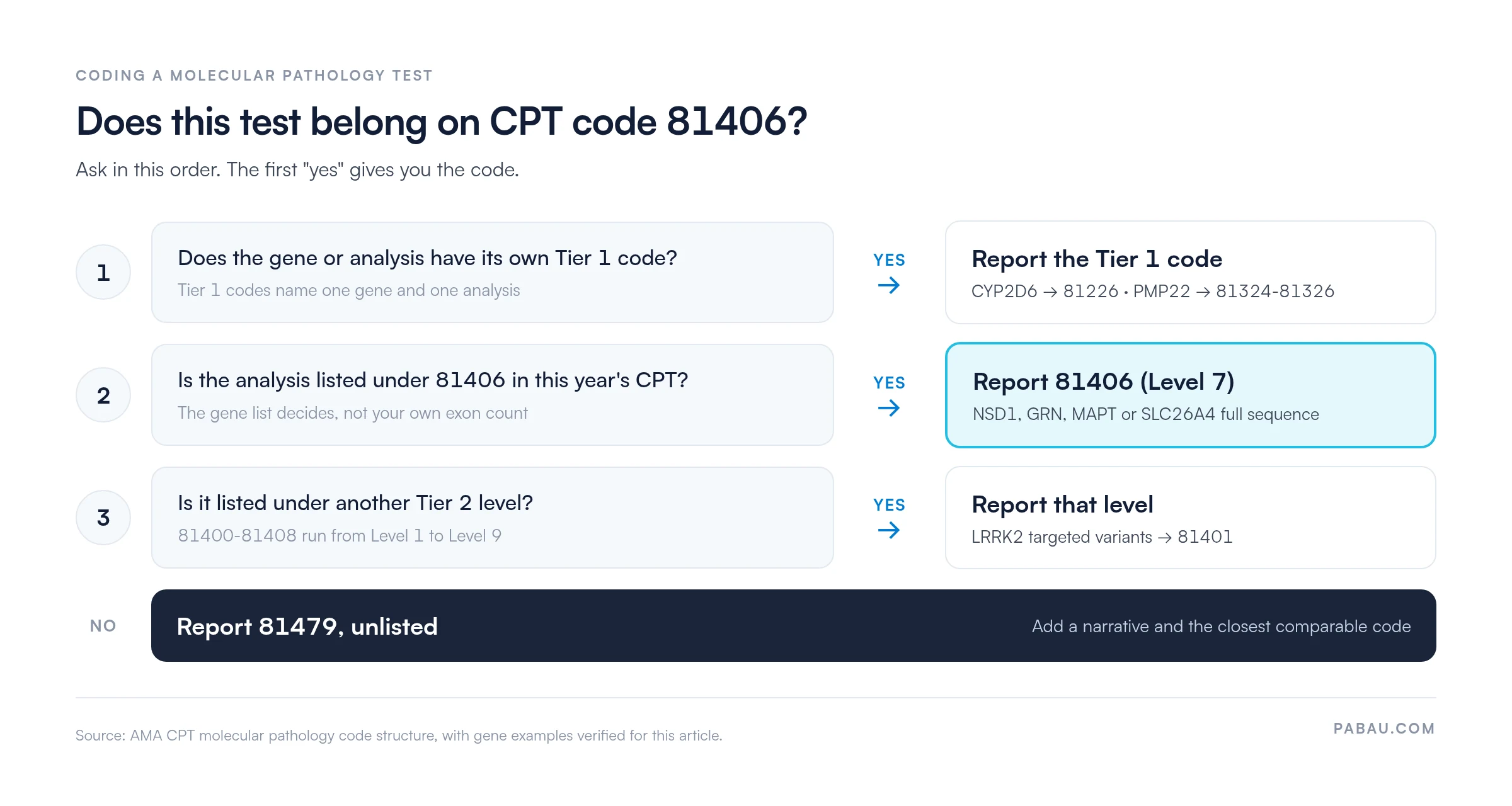
CPT 81479 is the unlisted molecular pathology code. It applies only when no Tier 1 or Tier 2 code describes the test. Reaching for it when the gene sits on the 81406 list is a coding error.
Unlisted claims also cost time. Many payers want a written description, the closest comparable code, and why that code falls short. A claim sent as 81479 that belongs on 81406 usually comes back for recoding or more records.
So run every molecular test through the same four checks, in this order.
Each MAC’s policy lists the diagnosis codes it accepts. Pair 81406 with a code outside that list, and the claim fails medical necessity, however sound the clinical reason. The pairings below are representative, so check them against your MAC’s policy.
Confirm each code in the CDC/NCHS ICD-10-CM web tool before you submit. The code set updates every October 1, so a code valid last year can lapse.
Medicare pays 81406 under the Clinical Laboratory Fee Schedule (CLFS), not the Physician Fee Schedule. Since 2018, CLFS rates come from private-payer market data under PAMA. The result is one national rate per code, with no RVUs involved.
Find the current figure in the quarterly files on the CMS Clinical Laboratory Fee Schedule page. Don’t forecast revenue from older published rates, because each pricing cycle can move them.
No national coverage determination governs 81406 across every indication. Coverage sits in MAC LCDs and billing articles instead. A test covered in one jurisdiction can be denied in another.
Before you send an 81406 claim to Medicare, work through this quick check:
Commercial payers set their own contracted rates. Some benchmark against the CLFS, while others use internal schedules. Without a negotiated molecular rate, a lab may see 81406 paid at a fraction of charges, or denied out of network.
Many commercial payers and Medicare Advantage plans require prior authorization (PA) for 81406. Traditional Medicare generally doesn’t, but the chart still needs medical necessity documentation before you bill. A missing authorization is one of the most common reasons these claims fail.
Confirm the payer’s current policy at the point of order, because PA rules change often. Checking insurance eligibility at the same time surfaces benefit limits before the patient is tested.
Our walkthrough of the prior authorization process covers what payers expect in a request. For 81406, plan on these points:
Medical necessity documentation has to exist when you bill, not after a denial. Payers audit molecular claims after payment, and missing records lead to recoupment demands that can exceed the original payment.
Requirements vary by LCD, but most payers expect these elements in the record:
Professional claims go out on the CMS-1500 or its electronic twin, the 837P. Institutional labs bill on the UB-04 with revenue code 0300 (laboratory) or 0310 (pathology). Here’s the sequence that keeps an 81406 claim clean:
A worked example. A neurologist orders GRN sequencing for a 58-year-old diagnosed with frontotemporal dementia, whose parent had the same condition. The lab confirms GRN full sequencing sits under 81406. The commercial plan’s authorization number goes in Box 23. G31.09 leads the diagnoses, with Z82.0 for the family history.
Before the batch goes out, run it against your clean claim checklist. One missing field on a high-value molecular claim can delay the whole payment.
Denials on 81406 cluster around narrow LCD criteria, authorization and modifiers. Start from the CARC on the remittance and match the fix to it. Our denial codes reference helps you trace repeat patterns to one root cause.
Track 81406 denials apart from your general lab dashboard. A 30-day look-back by CARC shows whether the problem is authorization (CO-197), medical necessity (CO-50) or modifiers (CO-4). Each one needs a different fix.
Most avoidable 81406 denials start with a field left blank at order entry. The authorization number never reached Box 23, or the ordering NPI went missing. Billing teams usually find out weeks later, from the remittance.
Pabau, the practice management platform we build, pre-fills the claim from the patient record. Its cleaner claims management software checks that required fields, such as authorization numbers, are complete before the claim can be sent.
In the US, claims go out through Claim.MD, with eligibility checks before the test and ERA posting when payment lands. Your team then works each denial from its code, instead of hunting through paper remittances.

Pabau’s claims management software validates required claim fields, such as authorization numbers, before sending, with Claim.MD eligibility checks and ERA posting.

81406 rewards labs that code from the gene list, not from an exon count. Get the level right, pair it with an LCD-listed diagnosis, and lock in authorization before the draw. Those three habits prevent most avoidable denials on this code.
The trade-off is more work at order entry, which feels slow until you compare it with an appeal. Book a demo to see how Pabau catches missing authorization numbers and NPIs before your molecular claims go out.

Need a clean claim checklist for molecular pathology? Building a clean claim walks through every required field on a CMS-1500, including the NPI and CLIA fields behind CO-16 denials.
Want to understand how clearinghouse validation works? How Claim.MD works as a clearinghouse explains eligibility checks, 837P transmission, and ERA processing for laboratory claims.
Seeing the same denial codes month after month? Denial management in healthcare shows how to trace repeat denials to one root cause and fix the process.
Worried about a post-payment audit? Medical billing compliance covers the records and controls auditors check on high-value claims.
Managing a high volume of denied molecular pathology claims? Revenue cycle management for clinical labs covers the systematic approach to tracking, appealing, and preventing denials across high-complexity code families.
Not under 81406, which covers the lab’s technical work. For Medicare, a physician who interprets a molecular pathology result and writes a report bills G0452. Commercial payers set their own rules, so check the contract first.
Usually not. If a genomic sequencing procedure code describes the panel, report that code instead. Stacking single-gene codes for a panel that has its own code is unbundling, and payers deny it.
A Z-code is a test identifier issued through the DEX registry, which Palmetto GBA runs for its MolDX program. MACs that use MolDX can require it on molecular claims, including 81406. Labs in other jurisdictions usually don’t need one.
It can. The Level 7 examples include cytogenomic array analysis for neoplasia, which is somatic work. Most 81406 listings, though, are germline full-gene sequences for inherited conditions. The listed analysis decides the code.



