

HCPCS code E0198: Water pressure pad billing guide
HCPCS code E0198 is a water pad for a standard mattress HCPCS code E0198 is the ...

Last Updated: Oct 13, 2026
81162 is the CPT code for BRCA1 and BRCA2 gene analysis by full sequence analysis and full duplication/deletion analysis. The AMA descriptor covers both genes and both methods on the same specimen, for hereditary breast and ovarian cancer testing.
Most billing errors with this code come from splitting the test into component codes such as 81163 and 81164. The National Correct Coding Initiative (NCCI) treats that as an unbundling violation when 81162 covers the complete analysis. Claims still carrying 81211, 81213 or 81214 fail outright, because those codes were deleted on January 1, 2019.
Let Pabau's smart automation suggest the right codes, reduce claim denials, and keep your practice compliant—effortlessly.
Automate repetitive tasks and focus on what matters most—your patients.
Reduce coding errors and ensure compliance with the latest regulations.
Clean claims, fewer denials, and faster reimbursements.
Powerful insights and reporting to help your practice thrive.
HIPAA compliant SOC 2 certified GDPR-compliant Trusted by 4,000+ clinics worldwide

CPT code 81162 bundles BRCA1 and BRCA2 full sequencing plus duplication/deletion analysis into one Tier 1 molecular pathology code. Billing its component codes alongside it is an NCCI unbundling violation.
CPT 81211, 81213 and 81214 were deleted on January 1, 2019. A claim that still carries one of them will be rejected outright.
Medicare coverage follows the active Local Coverage Determination (LCD). Eligibility usually needs a documented personal or family history meeting HBOC risk thresholds.
Modifier 33 removes patient cost-sharing when USPSTF criteria are fully documented. Incorrect use is a compliance risk under ACA Section 2713, not just a billing error.
Pabau’s claims management software submits 81162 claims electronically through Claim.MD, checks eligibility in real time, and posts ERA remittances back against the charge.
CPT code 81162 is a Tier 1 molecular pathology code. Its official American Medical Association (AMA) descriptor has two parts:
The code sits in the molecular pathology section (81105-81479) and covers germline testing only. Somatic or tumor-based BRCA analysis uses a different code set entirely.
Tier 1 classification means the AMA Editorial Panel has assigned a specific code to this analytic service. Tier 2 codes (81400-81408) work differently, using a stacked complexity-level structure. For billing purposes, Tier 1 codes like 81162 carry discrete descriptors that define which work is included in the service and which is not. That precision drives most of the unbundling exposure described below.
An analysis with no Tier 1 code of its own is reported instead at a Tier 2 complexity level, such as 81401.
81162 covers two distinct analytic methods performed on the same specimen for both genes simultaneously. Each component is required; billing the code when only one method was performed on only one gene is a descriptor mismatch.
The most common miscoding error is billing 81162’s component codes as a substitute for it when the lab performed the full combined analysis. Because 81162 already covers sequencing and del/dup analysis for both genes, submitting those components alongside it is an NCCI bundling violation. The reverse error is billing 81162 when only one gene or one method was performed. That is a descriptor mismatch, and it carries the same audit exposure.
Three codes that older billing guides still list are no longer valid. CPT 81211, 81213 and 81214 were deleted from the CPT code set effective January 1, 2019. The deleted 81211 covered full sequence analysis of both genes, plus common duplication/deletion variants in BRCA1 only. Its work is now split across the active component codes below.
Key rule: Use 81162 when the lab report confirms full sequencing of both BRCA1 and BRCA2 plus large rearrangement analysis. In that situation it is the only correct code. Splitting the same work across 81163 and 81164, or across the single-gene codes, is an unbundling violation under current NCCI tables.
Claim acceptance for CPT code 81162 depends on submitting a diagnosis code that appears on the payer’s covered-indications list. The ICD-10-CM codes below represent the most widely accepted groupings across Medicare and commercial payers. Our ICD-10-CM code library carries the full official descriptor for each one. Always verify them against the active Local Coverage Determination (LCD) for your MAC jurisdiction.
The distinction between preventive and diagnostic coverage matters for patient cost-sharing. Modifier 33 signals a USPSTF Grade B preventive indication. When it is used on an 81162 claim, ACA Section 2713 requires first-dollar coverage from most commercial plans. Without modifier 33, the claim processes as a diagnostic service and standard cost-sharing applies.
Medicare coverage for CPT code 81162 is governed by Local Coverage Determinations issued by individual Medicare Administrative Contractors (MACs). Verify the active LCD at the CMS Medicare Coverage Database before submitting claims. LCD numbering and criteria vary by jurisdiction and are revised regularly.
Common Medicare eligibility criteria appearing across active LCDs include the following. Checking the patient’s benefits before the test is ordered prevents the most common LCD-related denials.
Medicare Advantage plans may apply additional prior authorization requirements beyond traditional Medicare LCD criteria. The CMS ICD-10 codes and coverage resources confirm that coverage determinations for molecular diagnostic tests are updated annually. Verify them against the current year’s guidance.
Prior authorization requirements vary significantly by payer type. No universal PA rule applies, and submitting without verifying the specific plan’s policy is one of the most preventable denial drivers for CPT code 81162.
CPT code 81162 is reimbursed under the Medicare Clinical Laboratory Fee Schedule (CLFS), not the Physician Fee Schedule (PFS). The CLFS does not use RVU-based calculations. Rates are set through a market-pricing process under PAMA (Protecting Access to Medicare Act) and revised annually. CMS published the 2026 CLFS rates in late 2025. Verify the current national limitation amount directly from the CMS fee schedule lookup tool before billing.
Tracking payments against the CLFS rate and reconciling the electronic remittance advice is the fastest way to identify underpayments on 81162 claims. Practices that submit electronically through a clearinghouse can match each ERA remittance against the expected CLFS rate at the claim level. Lab code reimbursement differs from physician code reimbursement on four points.
Three modifiers are relevant to CPT code 81162. Each has a specific trigger condition. Using the wrong one creates a billing error. Using modifier 33 without meeting the full USPSTF documentation standard creates a compliance exposure.
Documentation for CPT code 81162 claims must demonstrate medical necessity before the test is ordered, not reconstruct it after a denial. A charge-capture workflow that pre-links the ICD-10 code and captures the required documentation fields prevents the most common submission errors. Setting that expectation with ordering providers at the start saves the billing team an appeal cycle later.
Submitting the 837 electronic claim file with incomplete documentation is a leading cause of medical necessity denials. Check that the ordering provider note and counseling record are retrievable before the lab submits the claim. The seven checkpoints below map each one to the denial it prevents.
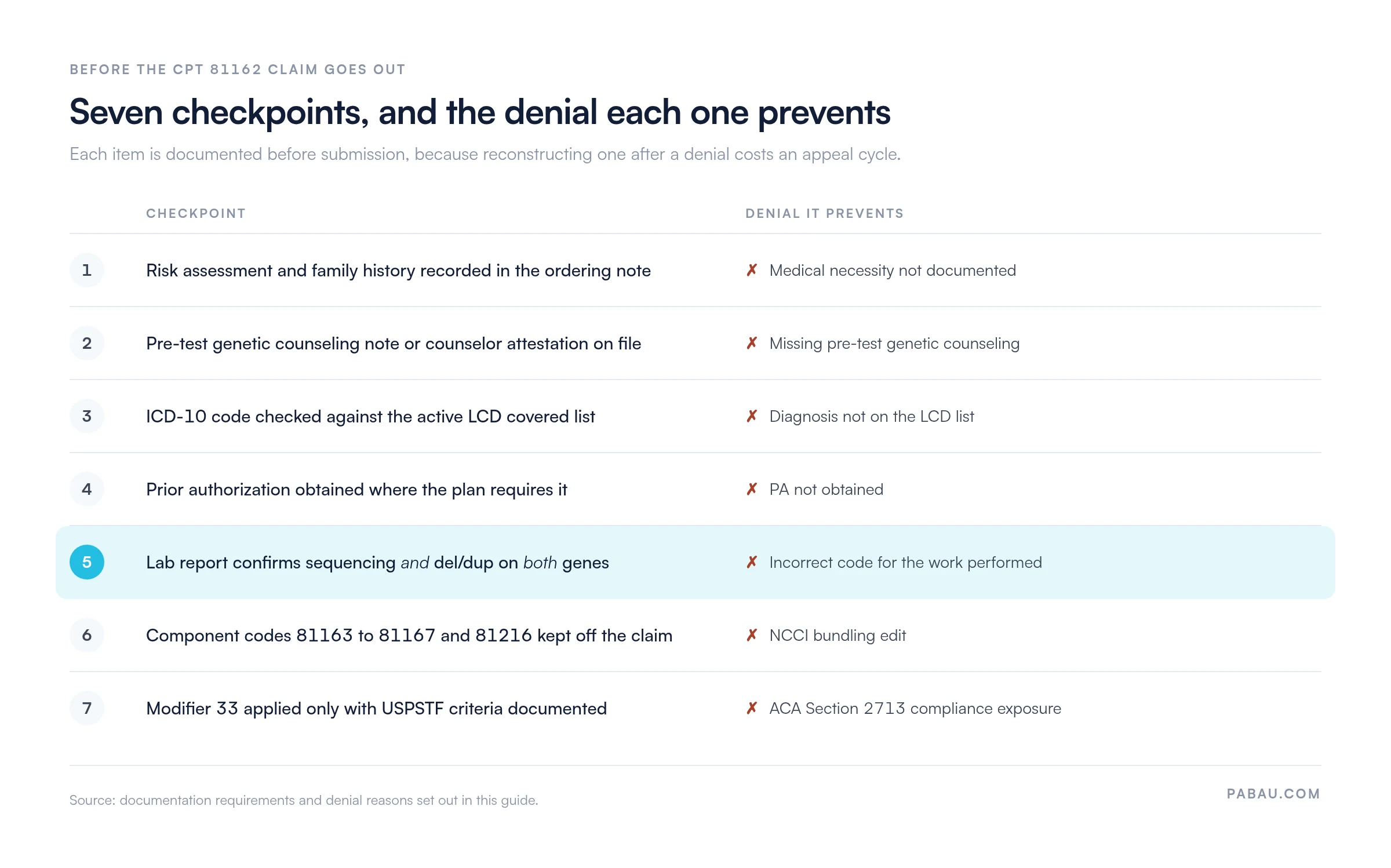
Set up CPT 81162 as a charge item in your billing system with the most common ICD-10 codes pre-linked as defaults. Flag any claim where the lab report description does not explicitly mention both full sequencing and del/dup analysis for both genes before submission.
Most 81162 denials are preventable, and the patterns below appear consistently across payers. Effective denial management for molecular pathology claims starts with matching the denial code to its root cause. The wrong appeal approach wastes time and appeal cycles, because sending clinical literature will not fix a missing PA number. Tracking denial codes at the CPT code level reveals which payer is generating recurring patterns.
Review your compliance standards for genetic testing once a year. Payer LCD updates and NCCI table revisions shift which denial patterns appear most often, even when your billing practices stay the same.
Several companion codes interact with CPT code 81162 on the same claim or on the same date of service. The rules differ by code type.
Genetic counseling codes (96040, 99401-99404): These can be billed on the same date as 81162 when counseling is genuinely provided as a separate, documented service. The counseling code is typically billed by the ordering provider or a certified genetic counselor under their own NPI, not by the laboratory billing 81162. A clean claim requires that the counseling note and the lab order appear as distinct services with different performing providers where applicable.
Hereditary cancer panel codes (81432, 81433): These multi-gene panel codes include BRCA1 and BRCA2 analysis among a broader gene set. If a comprehensive hereditary cancer panel was ordered, do not bill 81162 separately alongside 81432 or 81433 for the BRCA components. That is another form of unbundling.
NCCI edit interactions: NCCI edits for molecular pathology codes are updated quarterly. 81162 pairs as column 1 against its active component codes, among them 81163, 81164, 81165 and 81216. Modifier 59 will not resolve that edit where 81162 is the correct comprehensive code. Check the current NCCI tables before attempting to override a bundling edit with a modifier.
Genetic testing billing splits across two entities, and standard practice management workflows are rarely configured for it by default. The ordering practice captures the clinical encounter. The reference laboratory captures the test itself. When these two billing events are not coordinated, the lab’s claim goes out without documentation that already exists in the practice’s record.
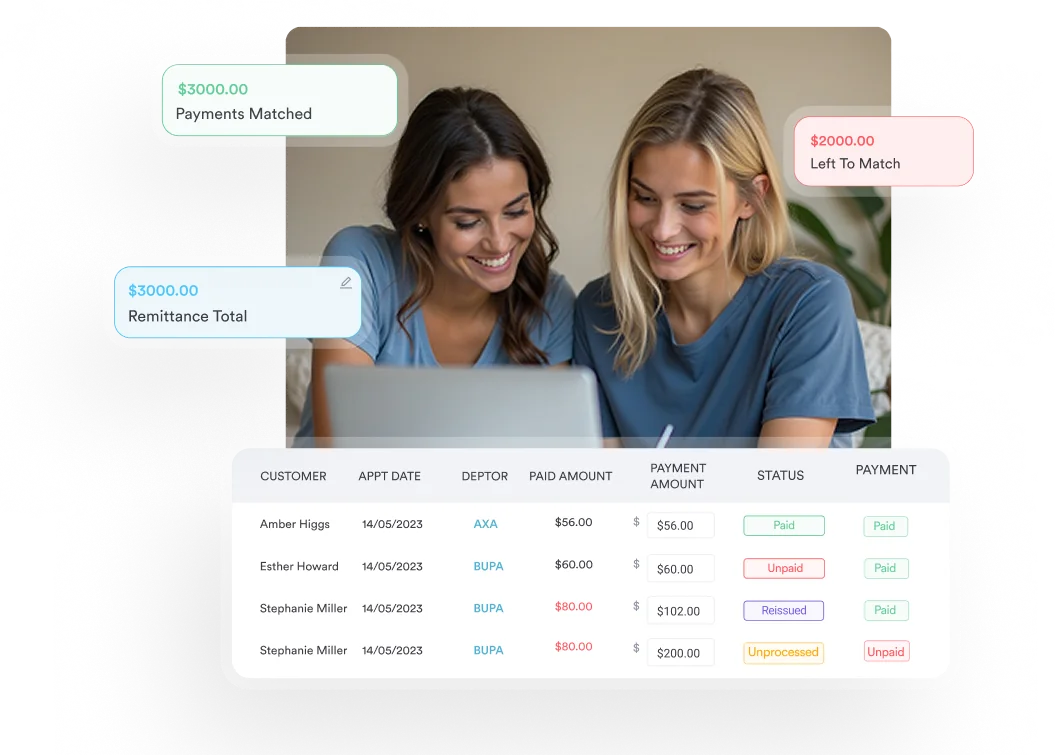
Pabau, a practice management platform built for healthcare practices, submits 81162 claims electronically through the Claim.MD clearinghouse. Its claims management software checks patient eligibility in real time before the test is ordered, then tracks each claim’s status after submission. ERA remittances post back against the original charge, so an underpayment or a denial is visible without a separate reconciliation step.
For practices using Pabau alongside a reference lab, one habit pays for itself. Treat the genetic counseling note as a required field in the ordering encounter, rather than a document to chase after a denial arrives.
Run a monthly denial report filtered to CPT 81162 across all payers. If the same denial reason comes back from three or more payers in one month, the ordering practice’s documentation template is the cause. Fix the template before you file another appeal.

Pabau submits claims electronically through Claim.MD, checks patient eligibility in real time, and posts ERA remittances back automatically. Billing teams can follow an 81162 claim without switching systems.

CPT code 81162 is a precise code for a complete service: BRCA1 and BRCA2 full sequencing plus large rearrangement analysis in one billable event. The two most costly errors are splitting the test into component codes, which NCCI treats as unbundling, and submitting without the documentation payers require. Billing a deleted code such as 81211 is the third.
Pabau’s claims management tools submit 81162 claims electronically, verify patient eligibility in real time, and track each claim’s status through to the ERA. Book a demo to see how a genetic testing claim moves from the order to the posted remittance.

Need to understand how clearinghouse submissions work for lab codes? Medical claims clearinghouse guide explains how electronic submissions route from the billing system to the payer.
Not sure which payer policies apply to your lab claims? Getting credentialed with insurance companies covers payer enrollment steps that affect which LCDs apply to your claims.
Looking for coding references across related billing codes? CPT billing code reference guides on Pabau cover procedure coding across multiple specialty areas.
CPT code 81162 covers BRCA1 and BRCA2 full sequence analysis plus duplication/deletion analysis, performed as germline testing. All of it falls under a single Tier 1 molecular pathology code. It does not cover somatic tumor testing, single-site known-variant testing, or RNA analysis.
There is no current difference to draw, because CPT 81211 was deleted from the CPT code set on January 1, 2019. Before then it covered full sequencing of both genes, plus common duplication/deletion variants in BRCA1 only. Use 81162 today when the lab performs full sequencing and full del/dup analysis on both genes. Use 81163, 81164, 81165, 81166, 81167 or 81216 when only one component or one gene was analyzed.
Yes. Medicare covers CPT code 81162 when the patient meets the eligibility criteria in the active Local Coverage Determination for the applicable MAC jurisdiction. That usually means a documented personal or family history consistent with hereditary breast and ovarian cancer syndrome, plus pre-test genetic counseling. Verify the current active LCD at the CMS Medicare Coverage Database before submitting.
Four groupings cover most claims. Z15.01 is genetic susceptibility to malignant neoplasm of breast, and Z84.81 is family history of carrier of genetic disease. Z80.3 covers family history of malignant neoplasm of breast, and the C50.x series covers a personal diagnosis. Always verify against the active LCD covered-indications list for your MAC.
CPT code 81162 is a Tier 1 molecular pathology code. Tier 1 codes sit in the 81105-81383 section and carry discrete AMA-assigned descriptors naming the exact analyte and analytic method. Tier 2 codes use a stacked complexity-level structure instead.
Yes. Genetic counseling codes (96040, 99401-99404) can be billed on the same date as 81162 when counseling is documented as a separate service. The ordering provider or a certified genetic counselor bills it under their own NPI. The laboratory billing 81162 is typically a different entity.



