CPT code 93503: Swan-Ganz catheter billing and modifiers
CPT code 93503: Official descriptor and procedure overview In the AMA CPT code s...

Last Updated: Oct 23, 2026
81401 is the CPT code for molecular pathology procedure, Level 2. Its descriptor examples are 2-10 SNPs, 1 methylated variant, 1 somatic variant, or detection of a dynamic mutation disorder/triplet repeat. Labs report it only for the analyses named in its AMA list, such as the ABL1 T315I variant or APOB common variants.
Coders often confuse it with the adjacent Tier 2 codes 81400, 81402 and 81403. The gene list printed under each code decides which one applies, and full-gene sequencing never falls under 81401. Genes with their own Tier 1 code, such as CYP2C19 (81225), are billed under that code instead.
Let Pabau's smart automation suggest the right codes, reduce claim denials, and keep your practice compliant—effortlessly.
Automate repetitive tasks and focus on what matters most—your patients.
Reduce coding errors and ensure compliance with the latest regulations.
Clean claims, fewer denials, and faster reimbursements.
Powerful insights and reporting to help your practice thrive.
HIPAA compliant SOC 2 certified GDPR-compliant Trusted by 4,000+ clinics worldwide

CPT Code 81401 is the Tier 2, Level 2 code for analyses named in its AMA list, such as ABL1 T315I or APOB common variants.
Genes with their own Tier 1 code never go under 81401. CYP2C19 is 81225, DPYD is 81232, JAK2 V617F is 81270 and PTEN is 81321-81323.
The same gene can sit under different levels. ACADM K304E alone is 81400, while the ACADM common-variant panel is 81401.
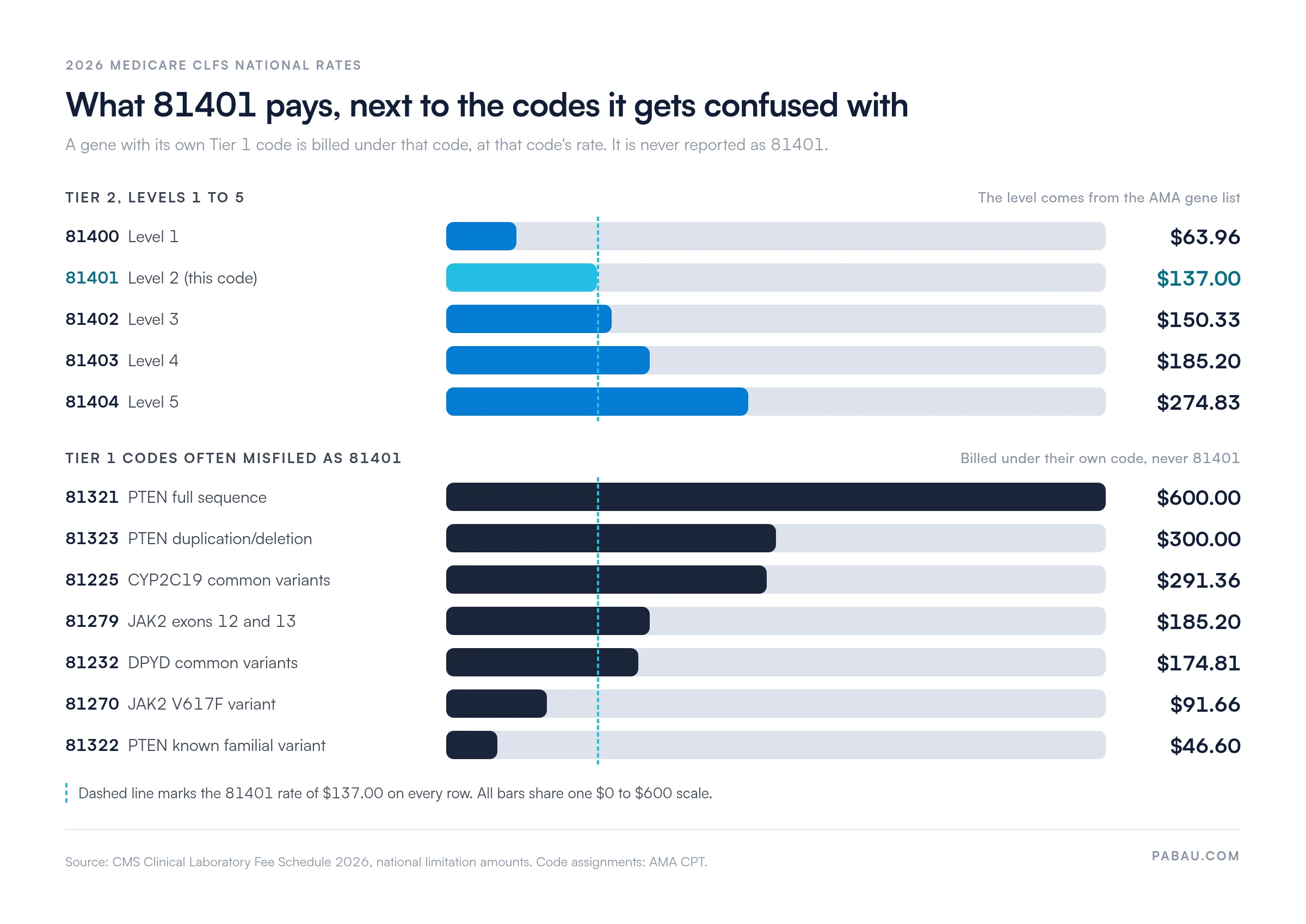
Medicare pays 81401 at $137.00 on the 2026 Clinical Laboratory Fee Schedule. MolDX contractors also require a DEX Z-Code on the claim.
Pabau, the practice management platform we build, checks every claim for missing details before it goes to the payer through Claim.MD.
CPT Code 81401 is the American Medical Association (AMA) code for a Tier 2, Level 2 molecular pathology procedure. Labs report it only for the gene analyses printed in its parenthetical list, such as the ABL1 T315I variant or APOB common variants.
The official descriptor reads “Molecular pathology procedure, Level 2”. Its parenthetical gives four examples of the work it covers:
The AMA’s CPT code set splits Tier 2 into nine levels, 81400 through 81408. Each level groups analyses of similar technical effort, from one germline variant at Level 1 to sequencing of more than 50 exons at Level 9. Further up that range, CPT code 81406 covers DNA sequence analysis of 11 to 25 exons at Level 7.
Labs find the level by locating the exact gene and analysis in the AMA list. The table shows the descriptor examples and some listed analyses for Levels 1 to 4.
Rates are the national limitation amounts in the CMS Clinical Laboratory Fee Schedule 2026 file. Gene examples come from the AMA descriptors printed in the same file.
CPT 81401 covers only the dozens of analyses named in its AMA list. They fall into four groups: common-variant panels, single somatic variants, methylation tests, and fusion-gene translocation assays.
Each entry pairs a gene with one exact analysis. That is why one gene can need a different code when the lab runs a different test on it.
The analysis type decides the code, even within one gene. ACADM K304E tested alone is 81400, but the ACADM common-variant panel is 81401. PRSS1 common variants are 81401, while PRSS1 full gene sequencing moves to 81404. ABL1 T315I is 81401, while BCR/ABL1 major breakpoint analysis has its own Tier 1 code, 81206.
A gene with its own Tier 1 code is never billed under a Tier 2 level. Several genes still get misfiled under 81401, so check the Tier 1 range (81105-81383) before you open the Tier 2 list.
JAK2 V617F has its own guide, CPT Code 81270, covering indications and MolDX rules. When no Tier 1 or Tier 2 code names the analysis, the unlisted molecular pathology code CPT 81479 is the correct fallback.
The correct Tier 2 level is the one whose AMA list names the exact gene and analysis. If the analysis appears under a code, use that code. If it appears under none, use 81479.
Before assigning any Tier 2 code, look up the exact gene and analysis type in the current AMA CPT codebook. The published list decides the level, not your view of analytical complexity. When in doubt, check the gene in the AAPC’s Codify tool before you submit the claim.
Medicare pays CPT Code 81401 under the Clinical Laboratory Fee Schedule (CLFS), not the Physician Fee Schedule. CMS sets CLFS rates from private-payer data collected under the Protecting Access to Medicare Act (PAMA). The national rate for 81401 is $137.00 in both the 2025 and 2026 files.
The chart sets that rate against its Tier 2 neighbors and the Tier 1 codes most often misfiled as 81401.
Pull the current quarterly file from the CMS CLFS page before you set expectations, since CMS can revise rates each quarter. CLFS rates carry no geographic adjustment and no professional or technical component split.
Commercial payer rates depend on each lab contract and can sit above or below the CLFS rate. Most payers do not publish them, so labs confirm them through their contracts or fee schedule requests.
The ICD-10-CM code on an 81401 claim must reflect the clinical reason for the specific gene analysis. A general “genetic testing” or screening code rarely supports it. Pairing 81401 with a diagnosis your MAC does not accept is the most common denial trigger for this code.
Link the ICD-10 code to the 81401 line itself, not only the claim header. Before billing, check the diagnosis against your MAC’s current coverage article, since the covered code and gene combinations change with each update.
Medicare coverage for CPT Code 81401 is local, so the rules depend on your Medicare Administrative Contractor (MAC). Wellpoint Federal, formerly NGS, publishes billing and coding article A56199 under LCD L35000 (Molecular Pathology Procedures). It lists covered and non-covered Tier 2 code and gene combinations.
In MolDX jurisdictions (Palmetto GBA, Noridian, WPS and CGS), labs must register each test in the DEX registry first. The Z-Code from that registration goes on every 81401 claim line. Each contractor’s policy is listed in the CMS Medicare Coverage Database.
An 81401 claim passes audit only when the record contains each element below. Missing any one of them can trigger a documentation denial or a recoupment after a post-payment audit.
Structured order forms that capture gene, analysis type and ICD-10 code at order entry prevent most of these denials. Medical billing compliance frameworks put these checkpoints into the front-end ordering process rather than fixing them after a denial.
CPT Code 81401 claims face a predictable set of denials, and front-end edits prevent most of them. The table maps each common denial code to its root cause and the fix for resubmission or appeal.
For Medicare, file a redetermination within 120 days of the initial determination. If that fails, request reconsideration by the Qualified Independent Contractor (QIC) within 180 days of the redetermination decision.
Peer-reviewed evidence on the clinical utility of the specific analysis strengthens an appeal. For CO-50 denials, cite the ACMG or NCCN guideline that supports the ordered test. Denial management workflows built around CARC tracking help structure these appeals. For CARC and RARC context, see the full list of medical billing denial codes.
National Correct Coding Initiative (NCCI) edits govern which molecular pathology codes can be billed together on one date of service. The most common error in this family is billing an analysis twice under two levels.
ACADM shows how it happens. The 81401 common-variant panel already includes K304E, so adding 81400 for K304E on the same specimen bills that variant twice. Report the one code that matches the full analysis performed.
The second pattern is stacking several 814xx lines for a test that has its own code. A gene with a Tier 1 code, or a panel with its own MAAA or PLA code, is billed under that code alone.
Run a pre-submission NCCI check on every claim that pairs 81401 with another molecular pathology code. If your lab bills multi-gene panels often, audit your billing rules against the current NCCI table each quarter.
Molecular pathology billing has more moving parts than routine lab work. Line-level ICD-10 linkage, prior authorization, NCCI edits and remittance reconciliation all give errors a way into the claim. A billing workflow built for lab claims covers six checkpoints:
Pabau’s claims management software runs validation checks every time you go to send a claim. If a required detail is missing, the Send button stays disabled until the claim is complete.
Claims then go to thousands of US payers through the Claim.MD clearinghouse, with real-time eligibility checks and claim status tracked in Pabau. Electronic remittance advice flows back into the same workflow, so denied 81401 lines reach follow-up quickly. Clean claim submission standards show how that clearinghouse layer catches CPT and ICD-10 mismatches before they reach the payer.

Pabau checks every claim for missing details before it goes out, submits it through Claim.MD, and tracks status and remittances in one place. See how it reduces 81401 denials.

Most 81401 denials start before the claim is built, when someone picks the code from the gene name alone. Check the Tier 1 range first, then the Level 2 list for the exact analysis. That one habit prevents the CYP2C19, DPYD and JAK2 misfilings that older guides still repeat.
The rest is discipline at order entry: a diagnosis your MAC accepts, a DEX Z-Code in MolDX states, and an ABN signed before the test. Book a demo to see how Pabau catches missing claim details before your molecular pathology claims reach the payer.

Need a framework for tracking claim denials by reason code? Electronic remittance advice explains how ERA files map adjustment codes to denial reasons and how to build automated routing workflows from ERA data.
Looking to verify payer eligibility before submitting 81401 claims? Insurance eligibility verification covers how real-time eligibility checks reduce non-covered-service denials at the point of order.
Want to understand the clearinghouse layer between lab and payer? Medical claims clearinghouse breaks down how 837P transactions are validated, edited, and transmitted to payers, and where CPT edit checks occur in the workflow.
CPT code 81401 covers Tier 2, Level 2 molecular pathology analyses named in its AMA list. Examples include the ABL1 T315I variant and common-variant analysis of APOB, GALT, PYGM and PRSS1. It does not cover full-gene sequencing or genes with their own Tier 1 code, such as CYP2C19, DPYD, JAK2 V617F or PTEN.
Medicare pays CPT 81401 at $137.00 nationally under the 2026 Clinical Laboratory Fee Schedule (CLFS), the same rate as 2025. It is not paid under the Physician Fee Schedule. CMS can revise CLFS rates each quarter, so confirm the current file before billing.
Each code covers the analyses named in its own AMA list. CPT 81401 covers listed analyses such as APOB or GALT common variants. CPT 81402 covers Level 3 entries such as CYP21A2 or MEFV common variants. CPT 81403 covers Level 4 entries such as VHL deletion/duplication analysis. Look up the exact gene and analysis rather than estimating complexity.
Medicare does not require prior authorization for CPT 81401, but a signed ABN is needed when a medical necessity denial is likely. Many commercial payers, including UnitedHealthcare, do require prior authorization for Tier 2 molecular pathology procedures. Check the payer’s current policy before ordering, as requirements vary by plan.
The most common reason is CO-50, when the diagnosis does not support the analysis under the MAC’s policy. CO-11 follows when the ICD-10 code does not match the gene tested. CO-16 covers missing details, such as a DEX Z-Code in MolDX states. Billing 81401 for a gene with its own Tier 1 code, such as CYP2C19 (81225), also leads to denials.
Yes, when each code is a distinct listed analysis with its own medical necessity documentation. Billing one analysis under two levels triggers NCCI edits (CO-97). For example, ACADM K304E (81400) should not be added to the ACADM common-variant panel (81401) on the same specimen. Modifier 59 applies only when the distinct purpose is documented.