

HCPCS Code G0163: Skilled nursing observation and assessment
What is HCPCS Code G0163? HCPCS Code G0163 is a deleted Level II code for skille...

Last Updated: Oct 15, 2026
78070 is the CPT code for parathyroid planar imaging (including subtraction, when performed). It reports static, two-dimensional scintigraphy that pinpoints an overactive parathyroid gland, usually an adenoma, before surgery.
The acquisition decides the code. Planar images alone stay on 78070, whether the study used one tracer or two. Add SPECT and the claim moves to 78071. Add SPECT with concurrent CT and it becomes 78072. Pick the wrong one and the claim is either underpaid or overcoded. The tracer lines, ICD-10 pairings and modifier splits below decide whether it gets paid the first time.
Let Pabau's smart automation suggest the right codes, reduce claim denials, and keep your practice compliant—effortlessly.
Automate repetitive tasks and focus on what matters most—your patients.
Reduce coding errors and ensure compliance with the latest regulations.
Clean claims, fewer denials, and faster reimbursements.
Powerful insights and reporting to help your practice thrive.
HIPAA compliant SOC 2 certified GDPR-compliant Trusted by 4,000+ clinics worldwide

CPT code 78070 reports parathyroid planar imaging, including subtraction when performed, with no SPECT or CT acquisition.
One tracer, usually Tc-99m sestamibi (A9500), is enough to report the code, and a second agent is billed only when subtraction is performed.
Add SPECT and the code becomes 78071, while SPECT with concurrently acquired CT makes it 78072.
E21.0 (primary hyperparathyroidism) is the most common paired ICD-10 code, and weak diagnosis linkage is a leading denial trigger.
Renal-origin secondary hyperparathyroidism is coded N25.81, so E21.1 only fits non-renal secondary disease.
CPT code 78070 is the code for parathyroid planar imaging (including subtraction, when performed), as defined in the American Medical Association’s CPT code set.
It reports static two-dimensional scintigraphy that localizes abnormal parathyroid tissue, most often an adenoma. The surgeon then uses the images to plan the parathyroidectomy, which is billed separately under 60500.
Before 2014, the code read simply “Parathyroid imaging.” The 2014 revision gave it its current wording and added 78071 and 78072 for studies with tomographic acquisition.
Most protocols use a single tracer, Tc-99m sestamibi, imaged at an early and a delayed time point. Parathyroid adenomas tend to hold on to sestamibi longer than thyroid tissue, so they stand out on the delayed images.
Some sites also give a thyroid-only agent and digitally subtract the thyroid image. That step is optional, and 78070 covers the study either way.
Technologists acquire planar images in anterior and oblique projections, typically 10 to 20 minutes and 2 to 3 hours after injection. A nuclear medicine physician then interprets the images and issues a written report. No tomographic reconstruction is performed, and that single fact decides the code.
With the procedure defined, the next question is the supply side. The radiopharmaceutical isn’t part of 78070, so each agent given goes on its own line with a HCPCS Level II code.
A single-tracer study carries one supply line, usually A9500. A second agent appears on the claim only when the study included subtraction.
In the hospital outpatient setting, Medicare packages diagnostic radiopharmaceuticals into the procedure payment. The HCPCS line is still reported, though. Check the current status and billing units for A9500, A9516 and A9512 in the CMS quarterly HCPCS update before each plan year.
CPT code 78070 is ordered mainly in two situations. The first is preoperative localization of an adenoma in a patient with confirmed primary hyperparathyroidism. The second is persistent or recurrent disease after a prior parathyroidectomy.
Both need biochemical confirmation before imaging is appropriate.
Payers want the reasoning in the chart, not just a diagnosis code on the claim. The ordering note should carry the calcium and PTH values behind the workup. The PTH assay is its own lab service, billed under 83970, and its result is what makes the scan necessary.
Accurate ICD-10-CM linkage is the most reliable way to head off a medical necessity denial. Use the most specific code that matches the documented clinical picture.
E21.3 (hyperparathyroidism, unspecified) is a fallback, so don’t submit it when the record documents primary disease and supports E21.0.
For lookups between procedure and diagnosis codes, CrossCoder offers CPT-to-ICD-10 crosswalks and coverage lookups by MAC jurisdiction. Ask your MAC whether a Local Coverage Determination for parathyroid imaging applies in your region, since criteria can differ.
Once the diagnosis is settled, the acquisition decides the procedure code. CPT 78071 adds SPECT to the same parathyroid study, and 78072 adds SPECT with concurrently acquired CT.
Both include the planar images, so the diagram below works from the record outward.
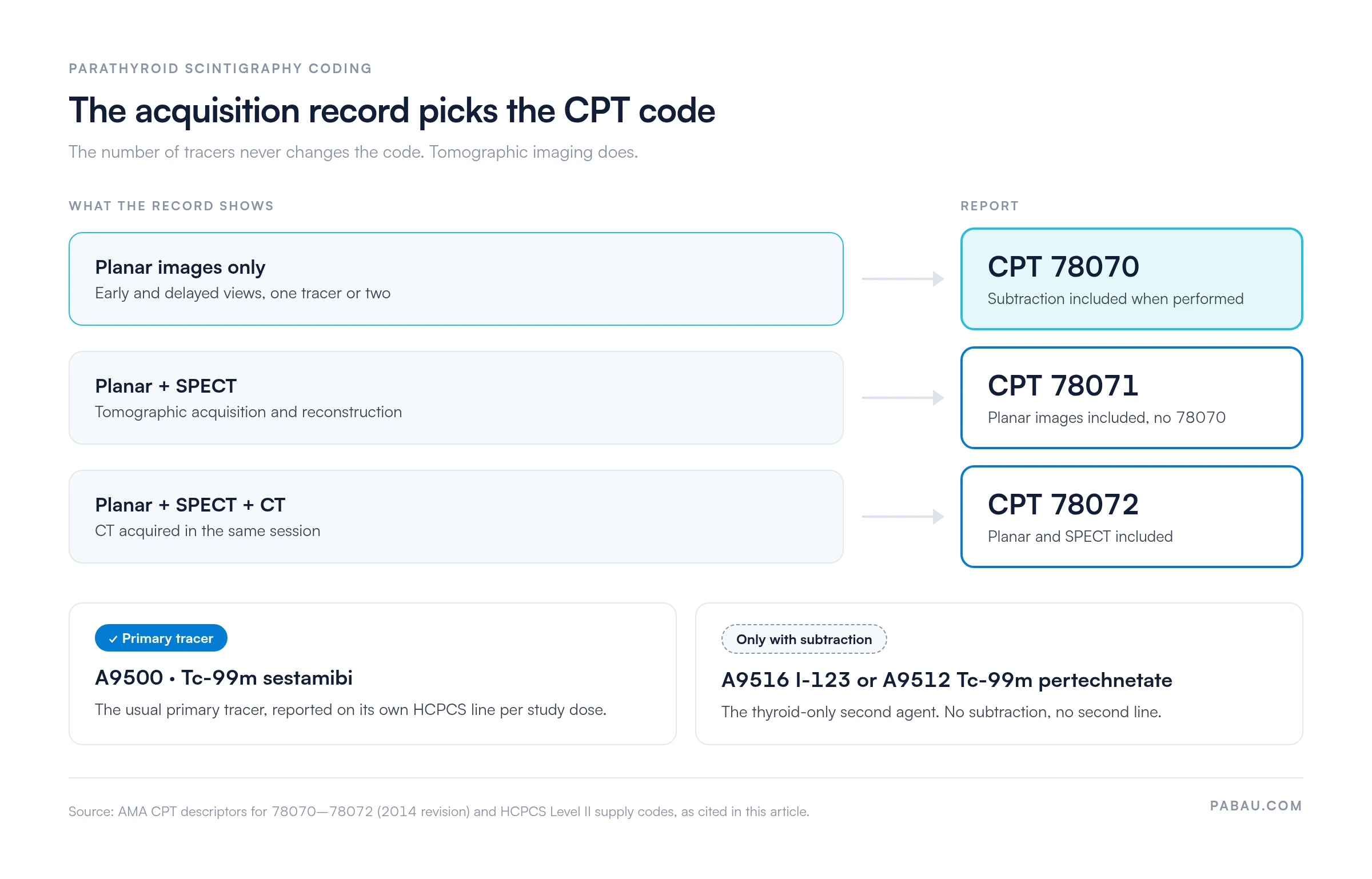
Picking the wrong code cuts both ways. Billing 78070 after a SPECT acquisition underpays the study. Reporting 78071 or 78072 for planar-only images is overcoding.
Code from what the acquisition record shows was performed. If an order for planar imaging ends in a SPECT acquisition, reconcile it with the ordering physician before the claim goes out.
Modifier choice depends on how the technical facility and the interpreting physician split the service. Get the split wrong and nuclear medicine claims bounce routinely.
Audit your claim splits at least quarterly. A physician billing global (no modifier) on claims where the facility also submits -TC creates duplicate billing exposure. Reconcile the modifier logic between the physician practice and the imaging facility before year-end.
A defensible claim for CPT code 78070 needs documentation at three points: the order, the procedure record and the final report. If one is missing, the claim is open to a medical necessity or services-not-rendered denial.
These five records cover all three.
If you build structured fields into your superbill documentation, map each of these five records to its own field rather than free text. Structured capture means fewer omissions at claim submission.
Medicare covers parathyroid scintigraphy when documented biochemical hyperparathyroidism establishes medical necessity and the imaging supports surgical planning.
Payment rates are updated each year in the CMS Physician Fee Schedule. Look up current facility and non-facility rates for your locality rather than relying on last year’s figures.
Prior authorization rules change by payer and plan year, so capture the authorization before the date of service rather than after a denial.
Coverage rules set the conditions, and the workflow below is how a billing team meets them. A clean claim on the first pass gets paid faster than a denied one gets worked.
Here’s a worked example. A radiologist reads a planar-only sestamibi study performed at a hospital. The radiologist bills 78070-26, linked to E21.0. The hospital bills the technical service and the A9500 line on its own facility claim. No second tracer line appears, because no subtraction was done.
A two-minute check at the end of the workflow catches most of the errors that cause rework. Tick each item before the claim leaves.
Even with a checklist, denials for parathyroid scintigraphy follow a predictable pattern. Effective denial management strategies start by finding which mistake drives the most volume in your payer mix.
A study performed with one tracer is not a valid reason to deny 78070. The descriptor covers subtraction only “when performed,” so appeal any denial that rests on a missing second agent.
Run a monthly denial drill. Filter your remittance reports to all 78xxx codes, group them by denial reason code and tally by payer. A handful of patterns usually drive most of the volume. Fix the root cause in intake and documentation rather than appealing claim by claim.
Many nuclear medicine billing teams check coverage in one tool and submit claims in another. Authorization status and tracer lines then get re-keyed between them, and that’s where errors creep in.
Pabau, the practice management platform we build, keeps both steps together. Its claims management software runs eligibility checks before the scan and submits claims electronically through Claim.MD in the US. Practices in the UK and Australia submit through Healthcode and Tyro Health.
Coverage gets confirmed before the date of service, so fewer claims come back for authorization problems. Your coders still choose the code and modifiers, and Pabau gets the finished claim to the payer.

Pabau checks patient eligibility before the scan and submits claims electronically through Claim.MD, so your team spends less time chasing authorization denials.

Code parathyroid imaging from the acquisition record. If the images are planar only, 78070 is correct whether the study used one tracer or two. SPECT moves the claim to 78071, and SPECT with concurrent CT moves it to 78072.
Bill a second tracer only when subtraction was performed, and never hold a single-tracer claim for a missing agent. Spend that effort on prior authorization and diagnosis specificity instead. Those are the denial triggers you control before the scan.
If your team still re-keys authorization details between tools, that’s the step worth fixing first. Book a demo to see how Pabau confirms eligibility before the scan and sends the 78070 claim through Claim.MD.

Need a structured approach to claim rejections? Denial codes in medical billing covers the most common CARC and RARC codes and what each signals about your claim.
Unsure how clearinghouse submissions work? Medical claims clearinghouse explains how 837P files move from your practice management system to payers and what can go wrong in transit.
Want to reduce time spent on eligibility checks? Insurance eligibility verification outlines automated verification workflows that flag coverage problems before the date of service.
Billing thyroid scans as well? CPT code 78014: Thyroid imaging with uptake walks through the neighboring endocrine nuclear medicine code.
No. Hyperparathyroidism is diagnosed from blood tests, mainly serum calcium and PTH. The scan only shows where the abnormal gland sits, so the surgeon can plan the operation. That’s why payers expect the lab results in the chart before they accept 78070 as medically necessary.
A dual-phase scan uses one tracer, sestamibi, imaged early and again a few hours later. A dual-tracer scan adds a thyroid-only agent so the thyroid can be subtracted. Both are planar studies, so both report 78070. Only the dual-tracer study adds a second supply line.
Parathyroid ultrasound is reported with CPT 76536, which covers ultrasound of the soft tissues of the head and neck. Surgeons often order it alongside the sestamibi scan. Each study is coded on its own line, with its own documented indication.
Yes. Medical necessity rests on the documented indication at the time of the order, not on the result. A negative or equivocal scan is still a completed study. Code it from the images acquired and the report issued.
Parathyroidectomy or exploration of the parathyroid glands is reported with CPT 60500. Re-exploration and mediastinal approaches use other codes in the same family. The imaging provider bills 78070 separately from the surgeon’s claim.




