CPT Code 28005: Incision of bone cortex, foot
CPT Code 28005: Definition and clinical scope CPT Code 28005 is the Current Proc...

Last Updated: Oct 22, 2026
78072 is the CPT code for parathyroid planar imaging (including subtraction, when performed) with tomographic SPECT and concurrently acquired CT for anatomical localization. It reports a SPECT/CT study that pinpoints an overactive parathyroid gland before surgery.
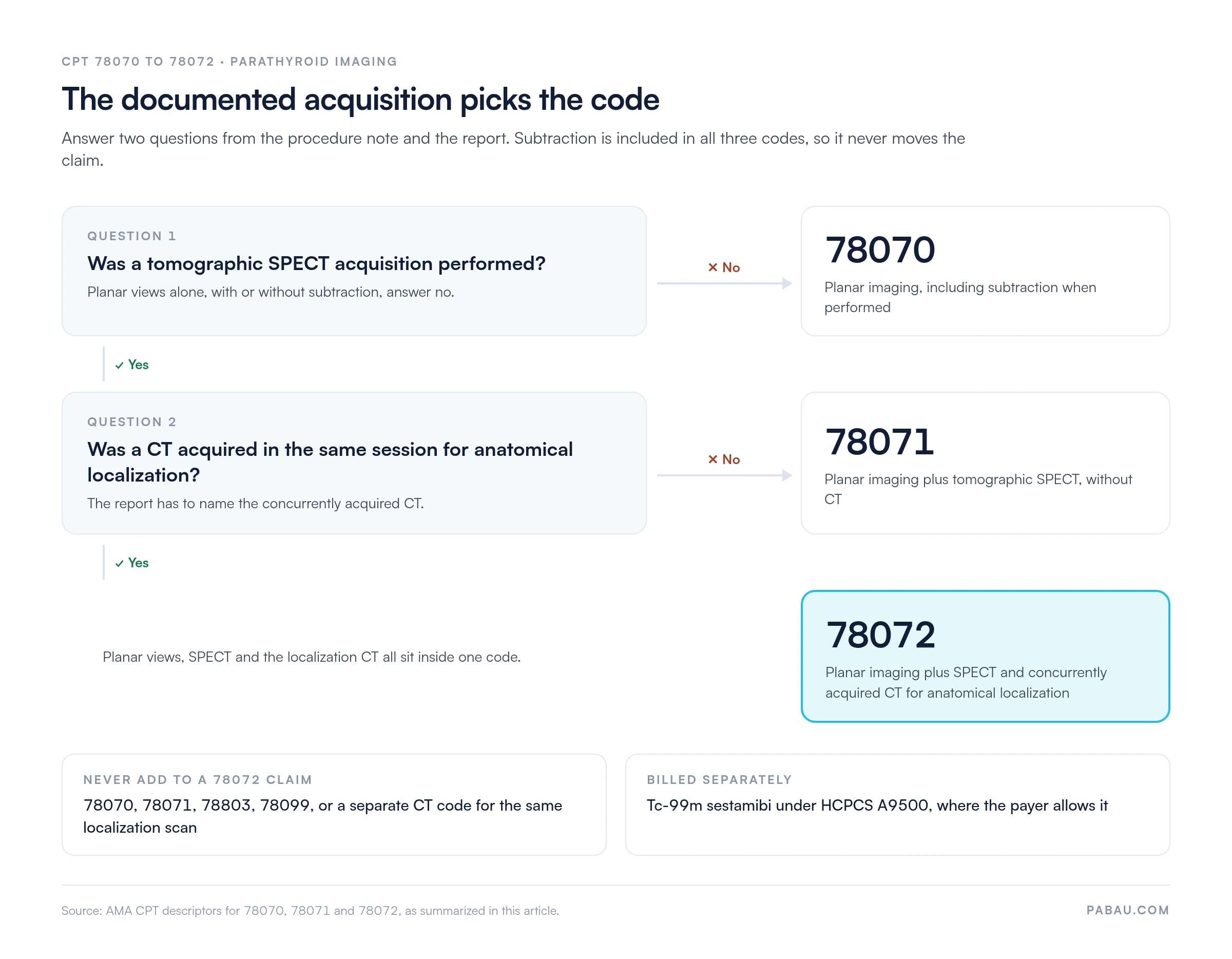
The documented acquisition decides the code. Planar images alone, with or without subtraction, stay on 78070. Planar imaging plus SPECT without CT is 78071. Only a study with SPECT and a concurrently acquired localization CT supports 78072, and the report has to name that CT.
Let Pabau's smart automation suggest the right codes, reduce claim denials, and keep your practice compliant—effortlessly.
Automate repetitive tasks and focus on what matters most—your patients.
Reduce coding errors and ensure compliance with the latest regulations.
Clean claims, fewer denials, and faster reimbursements.
Powerful insights and reporting to help your practice thrive.
HIPAA compliant SOC 2 certified GDPR-compliant Trusted by 4,000+ clinics worldwide

CPT code 78072 covers parathyroid planar imaging with tomographic SPECT and a concurrently acquired CT for anatomical localization.
Planar imaging alone is 78070, and planar imaging plus SPECT without CT is 78071. Subtraction is included in all three codes when performed.
The localization CT is part of 78072 itself, so 78099 and 78803 are never added to a 78072 claim.
Tc-99m sestamibi (HCPCS A9500) is billed separately, and primary hyperparathyroidism (E21.0) is the most common supporting diagnosis.
Pabau, the practice management platform we build, keeps orders, authorizations and reports with each claim, so a 78072 claim matches the documented study.
CPT code 78072 reports parathyroid planar imaging, including subtraction when performed, with tomographic SPECT and a concurrently acquired CT for anatomical localization. The full descriptor comes from the American Medical Association CPT code set, as reproduced by coding references. It reads: Parathyroid planar imaging (including subtraction, when performed); with tomographic (SPECT), and concurrently acquired computed tomography (CT) for anatomical localization.
It is the top tier of a three-code family in the diagnostic nuclear medicine range (78012-78999). One session covers the planar views, the SPECT acquisition and the localization CT, so the claim carries a single imaging code.
The neighboring nuclear medicine descriptors sit in our CPT code library. Within this family, the documented acquisition decides the code, as the flow below shows.
Most protocols inject Tc-99m sestamibi and image at an early and a delayed time point. Sestamibi washes out of thyroid tissue faster than out of a hyperfunctioning parathyroid gland, so the delayed images isolate the gland.
Some protocols add a second tracer, such as Tc-99m pertechnetate or I-123, and subtract the thyroid image. Subtraction is included in all three codes, so it never moves a claim from one code to another.
The CT is acquired on a hybrid SPECT/CT camera in the same session and fused with the SPECT images. It shows the surgeon where the gland sits relative to the thyroid and neck structures. That anatomical map supports preoperative planning for a focused parathyroidectomy in patients with confirmed or suspected hyperparathyroidism.
Coders need to know the bundling perimeter before submitting a nuclear medicine claim. Reporting an included component on its own line is unbundling under National Correct Coding Initiative (NCCI) edits.
The three parathyroid imaging codes form a ladder, and the documented acquisition decides the rung. Subtraction never changes the code. SPECT moves the claim from 78070 to 78071, and SPECT with a concurrently acquired localization CT moves it to 78072.
The procedure note and the interpretation report decide the code. Use 78072 only when they confirm SPECT and a concurrently acquired localization CT in the same session. SPECT without CT is 78071, and planar imaging alone is 78070.
Run a monthly audit that compares the acquisition documented in each parathyroid imaging report with the CPT code submitted. A 78072 claim with no CT in the report is overcoding, and a SPECT/CT report billed as 78070 or 78071 is undercoding. Catch both patterns before a payer audit does.
The concurrently acquired CT is part of CPT 78072 itself, so the code takes no SPECT/CT add-on. Some billing guides still pair parathyroid SPECT/CT with an extra code. For this code family, that pairing double-bills the study.
Coding references that reproduce the AMA descriptors agree on this point, but confirm it against your current CPT codebook. If a payer has paid an add-on alongside 78072 in the past, review those claims with your compliance team.
Every 78072 claim needs a supporting ICD-10-CM diagnosis that shows medical necessity. Medicare coverage follows the applicable MAC LCD/NCD for your jurisdiction, which sets the diagnoses it accepts. The ordering physician’s documentation must support the diagnosis submitted on the claim.
Check the coverage criteria in the applicable MAC LCD/NCD before you submit, since local policies change and differ by jurisdiction. Secondary diagnoses such as hypercalcemia or elevated PTH strengthen the medical necessity case. They rarely stand alone as the primary diagnosis for this study.
Modifier selection for 78072 depends on who owns the imaging equipment and who provides the professional interpretation. Getting it wrong is a frequent source of claim rejections.
Hospital outpatient departments bill 78072 under the Outpatient Prospective Payment System (OPPS), which pays by Ambulatory Payment Classification (APC) rather than the Physician Fee Schedule. The radiologist still bills the read separately with modifier 26.
Prior authorization for 78072 varies by payer and often by state. Medicare fee-for-service does not require it for this code, but many Medicare Advantage plans and commercial payers do. For nuclear medicine studies, verify authorization before the patient is scanned, not after the claim comes back.
Request authorization for the study you plan to perform, by its code. If the approval names 78071 and the team then acquires a localization CT, the 78072 claim no longer matches it. Include the indication, current PTH and calcium results with reference ranges, the planned SPECT/CT protocol, and the surgeon’s intent.
Medicare reimburses 78072 under the CMS Physician Fee Schedule, with rates adjusted by the geographic practice cost index (GPCI). Non-facility and facility rates differ because practice expense RVUs are higher outside a hospital.
Rates update each January, so verify current values with the CMS look-up tool or an RVU calculator such as FastRVU. Track electronic remittance advice to reconcile payments against expected fee schedule values.
Commercial payers negotiate rates independently and may pay more or less than Medicare. Payment for Tc-99m sestamibi (A9500) is also payer-specific. Pabau’s billing software connects to the Claim.MD clearinghouse for eligibility checks before the scan, so coverage questions surface before the patient arrives.
Tc-99m sestamibi is not included in CPT code 78072. The imaging code covers the procedure, and the radiopharmaceutical is reported under HCPCS A9500, described per study dose. Who reports A9500, and whether it is paid separately, depends on the setting.
Good superbill documentation for parathyroid imaging lists the radiopharmaceutical with dose, route and HCPCS code. That supports separate billing where allowed and reduces payer-initiated bundling edits.
Nuclear medicine claims combine imaging complexity with strict medical necessity rules, which makes them a frequent denial target. Understanding denial management in healthcare at the code level means mapping each denial reason to its documentation cause. A claims management software workflow catches most of these before submission.
A claim for CPT code 78072 holds up in an audit only when the record documents each element below. Thin documentation is a leading driver of post-payment recovery demands from Medicare contractors, so use this checklist before you submit.
Building a clean claim for 78072 starts at the order. The physician’s order should state the indication, current PTH and serum calcium values, and the clinical intent, usually preoperative localization. An order without these limits your appeal options after a medical necessity denial.
Create a standardized parathyroid imaging order form with fields for PTH level, serum calcium, surgical intent and the planned acquisition (planar, SPECT or SPECT/CT). A coder who receives it with the charge can confirm medical necessity and the correct code before the claim is batched.
Many imaging teams code parathyroid studies from the dictated report after the scan, with the order and the authorization stored somewhere else. That split is how a SPECT/CT study goes out as 78071, or a SPECT-only study goes out as 78072.
Pabau keeps the order, the authorization and the final report on the patient’s record, next to the claim. Before submission, the coder can check the documented acquisition against the authorized code in one place. Claims go out through the Claim.MD clearinghouse integration, and remittance details return to the same record.
The result is fewer corrected claims and a clear audit trail for each parathyroid study. When a denial pattern appears, you fix it at the order stage instead of on every resubmission.

Pabau keeps orders, authorizations and imaging reports with each claim. Nuclear medicine and endocrinology practices can bill codes like 78072 to match the documented study.

The localization CT decides whether a parathyroid study is 78072. Make it a rule that no claim leaves at 78072 until the report names a concurrently acquired CT. Make the reverse a rule too, so a documented SPECT/CT study never leaves as 78070 or 78071.
Put that check on the order and the authorization, not only at the coding step. The cost is one extra field on the order form. In return, you stop trading underpayments for overcoding risk.
Book a demo to see how Pabau keeps orders, reports and claims together for accurate nuclear medicine billing.

Need to understand how clearinghouses process nuclear medicine claims? Medical claims clearinghouse guide explains how electronic claim routing works between providers and payers.
Want to reduce denial rates across your billing operation? Denial codes in medical billing covers the most common CARC codes and how to respond to each.
Want the full path from order to payment? Revenue cycle management overview covers the end-to-end process from order to payment posting.
Authorizing a parathyroid SPECT/CT study? Medical prior authorization form gives you a structured form for the clinical details payers ask for.
CPT code 78072 covers parathyroid planar imaging with tomographic SPECT and a concurrently acquired CT for anatomical localization. Subtraction imaging is included when performed. The planar, SPECT and CT components all sit inside the code. The radiopharmaceutical, typically Tc-99m sestamibi (A9500), is billed separately.
78070 is parathyroid planar imaging, including subtraction when performed. 78071 adds tomographic SPECT. 78072 adds SPECT plus a concurrently acquired CT for anatomical localization. The documented acquisition decides the code, so billing 78072 without CT documentation is overcoding, and billing 78070 or 78071 after a SPECT/CT study is undercoding.
Yes. Medicare covers 78072 when the diagnosis meets the applicable MAC LCD/NCD, most often primary hyperparathyroidism (E21.0). Medicare fee-for-service does not require prior authorization, but Medicare Advantage plans often do. Documentation must show medical necessity and confirm the concurrently acquired CT.
No modifier is needed when the same entity owns the camera and provides the interpretation (global billing). Use modifier TC when the facility bills the technical component alone, and modifier 26 when a physician bills the interpretation only. Modifier 52 applies when the CT or SPECT acquisition was started but not completed. If no CT was acquired at all, report 78071 instead.
No. The SPECT acquisition and the concurrently acquired CT are both part of 78072, so neither code is added. 78099 is an unlisted code, and 78072 already describes parathyroid SPECT/CT. Adding 78803 reports the SPECT component twice and invites an unbundling denial.
No. Tc-99m sestamibi is reported under HCPCS A9500. In freestanding imaging centers, 78072 and A9500 appear on the same claim, one unit per study dose. In hospital outpatient settings, A9500 is typically packaged into the OPPS payment, so confirm payer rules before reporting it as a separate charge.
The most common reasons are missing prior authorization, a diagnosis outside the applicable MAC LCD/NCD, and the wrong code for the documented acquisition. Unbundling, such as adding 78803 or 78099 to 78072, is another. So is a report that does not document the concurrently acquired CT. Correct the claim to the documented study, or appeal with the clinical record.