HCPCS code P9058: Red blood cells, leukocytes reduced, CMV-negative, irradiated
HCPCS code P9058: Official descriptor and key attributes HCPCS code P9058 report...

Last Updated: Oct 26, 2026
78018 is the CPT code for thyroid carcinoma metastases imaging of the whole body. It reports a radioiodine scan that searches the entire body for residual or metastatic differentiated thyroid cancer, usually after thyroidectomy.
The code carries no uptake element. When uptake is calculated during the same study, report add-on code +78020 alongside 78018. 78015 covers a limited area, and 78016 covers metastases imaging with additional studies such as urinary recovery. The diagnostic radioiodine is billed on its own HCPCS line.
Let Pabau's smart automation suggest the right codes, reduce claim denials, and keep your practice compliant—effortlessly.
Automate repetitive tasks and focus on what matters most—your patients.
Reduce coding errors and ensure compliance with the latest regulations.
Clean claims, fewer denials, and faster reimbursements.
Powerful insights and reporting to help your practice thrive.
HIPAA compliant SOC 2 certified GDPR-compliant Trusted by 4,000+ clinics worldwide

CPT code 78018 reports whole body imaging for thyroid carcinoma metastases, and its descriptor contains no uptake measurement.
When uptake is calculated during the study, report add-on code +78020 with 78018, never on its own.
Bill the diagnostic radioiodine separately, using A9528, A9529 or A9531 for I-131 and A9509 or A9516 for I-123.
Code from the field of view in the report, since 78015 covers a limited area and 78016 adds studies such as urinary recovery.
CPT code 78018 carries the American Medical Association descriptor Thyroid carcinoma metastases imaging; whole body. Two words do the billing work. “Metastases” ties the scan to thyroid cancer, and “whole body” sets the field of view.
The descriptor says nothing about uptake. A whole body scan with no uptake calculation is a complete 78018. When the department does calculate radioiodine uptake, that work is reported with add-on code +78020.
Clinically, 78018 is ordered for patients treated for differentiated thyroid carcinoma, usually papillary or follicular, after thyroidectomy. The scan looks for residual thyroid tissue or iodine-avid metastases across the body.
That body-wide survey separates it from 78015, which covers a limited area. It also differs from 78016, which covers metastases imaging with additional studies such as urinary recovery.
The scan follows a set sequence, and the report should show each step. A correct code with a thin report still invites a denial on review.
Payers compare the report with the codes on the claim. A report describing a neck-and-chest field supports 78015, not 78018. A +78020 line with no calculated uptake values in the report is easy to recoup on audit.
The 78012-78020 family splits thyroid nuclear medicine into uptake studies, thyroid imaging and metastases imaging. Most coding errors on 78018 come from mixing those three groups up.
The deciding question for 78018 is the field of view. Whole body imaging for metastases is 78018. By contrast, 78015 covers a limited area, and 78016 covers metastases imaging with additional studies such as urinary recovery.
Uptake never changes the base code. It only decides whether +78020 joins a 78018 claim, as the three checks below show.
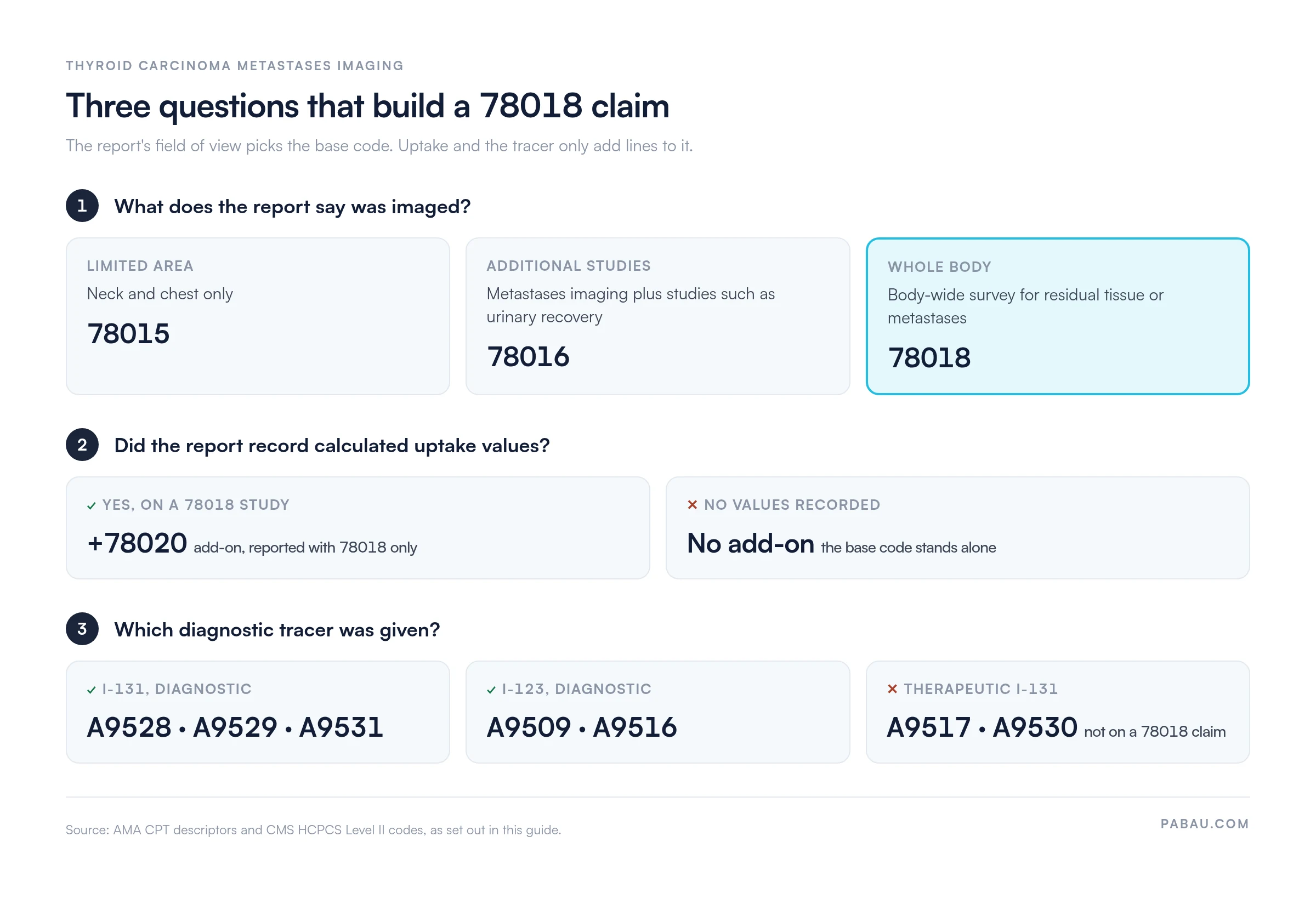
Because +78020 is an add-on code, it is never billed alone or swapped in for 78018. A claim with +78020 and no 78018 on the same date will reject.
Medical necessity is judged against the payer’s coverage policy, and against an applicable LCD where your MAC publishes one. The codes below are common pairings. Coders should still check the CPT-to-ICD-10 crosswalk and the payer policy before billing.
C73 or Z85.850 should lead the claim, with metastasis or postprocedural codes added where the record supports them. Note in the order why whole body imaging is needed, such as a rising thyroglobulin level or suspected distant spread.
Always report the most specific diagnosis available. C73 is far stronger than C80.1 (malignant neoplasm, unspecified). Payers check the diagnosis against covered indications, and a vague code raises the chance of review.
Modifier choice for CPT code 78018 depends on who performs and who reads the scan. One entity may do both, or the technical and professional components may be billed by different entities.
When one entity provides both the scan and the interpretation, it bills the global service with no modifier. The 26/TC split applies only when different entities provide the two components on separate claims. The same split applies to +78020 when it is billed.
CPT code 78018 is paid under the Medicare Physician Fee Schedule (MPFS) according to its relative value units (RVUs). Use the CMS Physician Fee Schedule lookup for current rates in your locality. Geographic Practice Cost Indices (GPCI) adjust every MPFS rate, so payment varies by location.
The FastRVU lookup tool lists work, practice expense and malpractice RVUs for 78018 and +78020. It helps estimate allowed amounts before the official fee schedule is confirmed. Private payer rates are negotiated separately from the MPFS and vary widely.
The radioiodine tracer is not part of the 78018 descriptor, so it is reported with its own HCPCS Level II code. In a physician office or imaging center, it is paid as a separate line. Under the hospital outpatient prospective payment system, diagnostic radiopharmaceuticals are packaged into the scan payment but should still be reported.
A9517 and A9530 are the therapeutic I-131 codes, used for ablation or treatment doses. They do not belong on a diagnostic 78018 claim. When Thyrogen is given for TSH stimulation, bill it with J3240, its own HCPCS code, rather than an unclassified drug code.
Traditional Medicare (Parts A and B, administered by MACs) does not require prior authorization for CPT code 78018. Coverage is enforced through medical necessity review instead. The picture changes for other plan types.
Prior authorization may be required in these situations:
Where a payer requires PA, request it for 78018 and +78020 together if uptake may be calculated. For traditional Medicare, make the superbill documentation strong enough to survive a pre-payment or post-payment audit. If coverage is uncertain, issue an Advance Beneficiary Notice (ABN) before the service.
Most 78018 denials fall into predictable categories. Good denial management workflows catch these errors before submission. The table maps each pattern to its root cause and a prevention step.
Reviewing common denial codes in medical billing alongside these patterns shows what triggers payer edits at code and claim level. A medical necessity appeal for 78018 should include the policy’s covered indication, the pathology report and the signed scan report.
Each MAC sets its own medical necessity rules, and some publish an LCD or billing article for nuclear medicine. Noridian covers Jurisdictions E and F, Novitas covers Jurisdictions H and L, and CGS covers Jurisdiction 15. Check your own MAC, as indications and documentation rules can differ.
Coverage for 78018 usually rests on these points:
The place-of-service (POS) code matters too. On-campus hospital outpatient departments use POS 22, and off-campus departments use POS 19. Physician offices and freestanding imaging centers generally use POS 11. A wrong POS changes the fee schedule rate applied and can trigger a rejection.
Before you submit, run the claim against the clean claim basics for this code. A claim missing any of these is likely to be rejected or denied:
Set a pre-submission check that flags any 78018 claim with no diagnostic radioiodine line (A9528, A9529, A9531, A9509 or A9516). Flag A9517 or A9530 on a 78018 claim as well, since those are therapeutic I-131 codes.
When a 78018 claim is denied or short-paid, the electronic remittance advice (ERA) carries the Claim Adjustment Reason Code (CARC). Common CARCs here include CO-4 (inconsistent modifier), CO-97 (payment included in another service) and CO-50 (not medically necessary). Each one points to a specific correction.
For a CO-50 denial, the appeal needs the clinical record showing why whole body imaging was ordered. For CO-4 or CO-97, the fix is usually a corrected claim with the right modifier or a separate radiopharmaceutical line. A CO-97 on +78020 often means 78018 was missing from the claim.
Medical billing workflows also matter for practices that handle both components of 78018 in-house. The global fee fits only when the same entity provides both components. Mixing global and split billing for one patient encounter is a common audit trigger.
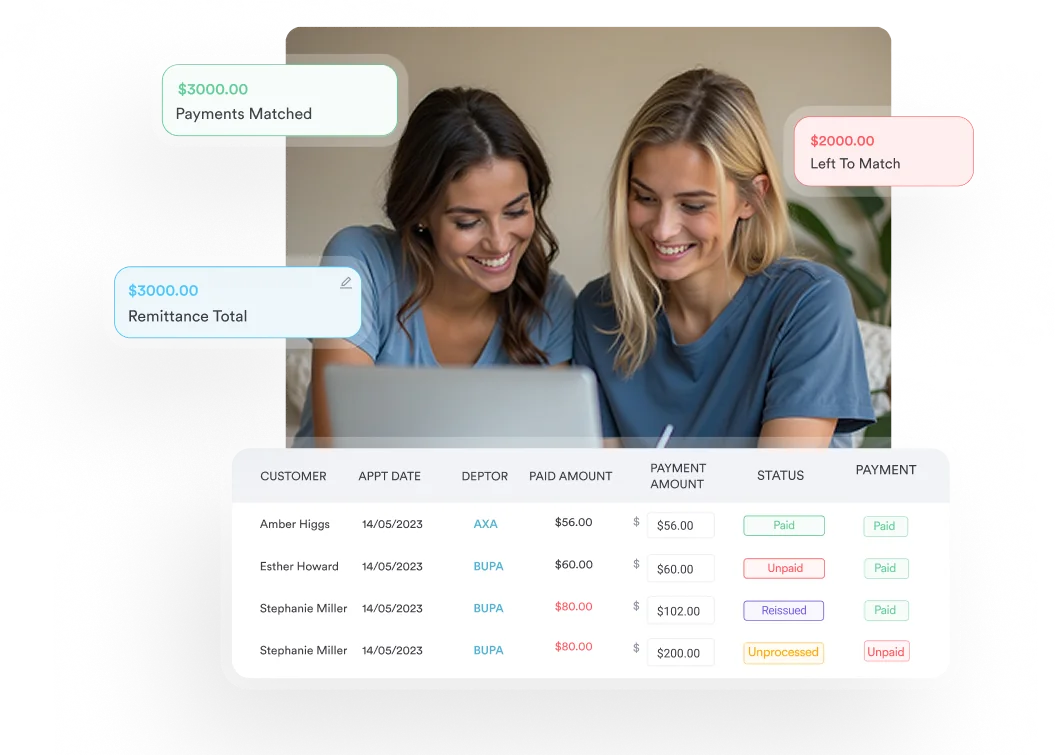
Many nuclear medicine billing teams track 78018 claims across a clearinghouse portal, a spreadsheet and the imaging report. That split makes it easy to miss a short-paid +78020 line or a CO-50 denial until the appeal window is closing.
Pabau, the billing platform we build, uses a Claim.MD integration to send claims from the patient record to the clearinghouse. ERAs come back into the same record, so payments are matched against each claim. Pabau’s claims management software then tracks denials and their reason codes until each one is resolved.
Code selection and diagnosis pairing stay with your coders, using the checks in this guide. What changes is the follow-up. Every 78018 claim, its remittance and its signed scan report sit in one place when an appeal has to be built.

Pabau sends 78018 claims electronically through Claim.MD and matches each remittance to the claim. Denied lines are tracked until they are resolved.

Bill CPT code 78018 on the field of view, not on uptake. If the report describes a whole body survey for thyroid carcinoma metastases, 78018 is correct. If uptake was calculated too, +78020 joins it, and the diagnostic radioiodine goes on its own line.
Most lost revenue on this code comes from a few avoidable slips. These include +78020 billed without 78018, a therapeutic I-131 code on a diagnostic scan, and a report that never states its field of view. Building those checks into the pre-submission review costs minutes and spares weeks of appeals.
Book a demo to see how Pabau sends nuclear medicine claims through Claim.MD and tracks every remittance and denial to resolution.

Need to understand how clearinghouse submissions work for nuclear medicine claims? Medical claims clearinghouse guide explains how claims route from practice to payer and where 78018 errors are caught.
Confused about 837 file formats for your nuclear medicine billing? 837 file overview covers the HIPAA-mandated electronic claim format used for all professional and institutional claims.
Want to reduce the back-and-forth on 78018 eligibility checks? Insurance eligibility verification covers real-time payer checks that flag coverage issues before the date of service.
CPT code 78018 covers thyroid carcinoma metastases imaging of the whole body. It is a radioiodine scan that looks for residual thyroid tissue or metastases across the body. It is used mainly after thyroidectomy in patients with differentiated thyroid cancer.
No. The 78018 descriptor covers imaging only. When radioiodine uptake is calculated during the study, report add-on code +78020 in addition to 78018. Bill +78020 only when the report records the uptake values.
Yes. Traditional Medicare covers 78018 when the diagnosis meets the MAC’s medical necessity rules and the record supports whole body imaging. Medicare Advantage plans may require prior authorization, so confirm with the plan before scheduling.
Both codes report thyroid carcinoma metastases imaging. 78018 covers the whole body, while 78015 covers a limited area such as the neck and chest. 78016 covers metastases imaging with additional studies, such as urinary recovery. Code from the field of view in the scan report.
Append modifier 26 (professional component) to 78018 when the physician only interprets the scan and the facility owns the equipment. The facility bills 78018-TC for the technical component. Do not bill the global service when different entities provide the two components.
The most common are C73 (malignant neoplasm of thyroid gland) and Z85.850 (personal history of malignant neoplasm of thyroid). Metastasis codes such as C77.0 or C79.51 can be added where documented. Always check the payer policy for your jurisdiction.