

CCSD code G5100: Bypass of duodenum billing guide
CCSD code G5100 bills a bypass that leaves the duodenum in place CCSD code G5100...

Last Updated: Oct 16, 2026
75630 is the CPT code for aortography, abdominal plus bilateral iliofemoral lower extremity, catheter, by serialography, radiological supervision and interpretation. In plain terms, it reports the imaging of the abdominal aorta plus runoff down both legs. Catheter placement is coded separately.
The runoff is what separates it from 75625, so the report's wording decides which code you bill. Most denials trace to missing runoff documentation, overlap with 75710 or 75716, or a skipped prior authorization. The sections below cover documentation, catheter codes, modifiers, Medicare coverage, and the fix for each denial.
Let Pabau's smart automation suggest the right codes, reduce claim denials, and keep your practice compliant—effortlessly.
Automate repetitive tasks and focus on what matters most—your patients.
Reduce coding errors and ensure compliance with the latest regulations.
Clean claims, fewer denials, and faster reimbursements.
Powerful insights and reporting to help your practice thrive.
HIPAA compliant SOC 2 certified GDPR-compliant Trusted by 4,000+ clinics worldwide

CPT code 75630 reports abdominal aortography plus bilateral iliofemoral runoff, while 75625 covers the aortogram without runoff.
75630 is the imaging supervision and interpretation code only, so catheter placement (36200, 36245-36248) goes on its own line.
Billing 75716 for the same runoff duplicates 75630, and modifier -59 fits only a separately documented, distinct study.
Most denials trace to missing runoff wording, overlap with 75710 or 75716, missing prior authorization, or an unsupported diagnosis.
Pabau’s claims management software pre-fills claims from the patient record and tracks each 75630 claim through Claim.MD to payment.
CPT code 75630 reports abdominal aortography plus bilateral iliofemoral lower extremity runoff, done through a catheter by serialography. It covers the radiological supervision and interpretation of that study.
In practice, contrast goes into the abdominal aorta through a catheter. The team images the aorta, then follows the contrast down both legs in timed runs with fluoroscopic or digital subtraction imaging.
Code 75630 sits in the Vascular Procedures subsection of Diagnostic Radiology (CPT 75600-75989), maintained by the American Medical Association. Three elements define its scope:
75630 has a professional and a technical component. In an office, one physician bills the global service. In a hospital outpatient setting, the facility bills the technical component and the radiologist appends modifier -26.
The only clinical difference between 75625 and 75630 is whether bilateral runoff imaging was performed and documented. Billing 75630 without runoff images in the report is upcoding, and it invites a denial or an audit.
Never report 75625 and 75630 for the same encounter. 75630 already includes the abdominal aortogram that 75625 describes. Billing both is unbundling, and NCCI edits catch it.
The radiology or operative report needs each of these elements before 75630 holds up on audit:
A report that shows abdominal aortography with no runoff supports only 75625. Payers auditing 75630 pull the radiology report first. If “bilateral runoff” or similar wording is missing, expect the claim to be downcoded. Sending clean claim documentation with the report attached, where payers ask for it, cuts that risk.
Catheter placement codes are reported separately from CPT code 75630. They describe placing and steering the catheter, while 75630 covers only the imaging S&I. A non-selective study from the aorta takes 36200.
Report only the highest selective order reached in each vascular family, per the CPT catheter-placement guidelines. Lower orders in the same family are included in that code. A third-order placement, for example, is reported with 36247 alone. For bundling questions, the CMS NCCI edits covered in the next section are the reference.
NCCI edits bundle CPT code 75630 with the extremity angiography codes 75710 and 75716. Because 75630 already includes bilateral runoff, billing either one for the same runs is duplicate billing.
Check current pairs in the CMS NCCI edits before each coding cycle, because edit pairs update quarterly.
Four modifiers apply to 75630, depending on the setting and what happened during the study:
In a physician office (POS 11), the global code goes out without -26 or -TC, because the physician owns both components. Never put -26 and -TC on the same claim line.
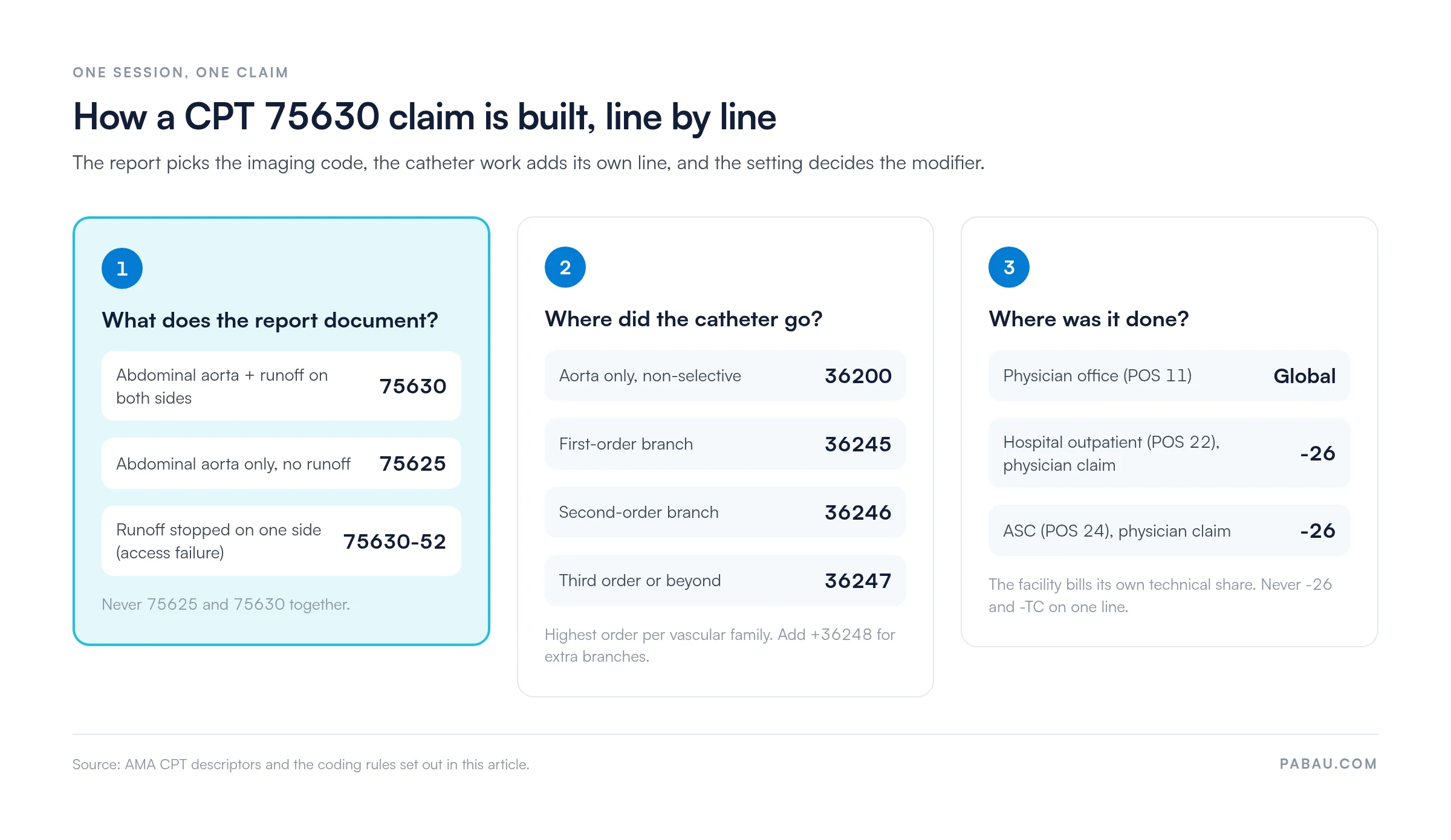
Take a typical session for suspected aortoiliac disease. The radiologist enters through the femoral artery, injects at the aorta, and follows the contrast down both legs.
The coder reads the report first. Bilateral runoff is documented, so the imaging line is 75630. The catheter stayed in the aorta, so the access line is 36200. Finally, the study ran in a hospital outpatient department, so the radiologist’s line carries -26. The three calls below cover most sessions you’ll code.
Medicare pays CPT code 75630 under the Physician Fee Schedule (MPFS), with separate national rates for facility and non-facility settings.
The 2026 MPFS final rule, published by CMS in late 2025, sets those rates. It applies the conversion factor to the code’s relative value unit (RVU) totals. Both change every year, so check current figures in the CMS MPFS look-up tool before billing.
The global RVU total for 75630 has three parts. Work RVUs reflect the physician’s effort on the S&I. Practice expense RVUs cover overhead and equipment, and malpractice RVUs cover liability cost. Non-facility rates run higher because the physician carries the practice expense in an office.
For coverage, see Novitas billing and coding article A56682 (applies in Novitas jurisdictions only), and check your own MAC’s LCD. Covered indications include suspected aortic aneurysm, aortic occlusive disease, and pre-operative assessment for revascularization.
Confirm the patient’s diagnosis fits your MAC’s covered indications before coding.
Check the 2026 MPFS Look-Up Tool on cms.gov for the most current national and geographically adjusted rates for 75630. Facility and non-facility rates differ, and billing the wrong rate for the setting is a common underpayment source. Run the look-up by entering code 75630 with your practice’s zip code to get locality-adjusted rates.
Prior authorization rules for CPT code 75630 vary by payer type and plan. No single rule covers commercial insurers, Medicare Advantage plans, and state Medicaid programs.
When you request authorization, include the diagnosis code, the patient’s history, and the ordering physician’s note on medical necessity. Add any prior imaging that supports the need for diagnostic aortography. A complete superbill with the procedure code, diagnosis codes, and treating provider avoids back-and-forth. Re-check insurance eligibility at every visit, since a plan change can alter authorization rules mid-episode.
Denials on CPT code 75630 fall into five recurring patterns. Each has its own fix, and the denial codes on the remittance tell you which one you’re facing.
The ICD-10-CM codes on a 75630 claim must support diagnostic abdominal aortography with runoff. Your MAC’s coverage article, such as Novitas A56682, lists the covered diagnoses.
Check each code against the current fiscal year code set, which updates every October.
Avoid R-range symptom codes as the primary diagnosis when the record documents a specific vascular disease. Specific codes cut medical necessity denials and line up with coverage criteria.
These five checks catch the denial patterns above before the claim leaves your practice:
The billing venue for CPT code 75630 affects the rate, who bills which component, and how the claim is built.
When facility and professional claims go out for the same encounter, confirm the POS code on the professional claim matches the care setting. A POS mismatch between the two claims is a common reason the professional claim gets denied.
Billing a 75630 claim often means hopping between the report, a clearinghouse portal, and a spreadsheet of open denials. Each handoff is another chance to drop a modifier or miss an eligibility problem.
Pabau, the practice management platform we build, pre-fills the claim from the patient record. Its claims management software includes CPT and ICD-10 lookup libraries and checks that claim-required fields are complete. Claims then go to payers through Claim.MD, with real-time eligibility checks before the visit.
Once a claim is out, ERA posting brings payments back into the record, and claim-status tracking shows which 75630 claims are still open. That leaves your team free to focus on report wording and modifiers instead of status calls.


Pabau pre-fills claims from the patient record, checks required fields, verifies eligibility in real time, and submits through Claim.MD. ERA posting and claim-status tracking show where each vascular imaging claim stands.

On 75630, the report is the claim. If the radiologist writes “bilateral iliofemoral runoff” and the catheter work sits on its own line, most of the denial risk is gone. If either piece is missing, no modifier fixes it later.
So start upstream. Agree on standard runoff wording with your radiologists, and add the five checks above to your pre-submission routine. Then track which denial pattern comes back most often, and fix that one first.
Want eligibility, submission, and remittance for these claims in one record? Book a demo to see how Pabau tracks vascular imaging claims from submission to payment.

Need to understand how clearinghouse claim validation works? Medical claims clearinghouse guide explains how clearinghouses screen claims before payer submission.
Want to reduce vascular billing denials systematically? Denial codes in medical billing covers CARC and RARC interpretation for effective appeal workflows.
Looking for ERA automation guidance? Electronic remittance advice (ERA) explains how 835 ERA files map payment and denial data back to your billing system.
Coding a first-order branch instead? CPT code 36245 covers selective first-order catheter placement in the abdominal, pelvic, and leg arteries.
Sending facility and professional claims together? The 837 file explains how electronic claim files are built and sent to payers.
No. 75630 is a catheter-based study. CT angiography of the abdominal aorta with bilateral iliofemoral runoff is reported with CPT 75635, which includes noncontrast images, if performed, and image postprocessing.
No. 75630 covers the abdominal aorta and the runoff only. Thoracic aortography is reported with 75600 without serialography, or 75605 by serialography.
Only in limited cases. Diagnostic angiography is separately reportable when no prior catheter-based study exists and the decision to intervene rests on it. It’s also allowed when a prior study is inadequate or the patient’s condition has changed. Append modifier -59 and document the reason.
Catheter codes 36200 and 36245-36248 are separately reportable with 75630, because 75630 covers only the imaging supervision and interpretation. Report the highest selective order reached in each vascular family. Lower orders in the same family are included.
Most denials trace to a report that doesn’t document bilateral runoff, overlap with 75716, or missing prior authorization. Others come from a diagnosis that misses your MAC’s coverage criteria, such as those in Novitas article A56682.



