CPT code 63081: Vertebral corpectomy, cervical spine
CPT code 63081: official descriptor and procedure overview CPT code 63081 descri...

Last Updated: Oct 6, 2026
75716 is the CPT code for angiography, extremity, bilateral, radiological supervision and interpretation. It covers the interpreting physician's supervision, image review and written report when both arms or both legs are studied in one session.
Catheter placement is reported separately with a 36000-series code. When only one extremity is imaged and interpreted, the correct code is 75710 instead.
Let Pabau's smart automation suggest the right codes, reduce claim denials, and keep your practice compliant—effortlessly.
Automate repetitive tasks and focus on what matters most—your patients.
Reduce coding errors and ensure compliance with the latest regulations.
Clean claims, fewer denials, and faster reimbursements.
Powerful insights and reporting to help your practice thrive.
HIPAA compliant SOC 2 certified GDPR-compliant Trusted by 4,000+ clinics worldwide

CPT code 75716 covers the radiological supervision and interpretation of bilateral extremity angiography, and catheter placement is reported separately.
Bill one unit of 75716 when both extremities are imaged in one session, because two units of 75710 trigger unbundling denials.
On Medicare claims, a non-selective iliac or femoral study done during cardiac catheterization is reported with add-on G0278 instead of a CPT code.
The claim needs a signed bilateral order, a report that interprets each extremity, and a record of the contrast administered.
CPT code 75716 is defined by the American Medical Association as Angiography, extremity, bilateral, radiological supervision and interpretation. It sits within the Radiology section of the CPT code set, under Diagnostic Radiology and the Vascular Procedures subsection. The code captures only the radiological supervision and interpretation (RS&I) work of the interpreting physician. That covers image acquisition oversight, contrast monitoring, fluoroscopic road-mapping, and the formal written report.
The table below places 75716 in context alongside its sibling codes:
CPT code 75716 covers the complete RS&I service for bilateral extremity angiography. That includes supervision of contrast injection, real-time fluoroscopic imaging of both limbs, road-mapping, and the interpreting physician’s written report on both extremities. It applies to bilateral lower extremity studies (femoral runoff) and bilateral upper extremity studies. It also covers a combined session where both sides are imaged under a single order.
What the code excludes:
A coder who sees “bilateral lower extremity angiography” in the report must confirm the interpreting physician’s note covers both sides before submitting 75716. A report that documents only one extremity in detail defaults to 75710.
CPT code 75710 is the unilateral counterpart to 75716. It covers RS&I for a single extremity angiography in one session. When both extremities are imaged in the same encounter, bill one unit of 75716, not two units of 75710. Payers, including Medicare, apply National Correct Coding Initiative (NCCI) edits that flag duplicate 75710 billing for bilateral work as unbundling.
Some commercial payers have policies that prefer unilateral billing with a bilateral modifier (-50). Always check the payer’s procedure-specific guidelines before submitting 75716 for non-Medicare plans.
CPT code 75716 is nearly always reported with at least one catheter placement code, because the RS&I and the access procedure are separate billable services. The catheter code depends on the level of selectivity documented in the procedure note. For lower-extremity branches, the family starts at 36245 for first-order placement and runs to 36247 for third order or beyond.
The 36245-36247 codes cover abdominal, pelvic, and lower-extremity branches only. Selective work in the arms uses the 36215-36218 arch-vessel family. Check the order of selectivity against the current CPT book before you pair it with 75716.
Verify current NCCI edits before combining 75716 with companion codes. Column 1/column 2 relationships change every year, and a pair that was separately reportable one year may require a modifier the next.
Document catheter selectivity explicitly in the procedure note before claim submission. Coders cannot infer selectivity from imaging findings alone. A note that states only ‘catheter advanced into the femoral artery’ does not support 36247 and will not withstand payer audit.
Medicare does not always accept 75716 when the angiography happens during a cardiac catheterization encounter. The Centers for Medicare and Medicaid Services (CMS) maintains HCPCS G-codes for studies done at the same time as a cardiac cath. Only one of them applies to extremity work.
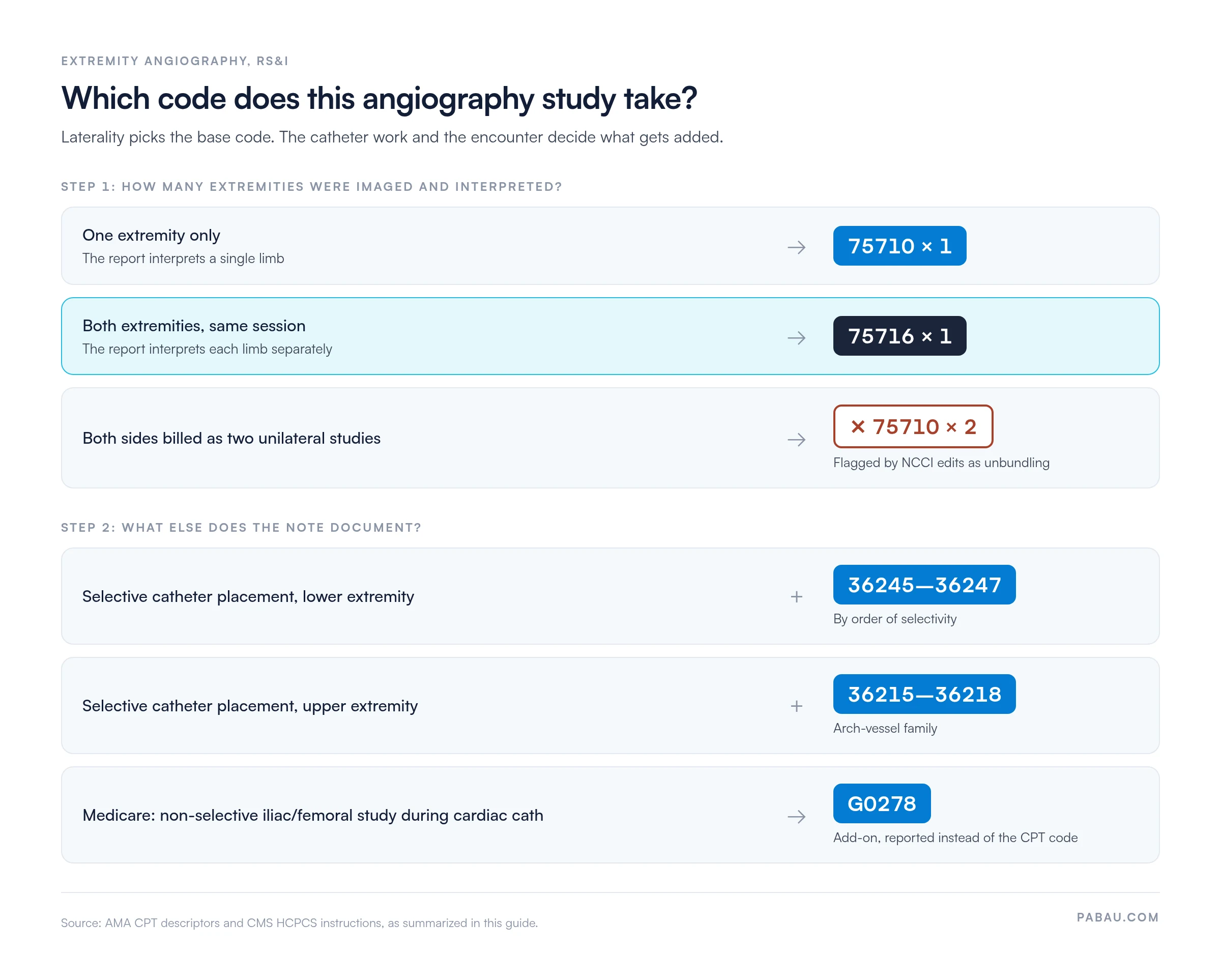
Put the laterality rule, the catheter codes, and the G0278 rule together, and the coding decision runs in two steps.
The Medicare Physician Fee Schedule (MPFS) assigns CPT code 75716 a global period of XXX, which means the global surgery concept does not apply. The code is priced as a professional component (modifier -26) and a technical component (modifier TC). Run insurance eligibility verification before the procedure to catch Medicare Advantage plans that apply different rules than traditional Medicare.
Medicare reimbursement for CPT code 75716 is published annually in the MPFS final rule. Pull the current-year rate for your locality from the CMS Physician Fee Schedule lookup tool. The tool prices the professional (-26) and technical (TC) components separately, and geographic practice cost indices (GPCIs) adjust each one for local costs. For RVU breakdowns by work, practice expense, and malpractice, the FastRVU lookup tool provides 2026 MPFS data at no cost.
Rates change with each MPFS final rule, typically effective January 1. Any benchmark cited in coding resources from prior years requires verification against the current fee schedule before relying on it for projections or appeals.
A claim for CPT code 75716 stands or falls on what the medical record documents. Payers may audit vascular imaging codes, so the record should be complete before submission rather than reconstructed after a denial. Meeting billing compliance requirements for RS&I codes means the interpreting physician’s report must contain specific elements, not just a generic imaging note.
Tying the documentation to clean claim submission is where much of the rework happens. A radiology report that describes “bilateral runoff studies” without interpreting each extremity’s findings does not meet the bilateral documentation standard most payers require. Practices using Pabau, the practice management platform we build, can submit and track CPT 75716 claims electronically through Claim.MD, its US clearinghouse partner.
Denial patterns for CPT code 75716 are consistent across payers, and most trace back to one of five errors. Pinning down which one caused a denial is the first step in any of the denial management workflows worth running. Each category also maps to a specific denial code on the payer’s remittance advice.
Run a 90-day look-back on all 75716 claims before changing coding staff or software. Clusters of CO-4 (modifier inconsistent with the procedure) and CO-16 (missing information) denials usually trace to how reports reach the billing team. Fix that handoff and the whole denial category stops recurring.
Reliable billing for CPT code 75716 comes down to a repeatable pre-submission workflow. As a general best practice, run a charge-capture review that confirms laterality, selectivity, and documentation completeness before any claim leaves the practice.
In many vascular and radiology practices, 75716 claims are still assembled by hand. A coder reads the radiology report and checks it against the procedure note. Then the details get rekeyed into a separate billing system before the claim goes out.
Pabau’s claims management software pulls the details already on the patient record into the claim. Claims go out through Claim.MD, and Pabau helps track them through submission and follow-up.
The result is less rekeying and a clear view of which 75716 claims are paid, pending, or denied. Your coder still owns the laterality and selectivity decisions, with more time to spend on them.

Pabau pulls patient record details into your claims, submits them through Claim.MD, and tracks each 75716 claim through follow-up. You spend less time rekeying data and chasing claim status.

Treat laterality as the first coding decision on every extremity angiogram. If the report interprets both limbs, bill one unit of 75716. If it interprets one, bill 75710, whatever the order said.
The remaining risk sits in the add-ons. Match the catheter code to the documented order of selectivity, and apply the Medicare G0278 rule only to non-selective iliofemoral studies done during cardiac catheterization.
Pabau helps track those claims through submission and follow-up, so a denial surfaces while the record is still fresh. Book a demo to see how it fits a vascular or radiology billing workflow.

Need to understand how claim denials are tracked and worked? Denial management in healthcare walks through the full denial lifecycle and appeal strategies for common coding errors.
Want to know what makes a claim pass on first submission? Clean claim submission covers the data elements payers check before processing any CPT code.
Looking for guidance on clearinghouse claim routing? How a medical claims clearinghouse works explains how electronic claim validation reduces denials before they reach the payer.
Imaging the abdominal aorta in the same session? CPT code 75625 covers the abdominal aortography RS&I code that often accompanies an extremity runoff study.
Coding a one-sided study instead? CPT code 75710 covers unilateral extremity angiography and how it differs from the bilateral code.
CPT code 75716 is the billing code for angiography, extremity, bilateral, radiological supervision and interpretation. It covers the interpreting physician’s oversight, image acquisition, and formal written report when both upper or both lower extremities are imaged in one session. It does not include catheter placement, which is reported separately.
Report 75716 with the catheter placement code that matches the documented selectivity. Use 36140 for non-selective extremity access, or 36245, 36246, or 36247 for first-, second-, or third-order lower-extremity placement. Upper-extremity selective work uses the 36215-36218 arch-vessel family. The procedure note must state the selectivity level, because coders cannot infer it from imaging findings alone.
No. 75716 and 75710 should not be reported together for the same anatomical territory in one session. If bilateral work is performed, one unit of 75716 replaces both units of 75710. If different territories are imaged under separate orders, such as one arm and one leg, check payer guidance and current NCCI edits before combining codes.
The most common reasons are billing two units of 75710 instead of 75716, and a report that does not document findings in both extremities. Missing prior authorization and a place-of-service or component mismatch also cause denials. On Medicare claims, a non-selective iliac or femoral study during cardiac catheterization must be reported with add-on G0278 instead of 75716.