CCSD code D1510: Myringotomy and tube insertion billing guide
What Is CCSD Code D1510? CCSD code D1510 is the procedure code assigned to myrin...

Last Updated: Oct 5, 2026
36200 is the CPT code for introduction of catheter, aorta. It covers placing a catheter in the aorta without entering any branch vessel. When a selective code such as 36245 is reported in the same session, 36200 is bundled into it.
It is the base of the vascular catheterization hierarchy. Billing it when a selective code applies, or missing it when it stands alone, commonly triggers denials in peripheral vascular cases.
Let Pabau's smart automation suggest the right codes, reduce claim denials, and keep your practice compliant—effortlessly.
Automate repetitive tasks and focus on what matters most—your patients.
Reduce coding errors and ensure compliance with the latest regulations.
Clean claims, fewer denials, and faster reimbursements.
Powerful insights and reporting to help your practice thrive.
HIPAA compliant SOC 2 certified GDPR-compliant Trusted by 4,000+ clinics worldwide

CPT code 36200 covers non-selective aortic catheter placement only, with the catheter tip kept in the aorta rather than any branch.
When selective catheterization is performed in the same session, 36200 is subsumed by the selective code and not separately reported.
Angiography supervision and interpretation codes (e.g. 75625, 75630, 75710) are separately billable alongside 36200 when performed.
Pabau, the practice software we build, submits CMS-1500 claims to thousands of US payers through its Claim.MD integration and brings ERA remittances back into Pabau.
CPT code 36200 reports placing a catheter in the aorta without entering any branch vessel. The table below captures the core billing facts coders need before working an aortic catheterization case.
CPT code 36200 covers percutaneous or open vascular access and catheter advancement to the aortic lumen and stops there. The AMA’s CPT code set classes it as non-selective because the catheter tip stops in the aorta, short of any named branch vessel.
Clinical scenarios that appropriately support 36200 as the sole catheterization code include:
The code does not include the imaging itself. Angiography supervision and interpretation is reported separately using the appropriate radiological S&I companion codes described below.
Correct documentation is what separates a clean claim from a denial. The operative report must trace the catheter from skin entry to final tip position in the aorta. Each step below corresponds to a documentation element auditors look for.
Missing any of these elements, especially the tip-position sentence, commonly leads to 36200 medical necessity denials.
Non-selective catheterization means the catheter tip stays in the aorta or the directly punctured vessel. The moment the catheter enters a branch off the aorta, the procedure becomes selective and a different CPT code applies.
The vascular family concept governs how coders count orders. Each first-order branch off the aorta is its own vascular family. Catheterizing the right renal artery and the right inferior phrenic artery means two first-order placements in two separate families. Each is reported with 36245, one unit per family.
Add-on 36248 applies only to additional second- or third-order branches within the same family. When the catheter moves into a third-order vessel, the first- and second-order entries in that family are included in 36247. Thoracic and brachiocephalic branches use their own codes, 36215 to 36218.
A frequent decision on aortic catheterization cases is whether to report CPT code 36200 alongside a selective code or let the selective code stand alone.
The rule: When selective catheterization is performed in the same session, 36200 is subsumed by the selective code and not separately reported. The National Correct Coding Initiative (NCCI) bundles 36200 with codes 36245 through 36248. Reporting both without a supported modifier produces an automatic NCCI edit denial. The diagram below maps each tip position to its code.
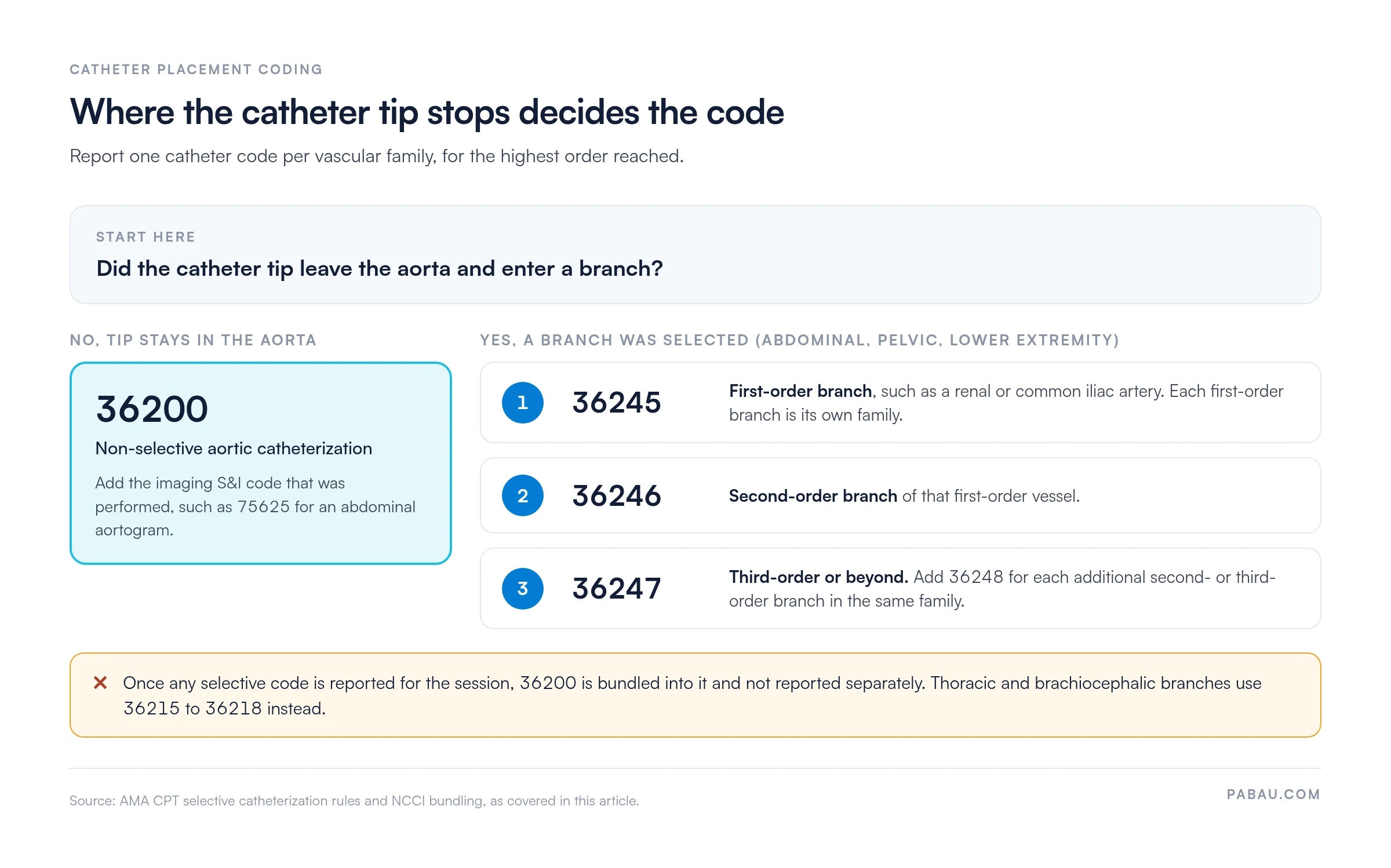
Three scenarios where this decision matters most:
Check whether a flush aortogram was performed before selective catheterization. If so, the S&I code for the aortic run (e.g. 75625) is separately billable even though 36200 itself is subsumed. Coders frequently miss the S&I code when they drop 36200.
CPT code 36200 rarely appears alone on a claim. Angiography supervision and interpretation codes, such as 75625 for abdominal aortography, are separately reportable when the same physician performs them. The AAPC’s CPT code lookup confirms these codes sit in a different CPT section (Radiology) from the catheterization code. That is why they survive NCCI bundling review.
Verify NCCI edit status against the current quarterly table before billing any pair. Using a medical claims clearinghouse that runs NCCI edit checks prior to submission catches these conflicts before they become denials.
Modifiers on 36200 are used sparingly and only when payer policy explicitly supports them. Incorrect modifier use on catheterization codes is a False Claims Act exposure area, so every modifier must be substantiated by the operative note.
Medicare reimbursement for CPT code 36200 is calculated from the CMS Physician Fee Schedule, with rates updated annually. The values below reflect 2026 fee schedule data. Verify current figures in the CMS lookup tool or the FastRVU 2026 calculator before billing.
The 0-day global period means there is no post-operative bundling window, so services on later days are billed separately. The non-facility rate is much higher because its practice expense covers the equipment and supply overhead a physician carries in an office setting.
Medicare does not require prior authorization for CPT code 36200 itself, but medical necessity documentation is still mandatory. CMS expects a supported ICD-10-CM diagnosis tied to each claim line. Reviewers check that the stated condition is consistent with aortic catheterization as a clinical intervention.
Commercial payers vary significantly. Some commercial plans require prior authorization depending on the setting and plan policy, so confirm with each payer. Insurance eligibility verification should capture those rules before scheduling. Document the authorization number on the claim when obtained.
Key payer requirements to verify before submission:
ICD-10-CM pairing is a primary audit focus for vascular catheterization claims. The code linkage rule applies directly here: The diagnosis must clinically justify aortic access, not merely describe the patient’s chronic conditions.
Sequence the diagnosis that drove the encounter as the primary code. Chronic conditions (hypertension, diabetes) that contributed to the vascular disease are secondary codes. Placing a comorbidity as the primary diagnosis without a vascular indication code is a sequencing error that triggers medical necessity review.
Denials on CPT code 36200 cluster around five root causes. Each is addressable before claim submission with the right documentation and edit checks in place. A structured denial management workflow catches most of these at the coding stage rather than after the remittance.
Run every 36200 claim through your clearinghouse’s NCCI edit engine before submission. Most bundling denials are preventable, because the edit fires in testing before the payer adjudicates.
On many vascular teams, the coder reads the op report, keys the claim into a separate clearinghouse portal, and posts remittances in a third system. A denied S&I line can sit unnoticed for weeks in that setup.
Pabau brings that work into one place, with claims software for specialists built into the practice platform. Through its Claim.MD integration, Pabau submits CMS-1500 claims to thousands of US payers and brings ERA remittances back into Pabau.
The 36200 claim, its S&I lines and the payer’s response all sit in the same system. When a line is denied, your team corrects and resubmits it without logging in to another portal.

Pabau submits CMS-1500 claims to thousands of US payers through its Claim.MD integration and brings ERA remittances back into Pabau. Your vascular team spends less time chasing payments.

Treat the catheter tip position as the coding decision on every aortic case. If the tip never left the aorta, 36200 and its S&I code carry the claim. Once any branch was selected, 36200 drops out and the selective code takes over.
The trade-off is a few seconds of documentation. One explicit tip-position sentence in the op report is cheaper than the medical necessity review that follows when it is missing.
Book a demo to see how Pabau carries a vascular claim from submission to remittance in one system.

Want a full overview of how claims flow from practice to payer? Medical claims clearinghouse explains the 837 transaction cycle, edit types, and what a clean claim looks like at submission.
Looking for fewer rejected submissions? What is a clean claim walks through the fields and checks a claim needs to pass first time.
Comparing clearinghouse options? Claim.MD clearinghouse covers how the clearinghouse handles submission and remittance.
New to the billing side of the practice? What is medical billing lays out the core steps from charge capture to payment.
Looking to reduce your overall claim rejection rate? Revenue cycle management breaks down the end-to-end process from eligibility through payment posting.
CPT code 36200 covers introduction of a catheter into the aorta. It is non-selective aortic access, where the catheter tip stays in the aortic lumen and enters no branch vessel. It includes percutaneous or open vascular access, sheath placement, catheter advancement to the aorta, and tip-position confirmation under fluoroscopy. It does not include angiography imaging, which is reported separately with the appropriate supervision and interpretation code.
CPT 36200 is a non-selective catheterization code. Non-selective means the catheter tip stays in the aorta or the directly punctured vessel, not in any named branch off the aorta. The moment the catheter enters a first-order branch (e.g. the right renal or common iliac artery), the procedure becomes selective. Code 36245 or higher then applies instead.
CPT 36200 represents non-selective aortic catheter placement with the tip remaining in the aorta. CPT 36245 represents first-order selective catheterization, with the tip advanced into a first branch off the aorta (e.g. a renal or common iliac artery). When 36245 is performed in the same session, 36200 is not reported separately. NCCI bundling rules fold the aortic pass-through into the selective code.
Modifier 59 (or its subset XS) may apply when 36200 is reported with a companion code that has an NCCI edit. The companion service must be distinct and substantiated by documentation. Modifier 52 applies when the procedure was started but terminated before completion. Modifier 50 and LT/RT do not apply to 36200 itself because the aorta is a midline structure. Verify modifier requirements against the current NCCI edit table and individual payer policy before applying.
The operative report must document: The access approach (percutaneous or open), the vessel entered and technique, and sheath placement. It must also record catheter advancement to the aorta, the tip’s aortic segment (e.g. abdominal aorta below the renal arteries), and fluoroscopic confirmation. Finally, it needs an explicit statement that no branch vessel was selectively catheterized. Leaving out the catheter tip position statement commonly triggers a denial.
Yes, Medicare covers CPT code 36200 when medically necessary, as indicated by a supported ICD-10-CM diagnosis code. The code carries a Medicare status indicator of A (payable per the Physician Fee Schedule) and a 0-day global period. Prior authorization is not required under traditional Medicare, but Medicare Advantage plans may impose authorization requirements depending on the clinical setting.