

CCSD code G5100: Bypass of duodenum billing guide
CCSD code G5100 bills a bypass that leaves the duodenum in place CCSD code G5100...

Last Updated: Oct 16, 2026
75625 is the CPT code for aortography, abdominal, by serialography, radiological supervision and interpretation. It covers the radiologist's supervision and interpretation of a contrast study of the abdominal aorta, imaged from the renal arteries to the bifurcation.
The code sits in the Diagnostic Radiology section of the AMA CPT code set. Catheter placement is reported separately. When the same aortic injection also images bilateral iliofemoral runoff, CPT 75630 replaces 75625. CPT 75635 is a CT angiography code, a different modality that never substitutes for a catheter study.
Let Pabau's smart automation suggest the right codes, reduce claim denials, and keep your practice compliant—effortlessly.
Automate repetitive tasks and focus on what matters most—your patients.
Reduce coding errors and ensure compliance with the latest regulations.
Clean claims, fewer denials, and faster reimbursements.
Powerful insights and reporting to help your practice thrive.
HIPAA compliant SOC 2 certified GDPR-compliant Trusted by 4,000+ clinics worldwide

CPT code 75625 covers abdominal aortography supervision and interpretation (S&I) only, and catheter placement is coded separately.
When the same aortic injection also images bilateral iliofemoral runoff, report CPT 75630 instead of 75625.
CPT 75635 is a CT angiography code, so it replaces the catheter codes for a CT study and is never billed with them.
Modifier 26 is required when the radiologist interprets at a facility that owns the equipment, and modifier 59 separates companion codes from NCCI edits.
Medicare LCD L35092 defines the covered indications, including aortic aneurysm, dissection, and peripheral arterial disease.
Practice management software like Pabau submits claims through Claim.MD, so code and eligibility problems surface before the payer sees them.
CPT code 75625 describes aortography, abdominal, by serialography, radiological supervision and interpretation. The parenthetical extension “with or without serialography, with or without delayed imaging” means the imaging method does not change the code. Rapid-sequence film and delayed acquisitions both fall under 75625. It does not cover catheter placement or contrast injection as procedural services. Those components are reported separately using the appropriate catheter placement codes from the 36000 series. An S&I code is reported alongside the procedural codes for the same study, never in place of them.
CPT code 75625 covers imaging of the infrarenal abdominal aorta and its major branches, from the level of the renal arteries through the aortic bifurcation. A single code captures all contrast injections and image acquisitions needed to complete the aortographic study at that anatomical level.
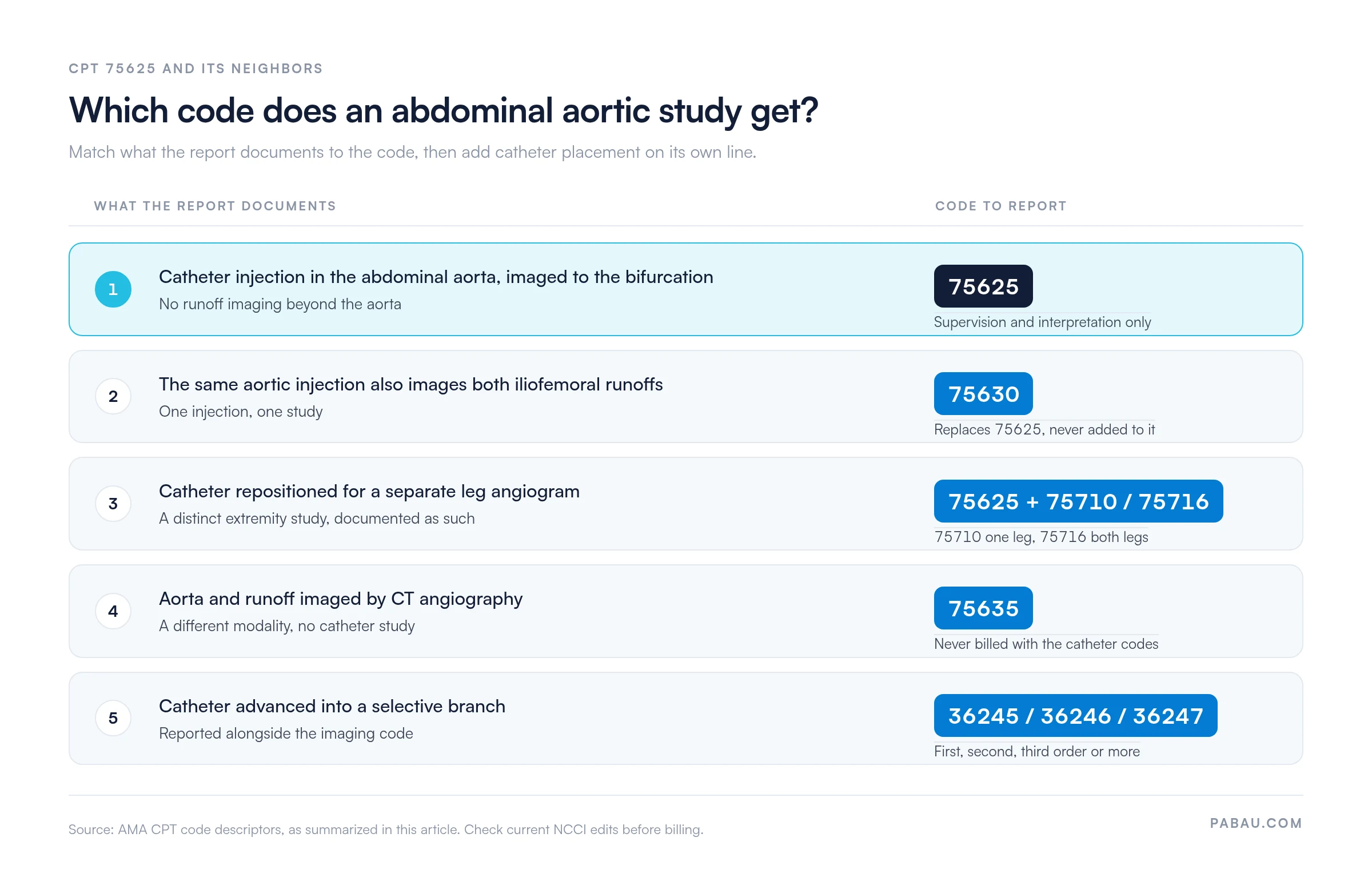
The distinction between 75625 and 75630 is the most common source of overcoding. When the aortic injection also images bilateral iliofemoral runoff, 75630 is the correct single code. Reporting 75625 plus 75710 or 75716 for that same runoff unbundles 75630 and triggers NCCI edit denials.
CPT 75635 is a different modality altogether. It is a CT angiography code, billed instead of the catheter codes when the study is done by CT. It is never combined with 75625, 75710, or 75716. The panel below sorts each scenario by what the report documents.
Accurate documentation is what separates a clean claim from a denial. The radiology report must capture every element payers look for to confirm the service was medically necessary and technically complete.
The radiology report must state the anatomical level of the injection and confirm the contrast went into the abdominal aorta. It must also describe the imaging findings and include the clinical indication. CMS and commercial payers reviewing CPT code 75625 claims look for that indication in the report itself, as well as in the order.
A report that is technically complete but lacks a mapped diagnosis will still be denied. The claim file must carry the matching ICD-10-CM code on the same line as 75625. The biller and the radiologist should confirm the diagnosis before submission.
Structure the radiology report in three parts. The technique section names the access site, catheter position, and contrast volume. The findings describe each aortic segment from the renal arteries to the bifurcation. The impression states the diagnosis that maps to the ICD-10-CM code on the claim. This structure meets the LCD L35092 documentation requirements and gives the biller what they need without a call-back.
Four codes sit close enough to 75625 that coders frequently pick the wrong one. Picking up the wrong code costs the practice money in either direction: Overcoding attracts audit attention, undercoding leaves reimbursement on the table.
CPT 36247 describes selective catheter placement in a third-order or more selective branch. First-order placement is CPT 36245, and second-order placement is CPT 36246. Each is separately reportable alongside CPT code 75625 when the catheter goes beyond the aorta and the report documents that position.
NCCI edits do not bundle 36247 with 75625 as a hard edit, but they do bundle it with some companion angiography codes. Always verify the current NCCI table edition before billing, as edits are updated quarterly. The clean claim standard requires that any unbundled code pair be supported by documentation in the procedure note showing distinct procedural steps.
CPT 76937, ultrasound guidance for vascular access, may be reported separately when real-time ultrasound guides the arterial puncture. A permanent record of the imaging must be documented as well. Verify payer-specific policy before appending 76937, as some commercial payers bundle it with the interventional code.
Modifier selection on CPT code 75625 determines whether the claim pays at the full global rate, the professional component only, or the technical component only. Getting this wrong is one of the fastest routes to a zero-payment remittance.
Modifier policies are payer-specific and audit-sensitive. Verify modifier requirements against individual payer bulletins before submission, particularly for modifier 59, which some payers have replaced with X-modifiers (XE, XS, XP, XU).
Medicare coverage for CPT code 75625 is governed by Local Coverage Determination (LCD) L35092, Diagnostic Abdominal Aortography and Renal Angiography. Its companion Billing and Coding Article, A56682, sets out the coding rules. Verifying insurance eligibility before scheduling reduces write-offs. Some Medicare Advantage plans add prior authorization requirements on top of original Medicare policy.
Prior authorization requirements for imaging codes vary by payer and Medicare Advantage plan. Do not assume that original Medicare’s no-auth policy extends to every Medicare Advantage product. Check payer-specific portals or use a clearinghouse with integrated medical billing compliance checks to flag plans that require authorization before the study date.
Medicare Physician Fee Schedule reimbursement for CPT code 75625 is published through the CMS Physician Fee Schedule Look-Up Tool. Rates differ by component and setting.
National rates are adjusted by the Geographic Practice Cost Index (GPCI) for your locality. Practices in high-cost areas such as Manhattan or San Francisco receive a higher multiplier than those in rural MACs. Use the FastRVU lookup tool to pull work, practice expense, and malpractice RVU values for 75625 and apply your MAC’s conversion factor.
Commercial payer rates vary by contract and usually run above Medicare national rates. Bill at your full chargemaster rate and let the contractual adjustment settle the balance. Tracking payment velocity against expected reimbursement is a core part of revenue cycle management for radiology groups.
CPT code 75625 claims are denied for a predictable set of reasons. Each one has a corrective step that, applied upstream, eliminates the denial before it happens. Understanding denial codes in medical billing is the first step to building a prevention workflow.
Build a denial management workflow that reviews all 75625 remittances within 48 hours of payment posting. It catches underpayments and sets up timely appeals before the contractual deadline expires. The electronic remittance advice (ERA) carries the CARC and RARC codes that explain why a line paid short or denied. That takes the guesswork out of the appeal letter.
Interventional radiology practices lose more revenue to missed charges than to outright denials. A procedure happens and the report gets dictated. Then the charge never reaches the billing queue, because no one mapped the report to the CPT code in time. These four habits keep that from happening.
Run a monthly audit of every encounter billed with CPT code 75625. Sort by denial reason code and look for patterns. If more than 10% of your 75625 claims deny for the same reason, such as CO-4, CO-50, or CO-97, the cause sits in the workflow. Fix it at the process level instead of claim by claim.
Without a checking step, a 75625 claim is only as clean as the coder’s last read of the report. A missed runoff study or a missing modifier 26 comes back weeks later as a denial, and someone has to rework it by hand.
Practice management software like Pabau submits claims electronically through Claim.MD, a US clearinghouse connected to over 4,000 payers. Pabau’s claims tools for billing teams return real-time eligibility responses. The 835 remittance files feed straight into denial tracking, so a short payment on a 75625 line shows up the day it posts.
A complete superbill closes the loop. When it captures the access site, catheter position, contrast volume, and imaging levels, the coder can code the encounter without a report call-back. The result is fewer resubmissions and faster payment on every aortography study.


Pabau submits CPT code 75625 claims electronically through Claim.MD and tracks every remittance in one place. See how it works for your interventional radiology practice.

CPT code 75625 rewards coders who read the report before they pick the code. Check whether the runoff came from the aortic injection, and whether the study was done by catheter or by CT. Those two questions decide between 75625, 75630, and 75635.
Then lock down the two errors that cost the most. Append modifier 26 on every facility-based claim, and map each diagnosis to the covered indications in LCD L35092. The trade-off is a few extra minutes per report, which costs far less than working a denial.
Book a demo to see how Pabau helps interventional radiology practices submit clean 75625 claims and track every remittance.

Need to understand how clearinghouse submissions work? Medical claims clearinghouse explains the end-to-end path from claim file to payer adjudication.
Want to decode your remittance files faster? Claim.MD clearinghouse guide covers ERA parsing, denial CARC codes, and secondary claim submission.
Building a credentialing workflow for your IR group? How to get credentialed with insurance companies walks through the payer enrollment process step by step.
Denials piling up on your radiology claims? Denial management in healthcare shows how to triage, appeal, and prevent repeat denials.
Not sure where the diagnosis sits on the claim? The 837 claim file explains each loop and segment a payer reads.
CPT code 75625 is the radiology supervision and interpretation code for abdominal aortography. It covers contrast imaging of the infrarenal abdominal aorta, with or without serialography and delayed imaging. It does not include catheter placement, which must be coded separately using the 36000-series catheter placement codes.
CPT 75625 covers abdominal aortography only, while CPT 75630 adds bilateral iliofemoral runoff filmed from the same aortic injection. When that runoff is documented, 75630 is the single correct code. Reporting 75625 plus separate runoff codes for it creates an NCCI bundling conflict. CPT 75635 is a CT angiography code and is never combined with either catheter code.
Modifier 26 applies when the radiologist interprets at a facility that owns the equipment. Modifier TC applies to the facility’s claim for the equipment and staff. Modifier 59, or an X-modifier, separates 75625 from a companion code that an NCCI edit would otherwise bundle. Separate documentation must support each service. Modifier 52 applies when the study was started but not fully completed.
The national Medicare rate for CPT 75625 changes each year with the Physician Fee Schedule update. It is then adjusted by the Geographic Practice Cost Index for your locality. The current rate is on the CMS Physician Fee Schedule Look-Up Tool at cms.gov. Search by code and MAC to get your allowed amount for the professional and technical components.
No. CPT 75625 is a supervision and interpretation code only. Catheter placement is reported separately with codes from the 36000 series. Selective placement uses CPT 36245 for a first-order branch, 36246 for second-order, and 36247 for third-order or more. The procedure note must document the catheter position to support both codes on the same claim.
The most common denial reasons are a diagnosis that misses the covered indications in LCD L35092 and runoff billed separately when CPT 75630 applies. Missing modifier 26 in a facility setting and absent prior authorization on Medicare Advantage plans follow close behind. Timely filing violations also occur when the charge is not captured promptly after the report is signed.



