

CCSD code G5100: Bypass of duodenum billing guide
CCSD code G5100 bills a bypass that leaves the duodenum in place CCSD code G5100...

Last Updated: Oct 16, 2026
CPT code 75820 reports the radiological supervision and interpretation (S&I) of a contrast venogram of one arm or one leg. It pays for overseeing the images under fluoroscopy and writing the signed report. The needle or catheter injection is billed separately with CPT 36005.
The rule that matters most is the one-limb limit. When both legs or both arms are imaged in one session, bill one unit of 75822, never two units of 75820. Missing S&I documentation, modifier errors and bundling conflicts are common causes of denial. Below, you’ll find the scope, modifiers, diagnosis pairings and a checklist to run before you submit.
Let Pabau's smart automation suggest the right codes, reduce claim denials, and keep your practice compliant—effortlessly.
Automate repetitive tasks and focus on what matters most—your patients.
Reduce coding errors and ensure compliance with the latest regulations.
Clean claims, fewer denials, and faster reimbursements.
Powerful insights and reporting to help your practice thrive.
HIPAA compliant SOC 2 certified GDPR-compliant Trusted by 4,000+ clinics worldwide

CPT code 75820 covers only the supervision and interpretation of a one-limb venogram, not the needle, catheter or contrast injection.
Report the injection with CPT 36005, and check current NCCI edits before you pair the two codes.
When both arms or both legs are imaged in one session, bill one unit of 75822 instead of two units of 75820.
Add modifier -26 when the physician reads the study in a facility that owns the equipment, and place LT or RT after it.
DVT codes from the I82.4- series and venous disease codes such as I87.2 commonly support medical necessity for 75820.
CPT code 75820 is the AMA code for unilateral extremity venography, radiological supervision and interpretation. In plain terms, it pays the physician who oversees a contrast venogram of one arm or one leg and writes the report.
The code sits in the Radiology section, under Diagnostic Radiology, in the Vascular Procedures range (75600-75989). Within that range, it belongs to the Veins and Lymphatics subsection (75801-75893).
The American Medical Association’s CPT code set treats 75820 as an S&I-only code. Needle or catheter access and the contrast injection are reported with a separate companion code.
Getting the scope right protects you from two opposite errors. Folding extra services into 75820 overcodes the claim, while leaving out the companion code undercodes it.
The S&I component covers oversight of image acquisition, fluoroscopic monitoring and the written report. Venous access and the contrast injection sit outside it.
Who bills which line depends on who does the work, a core part of any medical billing workflow. In a hospital, the physician bills the professional side and the facility bills the technical side. When one provider performs and reads the study in their own office, both code families appear on that provider’s claim.
A venogram follows a set clinical sequence, and each step leaves a chart entry a payer may ask for. Here’s what each one needs to show.
Flag reports that describe the access site only as ‘right lower extremity’ with no vessel named. Payers applying LCD criteria often want the named vessel, such as the great saphenous or femoral vein, to confirm the billed code.
CPT 75822 is the bilateral counterpart to 75820. It covers venography of both extremities, S&I only, in one session. Billing two units of 75820 instead is incorrect and is typically cut to one unit or denied.
Timing matters too. If one limb is imaged today and the other on a later date, each date of service gets its own 75820 claim. The test is same session versus different session, not same diagnosis.
Before filing, check the AAPC CPT code range listing for current descriptors and any addenda.
Picking a neighboring code is a quick route to a downcoded or rejected claim. Use the table below to confirm 75820 fits before you submit.
Note on 37238: Venous stenting with 37238 already includes the S&I work. Billing 75820 for diagnostic venography in the same session needs careful review of NCCI edits. Without documentation of a separate diagnostic study, expect a denial or a downcode.
Modifier choice for CPT code 75820 depends on the setting and on who owns the equipment. It can also depend on whether another code on the claim forms an NCCI edit pair with it. Modifier errors are a common cause of denial for S&I codes.
The injection code 36005 is the usual companion to 75820. It covers the injection, including needle or catheter introduction, while 75820 covers the S&I. Verify current pairs in the CMS NCCI edits before billing.
Put -59 or XS on the column-2 code only where NCCI lists an edit and documentation supports a distinct service. Fluoroscopy is already part of 75820, so don’t add a separate fluoroscopy code.
The diagnosis code decides medical necessity. Match it to the indication in the ordering note, not to a generic “venography” category.
Use the most specific laterality code the chart supports. Coding “unspecified” when the note names the right or left limb can be flagged on audit. Coverage policies vary, so confirm your payer’s LCD lists the diagnosis as covered.
Here’s the path a typical claim takes, and where each step can stall it.
Once the study is done, the example claim below shows how those lines fit together.
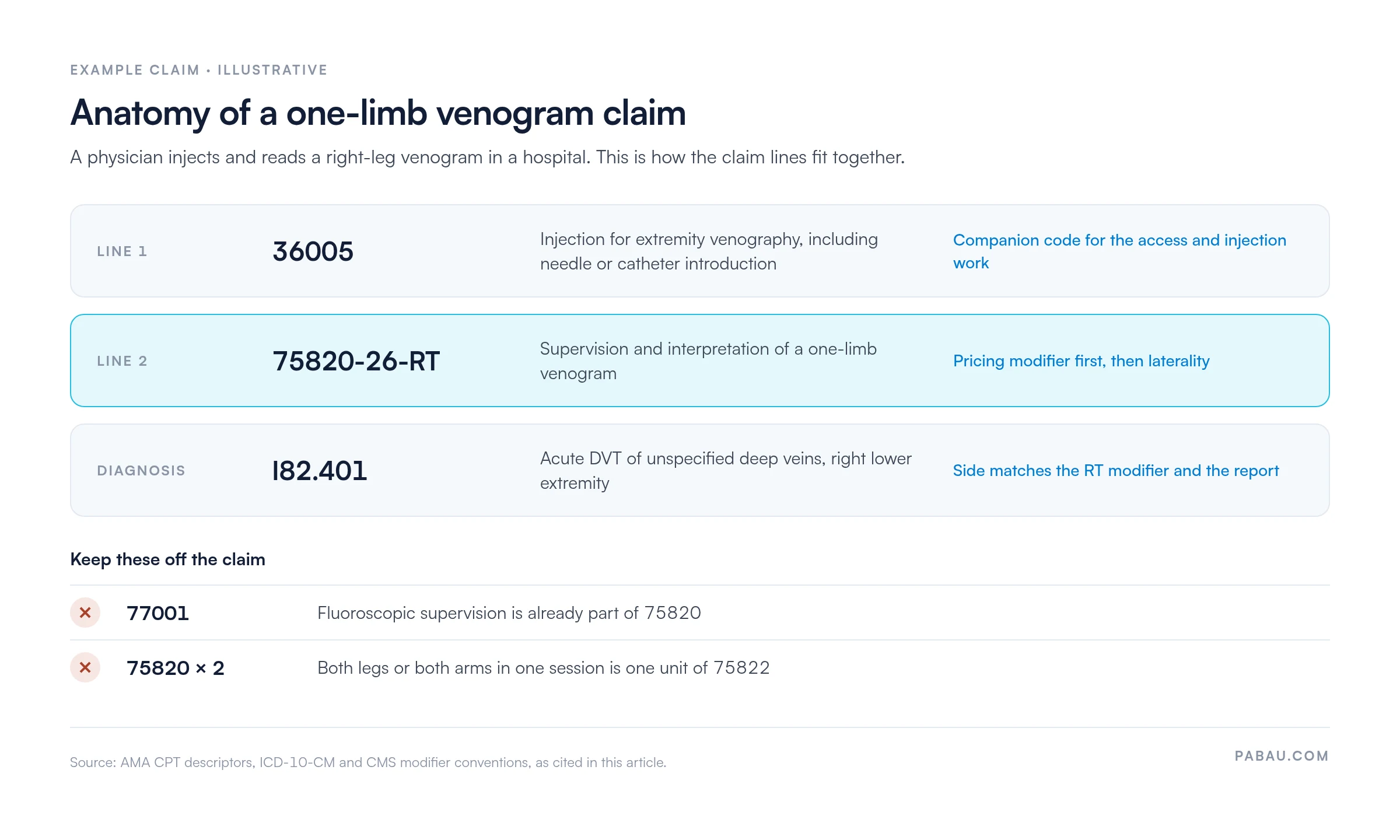
Medicare sets payment for CPT code 75820 each year through the Medicare Physician Fee Schedule (MPFS). Rates vary by locality, by modifier (global, -26 or TC), and by facility versus non-facility setting.
Check the CMS Physician Fee Schedule Look-Up Tool for your locality. The figures below are illustrative national ranges and may not match your MAC’s rates.
The FastRVU look-up tool shows the work, practice expense and malpractice RVUs for 75820. Multiply those by the conversion factor and your locality’s geographic practice cost index (GPCI) to get the allowed amount.
Prior authorization rules for venography vary by payer, plan year and plan type. Traditional Medicare does not require prior authorization for 75820 in most scenarios, but many Medicare Advantage and commercial plans do.
Running insurance eligibility verification before the study is booked heads off last-minute authorization denials. For medical necessity, the record typically needs all of the following:
Keeping these records consistent is part of medical billing compliance, and it’s a practice-wide workflow, not only a coder’s job. A pre-authorization checklist at scheduling gets approval on the chart before the day of service.
A two-minute check at charge entry is cheaper than any appeal. Tick each item before the claim leaves.
Denied 75820 claims tend to share a small set of root causes. Most can be prevented upstream rather than appealed.
A reference of medical billing denial codes helps your team read the remittance and choose the right fix. Sending a clean claim the first time, with documentation attached and modifiers checked, costs less than the appeal cycle.
A medical claims clearinghouse with front-end edits also catches many field-level errors before the payer sees the file.
Set your billing system to flag any claim with more than one unit of 75820 on the same date of service for review. Both legs or both arms in one session is 75822, so catching it at charge entry prevents a predictable denial.
In a lot of practices, charge entry still means retyping codes and patient details from the chart into a claim form. Each retyped field is a chance for a wrong unit or a missing authorization number.
Pabau, the practice management platform we build, fills the claim form from the patient record through its claims management software. CPT and ICD-10 lookup libraries sit inside the form, so coders search for 75820 or I82.401 instead of typing from memory.
Before a claim can be sent, Pabau checks that required fields such as membership numbers and authorization codes are complete. In the US, claims go through Claim.MD with real-time eligibility checks, and ERA remittances post back to the account.
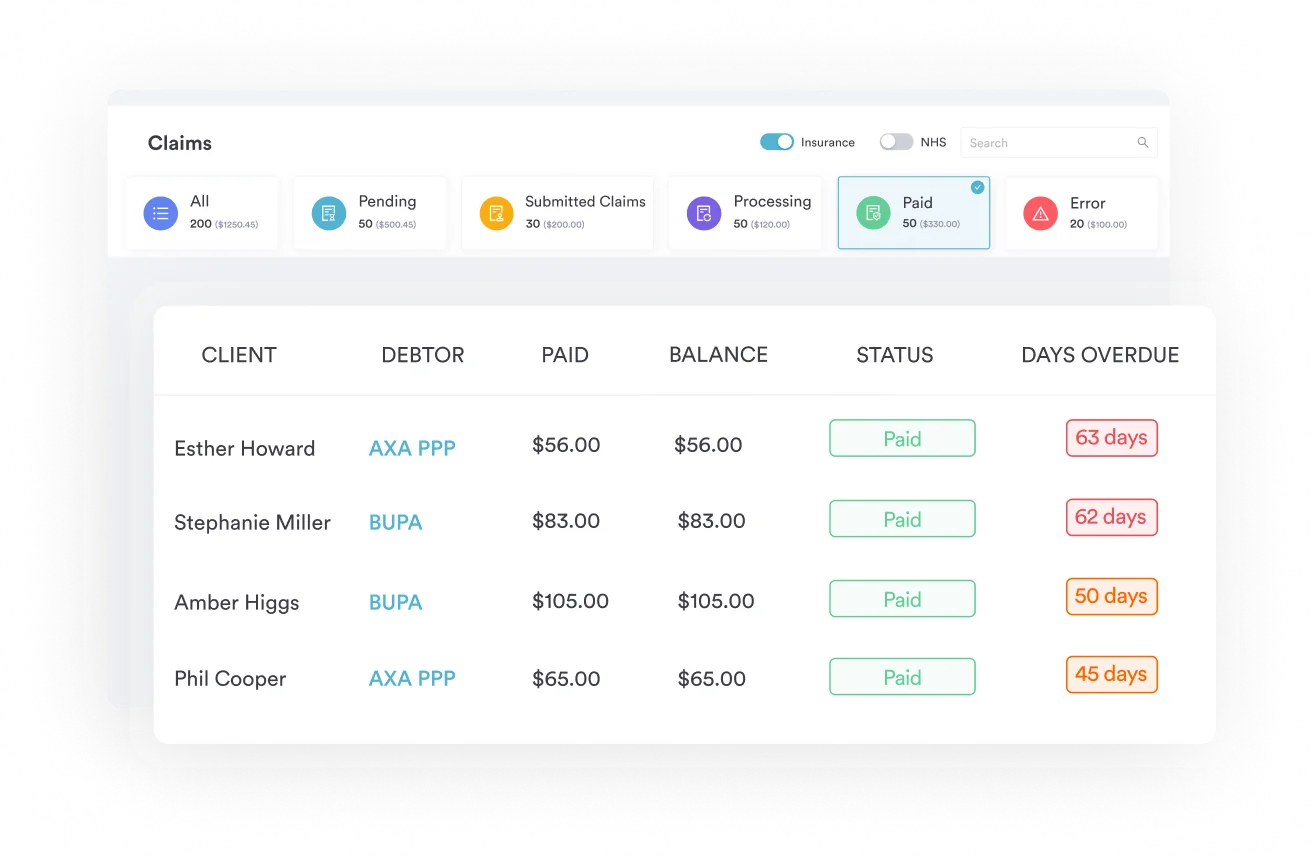

Pabau pre-fills claims from the patient record and checks required fields before they go out. US claims flow through Claim.MD with eligibility checks and ERA posting.

CPT code 75820 is a narrow code, so the clinical picture is rarely the hard part. The work is in the report and in how the claim lines are assembled.
If you change one habit, make it a laterality check at charge entry. The limb in the report, the modifier and the ICD-10 code should agree before a claim leaves. That one check guards against unit errors, side mismatches and audit flags together.
The trade-off is a little more time at charge entry for fewer appeals later. Book a demo to see Pabau pre-fill venography claims from the patient record and check required fields before they go out.

Need to understand how clearinghouse edits catch 75820 claim errors before payer submission? Pabau’s Claim.MD clearinghouse guide explains how front-end validation works for vascular radiology claims.
Want a reference for common denial codes your team will encounter on 75820 remittances? Denial codes in medical billing maps the most frequent CARC and RARC combinations with corrective actions.
Looking for a plain-language primer on the revenue cycle steps that surround a venography claim? What is revenue cycle management walks through each stage from eligibility check to payment posting.
No. CPT 75820 is for contrast venography read under fluoroscopy. A duplex ultrasound of the extremity veins is billed with 93970 for a complete bilateral study or 93971 for a unilateral or limited study.
Usually not. Venography used to guide lead placement is part of the implant procedure. Bill 36005 and 75820 separately only when documentation shows a distinct diagnostic need, such as a venous blockage found during lead placement.
Yes. CPT 36005 reports the injection for extremity venography, including needle or catheter introduction, and 75820 reports the S&I. Check current NCCI edits before filing.
Use 75820 for one arm or one leg. Use 75825 when the study images the inferior vena cava and 75827 for the superior vena cava. Both are central veins, not limbs.
Common choices are I82.401 or I82.402 for acute DVT of the right or left leg, and I87.2 for chronic venous insufficiency. Others include I87.001, postthrombotic syndrome without complications of the right leg, and I83.90, asymptomatic varicose veins of an unspecified leg.



