HCPCS Code L0472: Hyperextension TLSO billing guide
HCPCS code L0472: Official descriptor and device definition HCPCS code L0472 des...

Last Updated: Nov 5, 2026
74455 is the CPT code for urethrocystography, voiding, radiological supervision and interpretation. It covers the imaging and written report for a voiding cystourethrogram (VCUG), which films the bladder and urethra as the bladder fills and empties. The contrast injection is reported separately with CPT 51600.
The code sits in the Urinary Tract range (74400-74485) and splits into a technical component (TC) and a professional component (modifier 26). Most denials trace to a missing modifier or an unsupported diagnosis code, and getting both right means most claims clear first pass.
Let Pabau's smart automation suggest the right codes, reduce claim denials, and keep your practice compliant—effortlessly.
Automate repetitive tasks and focus on what matters most—your patients.
Reduce coding errors and ensure compliance with the latest regulations.
Clean claims, fewer denials, and faster reimbursements.
Powerful insights and reporting to help your practice thrive.
HIPAA compliant SOC 2 certified GDPR-compliant Trusted by 4,000+ clinics worldwide

CPT Code 74455 reports the radiological supervision and interpretation of a voiding cystourethrogram (VCUG). The contrast injection is billed separately with CPT 51600.
Bill 74455 globally when one entity owns the machine and reads the study. Split it into TC and modifier 26 when two entities bill.
A missing ICD-10 code that supports medical necessity is the leading denial trigger for 74455 claims.
Pabau’s claims management software submits and tracks 74455 claims through Claim.MD using the modifier and diagnosis codes your team enters.
CPT Code 74455 describes urethrocystography, voiding, radiological supervision and interpretation. The American Medical Association (AMA), which maintains the CPT code set, places 74455 in the Radiology section under Urinary Tract (74400-74485).
The study the code describes is a voiding cystourethrogram, often called VCUG. During a VCUG, contrast medium fills the bladder through a catheter and fluoroscopic images are taken during the filling phase and the voiding phase. As a result, the study shows bladder shape, urethral structure, and whether vesicoureteral reflux (VUR) is present.
Specifically, CPT 74455 covers the radiologic supervision and interpretation (RS&I) part of the VCUG. In other words, it covers the fluoroscopic images taken during the voiding study and the written radiology report.
However, it does not cover the contrast injection into the bladder. Instead, that service is reported on its own under CPT 51600 (injection procedure for cystography). This applies when two entities perform the services or when the payer requires unbundling.
CPT 74450 reports retrograde urethrocystography, radiological supervision and interpretation. In this study, contrast is injected backward through the urethral meatus, and the images show the urethra and bladder. By contrast, CPT 74455 images the same structures and also adds the voiding phase, captured as the patient empties the bladder.
The most frequent misassignment occurs when a provider performs a VCUG but selects 74450 because both codes image the urethra and bladder. So the voiding phase decides the code: if the patient voids during fluoroscopy, use 74455.
CPT 74455 follows standard radiology modifier rules. As a result, three billing cases apply, each driven by who owns the machine and who reads the images.
A common error is billing 74455 globally when the practice does not own the fluoroscopy machine. For example, in a hospital outpatient department, the hospital bills its share on the UB-04 under OPPS, with no TC modifier. Meanwhile, the reading radiologist bills 74455-26 on the physician claim. Billing the code globally in that setting therefore results in a duplicate claim denial.
Check the place of service (POS) code on every 74455 claim before submitting. On the physician claim, POS 22 or 19 (outpatient hospital) means the radiologist bills 74455-26 only. The hospital bills its share on the UB-04 under OPPS, with no TC modifier. POS 11 (office) often allows global billing if the practice owns the fluoroscopy machine.
Medicare pays for CPT 74455 through the Medicare Physician Fee Schedule (MPFS), updated every year on January 1. However, rates vary by region and by billing case (global or split components). For reference, the table below shows the CY2026 national values from the CMS PPRRVU file. Dollar figures are total RVUs multiplied by the $33.4009 conversion factor, before regional adjustment.
The technical component carries about 85% of the global value, so the split decides who collects most of the payment.
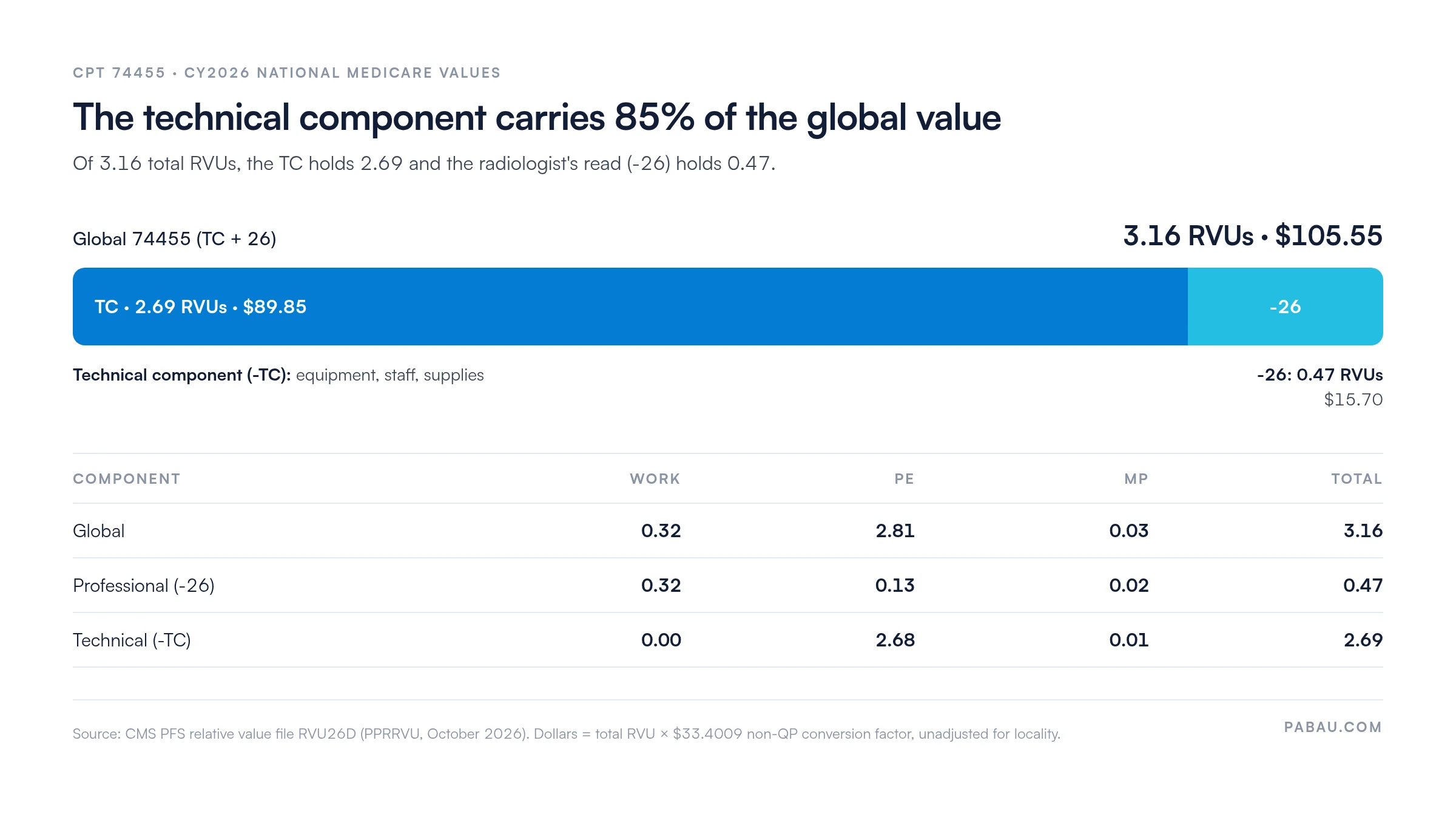
The CMS PFS relative value files carry the work, practice expense and malpractice RVUs for 74455, updated each quarter. Qualifying APM participants are paid at the $33.5675 conversion factor instead, or $106.07 globally. Commercial payer rates also vary, and payers tend to set them as a share of the Medicare fee schedule. Although the exact figure depends on the contract, rates often range from 100% to 150%.
Payers require a supporting ICD-10-CM diagnosis code that establishes medical necessity. Without a code that maps to an accepted clinical reason, the claim fails medical necessity review. As a result, it is denied however well the study is coded.
Guidelines from the American Urological Association (AUA) and the American Academy of Pediatrics (AAP) name the main indications for a VCUG. Specifically, they are vesicoureteral reflux workup, recurrent urinary tract infections in children, and voiding dysfunction evaluation.
ICD-10-CM codes update every October, so verify codes against the current CMS ICD-10-CM tabular list before billing, mainly for VUR codes, where reflux nephropathy and hydroureter change the code.
Prior authorization rules for CPT 74455 vary by payer, plan, and state. Medicare fee-for-service does not require prior authorization for VCUG as a standard rule, but Medicare Advantage plans may impose their own rules.
Confirm approval status before scheduling the study. Otherwise, an exam done without a required approval is denied, and that denial can be hard to overturn. Late approval depends on the payer, so ask early. Insurance eligibility verification done at scheduling also surfaces approval rules before the patient arrives.
A prior authorization request for 74455 should include the referring provider’s note on the clinical indication and any earlier scans. Also add the ICD-10 code that supports medical necessity. After that, most payers process standard PA requests within 3-5 business days.
The radiology report for a 74455 claim must contain key elements to survive payer audit. If any element is missing, the payer has grounds for recoupment on post-payment review, not just initial denial.
The medical billing workflow starts with this report, so the claim can only prove what the records show.
On a radiology study like 74455, a clean claim lines up three elements one to one. Specifically, they are the service done, the fluoroscopy method recorded, and the ICD-10 indication on the claim.
Knowing the physical sequence of a VCUG helps coders apply CPT 74455 correctly. It also shows when a companion code like CPT 51600 is billable with it.
Yes, CPT 74455 can sometimes be billed with urodynamics codes on the same date of service. However, NCCI edits decide whether separate billing is allowed or a modifier override applies.
The urodynamics studies most often done with it are CPT 51726 (complex cystometrogram), 51728 (CMG with voiding pressure studies), and 51736 (simple uroflowmetry). Each code pair has its own edit status in the current CMS NCCI tables, so before billing 74455 with any urodynamics code, verify the edit status directly in the AAPC CPT code lookup or CMS NCCI tool.
NCCI edit tables update every quarter, so confirm the current edit status before billing any CPT 74455 and urodynamics combination. After all, an edit that permitted separate billing last quarter may have changed.
Most 74455 denials fall into a small number of repeat patterns. Find the denial reason on the Explanation of Benefits (EOB), then match it to the fix below. Doing so resolves most rejections on first appeal.
A denial management workflow built around these patterns keeps a radiology or urology billing team ahead of the problem rather than reacting to remittances. Likewise, reviewing common denial codes with the CARC codes on your 835 remittances sorts each issue into code selection, records or approval.
Because many of these issues start at the front end, a pre-submission check for missing or invalid claim details catches them early. Reading each electronic remittance advice file, instead of only posting the payment, shows denial patterns that point to a record-keeping or workflow problem.
Many urology and radiology teams check coverage on a payer portal, key the claim into an outside clearinghouse and post the remittance by hand. As a result, each handoff is a chance for a -26 modifier or an N13.71 code to drop off the claim.
Pabau, the practice management platform we build, runs that cycle in one system. Its claims software for radiologists checks eligibility through Claim.MD before the visit. It then submits and tracks claims using the modifier and diagnosis codes your team enters.
Claim validation checks each claim for missing or invalid details before it leaves Pabau. When a payer rejects a claim, Pabau flags it with a link to the field that needs correcting. Payments then settle straight from electronic remittance advice (ERA) files.

Pabau checks eligibility through Claim.MD before the visit, then submits and tracks 74455 claims using the modifier and diagnosis codes your team enters. Rejected claims come back flagged with the field to fix.

CPT Code 74455 rarely fails on the code itself. Instead, it fails when the modifier doesn’t match the place of service, when the diagnosis doesn’t support the study, or when the plan wanted approval first.
Build those three checks into scheduling and report sign-off, before the claim leaves the practice. The urodynamics pairing is the one judgment call left, and the current NCCI table settles it each quarter.
Book a demo to see how Pabau submits and tracks urology and radiology claims through Claim.MD.

Need to understand how your clearinghouse processes 74455 claims? Claim.MD clearinghouse overview explains how electronic claim routing, real-time eligibility, and ERA posting work together.
Struggling with claim submission errors across your radiology billing? Medical billing compliance guide covers documentation standards, payer requirements, and audit readiness.
Want to see the 837 file structure behind your electronic claims? 837 file format explained breaks down the transaction set that carries 74455 claims to payers.
CPT Code 74455 covers the radiological supervision and interpretation of voiding urethrocystography, the study known as a voiding cystourethrogram (VCUG). The code includes fluoroscopic imaging during the filling and voiding phases plus the interpreting physician’s signed report. It does not include the contrast injection, which is reported on its own with CPT 51600.
CPT 74450 covers retrograde urethrocystography, where contrast is injected backward from the urethral meatus to image the urethra and bladder. The injection is reported with 51610. CPT 74455 covers a voiding cystourethrogram, where the bladder fills through a catheter and the patient voids under fluoroscopy. Use 74455 whenever the study includes the voiding phase, and 74450 when it does not.
Bill 74455 without a modifier when one entity owns the fluoroscopy equipment and reads the study (global billing). Bill 74455-TC when an office or imaging center supplies the equipment and staff but does not interpret. Bill 74455-26 when the physician performs only the interpretation and report. In a hospital outpatient department, the hospital bills on the UB-04 with no TC modifier, and the radiologist bills 74455-26.
The most frequent denial reasons are a missing or unsupported ICD-10 code, the wrong modifier and missing prior authorization. NCCI bundling conflicts add more when urodynamics codes are billed on the same date. An unsigned or incomplete radiology report is a less common but serious denial trigger because it removes the records that back the professional component claim.