

HCPCS Code Q4185: Cellesta flowable amnion billing guide
HCPCS Code Q4185: definition and official descriptor HCPCS Code Q4185 is the Lev...

Last Updated: Nov 20, 2026
74400 is the CPT code for urography (pyelography), intravenous, with or without KUB, with or without tomography. It reports the plain-film IVP, where contrast goes into a vein and timed X-rays follow it through the kidneys, ureters and bladder.
One code covers every combination of scout KUB and tomography, so the radiology report decides what the claim can defend. Because CT urography now handles most of this work, payers expect the record to say why plain-film urography was chosen.
Let Pabau's smart automation suggest the right codes, reduce claim denials, and keep your practice compliant—effortlessly.
Automate repetitive tasks and focus on what matters most—your patients.
Reduce coding errors and ensure compliance with the latest regulations.
Clean claims, fewer denials, and faster reimbursements.
Powerful insights and reporting to help your practice thrive.
HIPAA compliant SOC 2 certified GDPR-compliant Trusted by 4,000+ clinics worldwide

CPT code 74400 reports intravenous urography under one code, with or without a KUB film and with or without tomography.
The KUB and tomography sit inside the descriptor, so neither one adds a second code or a modifier.
Retrograde urography through a ureteral catheter is 74420, and antegrade urography through a nephrostomy tube is 74425.
CT urography has replaced most IVPs, so the record needs a stated reason for choosing plain-film urography.
Pabau, our practice management platform, verifies patient eligibility in real time and submits 74400 claims electronically through Claim.MD.
CPT code 74400 is the code for urography (pyelography), intravenous, with or without KUB, with or without tomography. AAPC’s code summary describes it as an exam of the kidneys, ureters and bladder after contrast is injected into a vein.
In plain terms, it’s the classic IVP. Contrast goes in through a vein, the kidneys filter it, and a run of timed X-rays follows it down to the bladder. The code sits in the Radiology section of the AMA’s CPT code set, in the urinary tract range that runs from 74400 to 74485.
The table puts 74400 beside the codes it’s most often confused with.
The radiologist may add a scout KUB film, conventional tomography of the kidneys, both or neither. Either way, the claim still carries 74400, with no sub-code and no modifier for the combination.
So the report, not the code, carries the detail. A charge sheet that mentions a KUB or tomography the report never names reads as unsupported in an audit. The fix takes seconds: the technique line lists every component that was acquired.
Each step below leaves a line in the record, and the claim leans on every one of them. A study done perfectly but documented thinly still gets denied.
The route of the contrast is the whole difference. In 74400 the contrast goes into a vein and the kidneys excrete it. In 74420, a urologist injects it up the ureter through a catheter, usually during cystoscopy.
A third route has its own code. Antegrade urography, where contrast runs down from a nephrostomy or pyelostomy tube, is 74425. The diagram maps all three routes, plus CT urography, to their codes.
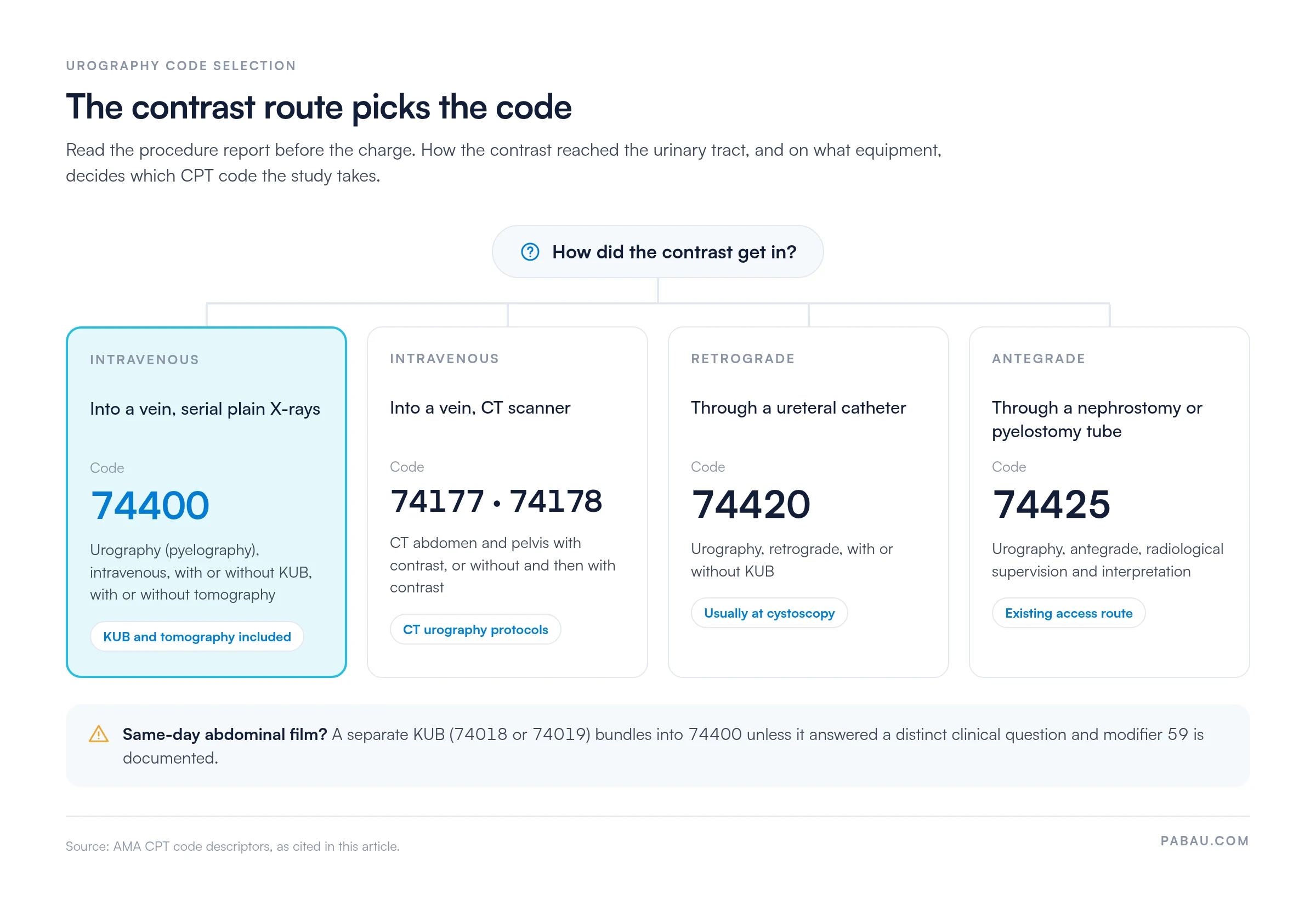
Billing 74400 for a retrograde study is a coding error that auditors look for. They compare the procedure report with the place of service and the urologist’s same-day codes, such as a cystoscopy.
CT urography is now the usual test for most urinary tract questions, because it shows stones and soft tissue in far more detail. It’s reported with a CT code, usually 74178 for the without-then-with-contrast protocol, and never with 74400.
That leaves 74400 with a narrower set of defensible cases. Think of a site with no CT access, a protocol chosen to keep radiation dose down, or a payer constraint written into the order. Many Medicare Advantage and commercial plans now question an IVP that has no stated reason.
Add one sentence to the technique section saying why plain-film urography was chosen over CT, such as CT being unavailable on site. That single line answers the most common medical necessity question before the payer asks it.
Payers read the ICD-10 codes on a 74400 claim to confirm the study was indicated. A diagnosis outside the payer’s coverage policy is a frequent denial trigger. Check the codes below against your MAC or payer policy, and use the ICD-10-CM code library to find a more specific option.
Kidney stones remain one of the more defensible indications. Pair N20.0 with a note on why CT wasn’t used, and the claim tells the whole story. Medicare contractors can be stricter than this table, so check the local coverage policy before you submit.
Traditional Medicare Part B doesn’t routinely require prior authorization for 74400. Many Medicare Advantage and commercial plans do, and their lists change from year to year. Verify it at scheduling for every patient, rather than going on memory of the last case.
When a plan does want authorization, send a complete package the first time:
Urgent requests move faster, but only when the clinical urgency is documented in the request itself.
Medicare sets 74400 payment each year in the CMS Medicare Physician Fee Schedule. Rates vary by locality and setting, so pull this year’s facility and non-facility figures for your MAC with the fee schedule look-up tool.
Like most radiology codes, 74400 splits into a professional component and a technical component. The professional part is the radiologist’s read, and the technical part covers the equipment and technologist. Who owns which part sets the modifier.
The FastRVU 2026 RVU lookup lists the work, practice expense and malpractice RVUs for 74400, so you can estimate payment for your locality. Many commercial payers set their fee schedule as a multiple of the Medicare rate.
National Correct Coding Initiative (NCCI) edits list the codes that can’t be billed with 74400 for the same patient on the same day. CMS updates them every quarter, so check the current table before submitting a combination you haven’t billed lately. The AAPC Codify CPT lookup helps with quick bundling and modifier checks.
The IV injection is part of 74400, so it’s never reported with a separate injection code. Whether the contrast agent itself is billable depends on the payer and the setting. Check the payer’s fee schedule and the current NCCI edits before adding a contrast supply code.
Modifier -26 goes on the radiologist’s claim for the read, and -TC goes on the facility’s claim for the equipment and staff. A global claim, where one entity bills both parts, carries neither modifier. Adding -26 when your entity also owns the equipment underbills the study.
A KUB is already part of the 74400 descriptor. A separate abdominal X-ray on the same date, now reported with 74018 for one view or 74019 for two, bundles into 74400. Older references still cite 74010, but that code was deleted on January 1, 2018.
Report the separate film only when it answered a distinct clinical question. In that case, append modifier -59 and document the separate indication in the record.
Most 74400 denials trace back to a handful of documentation and coding slips. Fixing them before submission costs far less than an appeal, and structured denial management workflows stop the same slip from repeating.
Run through these points before the claim leaves your system. Each one maps to a denial reason in the table above.
Much of the work on a 74400 claim happens around the code. Staff check coverage in one portal, re-key demographics into another and chase the signed report in a third.
Pabau’s claims software for specialty practices keeps those steps on one patient record. It verifies patient eligibility in real time and submits claims electronically through its Claim.MD integration.
Your coders still choose the code and the modifier. What changes is the admin around them. Coverage is confirmed before the patient arrives, and the claim goes out from the same record as the report.

Pabau’s claims management integrates with Claim.MD to verify patient eligibility in real time and submit claims electronically. Your team spends less time on payer portals and re-keyed data.

74400 is still an active, payable code, but payers now read it with a skeptical eye. Treat every IVP claim as one that has to explain itself.
Two lines in the record do most of that work. The report names what was acquired, and the chart says why plain films beat CT for this patient. A few seconds of dictation is a far smaller cost than weeks of appeal work.
Book a demo to see how Pabau checks eligibility and sends radiology claims electronically from the patient record.

Need to understand the broader clearinghouse workflow for radiology claims? Claim.MD clearinghouse guide explains how electronic claim routing works for US practices.
Looking to cut denial rates across your entire billing operation? Denial codes in medical billing covers CARC and RARC denial reason codes and how to respond to each.
Want to understand how the 837P claim format works for radiology submissions? 837 EDI file guide walks through the electronic claim transaction structure used for CPT code submissions.
Billing the CT version of the study instead? CPT code 74177 covers CT abdomen and pelvis with contrast, a common CT urography alternative.
Yes. 74400 remains an active CPT code, even though CT urography has replaced most IVPs. Payers still pay it when the record supports the choice of plain-film urography.
Yes. Intravenous pyelogram, intravenous urogram and excretory urography all describe the same exam. Each is reported with 74400 when it’s done on plain film.
It means conventional tomography, often called nephrotomography. The X-ray tube and film move together so one plane of the kidney stays sharp. It isn’t CT, and it adds no code.
Use 74425, urography, antegrade, radiological supervision and interpretation. It applies when contrast runs down from a nephrostomy or pyelostomy tube, not in through a vein.
No. Delayed images taken to follow slow drainage are part of the same intravenous urogram. They belong in the report, but they don’t add a unit or a second code.





