HCPCS Code Q4135: Billing Guide for Biovance Amniotic Membrane
HCPCS Code Q4135: Official Descriptor and Product Details HCPCS Code Q4135 is a ...

Last Updated: Nov 16, 2026
51610 is the CPT code for an injection procedure for retrograde urethrocystography. It covers the catheter placement and contrast injection only. The imaging read is reported separately with 74450, the radiological supervision and interpretation code.
The neighboring codes do different jobs. 51600 is the injection for cystography or voiding urethrocystography, and 51605 adds placement of a chain for contrast and/or chain urethrocystography. Choose 51610 only when the note documents retrograde contrast through the urethra.
Let Pabau's smart automation suggest the right codes, reduce claim denials, and keep your practice compliant—effortlessly.
Automate repetitive tasks and focus on what matters most—your patients.
Reduce coding errors and ensure compliance with the latest regulations.
Clean claims, fewer denials, and faster reimbursements.
Powerful insights and reporting to help your practice thrive.
HIPAA compliant SOC 2 certified GDPR-compliant Trusted by 4,000+ clinics worldwide

CPT code 51610 covers the injection for retrograde urethrocystography, while the imaging read is reported separately with 74450.
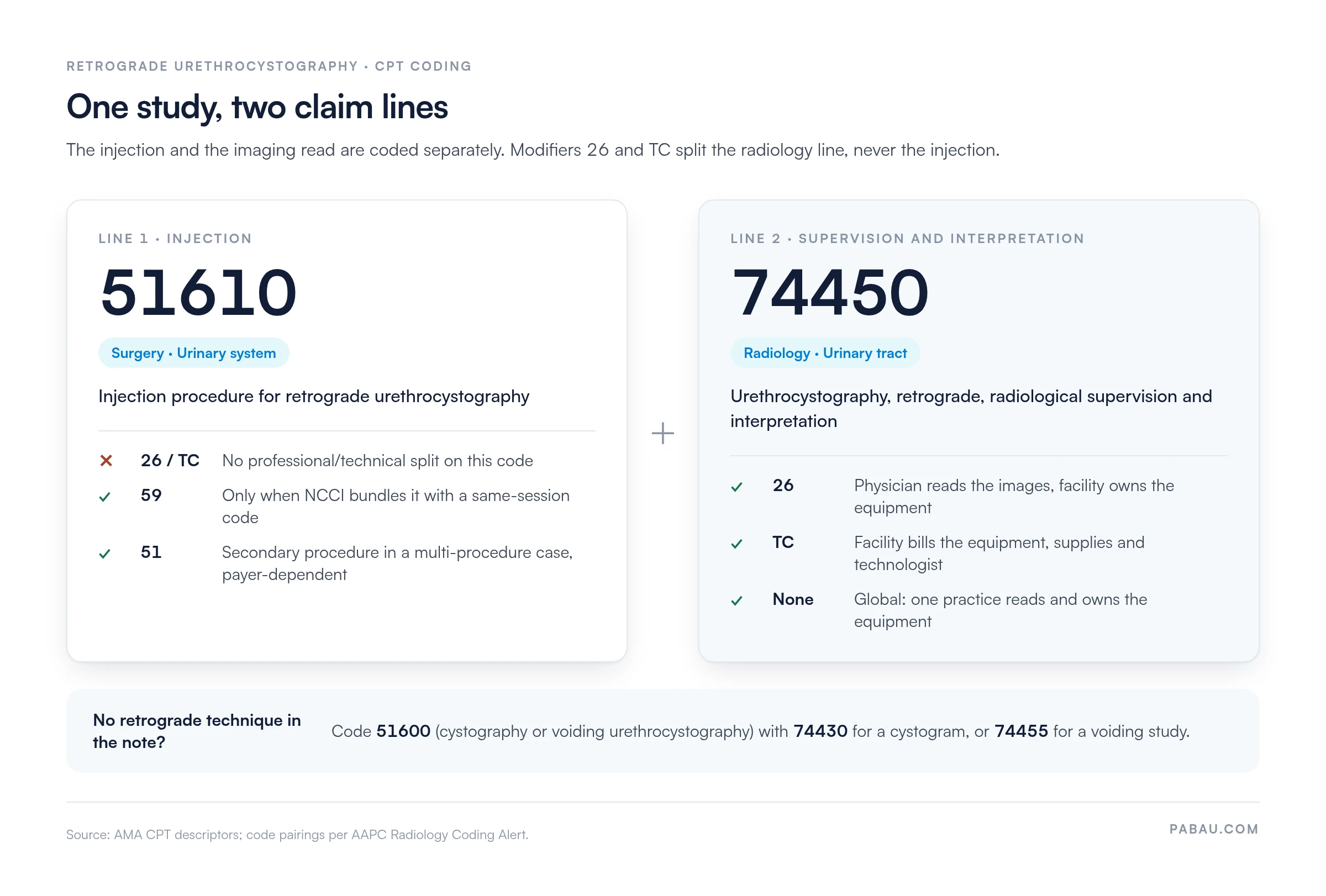
Modifiers 26 and TC belong on the radiology S&I code (74450), not on the 51610 injection.
Modifier 59 applies to 51610 only when an NCCI edit bundles it with a same-session code and the note supports a distinct service.
A missing signed interpretation and an unsupported ICD-10 diagnosis are common reasons these claims are denied.
Pabau’s claims management sends 837P claims through Claim.MD, runs eligibility checks and warns when a prior authorization is missing.
CPT code 51610 is the injection procedure for retrograde urethrocystography, a study that images the urethra and bladder with contrast run backward through the urethra. Guidance in the AAPC Radiology Coding Alert pairs 51610 with 74450, the supervision and interpretation (S&I) code.
So one study produces two claim lines. 51610 sits in the Urinary System subsection (50010-53899) of the CPT Surgery section, under the bladder introduction codes. The physician who reads the images reports 74450 for that work.
Retrograde urethrocystography fills the urethra and bladder with contrast through a catheter, against the normal direction of flow. Knowing the steps helps you check that the procedure note carries each element a payer expects.
The study runs in facility settings (hospital outpatient, ambulatory surgery center) and in the office. Setting changes the practice expense RVU Medicare applies, so the place of service code must match where the study happened.
51610 pays for the mechanical work of getting contrast in. Reading the images, the contrast drug and any voiding phase are reported elsewhere, which is where most coding errors on this study start.
Check the current quarterly NCCI (National Correct Coding Initiative) table before billing 51610 with a same-session cystoscopy or radiology code. CMS updates those edits every quarter, so last quarter’s answer may no longer hold.
The three injection codes differ by technique, and each pairs with its own S&I code. Defaulting to 51600 for every bladder contrast study undercodes a retrograde urethrogram and invites an edit when the note says retrograde.
The S&I pairing follows the technique. 51600 goes with 74430 for a cystogram, while 51610 goes with 74450.
If voiding under fluoroscopy is the point of the study, the read moves to 74455, and the injection to 51600. When the note never mentions urethral imaging or retrograde technique, 51610 is not supported.
Run the procedure note through a three-part test before selecting 51610. Does it specify retrograde contrast injection? Does it document urethral visualization, not just bladder filling? Does it name the catheter position at or near the meatus? If any element is missing, query the physician for an addendum before you code.
51610 has no professional and technical split, so 26 and TC never go on the injection line. They go on 74450, depending on who reads the images and who owns the equipment. The diagram below shows which modifier sits on which line.
Payers check the ICD-10-CM code on the claim against their coverage policies, including Local Coverage Determinations from Medicare Administrative Contractors. Without a supported diagnosis, the claim fails medical necessity however well the study is documented.
The table lists diagnoses commonly paired with a retrograde study. Confirm each code against the current CMS ICD-10-CM tabular list, which is updated every year.
Use the most specific code the record supports. Urethral stricture codes (N35.01x, N35.1x, N35.8x) split by site, sex and etiology, so they say more than N35.9. For a neurogenic bladder workup, check whether N31.9 can be replaced with a more specific N31 code.
A reviewer sees only the note. A well-performed study with no written interpretation, or no contrast agent named, reads like an undocumented one. These elements should appear in the procedure note for 51610.
An addendum can supply a missing element if it is completed before the claim goes out. Once a payer has asked for records, late clinical additions are likely to be treated as altered documentation. Document fully at the time of service.
Here is the path a retrograde urethrogram claim takes, and where each stage usually goes wrong.
Remittance data is where repeat errors show up first. Electronic remittance advice carries CARC denial reason codes that tie each denial to the edit behind it. That is faster to work from than a paper EOB.
Medicare payment for 51610 comes from the relative value units published each year in the Physician Fee Schedule. Each MAC applies a geographic practice cost index, so the national figure rarely matches local payment. Use the CMS Physician Fee Schedule Look-Up Tool for current rates.
The FastRVU lookup tool lists current work, practice expense and malpractice RVUs for 51610 by scenario. Cross-check it against the CMS tool before you set a fee schedule.
Medicare, Medicaid and commercial payers generally cover 51610 when the documented indication matches their policy. Prior authorization rules vary by payer and plan year, so check them before the study rather than after a denial.
Pabau, the practice management platform we build, tracks this inside the patient’s case. Its cleaner claims management runs eligibility checks through Claim.MD before the visit. The authorization code, dates and sessions sit on the case, with a warning when one is missing.
These five denial reasons are common on this code pair. Each one traces back to a step you can check before submission.
Teams that run denial management workflows catch most of these before a claim exits the practice. An appeal for a medical necessity denial should include the full procedure note and the supporting diagnosis. Attach the payer’s own policy where the denial contradicts it.
When a remittance code is unfamiliar, look it up in our guide to medical billing denial codes. It explains what each code means and what to fix before you resubmit.
Putting 26 on the injection. The professional component belongs to the read, so 51610-26 is an error that payers reject. Move the modifier to 74450.
Using 51610 for a voiding study. If voiding under fluoroscopy is the point of the study, the pair is 51600 with 74455. The retrograde pair only fits when contrast is pushed back up the urethra.
Billing the catheter separately. Placing the catheter used for the contrast is part of 51610. A separate catheter insertion line for the same catheter double-bills the work.
Without connected software, a urology team codes this study from the note, keys it into a separate billing system and waits for the remittance. Errors on the 74450 line surface weeks later, after the patient has left.
In Pabau, claims go to US payers through Claim.MD as CMS-1500/837P claims. Eligibility is checked before the appointment, and ERA remittances post back against the claim. Secondary claims run from the same record.
Prior authorizations are tracked on the patient’s case, with a warning when one is missing. Your team spends less time chasing paperwork and more time fixing the few claims that need it.

Pabau sends CMS-1500/837P claims through Claim.MD, checks eligibility and posts ERA remittances back to the claim. Prior authorizations are tracked, with a warning when one is missing.

Treat every retrograde urethrogram as two claims that happen to share a date. If your coders build the 51610 line and the 74450 line separately, the modifier errors on this study largely disappear.
The trade-off is a little more discipline at the note. A physician who documents retrograde technique and signs the read saves your team an addendum, a query or an appeal later.
Book a demo to see how Pabau checks eligibility and tracks authorizations before a urology claim goes out.

Need a clean-claim checklist for your urology billing team? Clean claim requirements in medical billing outlines the data elements every claim must carry before submission.
Want to understand how claim data moves from practice to payer? The 837 electronic claim file explained covers transaction format, field mapping and common rejection points.
Looking for guidance on insurance credentialing before you can bill? How to get credentialed with insurance companies walks through the enrollment process step by step.
Yes. They are the standard pair for a retrograde urethrogram. 51610 reports the injection and 74450 reports the supervision and interpretation, each on its own claim line.
No. 51610 has no professional and technical split. Modifier 26 or TC goes on 74450, depending on who reads the images and who owns the equipment.
Use 51610 when contrast is injected retrograde through the urethra. 51600 is the injection for cystography or a voiding urethrocystography, paired with 74430 or 74455.
Sometimes. NCCI edits decide whether the two codes bundle. Check the current quarter’s edits, and append modifier 59 only when the note supports a distinct service.
51610 carries a 000 global period. No postoperative days are bundled, so a follow-up visit on a later date is billed on its own.