HCPCS Code Q4185: Cellesta flowable amnion billing guide
HCPCS Code Q4185: definition and official descriptor HCPCS Code Q4185 is the Lev...

Last Updated: Nov 20, 2026
CPT code 73225 reports magnetic resonance angiography (MRA) of the upper extremity, with or without contrast material(s). It is one code for an MRA of the arm, whether the protocol uses contrast or not.
Joint MRI of the shoulder, elbow or wrist is a different study, coded 73221 to 73223. MRI of the arm outside a joint is 73218 to 73220. Medicare lists 73225 with restricted coverage, so your Medicare Administrative Contractor (MAC) decides when it pays and how much.

CPT code 73225 is magnetic resonance angiography of the upper extremity, with or without contrast, and it has no contrast-only variant.
Upper extremity joint MRI, the shoulder included, is coded 73221, 73222 or 73223, and non-joint MRI is coded 73218 to 73220.
The indication should be vascular, such as arterial thrombosis, aneurysm, vascular malformation, thoracic outlet syndrome or a failing dialysis access.
Medicare gives 73225 status R, restricted coverage, so the MAC sets coverage and price rather than the national fee schedule amount.
Pabau, our practice management and billing software, submits claims through Claim.MD and tracks authorization codes, dates and sessions, warning when one is missing.
The American Medical Association (AMA) descriptor for 73225 is “Magnetic resonance angiography, upper extremity, with or without contrast material(s).” CMS abbreviates it as “Mr angio upr extr w/o&w/dye” in its fee schedule files.
The study images the vessels of the arm rather than its joints or soft tissue. It typically follows the subclavian, axillary, brachial, radial and ulnar arteries, and the veins where the order asks for them. Guides to its neighbors in the 73218 to 73225 range sit in our CPT code library.
Pick the code by the study type first and the contrast protocol second. If the radiologist performed an angiogram of the arm vessels, the code is 73225, whatever the contrast decision.
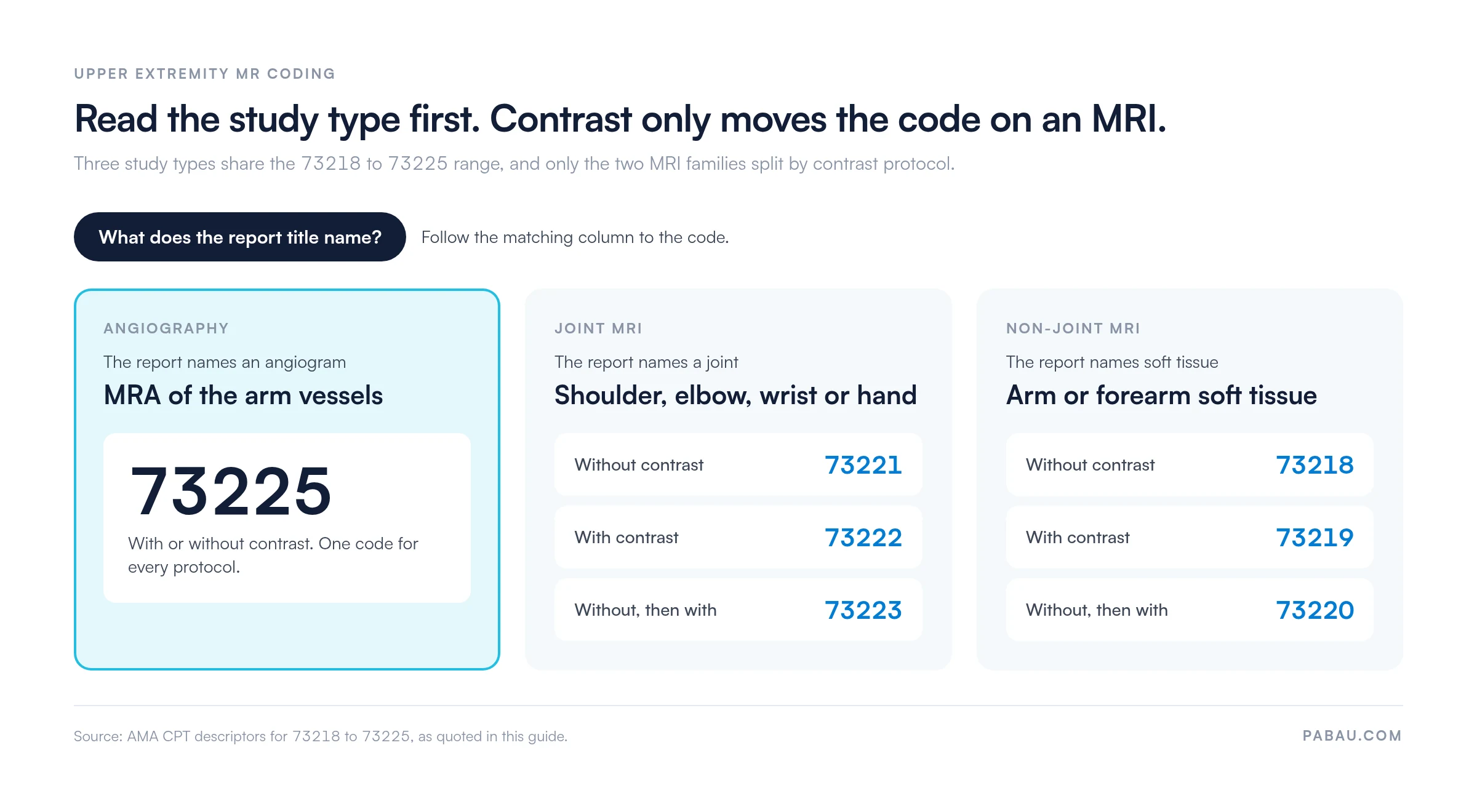
The shoulder is a joint, so shoulder MRI belongs to 73221 to 73223 like the elbow and wrist. Coding a shoulder MRI as 73225 reports an angiogram that never took place.
Contrast does not move an MRA between codes. A contrast-enhanced MRA and a non-contrast MRA are both 73225, so there is no contrast variant to upcode or downcode.
Sometimes a joint MRI and an MRA of the same arm are done in one session. Check the current NCCI edits before you report both, and document a separate indication for each study.
The record has to show that an angiogram was ordered for a vascular question and that one was performed. Reviewing clean claim requirements before submission catches most of the avoidable rework.
Maintaining radiology billing compliance means checking these elements against the report before every 73225 claim goes out.
Payers expect a vascular diagnosis behind an upper extremity MRA. A musculoskeletal code that suits joint MRI, such as a tendon tear, does not explain why the vessels were imaged.
Every code above was checked against the FY2027 ICD-10-CM files from CDC/NCHS, effective October 1, 2026. Confirm code status in the CDC ICD-10-CM browser tool before you submit.
Medicare has no national coverage policy for MRA of the arm. NCD 220.2 covers MRA nationally for named sites only: head and neck, lower extremity arteries, abdomen, pelvis and chest. Other uses fall to MAC discretion, so check your MAC for a local coverage policy.
Medicare pays 73225 at a rate set by the MAC, not at the national fee schedule amount. The Medicare Physician Fee Schedule (MPFS) gives the code status R, restricted coverage. CMS defines R as covered only in special circumstances and contractor priced when covered.
CMS still publishes relative value units (RVUs) for 73225. The table below multiplies them by the two CY2026 conversion factors, giving national, unadjusted reference figures.
The RVUs come from the CMS RVU26C file, July 2026 release, with non-facility and facility totals equal. Your MAC can price 73225 differently, and geographic adjustment changes the figure again. Check the CMS Physician Fee Schedule lookup tool for your locality.
Pabau submits claims through Claim.MD, and its streamlined claims management also checks eligibility and tracks remittances. The coder still chooses the CPT and ICD-10 codes for each study.
Most 73225 claims need a component modifier, a side modifier, or both. The table lists the modifiers that come up on this code and the error each one invites.
Both arms in one session take extra care. In the RVU26C file, 73225 carries bilateral surgery indicator 0. A both-sides claim under that indicator is paid at the lower of the total charge or 100% of the single-code amount.
Because 73225 is contractor priced, the MAC applies its own rules on top. Check the MPFS bilateral indicator and your payer modifier guidance before you bill a bilateral study.
Original Medicare runs no prior authorization program for 73225. The Appropriate Use Criteria (AUC) program for advanced imaging was paused, and its regulations were rescinded in the CY2024 fee schedule rule.
Medicare Advantage and commercial plans are a different story. Many send advanced imaging through a radiology benefit manager, and an MRA usually needs approval before the scan. A workflow that secures authorization before the scan prevents the costliest denial.
The National Correct Coding Initiative (NCCI) lists code pairs that cannot be billed together without a modifier. CMS updates the edit tables quarterly on its NCCI edits page, which also carries the Medically Unlikely Edits (MUEs).
Tracking denials by reason code shows which edits keep catching your claims.
Most 73225 denials trace back to coverage, authorization or code choice. Applying structured denial management strategies starts with knowing which reason you are looking at.
Before you code an upper extremity MR study, read the report title. If it says angiography, the code is 73225 regardless of contrast. If it names a joint, use 73221 to 73223, and the shoulder counts as a joint.
A 73225 claim depends on three things: the right authorization, a clean claim and a payment you can trace. Teams often track these across a payer portal, a spreadsheet and the clearinghouse.
Pabau keeps them on the patient record. It tracks authorization codes, dates and sessions on the case and warns when one is missing. Your team sees the problem before the scan rather than after the denial.
Claims go out through Claim.MD from the same record, with eligibility checks before the visit and remittances posted afterward. Pabau sends the codes your coder chose, so the decision between 73225 and a joint MRI code stays with them.

Pabau tracks authorization codes, dates and sessions on each case and warns when one is missing. Claims, eligibility checks and remittances run through Claim.MD from the same record.

Treat 73225 as an angiography code first. Read the report to see whether an angiogram was performed, then let a vascular diagnosis carry the claim. Joint and soft tissue MRI belong to their own codes, whatever contrast was used.
The Medicare side needs the most care. Status R means your MAC sets both coverage and price, so check local policy before you schedule rather than after the remittance arrives.
Book a demo to see how Pabau keeps imaging authorizations, claims and remittances on one patient record.

Need a denial code reference? Denial codes in medical billing covers the most common CARC and RARC codes that appear on radiology claim remittances.
Submitting claims electronically? Understanding the 837 file format explains how claim data is structured for payer submission, including how modifiers and diagnosis pointers are mapped.
Looking to verify eligibility before the study? Insurance eligibility verification shows how a coverage check before the visit stops an eligibility denial on an imaging claim.
Coding a contrast joint MRI instead? CPT code 73222 covers upper extremity joint MRI with contrast, including the MR arthrogram.
Imaging arm soft tissue before and after contrast? CPT code 73220 explains the non-joint MRI code for that protocol.
CPT code 73225 covers magnetic resonance angiography of the upper extremity, with or without contrast material(s). It images the arm vessels rather than the joints. Joint MRI, the shoulder included, is 73221 to 73223, and non-joint MRI of the arm is 73218 to 73220.
73225 is an MRA, an angiogram of the arm vessels, with or without contrast. 73223 is an MRI of an upper extremity joint, without contrast followed by contrast and further sequences. The study type decides the code, not the contrast protocol.
Medicare lists 73225 with status R, so the MAC sets the price when it covers the study. As a national reference, the July 2026 RVUs give 9.69 global, 2.34 professional and 7.35 technical. At $33.4009 per RVU, that is about $323.65 global before geographic adjustment.
Original Medicare has no prior authorization program for 73225. Most Medicare Advantage and commercial plans require approval for advanced imaging, often through a radiology benefit manager. Confirm that the authorization names 73225 and is valid on the date of service.
Vascular diagnoses support it. Examples are I74.2 for upper extremity arterial thrombosis, I72.1 for an arm artery aneurysm and Q27.31 for an arm vessel malformation. For a dialysis access problem, use T82.858A or T82.868A with Z99.2. Check your MAC’s local policy too.
No. Modifiers 26 and TC split the global service between the professional and technical components. The radiologist bills 26 for the interpretation, and the facility bills TC for equipment and staff. A provider who does both bills the global code without either modifier.