CPT code 59618: Cesarean after attempted VBAC billing guide
CPT code 59618 bills a cesarean after a VBAC attempt CPT code 59618 is the globa...

Last Updated: Nov 4, 2026
73220 is the CPT code for a non-joint upper extremity MRI without contrast material(s), followed by contrast material(s) and further sequences. It covers a non-joint study of the arm, forearm, wrist or hand with a plain series and a post-contrast series in one session.
When the radiologist runs both series, 73220 replaces 73218 and 73219 on the claim. Joint studies of the shoulder, elbow or wrist use 73221 to 73223 instead.
Let Pabau's smart automation suggest the right codes, reduce claim denials, and keep your practice compliant—effortlessly.
Automate repetitive tasks and focus on what matters most—your patients.
Reduce coding errors and ensure compliance with the latest regulations.
Clean claims, fewer denials, and faster reimbursements.
Powerful insights and reporting to help your practice thrive.
HIPAA compliant SOC 2 certified GDPR-compliant Trusted by 4,000+ clinics worldwide

CPT code 73220 reports a non-joint upper extremity MRI done without contrast, followed by contrast and further sequences in the same session.
The non-joint family is 73218 without contrast, 73219 with contrast, and 73220 without then with. Joint studies use 73221, 73222 and 73223 instead.
When the radiologist runs both a plain series and a post-contrast series, bill 73220 alone, never 73218 plus 73219.
The report must name the pre- and post-contrast series, the contrast agent and the dose, or the claim is open to denial.
Wrong code selection and missing prior authorization are the two leading denial triggers for 73220 claims.
CPT code 73220 is the code for a non-joint upper extremity MRI done without contrast and then with contrast in one session. The AMA descriptor reads “Magnetic resonance (eg, proton) imaging, upper extremity, other than joint; without contrast material(s), followed by contrast material(s) and further sequences.”
Two qualifiers set the scope. “Other than joint” points the code at the non-articular structures of the arm. “Without contrast material(s), followed by contrast material(s)” means the study has two parts: a plain series, then a contrast injection and a second series.
Structures reported under 73220 include the soft tissues of the upper arm and forearm. They also include the non-articular tendons, muscles, vessels and soft tissue masses of the wrist and hand. According to the AMA’s CPT code set overview, the descriptor language controls billing scope. A study that departs from it needs a different code from the family.
The 73218-73223 family splits along two axes. The first is joint versus non-joint anatomy. The second is the contrast sequence: without, with, or without followed by with. Getting either axis wrong produces a mismatched code that payers deny.
Decision rule: Ask two questions before selecting a code. First, does the study focus on a joint or on non-joint structures? Second, which series did the radiologist run: plain only, contrast only, or plain followed by contrast? The answers place the study in exactly one of these six codes, as the grid below shows.
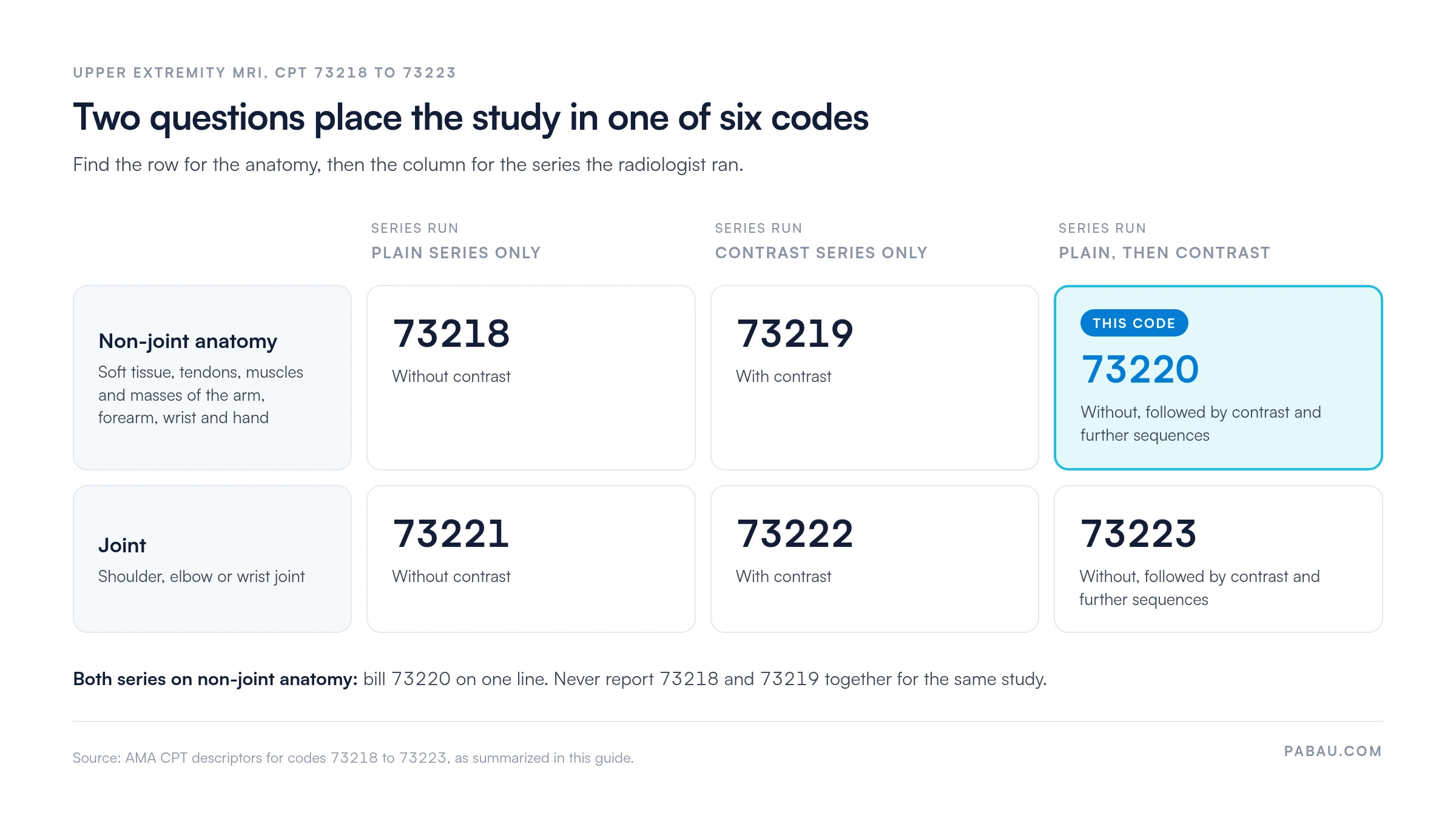
If the report shows a plain series and a post-contrast series of non-joint anatomy, the code is 73220. Never report 73218 and 73219 together for that study. If the order covers both joint and non-joint evaluation in one session, check payer bundling rules before billing two codes.
Check the radiology report’s body-part descriptor and its sequence list before assigning a code. A report titled ‘MRI Wrist’ may concern soft tissue of the distal forearm rather than the wrist joint itself. In that case 73218, 73219 or 73220 applies, depending on the contrast series the report lists. The anatomical focus and the series performed control code selection, not the body-part name on the order.
Payers evaluate 73220 claims against documentation that supports both the procedure performed and the medical necessity for ordering it. Weak documentation is the fastest route to a technical denial.
The radiology report must state the body region imaged and describe both series. It names the pre-contrast sequences, the post-contrast sequences, the contrast agent and the dose given. The ordering physician’s note must document the clinical indication that justifies a contrast study.
The contrast agent is a supply, separate from 73220 itself. In the office setting it usually goes on its own claim line with a HCPCS Level II code. A9579, for example, reports an unspecified gadolinium agent per mL. Hospital outpatient payers often package the agent instead, so check each payer’s rule.
The diagnosis code on the claim must show why a non-joint upper extremity MRI was medically necessary, and why it needed contrast. Payers cross-check the ICD-10-CM code against the procedure code to confirm the two align. A mismatch, such as billing 73220 with a joint-specific diagnosis, can trigger an automated denial before a human reviewer sees the claim.
Pairing caution: Diagnosis codes specific to a named joint, such as M25.511 (pain in right shoulder), do not support a non-joint upper extremity MRI. Use a non-joint soft tissue, infection or neoplasm code that matches the indication in the referring note. For a suspected bone infection, code the site and type the note documents, and fall back to M86.9 only when it names neither.
Medicare pays 73220 through the Physician Fee Schedule (MPFS). Rates are listed in the Centers for Medicare and Medicaid Services (CMS) Physician Fee Schedule lookup tool. Rates vary by geographic payment locality and by billing setting.
Because 73220 covers two series, its relative value units sit above those of 73218 and 73219. The exact rate changes with each annual MPFS update and varies by geographic payment locality. Use the CMS lookup tool to pull the current locality-adjusted rate for your practice address. Practices that send claims electronically get electronic remittance advice that shows each 73220 payment line by line.
Use the FastRVU 2026 RVU lookup tool to calculate the work, practice expense, and malpractice RVU components for 73220. Apply the current conversion factor for a locality-specific estimate.
Prior authorization requirements for 73220 vary by payer and plan type. Insurance eligibility verification before scheduling is the most reliable way to confirm whether a patient’s plan requires authorization for advanced imaging.
Check that the approval names 73220 itself. An authorization issued for 73218 or 73219 covers a single series, not the without-then-with study.
Proceeding without required authorization typically results in an administrative denial that clinical records alone rarely overturn. A retro-authorization request or peer-to-peer review may still be available, depending on the payer. Record the authorization number on the claim and in the patient record before the study is performed.
Correct modifier use on 73220 determines whether a claim pays at the right rate and avoids duplicate-billing edits. Radiology claims management workflows should enforce modifier logic when the claim is created, not after a denial. A clean claim submission for 73220 includes the correct modifier, a supported diagnosis code, and a prior auth number where applicable.
73220 already includes both the plain series and the post-contrast series. Billing 73218 or 73219 alongside it for the same extremity and session duplicates the service, and payers deny the extra line.
Do not bill 73220 and 73221 together for the same extremity on the same date. The exception is two distinct anatomical regions, imaged and documented separately. National Correct Coding Initiative (NCCI) edits may bundle these codes, depending on the version in effect. Check the current CMS NCCI edit tables before billing both codes. Local Coverage Determinations (LCDs) from your MAC may add restrictions specific to your jurisdiction.
Most 73220 denials fall into six predictable categories, and each has a specific corrective action. Tracking denials by CARC (Claim Adjustment Reason Code) in your electronic remittance advice shows which category causes the most write-offs. A structured denial management workflow catches these before they age past the appeal window.
Each denied line comes back with a CARC that names the payer’s reason. Our list of medical billing denial codes explains what each code means and which correction it calls for.
Pull your ERA files monthly and sort 73220 denials by CARC code. Start with CARC 50 (not deemed a medical necessity) and CARC 197 (precertification or authorization absent), the two most preventable on contrast MRI claims. Fixing one systemic process issue typically clears a cluster of denials at once.
Many imaging billing teams key each 73220 claim into a separate clearinghouse portal. They then check payer websites one by one to see where each claim stands. Every status check pulls time away from authorization follow-up and appeals.
Pabau, the practice management platform we build, submits claims electronically through Claim.MD. Your team sends the claim and follows its status without leaving Pabau. A 73220 line denied for a missing authorization or a contrast mismatch shows up while the appeal window is still open.
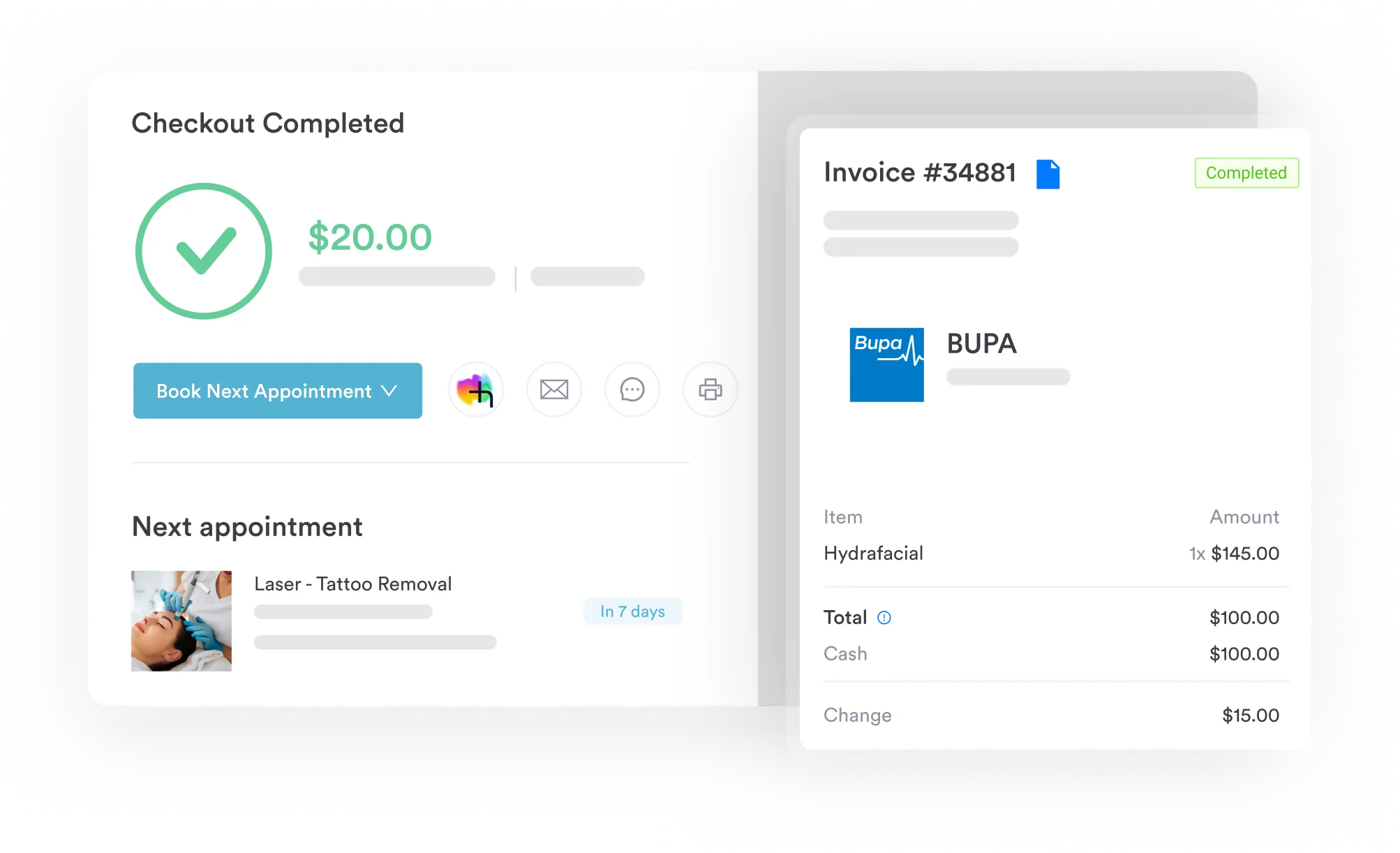
Remittance files come back into the same system, so your billing team can sort 73220 denials by CARC and fix the cause. Your coders still choose the codes, and your radiologists still own the report.

Pabau sends claims to payers through Claim.MD and tracks each claim’s status in the same system. Your billing team spots a denied 73220 line without checking a separate portal.

CPT code 73220 pays cleanly when the claim matches what the scanner did. The report shows a plain series and a post-contrast series of non-joint arm anatomy, and it names the agent and the dose. The diagnosis explains why contrast was needed, and the authorization names 73220 itself.
In this code family, a contrast error denies a claim as surely as a joint error does. Reading the sequence list before you code takes a minute, and it saves a denial, a refile and a second wait for payment.
Book a demo to see how Pabau keeps 73220 claims, remittances and denials in one place for your billing team.

Need to understand how clearinghouse submissions work for MRI claims? Pabau’s Claim.MD clearinghouse guide walks through how 837P files reach payers and return ERAs.
Tracking which denial codes are costing you the most? Our revenue cycle management overview explains how to build a denial tracking process across your imaging codes.
Want to reduce billing errors before claims are submitted? Medical billing compliance guidance covers the documentation and process controls that prevent the most common 73220 rejection triggers.
Coding the same study on the leg? CPT code 73720 covers the non-joint lower extremity MRI run without and then with contrast.
Ordering CT instead of MRI for the arm? CPT code 73200 explains how a non-contrast upper extremity CT is coded and billed.
CPT code 73220 covers an MRI of non-joint upper extremity anatomy done without contrast, followed by contrast and further sequences. It includes the soft tissues of the upper arm and forearm and the non-articular structures of the wrist and hand. Joint studies and single-series studies use other codes in the family.
All three cover a non-joint upper extremity MRI and differ only by contrast. 73218 is without contrast, 73219 is with contrast, and 73220 is without contrast followed by contrast and further sequences. When the radiologist runs both series, bill 73220 alone.
CPT 73220 covers non-joint upper extremity anatomy, imaged without and then with contrast. CPT 73221 covers an upper extremity joint imaged without contrast only. If the study centers on the shoulder, elbow or wrist joint, use a joint code from 73221 to 73223. If it centers on soft tissue between or around joints, use 73218, 73219 or 73220.
Most Medicare Advantage, commercial HMO and Medicaid managed care plans require prior authorization for 73220. Original Medicare does not generally require it, but the study must still meet medical necessity rules. Check that the approval names 73220, because an approval for 73218 or 73219 does not cover a two-series study.
Medicare pays 73220 under the Physician Fee Schedule, and the rate varies by locality and by the component billed (global, TC or 26). Because it covers two series, it carries more relative value units than 73218 or 73219. Use the CMS Physician Fee Schedule lookup tool at cms.gov for your current locality-adjusted rate.
Generally no, not for the same extremity on the same date. NCCI edits may bundle the pair. Modifier 59 or XS may apply if two distinct anatomical regions were imaged and separately documented, but payers scrutinize this pairing closely. Verify current edits before billing both codes on one claim.
The most common reasons are wrong code selection, such as 73218 plus 73219 billed instead of 73220, and missing prior authorization. Others include a diagnosis that does not justify contrast, missing contrast documentation, modifier errors and NCCI bundling edits. Each has a corrective action in the denial table above.