



CCSD code G5100: Bypass of duodenum billing guide
CCSD code G5100 bills a bypass that leaves the duodenum in place CCSD code G5100...

Last Updated: Oct 16, 2026

CPT code 73222 describes MRI of any upper extremity joint performed with contrast material, covering the shoulder, elbow, or wrist.
Selecting between 73221, 73222 and 73223 depends on whether contrast was administered, so read the radiology report first.
Missing contrast documentation in the medical record is the most common reason for 73222 claim denials, per Medicare auditors.
Practice management software like Pabau embeds CPT code selection into the encounter record, so staff pick codes in context instead of re-keying them.
CPT code 73222 reports magnetic resonance imaging (MRI) of any joint of the upper extremity, with contrast material(s). That descriptor comes from the American Medical Association (AMA), which maintains the CPT code set. The code sits in the Diagnostic Radiology section and applies when contrast is administered during MRI of the shoulder, elbow, or wrist.
The code belongs to the 7322x family, which covers three contrast scenarios for upper extremity joint MRI. Those scenarios are without contrast, with contrast, and without followed by with contrast. Picking the wrong one is a common radiology billing error.
A practice that bills 73222 for a scan performed without contrast faces downcoding on audit. A practice that bills it without a contrast record faces outright denial.
The official AMA descriptor for CPT code 73222 is specific about both the anatomy and the contrast requirement. Both elements must be present for the code to apply.
MRI of the upper extremity with contrast is ordered when the clinical question needs soft tissue characterization that plain MRI cannot resolve. The contrast agent, usually gadolinium, sharpens the picture of synovial enhancement, vascular structures, and lesion margins.
The ordering physician’s clinical judgment governs contrast use. The American College of Radiology (ACR) Appropriateness Criteria provide evidence-based guidance for each scenario.
Commonly accepted clinical indications for CPT 73222 include:
Contrast is not typically required for routine rotator cuff tear evaluation. Most payers accept CPT 73221 for that indication. Defaulting to 73222 for every shoulder MRI without clinical justification is a common upcoding error.
Plain-film imaging often precedes joint MRI, and the two use separate codes. A two-view elbow X-ray is reported under CPT code 73070, not an MRI code.
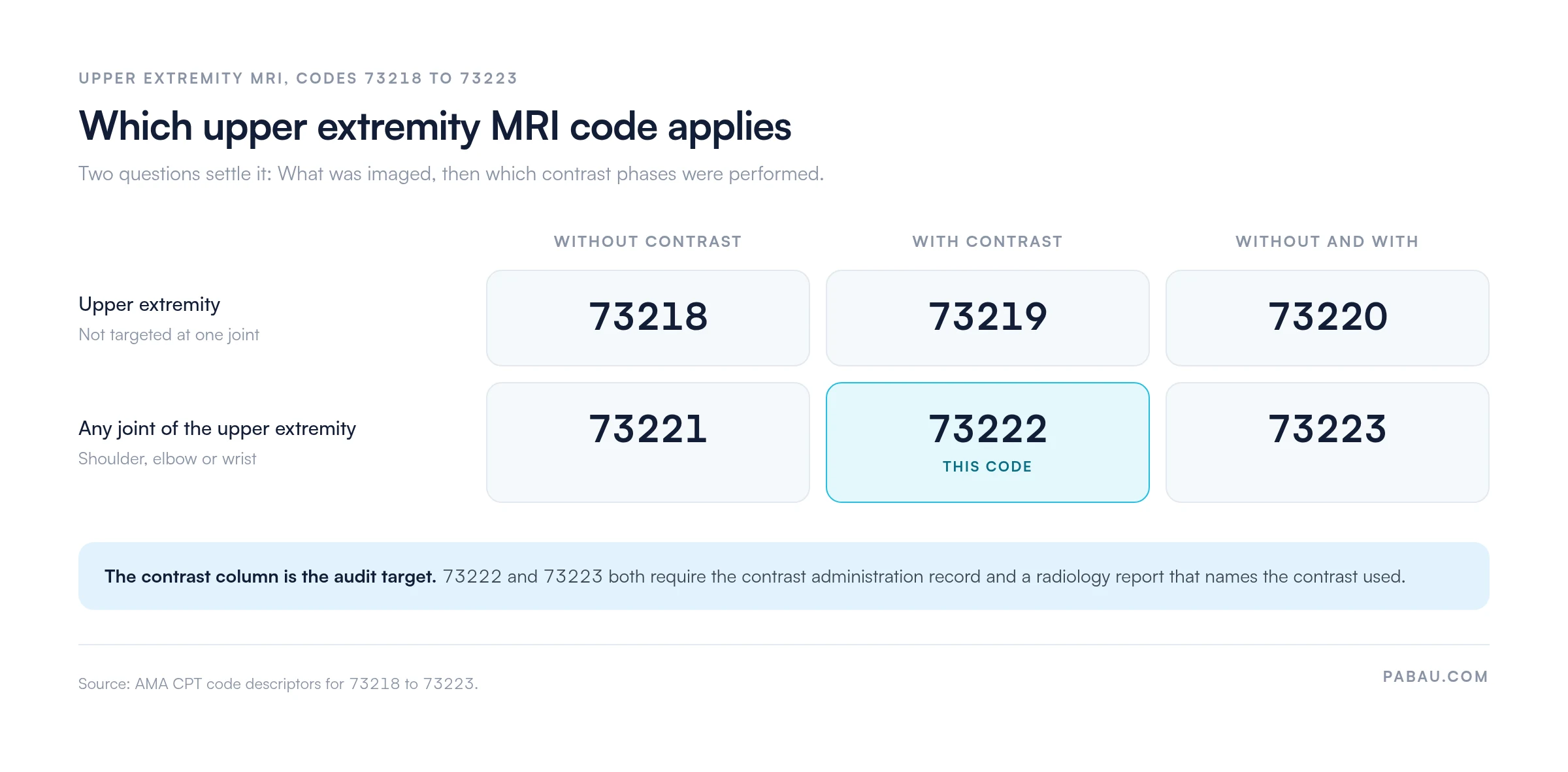
The 73218-73223 family splits into two anatomical categories. Codes 73218-73220 cover the upper extremity itself, without targeting one joint. Codes 73221-73223 cover any joint of the upper extremity. Confusing the two groups is a common billing error, and contrast use then decides which joint code applies.
Specificity is the distinction that matters here. The joint codes apply when the imaging targets one joint rather than the extremity as a whole. The chart below runs the two questions that settle the code, in the order a coder meets them.
Medicare payment for 73222 comes from the CMS Medicare Physician Fee Schedule (MPFS). The amount varies by geographic locality and by place of service. Use the MPFS lookup tool for the figure that applies to your own locality.
Medicare rates are locality-specific and they change annually. Verify exact dollar amounts through the CMS MPFS lookup tool before quoting a figure to a provider. Commercial payer rates can differ substantially from Medicare. Pabau’s Claim.MD clearinghouse integration routes submitted claims to the correct payer with current fee schedule data.
RVUs determine Medicare payment under the Resource-Based Relative Value Scale (RBRVS). Use the FastRVU lookup tool to retrieve the current work, practice expense, and malpractice RVU values for CPT 73222 by year.
When billing CPT 73222 in a non-facility setting, confirm the place of service (POS) code is correct. POS 11 (office) generates a higher total RVU than POS 22 (outpatient hospital), because practice expense RVUs are higher in non-facility settings. An incorrect POS code can result in underpayment that is difficult to recover after adjudication.
Radiology billing for CPT code 73222 commonly requires modifiers to indicate the component billed, the laterality, or a procedural distinction. Applying the wrong modifier is one of the fastest ways to generate a denial or a compliance flag.
Modifiers -26 and -TC should never appear on the same claim line for the same code. When a practice owns its imaging equipment and employs the radiologist, bill the global code instead. That means 73222 with no component modifier, covering both the technical and the professional service.
Every CPT 73222 claim requires at least one ICD-10-CM diagnosis code that supports medical necessity. Local Coverage Determinations (LCDs) issued by Medicare Administrative Contractors (MACs) name the diagnoses covered for upper extremity MRI with contrast. Check your MAC’s LCD before you submit.
The codes below are the ones that appear most often on 73222 claims.
ICD-10 pairing alone does not guarantee coverage. Verify each diagnosis against your MAC’s LCD and the payer’s Local Coverage Article (LCA) for upper extremity MRI.
The medical record must support both the procedure performed and the medical necessity of contrast administration. Thin documentation is the leading cause of CPT 73222 denials on post-payment audit. Work through the checklist below before the claim goes out.
Every element of the code description has to appear in the chart. For 73222 that reduces to one rule. No contrast record, no 73222.
CPT 73222 has a predictable set of claim failure points. Most come from thin documentation or from misapplying the code family rules. Every one of them is visible before submission, if someone checks. Without that check, the same denial codes come back quarter after quarter.
A pre-submission scrub that checks CPT and ICD-10 pairing plus modifier logic removes most of these. Getting the claim right the first time saves the cost of rework and keeps the practice off payer compliance reports.
Run a monthly internal audit on the 73222 claims submitted in the prior 30 days. Pull 10 random cases and check each one for three things. It needs a contrast administration record, a radiologist report that notes contrast use, and an ICD-10 code matching the MAC LCD. If any of the three is missing across several claims, an external audit will find the same problem.
Billing errors for CPT code 73222 usually start upstream of claim submission. When code selection, modifier assignment, and ICD-10 pairing happen outside the encounter record, transcription errors follow.
Pabau’s claims management software puts procedure code selection inside the appointment and treatment record. Billing staff pick CPT codes in context instead of re-keying them from a separate lookup.
Completed claims then route through the Claim.MD clearinghouse, which validates them against payer rules before transmission. Missing modifiers and ICD-10 mismatches surface there, so the radiology team can fix them before a denial lands.

Pabau attaches CPT codes, modifiers, and supporting ICD-10 codes to the encounter record, so your team spots missing documentation before the claim goes out.

Misapplying CPT code 73222 costs a practice more than the reimbursement on one claim. Missing a single line of contrast documentation does the same. Audit exposure, recoupment letters, and corrective action plans all carry operational cost that compounds.
One trade-off is worth remembering. Billing 73221 when the contrast record is thin costs less than defending 73222 on audit.
Pabau attaches CPT codes, modifiers, and ICD-10 pairings to the encounter record at the point of care. The documentation trail that supports a 73222 claim is built before the patient leaves. Book a demo to see how that keeps upper extremity MRI claims clean on first submission.

Need to understand how billing errors turn into denied claims? Denial management in healthcare covers the root causes of claim rejections and the workflow steps to recover revenue.
Want to build a cleaner claims submission process? Submitting a clean claim explains what payers check before adjudicating a claim and how to pass those checks on first submission.
Looking at radiology billing for other procedure families? IVF procedure billing codes illustrates how the same documentation and medical-necessity principles apply across specialty CPT families.
CPT code 73222 is used to report MRI of any joint of the upper extremity performed with contrast material, covering the shoulder, elbow, or wrist. It applies when gadolinium or another contrast agent is administered during the scan. The imaging target must be a specific joint, not the upper extremity as a whole.
CPT 73221 covers MRI of any upper extremity joint without contrast. CPT 73222 covers the same anatomy with contrast. Both codes apply to joint-specific imaging of the shoulder, elbow, or wrist. The contrast administration record in the radiology report is what decides between them.
Medicare payment for CPT 73222 varies by geographic locality and place of service, and it updates annually with the Medicare Physician Fee Schedule. Use the CMS MPFS lookup tool at cms.gov to retrieve the current facility and non-facility rates for your locality before quoting a figure.
The most common modifiers for CPT 73222 are -26 (professional component) and -TC (technical component). Others are -LT or -RT for laterality, -50 for a bilateral study, and -59 for a distinct procedural service. Never apply -26 and -TC to the same claim line for the same code.
Common ICD-10 pairings for CPT 73222 include M75.1xx (rotator cuff syndrome), M00.x (pyogenic arthritis), and M05-M06 (rheumatoid arthritis). Neoplasm codes C49.1x and D21.1x cover malignant and benign soft tissue masses of the upper limb. Always verify against your MAC’s Local Coverage Determination before submitting.
Required documentation starts with a signed order that specifies contrast and a contrast administration record naming the agent, dose and route. You also need a radiologist report that references contrast use, plus clinical notes establishing medical necessity. Missing any of these elements makes the claim unsupportable on audit.
CPT 73222 covers MRI of an upper extremity joint with contrast only. CPT 73223 covers the same joint imaged first without contrast, then with contrast in one session. Use 73223 when the protocol includes both pre-contrast and post-contrast sequences. Use 73222 when only post-contrast sequences are performed.



