CCSD code A2720: Proximal gastric vagotomy billing guide
What is CCSD code A2720? CCSD code A2720 is the procedure billing code assigned ...

Last Updated: Oct 8, 2026
93931 is the CPT code for duplex scan of upper extremity arteries or arterial bypass grafts; unilateral or limited study. It covers a complete duplex exam of one arm, or a limited scan of a specific arterial segment or bypass graft.
Its bilateral counterpart, CPT 93930, applies when both arms are fully examined. Billing 93930 when only one arm was scanned, or only a limited segment was checked, is upcoding. It invites claim denial and post-payment audit recovery.
Let Pabau's smart automation suggest the right codes, reduce claim denials, and keep your practice compliant—effortlessly.
Automate repetitive tasks and focus on what matters most—your patients.
Reduce coding errors and ensure compliance with the latest regulations.
Clean claims, fewer denials, and faster reimbursements.
Powerful insights and reporting to help your practice thrive.
HIPAA compliant SOC 2 certified GDPR-compliant Trusted by 4,000+ clinics worldwide

CPT Code 93931 covers a unilateral or limited duplex scan of upper extremity arteries or arterial bypass grafts, not a bilateral complete study.
The scan needs both real-time B-mode imaging and spectral Doppler waveform analysis, and either component alone does not meet the duplex definition.
Billing 93931 and 93930 for the same patient on the same date conflicts with NCCI bundling edits and is a common denial trigger.
Under the CY2026 Medicare fee schedule, 93931 carries 3.62 total RVUs, about $120.91 nationally before locality adjustment.
Pabau, the practice management platform we build, submits claims electronically and tracks their status through Claim.MD.
CPT Code 93931 is defined by the American Medical Association as: Duplex scan of upper extremity arteries or arterial bypass grafts; unilateral or limited study. It sits in the CPT Medicine section under Noninvasive Vascular Diagnostic Studies, within the extremity arterial studies range (93922-93931).
The code covers two clinical scenarios under one descriptor. “Unilateral” means a complete duplex examination of one upper extremity. “Limited” means a partial or follow-up scan of a specific arterial segment or bypass graft rather than the full arterial tree. Both share the same code, so the report must say which one applies.
Duplex scanning, as the AMA defines it, has two simultaneous components. Real-time B-mode (grayscale) imaging shows the vessel anatomy, and spectral Doppler waveform analysis characterizes blood flow. Color flow mapping is routinely added but is not sufficient on its own. A scan with Doppler waveforms but no B-mode imaging, or grayscale images without Doppler, does not qualify under this code.
Medical necessity is the gating requirement for every 93931 claim. Payers use Local Coverage Determinations (LCDs) to specify which clinical indications support reimbursement. The most common justified uses are:
Each indication must appear as a documented clinical reason in both the ordering physician’s referral and the interpreting physician’s report. A diagnosis code alone is not sufficient. The order must state why the unilateral or limited study was needed.
A compliant duplex scan report supporting a CPT 93931 claim contains each of the following elements. Missing any one of them is grounds for a medical review denial or recoupment on audit.
Under standard medical billing compliance rules, the signed report must be in the record when the claim goes out, not reconstructed after a payer request. Practices that rely on templated reports should check that each template pulls laterality and vessel-level findings from the technologist’s worksheet.
CPT 93930 covers a bilateral complete study of the upper extremity arteries, while CPT 93931 covers a unilateral or limited study. The two are easy to confuse on a busy billing day. The code follows what was scanned and documented on the date of service, not what the order requested.
Billing 93930 when only one extremity was scanned is upcoding. It invites claim denial and, under repeated audit, post-payment recovery. Billing two units of 93931 for a bilateral complete scan instead of 93930 is fragmentation, which NCCI edits flag.
CPT Code 93931 belongs to a suite of noninvasive vascular diagnostic codes. The right choice turns on modality (duplex imaging or physiologic pressure studies), body region, and laterality. The decision path below sorts the upper extremity arterial codes in two questions.
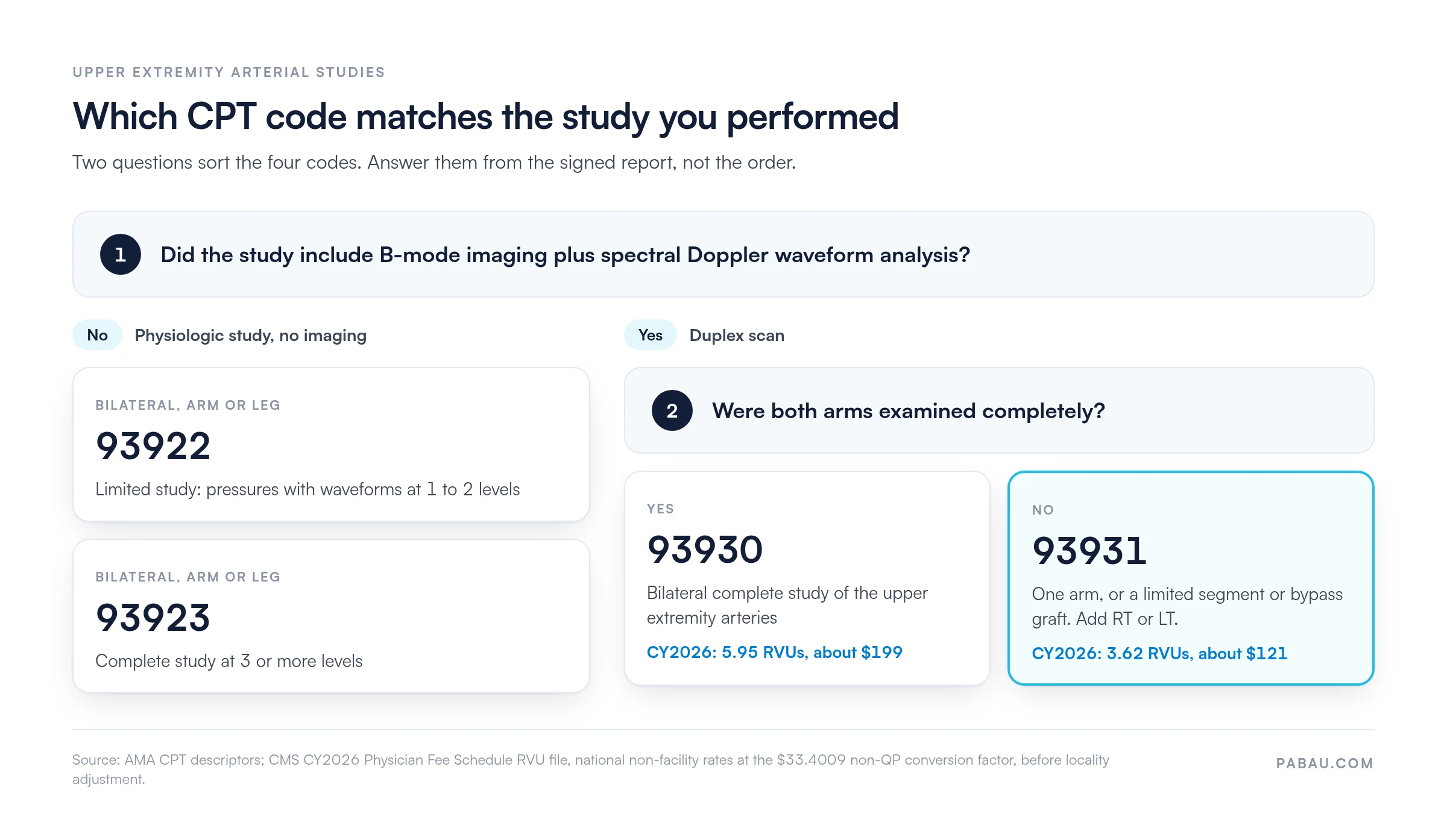
The table below covers the neighboring codes coders confuse most often with 93931.
Confirm whether the ordering provider intended an imaging study (93931/93930) or a physiologic study (93922/93923) before coding. Ordering physicians sometimes write ‘arterial Doppler’ without specifying whether they want duplex imaging or pressure-waveform studies. Getting this wrong generates a denial that requires a corrected claim and a new authorization.
The AAPC coding guidance and the CMS NCCI Policy Manual set bundling restrictions that block certain code combinations on the same claim. For CPT 93931, the critical restrictions are:
Sometimes a physiologic study such as 93922 and a duplex scan are both needed at one visit. Document a separate indication for each, and report them on separate claim lines. Be ready to supply that documentation on request, and never rely on a modifier alone to justify the pairing.
The CY2026 Medicare Physician Fee Schedule (MPFS) sets payment for CPT 93931 from its relative value unit (RVU) components. Rates vary by MAC jurisdiction and geographic practice cost index (GPCI) locality adjustment. Use the CMS Physician Fee Schedule lookup tool to find the exact rate for your locality.
For RVU values by locality, the FastRVU lookup tool pulls CMS fee schedule data with geographic adjustments.
When the technical component (the scan) and the professional component (the interpretation) are performed by different entities, split the claim. Append modifier 26 for the interpretation alone, or modifier TC for the technical scan alone. Neither entity can bill globally in a split setup, and misusing global billing there is a common audit finding.
Medicare does not require prior authorization for CPT 93931 under the current program, but it does enforce medical necessity review. Coverage is set by each MAC’s own LCD for noninvasive vascular studies. Check your MAC’s active LCD in the Medicare Coverage Database before assuming coverage for an indication.
Solid insurance eligibility verification before scheduling reduces 93931 denials from inactive coverage or plan-specific limits. Commercial insurers vary considerably. Some require prior authorization for any vascular duplex study in an office setting, particularly for high-utilization providers. Confirm payer-specific authorization at scheduling, not on the day of service.
Key payer documentation requirements across Medicare, Medicaid, and commercial plans:
Correct place of service (POS) coding and modifier use directly affect payment and claim acceptance. Get either wrong and the claim pays at the wrong rate or denies outright.
CMS sets the supervision level for each diagnostic test on the fee schedule, so confirm the indicator for 93931 with your MAC. Under general supervision, the physician does not need to be present during the scan. The physician still stays responsible for training the technologist and maintaining the equipment.
The ICD-10-CM diagnosis code on the claim must match an indication covered by the payer’s LCD. The following codes are among those most commonly linked to CPT 93931 medical necessity:
Always check that the diagnosis code is on the payer’s approved LCD list for CPT 93931. A clinically sensible code that is missing from the LCD draws a medical necessity denial, and overturning it on appeal takes additional clinical evidence. To confirm a code’s full descriptor before the claim goes out, look it up in our ICD-10-CM code directory.
Strong denial management workflows for CPT 93931 start before the claim is submitted. The most frequent denial triggers, and the pre-submission checks that prevent each, are:
The goal is submitting a clean claim the first time rather than working through a corrected claim cycle. Superbill documentation that records the treatment, the side scanned, and the codes billed gives the biller what the claim needs.
Run a quarterly audit of your 93931 claims against your 93930 claims. The ratio of unilateral to bilateral upper extremity duplex studies should reflect your clinical volume. A practice scanning mostly symptomatic single-arm patients should have far more 93931 claims than 93930 claims. A ratio that skews heavily toward 93930 without matching bilateral scan documentation is a pre-payment audit flag.
In many vascular practices, duplex claims live across a scheduling tool, a reporting system, and a separate clearinghouse portal. When a 93931 claim comes back denied, someone has to find the report, correct the claim, and resubmit it by hand.
Pabau’s faster claims management sends claims electronically through Claim.MD, its US clearinghouse partner. Claim status is tracked in the same system that holds the appointment and the patient record.

The coding decisions in this guide still sit with your coders and interpreting physicians. What changes is the follow-up. Your team works denials from the same place it books scans and keeps records, instead of switching between systems.

Pabau submits claims electronically through Claim.MD and tracks their status, so your team can follow up on 93931 denials without a second portal.

CPT Code 93931 rewards precision more than speed. Code it from the signed report, not the order, and the choice between 93931, 93930, and the physiologic codes usually settles itself.
The habit worth building is a hard stop on laterality and a stated indication before the report is signed. Fixing either one after a denial means an amended report and a resubmission, which costs far more time than the check.
The trade-off is a slightly slower sign-off for technologists and physicians, in exchange for more claims that pay on the first pass. Book a demo to see how Pabau tracks your vascular claims from submission to payment.

Need a structured framework for vascular billing claims? Medical billing fundamentals for practice teams covers the end-to-end claims workflow from charge capture through payment posting.
Handling claim denials across your vascular practice? Understanding electronic remittance advice explains how to read ERA files and identify CARC denial codes tied to noninvasive vascular study claims.
Want to know how a clearinghouse handles CPT claims? Claim.MD clearinghouse overview explains how claims travel from your practice to the payer and back.
Scanning veins instead of arteries? CPT code 93971 covers the unilateral or limited duplex scan of extremity veins, upper or lower.
Measuring pressures rather than imaging? CPT code 93923 covers complete bilateral physiologic studies of the upper or lower extremity arteries.
CPT Code 93931 covers a unilateral or limited duplex scan of upper extremity arteries or arterial bypass grafts. The study requires both real-time B-mode imaging and spectral Doppler waveform analysis. It applies when one arm is fully evaluated, or when a limited segment is checked in one or both arms. Targeted bypass graft surveillance is a typical example.
CPT 93931 covers unilateral or limited studies only. When both arms are fully evaluated in a complete bilateral exam, CPT 93930 applies instead. Billing 93930 for a scan of one arm is upcoding, which invites claim denial and post-payment audit recovery.
Generally no, not on the same date without separate documented clinical indications for each study. CPT 93922 is a limited bilateral physiologic study using pressures and waveforms without imaging, while CPT 93931 uses duplex imaging. If both are medically necessary for different clinical questions, each needs its own documented indication. Even then, some payers disallow the combination.
The most common denial reasons are missing laterality in the interpreting physician’s report and a missing clinical indication. Other frequent causes include a diagnosis code missing from the payer’s LCD and a wrong place of service. Upcoding to CPT 93930 for a one-arm scan is another. Each one is preventable with pre-submission claim checks.