CCSD Code S5535: Description, tariff, medical aid and claim requirements
CCSD Code S5535: Official description and procedure scope CCSD Code S5535 is a b...

Last Updated: Nov 20, 2026
63015 is the CPT code for cervical laminectomy with exploration and/or decompression of the spinal cord and/or cauda equina across more than 2 vertebral segments. It excludes facetectomy, foraminotomy and discectomy, and spinal stenosis is the typical indication.
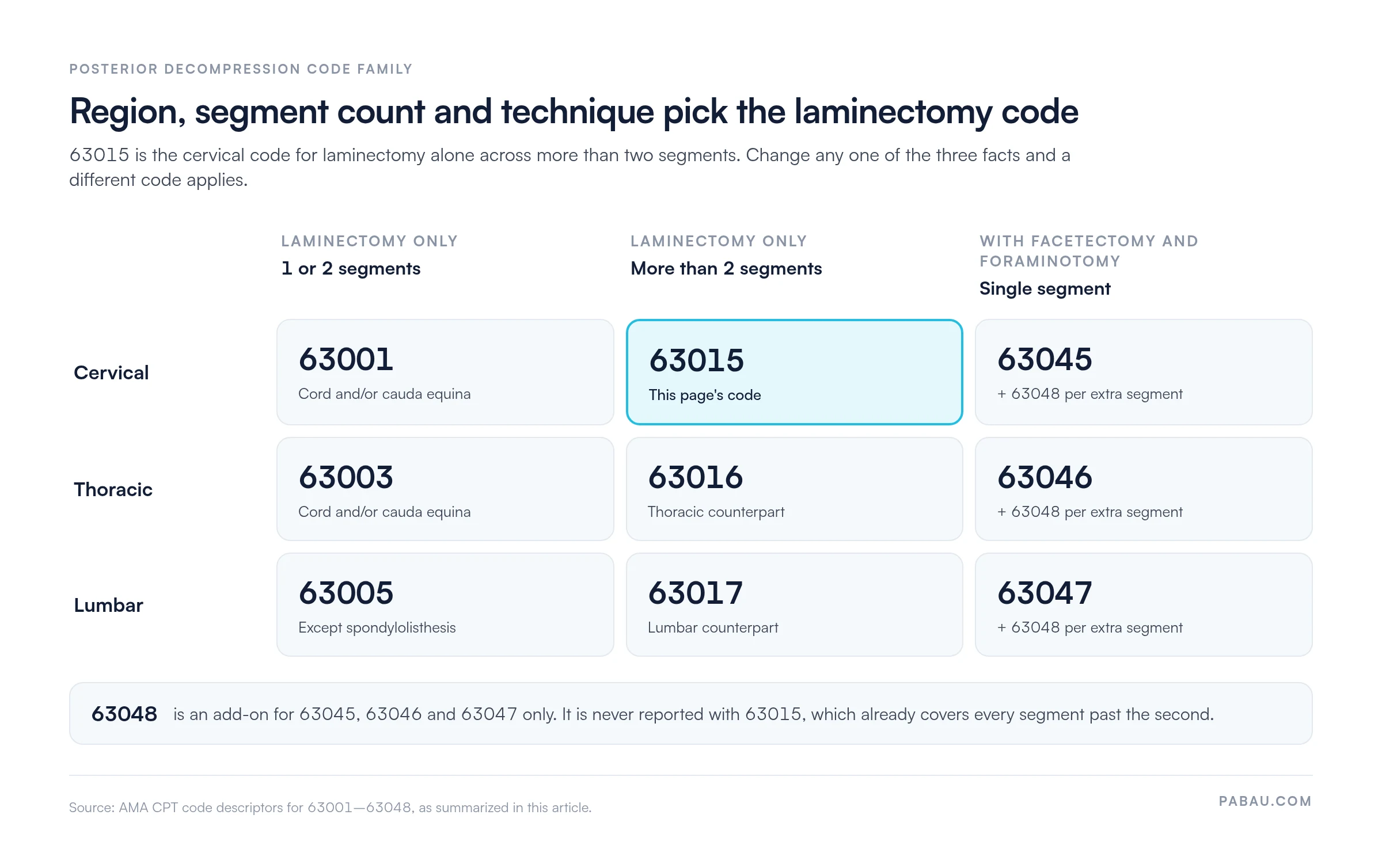
The difference between 63015 and the lumbar codes (63005, 63047) turns on region, segment count and whether facetectomy or foraminotomy was done. Multilevel thoracic and lumbar laminectomies report 63016 and 63017 instead.
Let Pabau's smart automation suggest the right codes, reduce claim denials, and keep your practice compliant—effortlessly.
Automate repetitive tasks and focus on what matters most—your patients.
Reduce coding errors and ensure compliance with the latest regulations.
Clean claims, fewer denials, and faster reimbursements.
Powerful insights and reporting to help your practice thrive.
HIPAA compliant SOC 2 certified GDPR-compliant Trusted by 4,000+ clinics worldwide

CPT code 63015 covers laminectomy without facetectomy, foraminotomy or discectomy across more than two cervical vertebral segments.
The operative report must name each level treated and state that the spinal cord and/or cauda equina was decompressed.
Thoracic and lumbar multilevel laminectomies report 63016 and 63017, and add-on 63048 is never reported with 63015.
Reporting 63015 and 63047 for the same session can trip an NCCI edit, so check the pair before the claim goes out.
In Pabau’s claims management software, prior authorization is tracked on the case, with a warning when an auth code is missing.
CPT code 63015 describes a cervical laminectomy with exploration and/or decompression of the spinal cord and/or cauda equina across more than two vertebral segments. It is a Category I code in the CPT code set, which the AMA’s CPT Editorial Panel maintains. The procedure excludes facetectomy, foraminotomy and discectomy, and spinal stenosis is its typical indication.
The key phrase is “more than 2 vertebral segments,” and the region matters just as much. A surgeon who removes the lamina at three or more cervical levels, with no facetectomy, reports 63015. A single lumbar level decompressed with facetectomy and foraminotomy reports 63047 instead. A lumbar laminectomy at one or two levels without facetectomy reports 63005.
The procedure removes the posterior arch of the vertebra (the lamina) at each involved level, often with partial or complete resection of the ligamentum flavum. It relieves pressure on the spinal cord and/or cauda equina, as the descriptor puts it. No facet joint removal (facetectomy), no foramen enlargement (foraminotomy), and no disc removal (discectomy) are included. If the surgeon performs any of those additional steps, different or additional codes apply.
These two codes sit in the same procedure family but differ on region, segment count and technique. 63015 is a cervical laminectomy alone across three or more segments. 63047 is a single lumbar segment decompressed with facetectomy and foraminotomy, so neither code can stand in for the other.
For three or more lumbar levels decompressed with facetectomy and foraminotomy, report 63047 for the first segment and 63048 for each additional one. A multilevel lumbar laminectomy without facetectomy reports 63017. Reporting 63015 and 63047 for the same date of service can also trip a National Correct Coding Initiative (NCCI) edit. Check the current procedure-to-procedure table before billing both.
The wider family follows the same logic. Laminectomy alone at one or two segments reports 63001 in the cervical spine, 63003 in the thoracic spine and 63005 in the lumbar spine. The matrix below places all nine codes by region, segment count and technique.
Several codes appear routinely on the same operative claim as 63015. Each has specific bundling rules under the NCCI Policy Manual.
Before appending instrumentation add-ons (22840, 22842), confirm the operative report documents implant placement. Payers audit these combinations. A note that says only ‘the spine was stabilized’, without the hardware type and segment count, invites a denial of the add-on.
Medical necessity for a multilevel laminectomy requires a diagnosis that explains why conservative treatment failed and why decompression of the spinal cord was necessary. Cervical spinal stenosis in the M48.0x range is the primary supporting diagnosis group.
Use the most specific character available, for example M48.02 for cervical stenosis, matched to the levels in the operative note. Thoracic stenosis (M48.04) and lumbar stenosis (M48.061 or M48.062) support 63016 and 63017 rather than 63015. Payers running LCD edits will reject claims where the diagnosis region does not match the operative site.
A clean claim for 63015 rests on five documentation pillars. Missing any one of them gives the payer grounds to deny on medical necessity or coding specificity. Submitting a clean claim for spine surgery means all five are present before the claim leaves the billing system.
Medicare fee-for-service does not require prior authorization for most spinal surgical procedures. Medicare Advantage plans run their own prior auth policies and frequently require precertification for laminectomy. Commercial payers and Medicare Advantage plans treat prior authorization for 63015 as a standard requirement in most markets. Good revenue cycle management practices build pre-auth confirmation into the surgical scheduling workflow, not the billing workflow.
What payers typically require before approving prior auth for a multilevel laminectomy:
Reimbursement for CPT code 63015 is calculated from its RVU components under the CMS Physician Fee Schedule. The table below shows the 2026 national values from the FastRVU 2026 lookup for 63015. Actual payment varies by Geographic Practice Cost Index (GPCI) locality, so cross-check the CMS PPRRVU2026 relative value file before quoting an amount. Pabau sends claims electronically through its Claim.MD integration, which reaches thousands of US payers with eligibility checks and ERA remittances.
RVU values are updated annually with each MPFS final rule. The 2026 conversion factor and locality-specific GPCI adjustments affect actual payment. Use the AAPC Codify CPT lookup alongside the CMS fee schedule tool to cross-reference status indicators and billing restrictions for 63015 and its add-ons.
Modifier selection for 63015 depends on the surgical team structure and whether additional procedures occurred on the same date. In claims software for surgeons such as Pabau, the biller sets each modifier on the 63015 claim line before submission.
The modifiers payers see most often on 63015 claims, and what each one does to payment, are listed below.
Good denial management workflows for 63015 start with knowing which denials recur. The table below maps the common denial triggers to their resolution. Each one fixed before submission saves a resubmission or appeal later.
Our denial code reference maps each of these denial categories to the CARC codes on your 835 remittance.
The laminectomy code family reaches well beyond the 63015 and 63047 pairing. Each adjacent code differs by region, number of levels, or type of decompression. The table below rules out six neighboring codes that coders mix up with 63015.
Run a three-point check before a 63015 claim goes out. First, confirm the operative report names three or more cervical levels. Second, make sure no 63047 or 63048 line sits on the same claim. Third, match the ICD-10-CM diagnosis region to the operative levels.
Spine billing teams often track 63015 authorizations, level counts and diagnosis codes across the surgeon’s notes, a payer portal and a spreadsheet. A missing auth code or a lumbar diagnosis on a cervical case then surfaces only when the denial arrives.
In Pabau, the authorization code, dates and sessions sit on the patient’s case, and the system warns when an auth code is missing. The claim goes out electronically as an 837P through the Claim.MD integration, with eligibility checks before surgery and ERA remittances afterward.
The billing team works from one record per case, so the level-count and diagnosis checks above happen before submission rather than during an appeal.

Pabau tracks prior authorization on each case and warns when an auth code is missing. It sends 63015 claims through Claim.MD to thousands of US payers.

CPT code 63015 pays cleanly when three facts line up. The surgery is a cervical laminectomy without facetectomy, the operative report names more than two levels, and the diagnosis matches those levels.
Settle the code at scheduling, while the authorization request is being built, rather than at the billing desk after surgery. A few extra minutes per case up front costs far less than a denial and appeal cycle later.
Pabau’s claims management tracks prior authorization on the case and warns when an auth code is missing. It then sends 63015 claims to thousands of US payers through Claim.MD. Book a demo to see how a spine practice can move from authorization to payment in one system.

Coding a single lumbar level with facetectomy? CPT code 63047 covers the descriptor, the 63048 add-on and the documentation payers expect.
Decompressing one or two lumbar levels without facetectomy? CPT code 63005 explains when the lumbar laminectomy code applies and when spondylolisthesis rules it out.
Confused about what makes a claim clean? What makes a clean claim walks through the documentation and coding checklist that gets claims paid on first submission.
Want to understand how denials are categorized? Denial codes in medical billing maps CARC and RARC codes to their resolution actions for spine and surgical claims.
CPT code 63015 covers laminectomy with decompression of the spinal cord and/or cauda equina across more than two vertebral segments. It excludes facetectomy, foraminotomy and discectomy, and it applies to the cervical spine only. Thoracic cases report 63016, and lumbar cases report 63017.
CPT 63015 is a cervical laminectomy across more than two segments, with no facetectomy or foraminotomy. CPT 63047 is a single lumbar segment decompressed with facetectomy and foraminotomy. Extra lumbar segments add 63048 to 63047, while a multilevel lumbar laminectomy without facetectomy reports 63017.
CPT code 63015 carries a 90-day global surgery period under Medicare. Routine postoperative visits within 90 days of the procedure date are included in the surgical fee and cannot be billed separately. Visits for unrelated conditions during the global period require modifier 24 on the E&M code to bypass the global package. Verify the global period in the current MPFS data file from CMS before billing.
The work RVU for CPT 63015 is about 20.33 under the 2026 Medicare Physician Fee Schedule. Total RVUs come to about 43.25 once practice expense (15.08) and malpractice (7.84) RVUs are added. Multiply the total by the 2026 conversion factor of $33.4009 and the local GPCI to get the payment.
Usually not. Reporting 63015 and 63047 for the same date of service can trigger an NCCI edit, so check the current procedure-to-procedure table first. 63048 is never reported with 63015. For more than two cervical levels without facetectomy, 63015 alone covers every level.
The most common pairings are cervical stenosis codes: M48.02 for the cervical region and M48.03 for the cervicothoracic region. Cervical spondylosis with myelopathy (M47.12) or radiculopathy (M47.22), cervical spondylolisthesis (M43.12) and G99.2 myelopathy are also reported. Thoracic stenosis (M48.04) supports 63016 rather than 63015.