HCPCS code A4714: Treated water for peritoneal dialysis billing guide
HCPCS code A4714: Official descriptor, code type, and payment status HCPCS code ...

Last Updated: Oct 15, 2026

CPT code 72156 reports a cervical spine MRI performed without contrast, then repeated with contrast and further sequences in the same session.
It is not the contrast-only cervical code. That code is 72142. The without-contrast-only code is 72141.
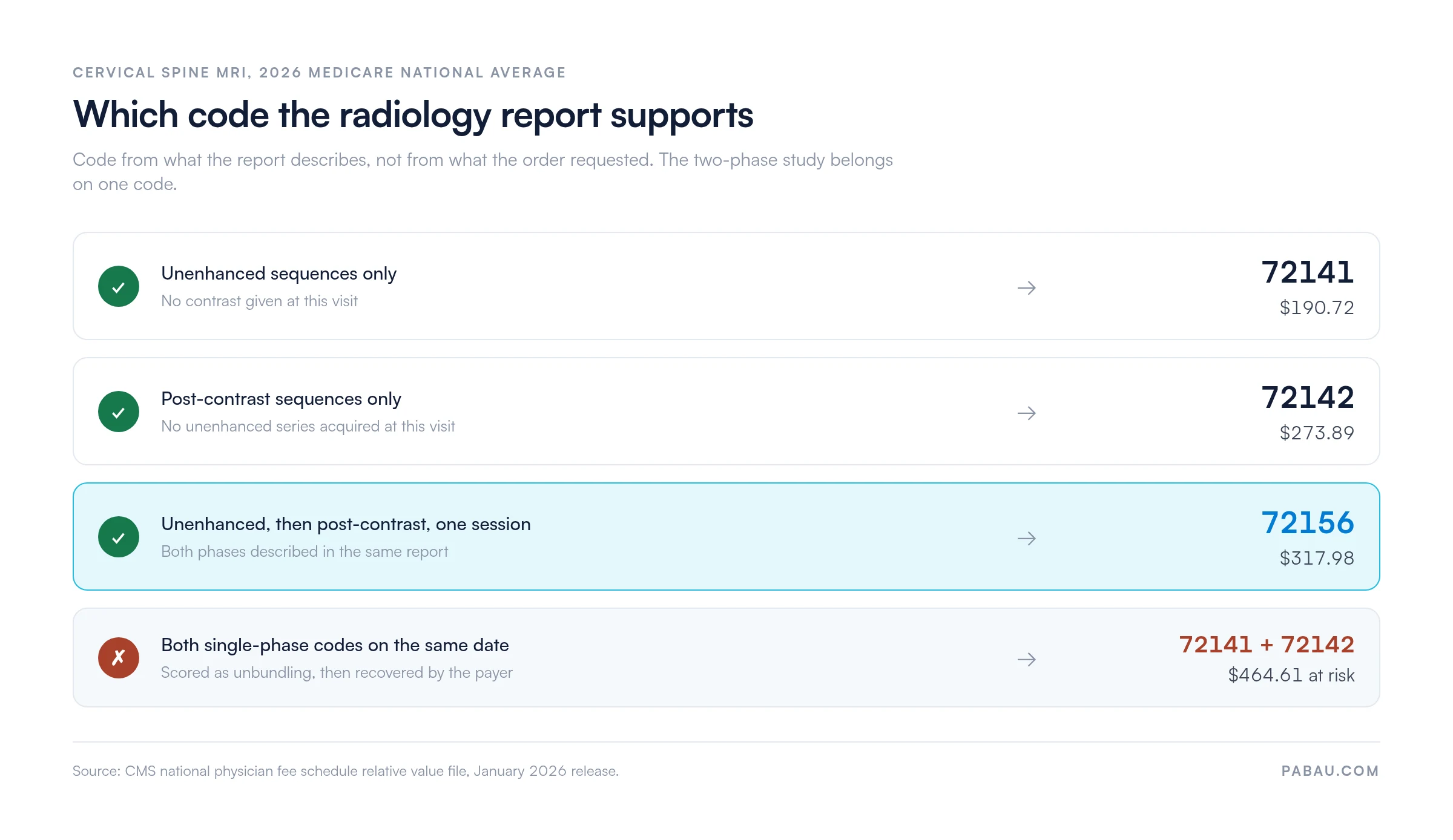
Medicare values 72156 at 9.52 total RVUs in 2026, about $317.98 nationally, and the total is identical in facility and non-facility settings.
Billing 72141 plus 72142 for one two-phase exam would pay $464.61, but payers treat that split as incorrect coding rather than a billing choice.
Pabau’s claims management software submits 837P claims through Claim.MD and returns ERA denial codes in the same workflow.
CPT code 72156 reports magnetic resonance imaging of the cervical spinal canal and contents.
The study is performed without contrast material, then repeated with contrast material and further sequences. One code covers both phases when they happen in the same session. It is not the contrast-only cervical code, which is 72142, and it is not the without-contrast code, which is 72141.
That distinction is where most of the money and most of the denials sit. Reporting the two single-phase codes separately for one two-phase exam appears to pay more, and payers score it as unbundling. This reference covers the official AMA descriptor, 2026 Medicare rates and RVUs, and the applicable modifiers. It also covers ICD-10 pairings, documentation standards, and the denial patterns billing teams see most.
The American Medical Association publishes the official descriptor. It reads: Magnetic resonance (eg, proton) imaging, spinal canal and contents, without contrast material, followed by contrast material(s) and further sequences; cervical.
The code sits in the Radiology chapter of the CPT code set, under the magnetic resonance subsection for the spine and pelvis. It shares a parent descriptor with 72157 (thoracic) and 72158 (lumbar). All three describe the same two-phase protocol, applied to a different region of the spine.
In practice, the scanner acquires a pre-contrast series of the cervical spine first. Gadolinium-based contrast is then injected, and a further set of sequences is acquired after it circulates. Both phases belong to one examination, so one code reports the whole study.
Enhancement can only be identified by comparison, because blood products, fat, and proteinaceous fluid are already bright on unenhanced T1 images. Without the baseline, the radiologist cannot say whether a bright lesion took up contrast or was bright to begin with.
The combined protocol is ordered when the clinical question needs both a baseline and an enhancement pattern to answer it. A single-phase study cannot separate enhancing tissue from tissue that was already bright. The American College of Radiology appropriateness criteria and each MAC’s local coverage determination set out the scenarios payers accept.
Commonly accepted indications appear below. Code selection must follow the documented findings in the chart, and the list does not guarantee coverage for any specific diagnosis.
Two scenarios fall outside 72156. If no contrast is given at all, report 72141. If a recent unenhanced study already exists and only post-contrast sequences are acquired at this visit, report 72142. The report has to support whichever version was actually performed.
Prior authorization rules differ by payer and plan year. Confirm the requirement for each payer before the exam is scheduled.
The figures below come from the January 2026 release of the CMS national physician fee schedule relative value file. They use the 2026 conversion factor of $33.4009 for clinicians who are not qualifying APM participants. Verify your own locality with the CMS Physician Fee Schedule lookup tool before you use any of it for revenue projections.
Two details are worth pulling out of that table. The professional component is a third of the global value, so the interpretation is the smaller half of the money by a wide margin. And the facility total for 72156 is also 9.52 RVUs, which means place of service alone does not move the payment on this code. The modifier does.
Clinicians who are qualifying APM participants are paid on a separate 2026 conversion factor of $33.5675, which puts the global rate at $319.56. High-GPCI localities such as the San Francisco Bay Area or Manhattan typically sit well above either national figure. Commercial payers often set rates as a percentage of Medicare, commonly 100% to 150%, though every contract differs.
Run the arithmetic on the same fee schedule and the incentive to split becomes obvious. It is also the reason the combined code exists.
The split pays $146.63 more per study on paper. CPT instructs that both phases of one session are reported with the single combined code. Splitting them is a correct-coding error rather than a billing option. Payers apply bundling edits to recover it, and a pattern of split claims is the kind of finding that opens an overpayment review.
Audit a quarter of cervical MRI claims against the radiology reports. Any report that describes pre-contrast sequences and post-contrast sequences in one session belongs on 72156. Two component codes on that date are worth correcting before a payer does it for you. So is a lone 72142 where the report also documents an unenhanced series.
Modifier selection depends on who owns the scanner, who reads the images, and where the exam took place. Incorrect modifiers are a leading cause of radiology claim reversals and overpayment audits. Check each one against the individual payer policy before submission.
Splitting 26 and TC: a hospital outpatient department may own the scanner while an independent radiology group reads the images. The department then bills 72156-TC and the group bills 72156-26. Billing the global code from either side in that arrangement is upcoding. The two components together should equal the global allowable, which is $105.55 plus $212.43 at the 2026 national average.
Clean claims on this code come down to authorization, place of service, correct code selection, and a report that documents both phases. Each one fails in a different way, and each is cheaper to catch before submission than to appeal afterward.
Traditional Medicare Part B generally does not require prior authorization for outpatient MRI, and enforces coverage at claim review through the applicable LCD instead. Medicare Advantage and most commercial plans do require it, often through a radiology benefit manager such as eviCore or Carelon.
Authorize the combined study, not one phase of it. An approval issued for 72141 does not cover a two-phase exam, and the mismatch surfaces after the scan when the claim goes out as 72156. Checking benefits at scheduling captures the plan’s limits and its authorization rules in one step.
The place of service code must match where the MRI was physically performed. POS 22 applies to a hospital outpatient department, POS 19 to an off-campus outpatient department, and POS 11 to an office or freestanding imaging center. A POS that contradicts the billing modifier is a standard audit flag, even though the two settings carry the same total RVUs here.
Pick the code from what the radiology report describes, not from what the order requested. Orders change at the scanner when contrast is added or withheld, and the claim has to follow the report.
The chart below sets the three cervical codes against what each one pays, and against the exposure that comes with splitting them.
Do not append modifier 59 to force 72141 and 72142 through on the same date for one exam. That is the unbundling pattern payers look for. Build the charge slip with the single combined code so nobody re-adds the second line during data entry.
Documentation is the most reliable denial-prevention tool on this code, because 72156 has to prove two phases rather than one. Confirm the chart carries each of the following before the claim goes out.
Diagnosis coding must follow the documented findings. The codes below are diagnoses commonly paired with a combined cervical spine MRI, not a prescriptive list. Verify medical necessity pairings against your MAC’s active LCD, using the CrossCoder crosswalk or the CDC ICD-10-CM tool.
The remittance advice flags medical necessity mismatches through CARC 50. On this code the denial usually traces back to a diagnosis that supports imaging but not the contrast phase, such as uncomplicated radiculopathy.
Denials on this code cluster into five patterns. Handling them before submission costs far less staff time than appealing them afterward.
The denial codes reference carries the full CARC and RARC crosswalk with appeal language. Sending a complete 837P file on the first pass is the surest way to avoid CARC 5 and CARC 197. Both come from administrative omissions rather than clinical disagreement.
The spinal MRI codes run on a grid. One axis is the region, and the other is the contrast protocol. Each region has a without-contrast code, a with-contrast-only code, and a combined code for the two-phase study. Confirm the current descriptor with the AAPC Codify CPT lookup before you bill.
Figures are 2026 Medicare national averages for the global service, from the CMS relative value file. Note the pattern in the third column. The combined codes are priced almost identically across all three regions, because the protocol is the same and only the anatomy changes.
Choosing between 72141, 72142, and 72156: start from the report. Unenhanced only points to 72141, post-contrast only points to 72142, and a documented pre-contrast series followed by post-contrast sequences points to 72156. Ordering contrast without a supporting indication exposes the practice to medical necessity denials and, in an audit, to recovery of the difference.
Put the three cervical codes on your scrubbing rules as a set. A claim carrying 72141 and 72142 for the same date should be stopped and rebilled as 72156. A lone 72142 should be checked against the report for an unenhanced series. Two rules cover the majority of the correct-coding exposure on cervical MRI.
Radiology billing teams working this code hit the same loop every week. Authorization is not confirmed at scheduling, and the modifier goes on without a POS check. The code then gets picked from the order rather than from the report.
Each miss costs 15 to 30 minutes of rework, and the payment slips another remittance cycle. Closing those three points at the source is cheaper than reworking the claim after a denial.
Pabau, our practice management software, includes claims software for radiology that connects to Claim.MD, our US clearinghouse partner. It transmits 837P claims to thousands of payers and pulls 835 remittance files back automatically. Billing staff read denial reason codes beside the original claim without switching systems.
The superbill export carries the CPT, ICD-10, modifier, and place of service fields, already populated from the appointment record. The combined code does not get split or downgraded during data entry. Authorization status sits on the appointment too, which means an unapproved two-phase study is visible before the patient is on the table.
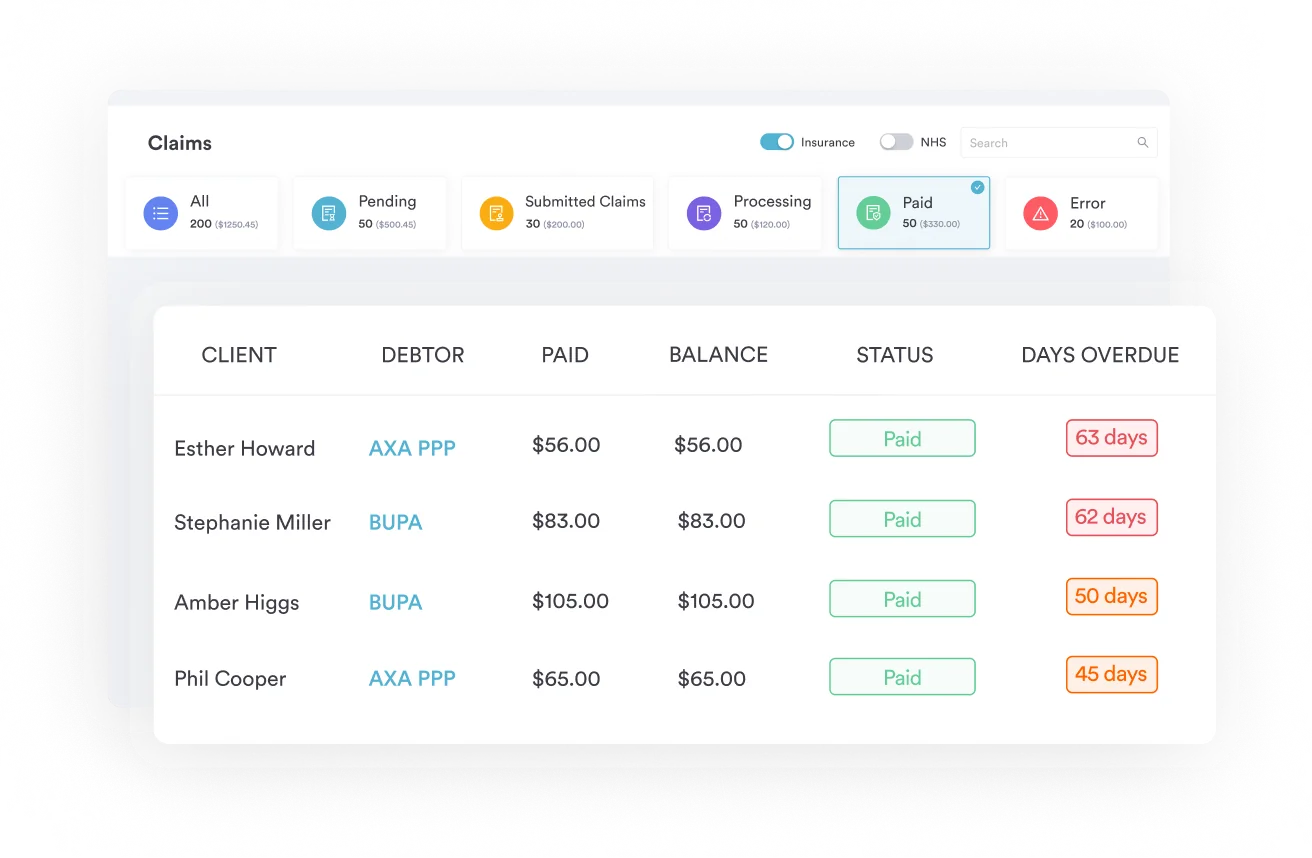
Imaging practices running high volumes of contrast studies gain the most here. Pre-submission scrubbing and automated remittance matching remove most of the manual overhead on two-phase codes.

Pabau connects to Claim.MD to submit 837P claims, pull ERA responses back automatically, and surface denial reason codes before they pile up. See how it fits your radiology billing workflow.

CPT code 72156 is the cervical spine MRI performed without contrast and then repeated with contrast in the same session. Treating it as the contrast-only code causes most of the trouble on this family. That mistake points teams toward 72142, or toward a two-line split that payers unwind. Code from the report, authorize the combined study, and match the modifier to the ownership model.
Pabau handles 837P submission, remittance retrieval, and denial code tracking through the Claim.MD integration, so billing teams work exceptions instead of routine claims. Book a demo to see how it fits your imaging practice.

Need a reference for managing claim denials across code types? Denial codes in medical billing covers CARC and RARC crosswalks with appeal template guidance.
Billing the single-phase cervical study instead? CPT code 72141 covers the without-contrast cervical spine MRI, its rates, and its documentation standards.
Submitting claims electronically and unsure how the file works? Electronic 837 claim file explains the 837P transaction set and what each segment means for professional claims.
Want to understand how payers post payments back to your system? Electronic remittance advice breaks down ERA file structure, CARC codes, and reconciliation workflows.
CPT code 72156 covers an MRI of the cervical spinal canal and contents performed without contrast material, then repeated with contrast material and further sequences. Both phases belong to one session and are reported with this single code. It does not describe a contrast-only study.
No. The contrast-only cervical spine MRI code is 72142. CPT 72156 describes the combined study, where an unenhanced series is acquired first and post-contrast sequences follow in the same session. Report 72141 when no contrast is given at all.
CMS values 72156 at 9.52 total RVUs for 2026, which is about $317.98 at the national conversion factor of $33.4009. The professional component with modifier 26 is roughly $105.55 and the technical component is roughly $212.43. Verify your locality rate through the CMS fee schedule tool.
No. Reporting both single-phase codes for one two-phase session is unbundling, and payers apply edits to recover it. The split would pay about $464.61 against $317.98 for 72156, which is exactly why the edits exist. Report the combined code alone.
Modifier 26 reports the radiologist interpretation and modifier TC reports the equipment and technologist. No modifier is used when one entity owns the scanner and reads the study. Modifier 59 or XU applies only to a genuinely separate spinal MRI, never to split the two phases of 72156.
All three describe the same without-then-with-contrast protocol in different regions. CPT 72156 is cervical, 72157 is thoracic, and 72158 is lumbar. Their 2026 national averages sit within a dollar of each other, because only the anatomy changes.
Commonly paired codes include C41.2 and C79.51 for neoplasm, and M46.32 for cervical discitis. G35, M96.1, and M50.00 cover multiple sclerosis, postlaminectomy syndrome, and cervical disc disorder with myelopathy. Selection must follow the documented findings rather than this list.