

HCPCS Code Q4185: Cellesta flowable amnion billing guide
HCPCS Code Q4185: definition and official descriptor HCPCS Code Q4185 is the Lev...

Last Updated: Nov 20, 2026
22855 is the CPT code for removal of anterior instrumentation. It covers taking out spinal fixation hardware, such as plates, rods and screws, that was placed through an anterior approach.
Payers can deny or downcode a claim when the operative note does not state that the hardware was removed through an anterior approach.
Let Pabau's smart automation suggest the right codes, reduce claim denials, and keep your practice compliant—effortlessly.
Automate repetitive tasks and focus on what matters most—your patients.
Reduce coding errors and ensure compliance with the latest regulations.
Clean claims, fewer denials, and faster reimbursements.
Powerful insights and reporting to help your practice thrive.
HIPAA compliant SOC 2 certified GDPR-compliant Trusted by 4,000+ clinics worldwide

CPT Code 22855 applies only to removal of anterior instrumentation, while posterior hardware removal is reported with 22850 or 22852.
22855 is a standalone code with a 90-day global period, so a removal inside the original fusion’s global window needs modifier -58, -78 or -79.
A frequent denial trigger is an operative note that documents hardware removal without explicitly confirming the anterior surgical approach.
Pabau, the practice management platform we build, submits 837P claims and runs eligibility checks through Claim.MD.
CPT Code 22855 is the procedure code for removal of anterior instrumentation used for spinal stabilization. AAPC’s code summary describes it as removing previously implanted spinal instrumentation from the anterior, or front, portion of the spine. The official AMA CPT descriptor reads: “Removal of anterior instrumentation.” It covers anterior cervical plates, anterior thoracic rods and screws, and anterior lumbar fixation systems.
Surgeons remove this hardware for several documented clinical reasons. Typical indications are hardware failure, infection at the implant site, adjacent segment disease, implant migration causing pain or neurological symptoms, and planned revision surgery. For billing, 22855 covers the removal itself, not any reimplantation or new fusion performed in the same session.
Two criteria define the scope of CPT Code 22855. The approach must be anterior, and the hardware must be rods, screws, plates, or other anterior fixation devices. Both must be present to report this code.
Reporting 22855 when only an interbody cage is removed is a coding error. An interbody cage removed without anterior plate or screw fixation is not reported with 22855. Verify the correct code in the current AMA CPT book. If the removed hardware includes both an anterior plate and an interbody device, 22855 is the correct code for the instrumentation removal component.
Coders do not need every surgical nuance. They do need enough anatomical context to map operative report language to CPT Code 22855 rather than a related code.
The surgeon accesses the spine from the front of the body. For cervical cases, this means a standard anterior cervical approach with retraction of the esophagus and trachea. For lumbar cases, the approach is typically retroperitoneal. Once the hardware is exposed, screws are removed with the appropriate driver and plates are detached from the vertebral body. The wound is then irrigated and closed in layers.
The phrase “anterior instrumentation” must appear in the operative report. Notes that say only “hardware removal” or “implant removal” give payers grounds for downcoding to a non-specific code. They can also lead to denial for insufficient documentation.
Payers require specific elements in the operative note and supporting records to process a CPT Code 22855 claim. Missing any of these is the most direct path to denial. The goal is submitting a clean claim the first time. Build the checklist below into the pre-submission workflow rather than chasing it after a denial.
The 22850-22855 family mixes removal and insertion codes, which is why it trips up experienced spine coders. Posterior hardware removal is reported with 22850 or 22852, and anterior removal with 22855. The guide below pairs that code choice with the modifier question that follows it.
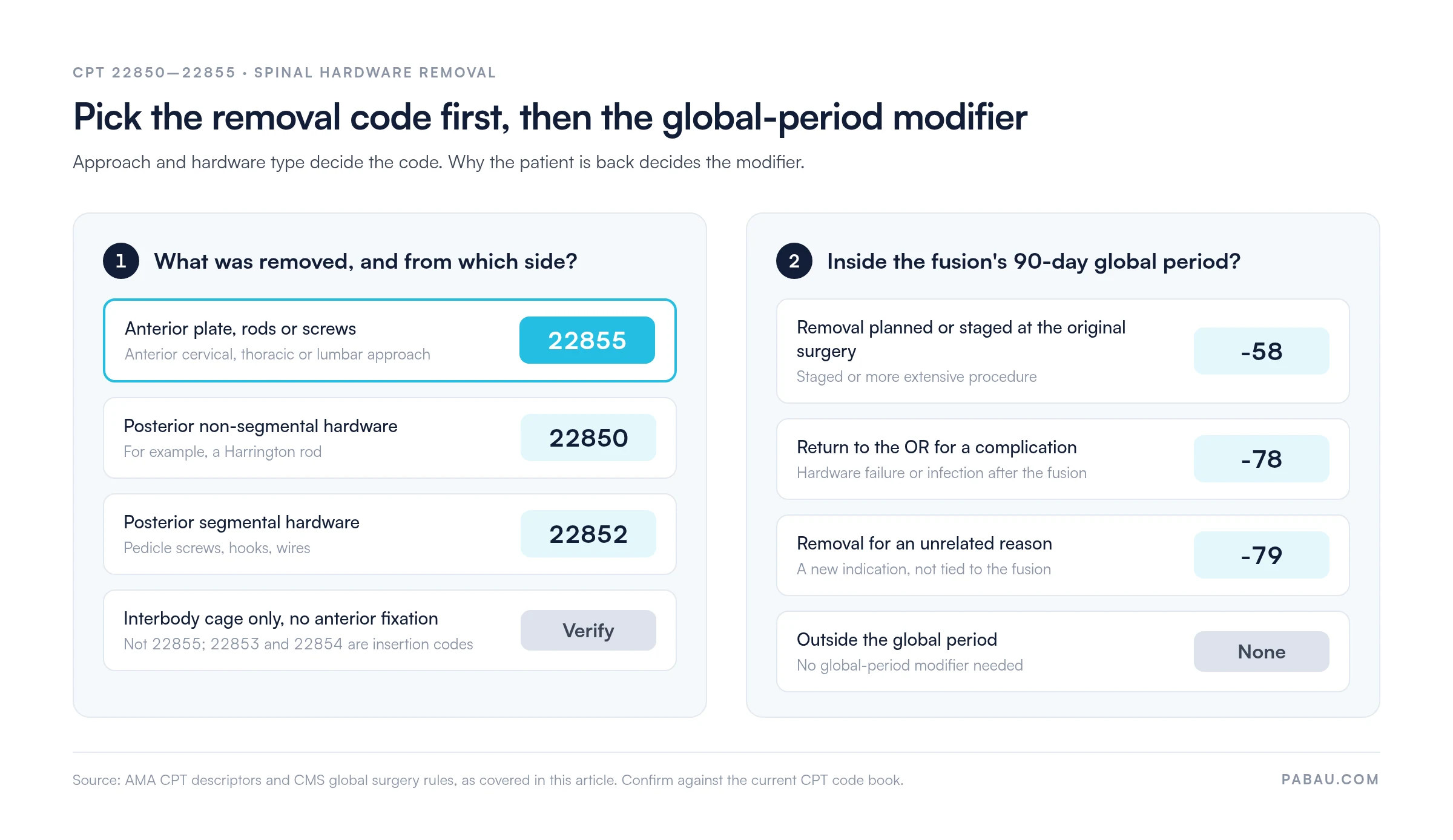
Two codes inside the range are not removal codes at all. 22853 and 22854 are add-on codes for inserting an interbody or intervertebral device during arthrodesis. Reporting either one for a removal triggers CCI edit denials or downcoding.
CPT Code 22855 is sometimes performed on the same date as an anterior cervical discectomy and fusion (ACDF) or another primary spinal procedure. Separate reporting then depends on whether a CCI edit pairs the two codes. If a CCI edit exists for the code pair, modifier -59 (distinct procedural service) may be required to report the removal separately. That applies only when the removal is clinically distinct and separately documented.
Modifier -51 (multiple procedures) applies when 22855 is a secondary procedure on the same date as a primary spine code. It is used only when no bundling edit exists. Always verify the current CCI edit table for the specific code pair before applying modifiers, because CCI edits update quarterly.
Before billing 22855 with any primary fusion code on the same date, run the specific code pair through the current CMS CCI edit table. CCI edits update quarterly, so a pairing that required modifier -59 last year may have a different edit status today. Flag all same-day spinal procedure combinations for pre-submission review.
Modifier selection for CPT Code 22855 depends on the clinical scenario. A wrong modifier is a frequent denial trigger, and using -59 to bypass a valid CCI edit is a known audit flag.
Medicare payment rates for CPT Code 22855 come from the annual CMS Physician Fee Schedule. Rates differ between facility settings (hospital outpatient, ambulatory surgical center) and non-facility settings (office). Anterior instrumentation removal is almost always performed in a facility setting. Use the FastRVU lookup tool to retrieve the current year’s figures, since the MPFS updates annually and static published rates go out of date.
Within the 90-day global period of 22855, payers bundle the same surgeon’s E/M visits and minor procedures into the global payment. A visit or procedure for a separate condition is the exception, billed with modifier -24 or -79 as applicable. Pabau’s claims tools submit 837P claims and run eligibility checks through Claim.MD for Medicare and commercial payers.
Denials for CPT Code 22855 cluster around a small number of fixable errors. The table below maps common denial patterns for spinal instrumentation removal codes to their root cause and the specific fix. For broader context, see denial management workflows and denial codes in medical billing.
A medical claims clearinghouse checks each claim for format and payer errors before electronic transmission. It cannot confirm that the operative note supports 22855, so that check stays with the coder.
Build a five-point 22855 checklist into your spine billing workflow. Confirm the anterior approach in the operative note and match the ICD-10 code to the documented indication. Check CCI edits for every same-day spine code, confirm prior auth for commercial payers, and check the original fusion’s global period. Running this five-point check before each submission catches most of the denial triggers in the table above.
The ICD-10 diagnosis code on a 22855 claim must reflect the specific clinical reason the hardware was removed. Coders should select the most specific subcategory available within the applicable category, confirmed against the operative report and physician documentation.
The 7th character on T84 codes indicates encounter type: A (initial encounter), D (subsequent encounter), S (sequela). Use A while the patient receives active treatment for the complication, and the removal surgery itself counts as active treatment. Use D for routine aftercare once that treatment is complete, and S for a later condition that results from the complication.
Spine practices often track a hardware removal claim across an EHR, a payer portal and a spreadsheet of global period dates. Each handoff is a chance for the anterior approach, the authorization number or the modifier to drop off the claim.
Pabau keeps the operative note, the prior authorization and the claim on one patient record. Authorization codes, dates and sessions are tracked on the patient’s case, with a warning when one is missing. A missing approval shows up before the 22855 claim does.
From there, Pabau’s claims management software submits 837P claims and runs eligibility checks through Claim.MD, and ERA remittances come back to the same record. Your coders review the 22855 documentation once, in the system that sends the claim.

Pabau keeps operative notes, prior authorizations and claims together, then submits 837P claims and runs eligibility checks through Claim.MD. See how it fits your spine surgery practice.

CPT Code 22855 has three boundaries: an anterior approach, anterior hardware, and removal only. Before a claim goes out, test the operative note against all three, then check whether the date of service falls inside the fusion’s global period.
If it does, the reason for the return decides the modifier. A planned stage takes -58, a complication takes -78, and an unrelated problem takes -79. Settling that before submission costs far less time than appealing a denial afterward.
Book a demo to see how Pabau keeps operative notes, authorizations and claims together for spinal hardware removal billing.

Need a clearinghouse that handles spine surgery claims? Claim.MD clearinghouse overview explains how a clearinghouse routes 837P claims and eligibility checks between a practice and its payers.
Want to reduce first-pass denial rates across all procedure codes? Denial management in healthcare covers systematic workflows for catching errors before claims leave the practice.
Looking for clean claim submission best practices? Clean claim guidelines outlines the documentation and coding standards that drive first-pass acceptance rates.
Removing posterior hardware instead? CPT code 22852 covers removal of posterior segmental instrumentation such as pedicle screws, hooks and wires.
Coding the spondylolisthesis behind a revision? ICD-10 code M43.16 explains the lumbar spondylolisthesis code that can support medical necessity.
CPT Code 22855 is the procedure code for removal of anterior instrumentation from the spine. It covers the surgical extraction of rods, screws, plates, or other fixation hardware originally inserted through an anterior (front) approach. It is a standalone code, not an add-on, and carries a 90-day global surgery period.
CPT Code 22855 covers removal of anterior plates, anterior rods and screws, and anterior cervical fixation hardware at any spinal level. It excludes posterior hardware removal, which is reported with 22850 or 22852. An interbody cage removed without anterior fixation is not reported with 22855, so verify that code in the AMA CPT book. Reimplantation or a new fusion at the same session is reported separately.
Inside the original fusion’s global period, use -58 for a staged or planned removal. Use -78 for a return to the OR for a complication such as hardware failure or infection, and -79 for an unrelated removal. Outside the global period, -59 applies when a CCI edit pairs 22855 with a same-day fusion code but the removal is distinct. Modifier -51 applies when no CCI edit exists, and -22 when removal is significantly harder than typical.
CPT Code 22855 covers anterior instrumentation removal, while 22852 covers posterior segmental instrumentation removal (pedicle screws, hooks, wires). 22853 is an add-on code for insertion, not removal, of an interbody biomechanical device. The key distinctions are surgical approach (anterior vs. posterior) and service type (removal vs. insertion).
Medicare payment rates for CPT Code 22855 are updated annually through the CMS Physician Fee Schedule. Because the conversion factor and RVU values change each year, verify the current rate in the CMS MPFS lookup tool or the FastRVU calculator. The facility rate is lower than the non-facility rate, though anterior instrumentation removal is almost always performed in a facility setting.
Yes, but only after checking the CCI edit table for each specific code pair. If a CCI edit exists, modifier -59 may allow separate billing when the removal is clinically distinct and separately documented. If no CCI edit exists, modifier -51 applies. Billing 22855 during the 90-day global period of the original fusion without modifier -58, -78 or -79 will result in denial.





