HCPCS Code G0163: Skilled nursing observation and assessment
What is HCPCS Code G0163? HCPCS Code G0163 is a deleted Level II code for skille...

Last Updated: Oct 15, 2026
B4168 is the HCPCS Level II code for parenteral nutrition solution; amino acid, 3.5%, (500 ml = 1 unit) - home mix.
It covers the protein component only, so dextrose, lipids and additives each bill on their own line. Medicare pays for home parenteral nutrition under the Part B prosthetic device benefit, with coverage criteria set by the Parenteral Nutrition LCD L38953. CMNs ended on January 1, 2023, so a Standard Written Order and the clinical record now carry medical necessity.
Let Pabau's smart automation suggest the right codes, reduce claim denials, and keep your practice compliant—effortlessly.
Automate repetitive tasks and focus on what matters most—your patients.
Reduce coding errors and ensure compliance with the latest regulations.
Clean claims, fewer denials, and faster reimbursements.
Powerful insights and reporting to help your practice thrive.
HIPAA compliant SOC 2 certified GDPR-compliant Trusted by 4,000+ clinics worldwide

HCPCS Code B4168 is the amino acid component of a home-mix parenteral nutrition solution, at 3.5%, billed per 500 ml unit.
B4168 is a parenteral code. The enteral formula codes B4149 to B4162 bill per 100 calories and never stand in for it.
Medicare covers it under the Part B prosthetic device benefit, and the Parenteral Nutrition LCD L38953 sets the coverage criteria.
One unit carries 17.5 grams of protein, and a solution under 10 grams of protein a day is coded B9999 instead.
CMS retired the CMN and DIF (CMS Form 10126) from January 1, 2023, so a Standard Written Order and clinical records carry medical necessity.
Claims management software like Pabau keeps the order, clinical records and DME MAC submissions in one place, which helps cut parenteral nutrition denials.
HCPCS Code B4168 describes the amino acid component of a home-mix parenteral nutrition solution, at a concentration of 3.5%.
The official CMS long descriptor reads “Parenteral nutrition solution; amino acid, 3.5%, (500 ml = 1 unit) – home mix”. One unit is 500 ml of solution. The code belongs to the B-series of HCPCS Level II, which covers enteral and parenteral nutrition therapy.
B4168 is infused into a vein. It carries protein alone, so dextrose, lipids and additives each take their own claim line. The descriptor has not changed since the code entered the HCPCS on January 1, 1984. The January 2026 Alpha-Numeric HCPCS file still shows no termination date.
Values above come from the CMS January 2026 Alpha-Numeric HCPCS file and the DME MAC parenteral nutrition policy. Check the descriptor in the current file each year before billing a new formulation.
B4168 covers the protein component of a home-mix parenteral nutrition regimen for patients whose gastrointestinal tract cannot absorb adequate nutrition. Coverage applies in the home setting under the prosthetic device benefit. The record must show a documented need for total or partial parenteral nutrition.
Included under B4168:
Explicitly excluded:
The costliest mix-up on this code is route. B4168 goes into a vein, while B4149 through B4162 describe formula delivered into the gut. Those enteral codes bill per 100 calories rather than per 500 ml. A route error therefore corrupts the unit count as well as the code.
Coverage criteria for every home parenteral nutrition code sit in LCD L38953. Four conditions have to be documented before a B4168 claim is reasonable and necessary.
The LCD also sets nutrient ranges that the order has to sit inside, or the practitioner has to justify. Total caloric intake runs 20 to 35 cal/kg/day. Protein orders run 0.8 to 2.0 gm/kg/day across B4168, B4172, B4176 and B4178.
Diagnosis codes must reflect the documented condition. The list below shows clinically appropriate codes rather than a shortcut to code selection independent of the record.
Verify covered diagnosis codes against your jurisdiction’s current LCD before submitting. Each of the four DME MAC jurisdictions may publish a slightly different covered-diagnosis list.
B4168 claims follow the Medicare Part B pathway through the DME MAC. First-pass payment depends on finishing each step below before the claim is generated.
One unit of B4168 is 500 ml of 3.5% amino acid solution. At 3.5 grams of protein per 100 ml, that unit delivers 17.5 grams of protein. Hold on to that figure, because it governs both the unit count and the code choice.
Worked example: a 70 kg patient is ordered 1.0 gm/kg/day of protein, which sits inside the LCD’s 0.8 to 2.0 range. That is 70 grams a day, or four units of B4168. Four units is 2,000 ml of solution a day, so a 30-day month bills 120 units.
B4168 is the most dilute code on the amino acid ladder, and the volume in that example shows why it matters. The same 70 grams of protein from a 7% solution takes half the fluid and bills under B4176. The order sets the concentration, and the concentration sets the code.
Two rules decide what happens at the edges of the range:
Common unit calculation errors:
Every B4168 line needs one of four modifiers. Policy article A58836 states that a claim line billed without KX, GA, GY or GZ is rejected as missing information.
KX attests that the documentation is on file, not that the claim will be paid. Appending it when the record is incomplete is a compliance exposure, so confirm the supporting records exist before the modifier goes on the line.
Original Medicare requires no prior authorization for B4168. The CMS Required Prior Authorization List for DMEPOS covers items such as power mobility devices, lower-limb prostheses and certain orthoses. No B-series nutrition code appears on it.
Medical necessity no longer runs through a Certificate of Medical Necessity. CMS eliminated CMNs and DME Information Forms for dates of service on or after January 1, 2023, and CMS Form 10126 was the parenteral DIF. Claims that still arrive with one attached are rejected and returned to the supplier.
The Standard Written Order and the clinical record carry the case instead. Between them they have to show the diagnosis, the permanent gastrointestinal impairment, a nutritional assessment and the expected duration of therapy. Policy article A58836 sets out those requirements, alongside the general rules in Standard Documentation Requirements article A55426.
Other payers do often require PA for home parenteral nutrition. That includes Medicare Advantage plans, state Medicaid programs, and commercial payers such as Blue Cross Blue Shield, Cigna and Aetna. Check each plan’s coverage policy before therapy starts, rather than after the first infusion.
Thin documentation is the leading cause of B4168 denials. Assemble the package before the first claim goes out, because reconstructing it after a denial rarely rescues the payment. The table below covers each record a DME MAC can ask to see.
Refill timing carries its own rules. Contact about a refill can happen no sooner than 30 calendar days before the current supply runs out. Delivery follows no sooner than 10 days before that point. No more than one month’s supply may be dispensed at a time.
Home-mix parenteral codes describe components, not whole solutions. B4168 is the protein line, and three sibling codes cover the stronger amino acid concentrations. Dextrose, lipids and additives bill separately again.
One quirk of the ladder catches compounding pharmacies out. B4168 names a single concentration, 3.5%, and the next code up starts at 5.5%. No B-series code describes a home-mix amino acid solution between those two figures.
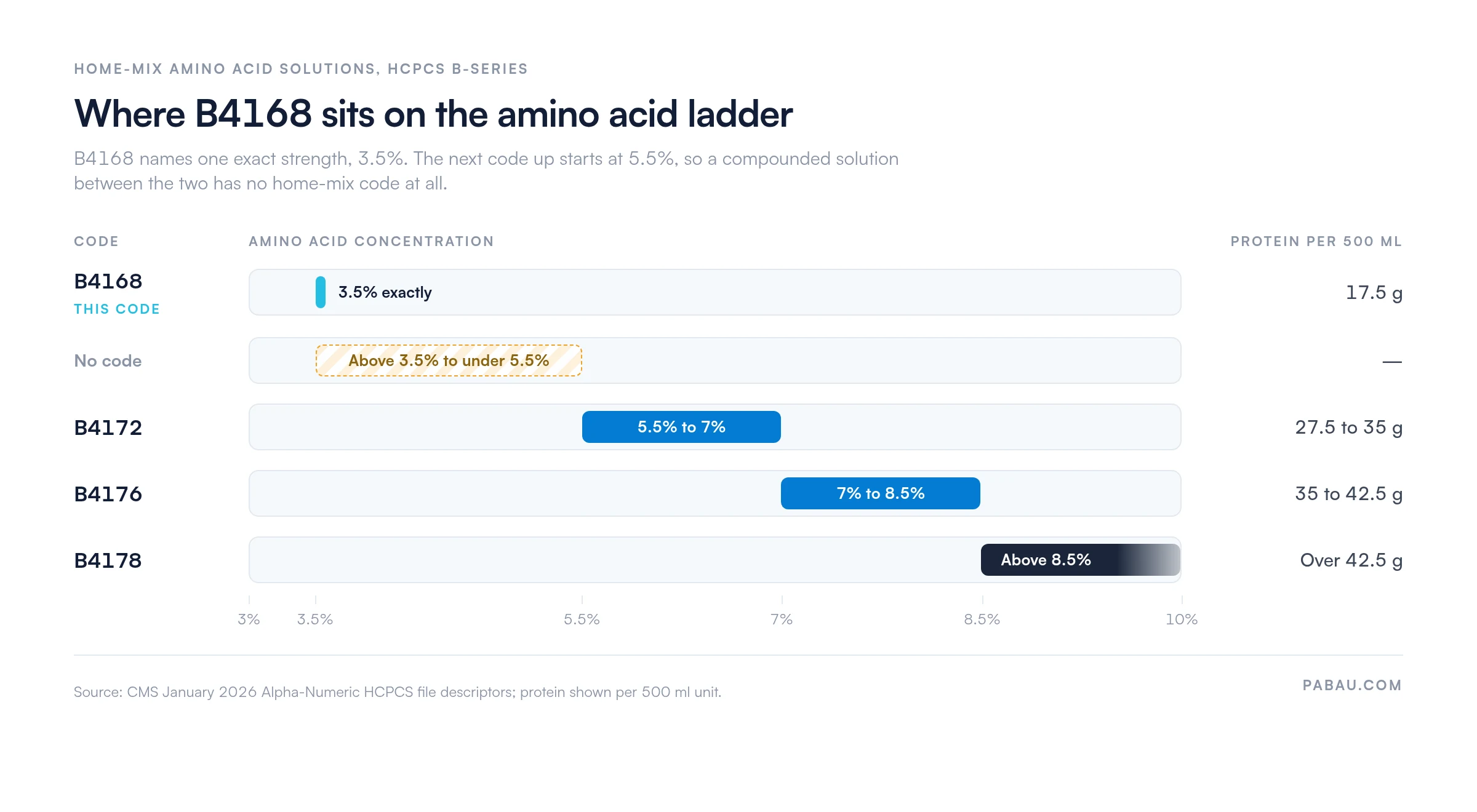
Rounding a 4% order into B4168 to make the claim fit is miscoding, and it invites a recoupment on audit. Policy article A58836 points suppliers to the Pricing, Data Analysis and Coding (PDAC) contractor for guidance on correct coding. An off-ladder concentration is exactly that question.
Keep the amino acid concentration on the face of the Standard Written Order, not buried in an attached compounding sheet. B4168 is the only amino acid code tied to one exact percentage. A reviewer who cannot find 3.5% in the order cannot confirm the code. That single line is the cheapest denial prevention available on this claim.
Most B4168 denials follow a predictable pattern, and the denial reason codes on the remittance advice point straight at the cause. Reading them is the fastest route to a corrected claim.
A Medicare redetermination request must be filed within 120 days of the initial determination. Tracking denials by reason code shows a billing team which record fails most often, well before unpaid claims start to age.
B4168 carries pricing indicator 39 in the HCPCS record, which marks it as a parenteral and enteral nutrition (PEN) item. Payment on a fee schedule basis for PEN is a regulatory requirement at 42 CFR 414.102.
CMS maintains the PEN fee schedule as a separate file from the main DMEPOS fee schedule. It goes to the DME MACs rather than to the quarterly public files. No B-series nutrition code appears in the public DMEPOS file, so confirm the current amount with your DME MAC.
For calendar year 2026, CMS applied an update factor of 2% to fee schedule amounts not adjusted through a competitive bidding program. That figure is the 2.7% CPI-U increase less a 0.7% total factor productivity adjustment. Medicare then pays 80% of the allowed amount once the Part B deductible is met.
The remaining 20% falls to the patient or a secondary payer. Reviewing the electronic remittance advice each cycle is the quickest way to catch an underpayment before it ages into a write-off.
B4168 never travels alone. A home-mix regimen needs a carbohydrate source, usually lipids and additives, plus a pump and daily supplies. The table below shows what sits beside the protein line on a typical monthly claim.
Two limits apply across the whole regimen. Only one infusion pump is covered per patient, whether the claim carries B9004 or B9006. One supply kit and one administration kit are covered for each day parenteral nutrition is given. In an outpatient facility, the pump and the IV pole are denied as not separately payable.
A single month of home parenteral nutrition produces a claim with five or six lines, each tied to a different detail of the same order. The prescriber holds the concentration, the dietitian holds the protein target, and the nursing team holds the infusion logs. Billing staff then reconcile all of it by hand.
Pabau, the practice management platform we build, keeps the order, the clinical notes and the billing on one patient record. Used as infusion claims software, it builds each claim from that record. The amino acid, dextrose and lipid lines all come from the order the clinician signed.
Claim status and rejections live in the same place. When a line comes back, the team corrects the record behind it and resubmits, rather than rebuilding the claim from scratch. Your staff spend less of each month chasing parenteral nutrition payments and more of it on patient care.

Pabau’s claims management tools help home infusion providers track Standard Written Orders, manage DME MAC submissions, and reduce parenteral nutrition claim denials. See how it works for your practice.

Coding B4168 well comes down to two readings of the order. Check the route first, because an enteral product on a parenteral code fails at the first review. Then check the concentration, because 3.5% is the only strength this code describes.
If your team bills home mix every month, build a short pre-submission check around the three points these claims fail on. Those are the concentration match, the SWO elements, and the KX attestation against L38953. The check costs minutes per claim, while one rejection can hold up a full month of payment.
Book a demo to see how Pabau keeps orders, clinical records and parenteral nutrition claims together for home infusion teams.

Need a framework for managing claim denials systematically? Denial management in healthcare covers the denial prevention and appeal workflow for DME and infusion claims.
Want to understand the clearinghouse step in your DME billing workflow? Medical claims clearinghouse guide explains how claims are scrubbed and routed before reaching the payer.
Trying to get more parenteral nutrition claims paid on the first pass? What makes a clean claim breaks down the checks a claim needs before it leaves your practice.
Reconciling monthly home infusion payments? Electronic remittance advice explained shows how to read the adjustment and reason codes on each payment.
HCPCS Code B4168 is a Level II code for the amino acid component of a home-mix parenteral nutrition solution at 3.5%. One unit is 500 ml, which carries 17.5 grams of protein. Dextrose, lipids and additives bill on separate lines. The DME MAC processes the claim under the Medicare Part B prosthetic device benefit.
B4168 is parenteral. It describes a solution infused into a vein, not a formula fed into the gut. The enteral formula codes sit nearby at B4149 through B4162 and bill per 100 calories rather than per 500 ml. Billing an enteral product on B4168 is miscoding and the claim is denied.
One unit of B4168 is 500 ml of 3.5% amino acid solution, carrying 17.5 grams of protein. Calculate the quantity from the daily volume in the practitioner’s order, then multiply by the days in the billing period. A 2,000 ml daily order is four units a day, or 120 units across a 30-day month.
Both codes describe the amino acid component of a home-mix parenteral solution, and both bill per 500 ml unit. The difference is concentration. B4168 is 3.5% exactly, while B4172 covers 5.5% through 7%. No B-series code describes a home-mix amino acid solution between those two figures, so ask the PDAC contractor about an off-ladder strength.
Neither. Original Medicare requires no prior authorization, because no B-series nutrition code appears on the CMS Required Prior Authorization List for DMEPOS. CMS also eliminated the CMN and the DIF for dates of service on or after January 1, 2023. A Standard Written Order and the clinical record now establish medical necessity.
The frequent causes are a missing KX, GA, GY or GZ modifier, a concentration that does not match 3.5%, or an incomplete Standard Written Order. Others are a component line billed with a premix code, units above the ordered quantity, or no record that enteral nutrition was ruled out. Check the remittance reason code, then correct and resubmit, or request a redetermination within 120 days.