CPT code 63081: Vertebral corpectomy, cervical spine
CPT code 63081: official descriptor and procedure overview CPT code 63081 descri...

Last Updated: Oct 6, 2026
64624 is the CPT code for destruction by neurolytic agent, genicular nerve branches including imaging guidance, when performed. It covers ablation of the superolateral, superomedial and inferomedial genicular nerves of one knee, reported as one unit per knee. Append modifier 52 when fewer than three branches are destroyed.
Most denials on this code come from three errors. Imaging guidance is billed separately, although the code already includes it. A second unit or an add-on code is billed for extra branches. Cryoneurolysis is billed as 64624, which Noridian's Medicare guidance rules out.
Let Pabau's smart automation suggest the right codes, reduce claim denials, and keep your practice compliant—effortlessly.
Automate repetitive tasks and focus on what matters most—your patients.
Reduce coding errors and ensure compliance with the latest regulations.
Clean claims, fewer denials, and faster reimbursements.
Powerful insights and reporting to help your practice thrive.
HIPAA compliant SOC 2 certified GDPR-compliant Trusted by 4,000+ clinics worldwide

CPT 64624 covers neurolytic destruction of the superolateral, superomedial and inferomedial genicular nerve branches of one knee.
Report one unit per knee, whatever the branch count. Append modifier 52 when fewer than three branches are destroyed.
Imaging guidance is part of the code, so 76942, 77002 and 77012 never go on the same claim.
CPT 64625 is a sacroiliac joint ablation code, not an add-on for extra genicular nerves.
Noridian’s Medicare article A59752 says iovera cryoneurolysis is not destructive and should not be billed as 64624.
CPT code 64624 is defined by the American Medical Association (AMA) as destruction by neurolytic agent, genicular nerve branches including imaging guidance, when performed. It is the code for genicular nerve ablation of the knee, most often done for chronic osteoarthritis pain. The code has carried this descriptor since the 2020 CPT code set.
One unit of 64624 covers destruction of three named branches of one knee: the superolateral, superomedial and inferomedial genicular nerves. There is no add-on code for each extra nerve. When fewer than three branches are destroyed, the physician appends modifier 52 for a reduced service.
CPT 64624 covers any technique that destroys the genicular nerve branches, so the nerve stops carrying pain signals until it regrows. The patient lies supine, and the physician uses fluoroscopy or ultrasound to place a needle or probe beside each branch.
Three destruction methods fall under the code:
The operative note must name the method, the branches treated, the side and the imaging used. The same code applies whichever destructive method is chosen, subject to the payer’s coverage policy.
The code is limited to destruction of the genicular branches, so several neighboring knee and nerve procedures need a different code:
Most cross-coding errors on 64624 come from three mix-ups. Coders treat 64625 as an add-on, bill the diagnostic block on the same claim, or report a non-destructive technique as destruction. The table sets out where each neighboring code applies.
A single-knee ablation of all three branches bills as 64624 x1. If only two branches are destroyed, it bills as 64624-52 x1. Ablation of both knees in one session bills as 64624-50 with one unit, or with RT and LT lines where the payer asks for them. The diagram below runs through the four questions that decide each claim line.
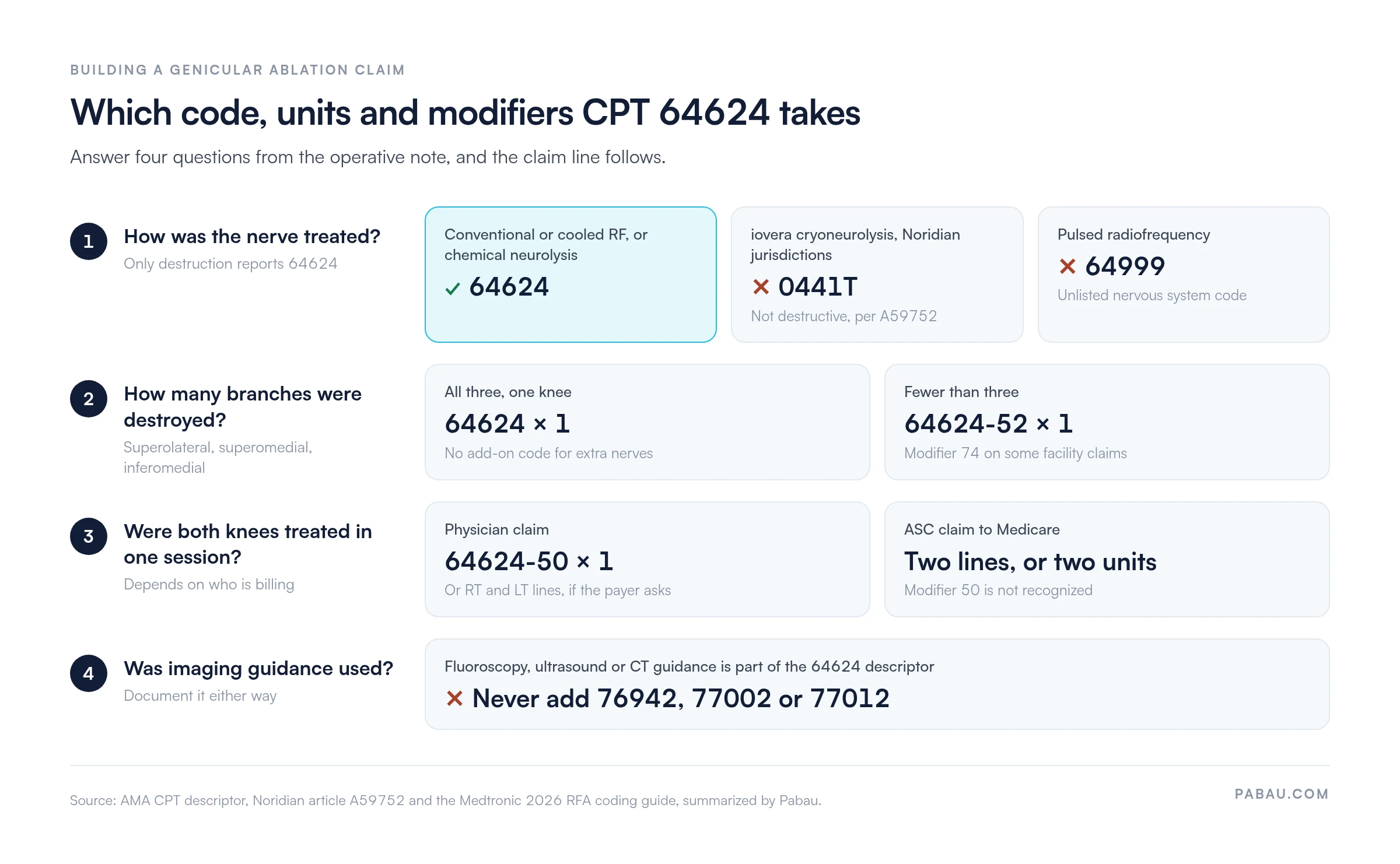
Imaging guidance is written into the 64624 descriptor, so it is never billed on a separate line. NCCI edits block fluoroscopy, CT, ultrasound and MRI guidance codes with 64624, including 76942, 77002 and 77012.
The phrase “when performed” means the code pays the same with or without imaging. Document the modality anyway, because payer coverage policies for genicular ablation usually expect image guidance.
Remove 76942, 77002 and 77012 from any charge template linked to 64624. A guidance line on the same claim triggers an NCCI edit. The claim then comes back for correction, even when the procedure was coded correctly.
Because 64624 is defined per knee, the modifiers tell the payer how much of that knee was treated and which side:
Medicare Part B covers CPT 64624 when the Medicare Administrative Contractor’s coverage policy is met and the record documents medical necessity. There is no national coverage determination, so the criteria come from each MAC’s local coverage determination (LCD). Check yours in the CMS Medicare Coverage Database before you assume coverage.
The 2026 national averages below come from the Medtronic 2026 RFA coding and payment guide, which reproduces the CY 2026 Medicare fee schedules. Your local rate depends on geographic adjustment, so confirm it in the CMS Physician Fee Schedule look-up tool.
Commercial rates are set by contract and usually differ from Medicare. Bilateral and reduced-service claims pay differently, so price them from the payer’s own rules.
Most commercial payers and many Medicare Advantage plans require prior authorization for CPT 64624. Traditional Medicare Part B does not require it, but MAC coverage policies set documentation criteria the claim must meet.
A complete authorization request for 64624 typically includes:
A missing authorization is one of the most frequent denial reasons for this code. A corrected claim with the authorization number can still be paid, but it adds weeks to the payment cycle.
Cryoneurolysis should not be billed to Medicare as 64624 in Noridian’s jurisdictions. Noridian’s Billing and Coding: Cryoneurolysis Instructions (A59752) says CPT 64624 and 64640 require destruction of the target nerve. It finds the iovera system temporary and not destructive, so neither code is appropriate.
Noridian instead directs iovera treatment at the knee to Category III code 0441T and reviews those claims case by case. The article covers Noridian’s JE and JF jurisdictions. A59752 now carries the JF guidance that sat in the retired article A59753, which ended on September 25, 2025.
Practices that offer both ablation and cryoneurolysis should keep separate authorization workflows for each. An authorization obtained for radiofrequency ablation does not cover a cryoneurolysis session, and switching the method afterward creates a compliance risk.
An operative note that passes payer review for CPT 64624 must go well beyond “performed RFA of the knee.” Auditors look for detail at the level of each nerve branch, not just the joint. Every note needs these elements:
A procedure note template built around these elements prevents the vague-documentation denial before it starts. Clean claim submission depends on a note that captures every billable detail at the time of service.
The diagnosis code on the claim establishes medical necessity for 64624. A code missing from the MAC’s covered diagnosis list leads to a denial even when the procedure was clinically appropriate.
Confirm that the chosen code appears on the covered diagnosis list for your MAC’s genicular nerve policy. The covered list sits in the billing and coding article attached to each LCD. On a bilateral 64624-50 claim, M17.0 is the matching diagnosis when both knees have primary osteoarthritis.
Genicular ablation claims are denied for a small set of repeat reasons. Coverage criteria differ between MACs, so payers apply them unevenly. These are the seven patterns practices see most often.
Denial management workflows that route each CARC and RARC denial code to the right follow-up action shorten resolution time for 64624 denials. Practices with a high ablation volume benefit from a dedicated denial queue for this code.
Most 64624 denials start in the note or the claim build, not at code selection. Pabau, the practice management and billing platform we build, puts the code’s rules into the clinical workflow so errors are caught before the claim leaves.
For 64624, four capabilities matter most:
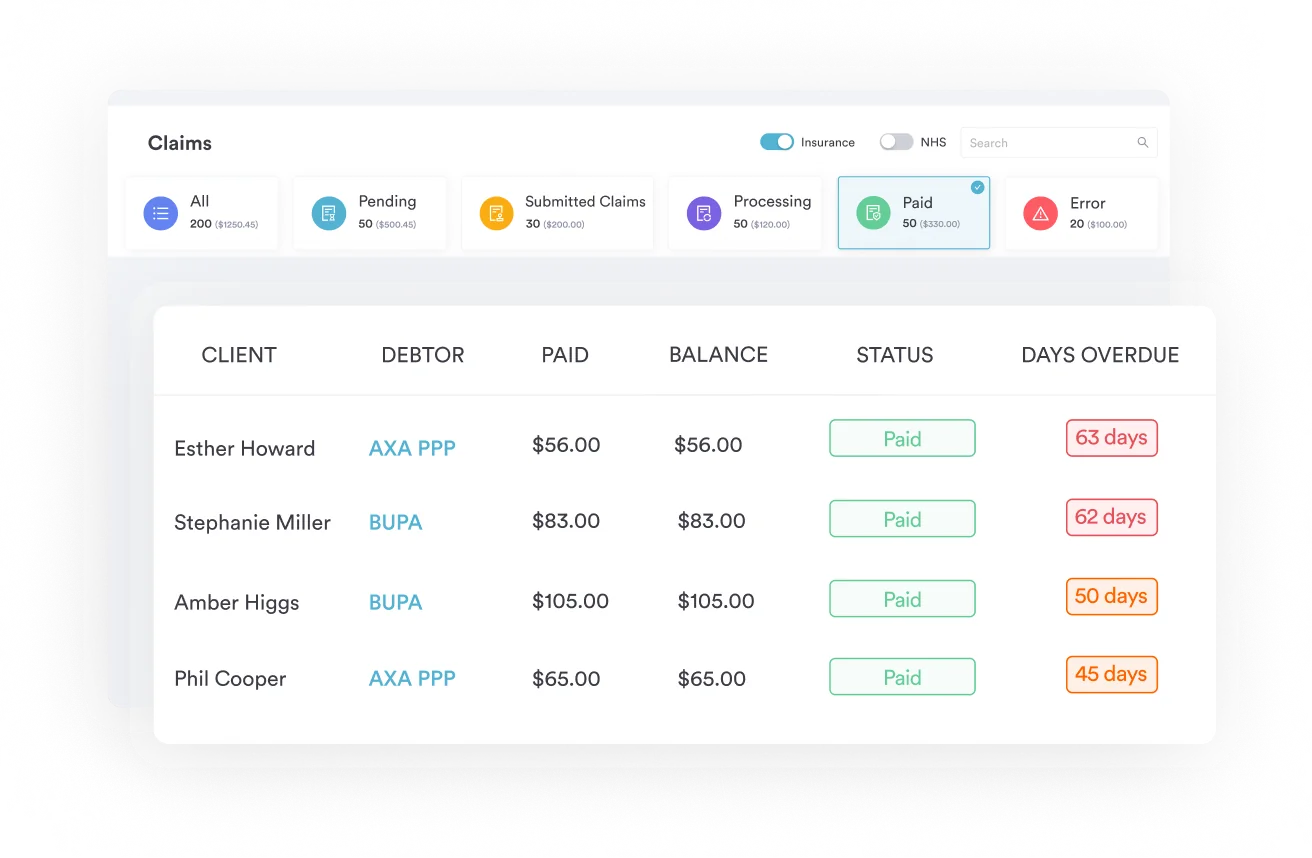
Denial reports filtered by CPT code show whether 64624 denials cluster around one payer, provider or missing note element. A quarterly review lets the billing team fix the pattern before the next batch goes out.
Run a pre-service check for every CPT 64624 case. Confirm authorization for the specific method, a covered diagnosis code and a documented diagnostic block result. Check that conservative care failure is dated and that the template names all three branches. A problem caught before the visit takes minutes to fix, while one caught after a denial takes weeks.

Pabau links procedure notes, scheduling and claims in one platform. Build each 64624 claim from the note, track prior authorization before the procedure and submit through Claim.MD.

CPT 64624 is one code for one knee, with three named branches and imaging already included. Most billing errors on it come from older coding habits: an add-on unit for each nerve, a separate guidance line, or cryoneurolysis billed as destruction. Strip those habits out of your charge templates first, because they cause the most avoidable denials.
Then check coverage before the procedure is booked. Your MAC’s policy and the patient’s plan decide whether the claim pays, and Noridian has already ruled out 64624 for iovera.
Book a demo to see how Pabau builds each 64624 claim from the procedure note and checks it before it reaches the payer.

Want to understand how electronic remittance advice fits into your revenue cycle? Electronic remittance advice (ERA) explains how 835 files map payment data back to submitted claims.
Looking to verify patient eligibility before RFA procedures? Insurance eligibility verification outlines how real-time eligibility checks prevent coverage surprises on the day of service.
Getting 64624 authorized before the procedure? Prior authorization process walks through each step from request to approval.
CPT code 64624 covers destruction by neurolytic agent of the genicular nerve branches of one knee, with imaging guidance included. It requires the superolateral, superomedial and inferomedial branches. It is reported once per knee, with modifier 52 when fewer than three branches are destroyed. Diagnostic nerve blocks report 64454 instead.
CPT 64624 is genicular nerve destruction at the knee, while CPT 64625 is radiofrequency ablation of the nerves supplying the sacroiliac joint. They are unrelated procedures. CPT 64625 is not an add-on for extra genicular nerves, because 64624 already covers all three branches in one unit per knee.
Yes, for most commercial payers and many Medicare Advantage plans. Traditional Medicare Part B does not require prior authorization for 64624, but MAC coverage policies set specific documentation criteria. Always confirm the requirement with the payer before scheduling the procedure.
Yes. When both knees are ablated in the same session, physicians report 64624-50 with one unit. Some payers want RT and LT on two lines instead. In an ASC, Medicare does not recognize modifier 50, so report two lines or one line with two units.
Not in Noridian’s jurisdictions. Noridian’s billing and coding article A59752 says the iovera system is temporary and not destructive, so 64624 and 64640 are not appropriate. It directs iovera treatment at the knee to Category III code 0441T. Check your own MAC’s guidance before billing.
No. The 64624 descriptor includes imaging guidance, and NCCI edits block 76942, 77002, 77012 and other guidance codes from being billed with it. Document the imaging in the note, but leave the guidance code off the claim.